Access to employment opportunities that support the economic status of households, communities, or governments.

Icon

Deploy Offshore Wind Turbines

Sector
Electricity
Image
Image
Offshore wind turbines
Coming Soon
Off
Summary

Offshore wind turbines are ocean-based machines that harness natural wind to generate electricity. These turbines use the relatively strong winds over the water to rotate their blades, which power a generator to make electricity. The electricity travels through underwater cables to reach the land. There are two main types: fixed-bottom turbines, which are attached to the seabed in shallow waters (typically up to 60 meters deep), and floating turbines, which sit on platforms anchored in deeper waters. Offshore wind farms can produce more electricity than land-based wind farms because ocean winds are usually stronger and steadier than winds on land.

Deploying additional offshore wind turbines reduces CO₂ emissions by increasing the availability of renewable energy sources to meet electricity demand, therefore reducing dependence on fossil fuel-based sources in the overall electricity grid mix.

Description for Social and Search
Deploy Offshore Wind is a Highly Recommended climate solution. It offers immense clean energy potential but faces challenges of high costs and competing uses of the seas.
Overview

An estimated 23% of global GHG emissions (100-yr basis) comes from electricity generation (Clarke et al., 2022); in 2022, more than 60% of global electricity generation came from fossil fuel–based energy sources (International Energy Agency [IEA], 2024a).

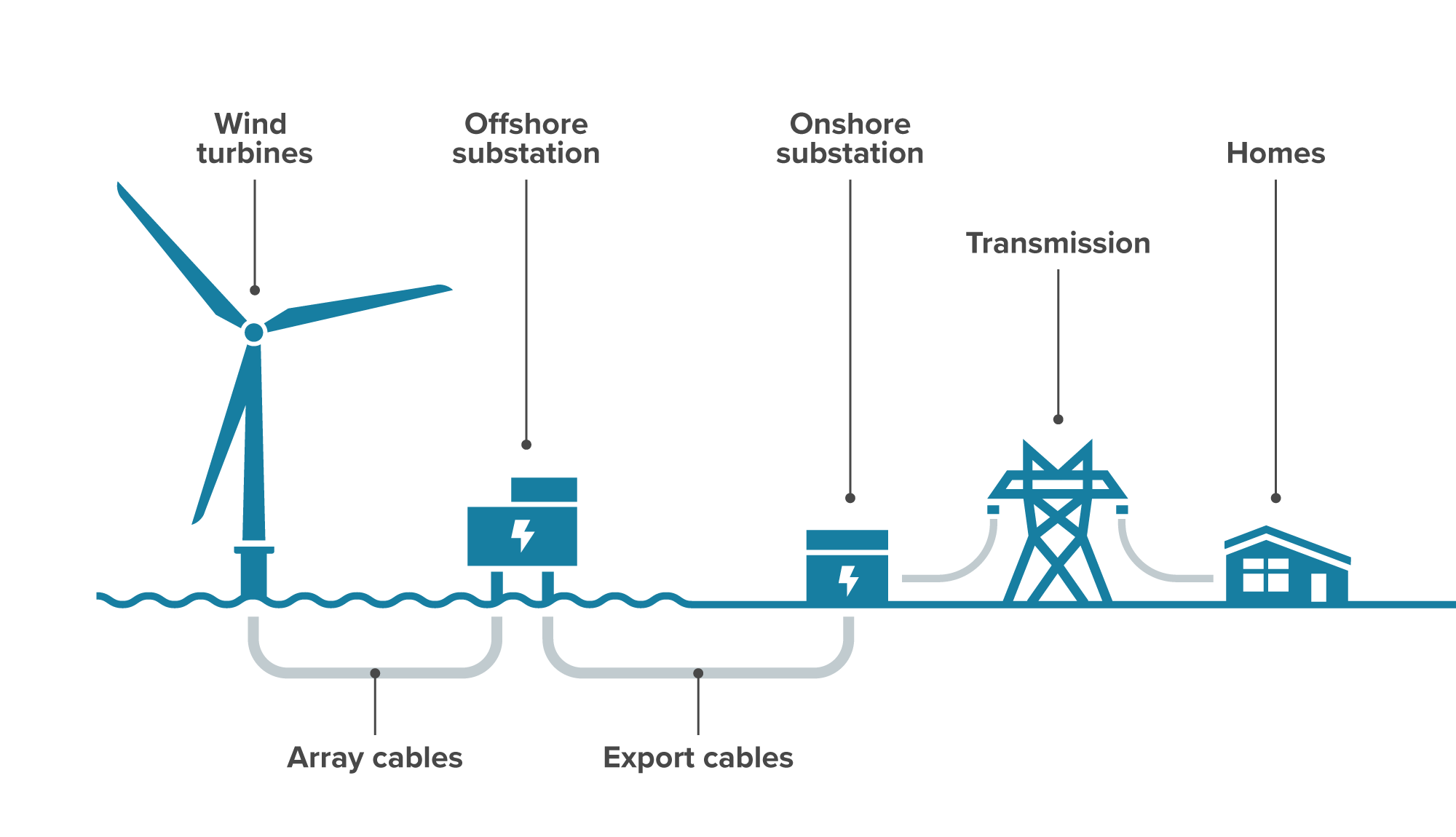
Offshore wind turbines generate electricity by converting the energy from rotating turbine blades into electrical energy. The main components of offshore wind turbines include rotor blades, a tower to raise the rotor above the water, a nacelle hub that houses the generator and other key components, and a foundation that stabilizes the structure in the water. Offshore wind farms require additional infrastructure to transport generated energy through undersea cables to transformers and power substations before electricity can be supplied to consumers (Figure 1). To optimize performance, offshore turbines often use advanced control systems (e.g., yawpitch, and safety sensors).

Figure 1. Simplified schematic of an offshore wind power system, showing electricity flow from wind turbines through array cables, offshore and onshore substations, and transmission and distribution infrastructure to end users.

Image
Schematic diagram of an offshore wind power system.

Source: Ørsted (n.d.) 

Offshore wind turbines are often placed far from the coast to avoid causing noise pollution or taking up space on land. Foundations can be fixed to the seafloor (fixed-bottom) or floating depending on water depth and other characteristics, such as seabed topography and operational logistics (Afridi et al., 2024). Most offshore wind turbines operating in 2023 were fixed-bottom and limited to seafloor depths around 50 meters. Floating wind farms access wind resources over deeper waters, up to 1,000 meters (de La Beaumelle et al., 2023). 

Wind speeds over water are generally higher and more consistent than over land, which allows for more reliable and increased electricity generation. Potential power generated from offshore wind turbines is directly proportional to the swept area of the rotor blades and the wind speed cubed; a doubling of wind speed corresponds to an eightfold increase in power (U.S. Energy Information Administration [U.S. EIA], 2024). The maximum electrical power a turbine can generate is its capacity in MW. The average installed offshore wind turbine rating grew from 7.7 MW in 2022 to 9.7 MW in 2023 (McCoy et al., 2024), with the total global installed capacity reaching 75.2 gigawatts (GW) in 2023 (Global Wind Energy Council [GWEC], 2024).

The global weighted average capacity factor for offshore wind turbines has reached 41% (International Renewable Energy Agency [IRENA], 2024c) – an increase from 38% a decade earlier – driven by advancements in turbine efficiency, hub height, rotor diameter, and siting optimization. Our analysis assumed an offshore wind turbine capacity factor of 41% (IRENA, 2024c). Offshore wind capacity varies across regions due to differences in policy support, coastal geography, water depths, and infrastructure readiness. Electric power output can be converted to energy generated by multiplying capacity by the time interval and the capacity factor. For annual generation, we multiply by 8,760 hours for one year.

The main siting considerations for offshore wind farms are distance from shore and water depth, but energy output can also be impacted by atmospheric wind conditions as well as the configuration of turbines within a wind farm (de La Beaumelle et al., 2023; IRENA, 2024c). Protected areas are also excluded during siting.

Since wind is a clean and renewable resource, offshore wind turbines do not contribute to GHG emissions or air pollution while generating energy. There are emissions associated with the manufacturing and transportation of turbine components. For this assessment, we did not quantify emissions during the construction of offshore wind farms; these emissions can be addressed with industry-sector solution assessments. Increased deployment of offshore wind turbines contributes to reduced CO₂ emissions when it reduces the need for electricity generation from fossil fuels.

Adeyeye, K., Ijumba, N., & Colton, J. (2020). Exploring the environmental and economic impacts of wind energy: A cost-benefit perspective. International Journal of Sustainable Development and World Ecology27(8), 718–731. Link to source: https://doi.org/10.1080/13504509.2020.1768171 

Afridi, S. K., Koondhar, M. A., Jamali, M. I., Alaas, Z. M., Alsharif, M. H., Kim, M. K., Mahariq, I., Touti, E., Aoudia, M., & Ahmed, M. M. R. (2024). Winds of progress: An in-depth exploration of offshore, floating, and onshore wind turbines as cornerstones for sustainable energy generation and environmental stewardship. IEEE Access12, 66147–66166. Link to source: https://doi.org/10.1109/ACCESS.2024.3397243 

Akhtar, N., Geyer, B., Rockel, B., Sommer, P. S., & Schrum, C. (2021). Accelerating deployment of offshore wind energy alter wind climate and reduce future power generation potentials. Scientific Reports11(1), Article 11826. Link to source: https://doi.org/10.1038/s41598-021-91283-3 

Akhtar, N., Geyer, B., & Schrum, C. (2024). Larger wind turbines as a solution to reduce environmental impacts. Scientific Reports14(1), Article 6608. Link to source: https://doi.org/10.1038/s41598-024-56731-w 

Alsaleh, A., & Sattler, M. (2019). Comprehensive life cycle assessment of large wind turbines in the US. Clean Technologies and Environmental Policy21(4), 887–903. Link to source: https://doi.org/10.1007/s10098-019-01678-0 

Atilgan Turkmen, B., & Germirli Babuna, F. (2024). Life cycle environmental impacts of wind turbines: A path to sustainability with challenges. Sustainability, 16(13), Article 5365. Link to source: https://doi.org/10.3390/SU16135365 

Beiter, P., Cooperman, A., Lantz, E., Stehly, T., Shields, M., Wiser, R., Telsnig, T., Kitzing, L., Berkhout, V., & Kikuchi, Y. (2021). Wind power costs driven by innovation and experience with further reductions on the horizon. Wiley Interdisciplinary Reviews: Energy and Environment10(5), Article e398. Link to source: https://doi.org/10.1002/WENE.398 

Bills, G. (2021). Turbine lifetime limits require a reality check | News+ | IJGlobal. Link to source: https://www.ijglobal.com/articles/157132/turbine-lifetime-limits-require-a-reality-check 

Bosch, J., Staffell, I., & Hawkes, A. D. (2018). Temporally explicit and spatially resolved global offshore wind energy potentials. Energy163, 766–781. Link to source: https://doi.org/10.1016/J.ENERGY.2018.08.153 

Buonocore, J. J., Luckow, P., Fisher, J., Kempton, W., & Levy, J. I. (2016). Health and climate benefits of offshore wind facilities in the Mid-Atlantic United States. Environmental Research Letters11(7), Article 074019. Link to source: https://doi.org/10.1088/1748-9326/11/7/074019 

Clarke, L., Wei, Y.-M., De La Vega Navarro, A., Garg, A., Hahmann, A. N., Khennas, S., Azevedo, I. M. L., Löschel, A., Singh, A. K., Steg, L., Strbac, G., & Wada, K. (2022). Energy Systems. In P. R. Shukla, J. Skea, R. Slade, A. Al Khourdajie, R. van Diemen, D. McCollum, M. Pathak, S. Some, P. Vyas, R. Fradera, M. Belkacemi, A. Hasija, G. Lisboa, S. Luz, & J. Malley (Eds.), Climate change 2022: Mitigation of climate change. Contribution of working group III to the sixth assessment report of the intergovernmental panel on climate change (pp. 613–746). Cambridge University Press. Link to source: https://doi.org/10.1017/9781009157926.008

de La Beaumelle, N. A., Blok, K., de Chalendar, J. A., Clarke, L., Hahmann, A. N., Huster, J., Nemet, G. F., Suri, D., Wild, T. B., & Azevedo, I. M. L. (2023). The global technical, economic, and feasible potential of renewable electricity. Annual Review of Environment and Resources48, 419–449. Link to source: https://doi.org/10.1146/annurev-environ-112321-091140 

Degraer, S., Carey, D. A., Coolen, J. W. P., Hutchison, Z. L., Kerckhof, F., Rumes, B., & Vanaverbeke, J. (2020). Offshore wind farm artificial reefs affect ecosystem structure and functioning: A synthesis. Oceanography33(4), 48–57. Link to source: https://doi.org/10.5670/oceanog.2020.405 

E2. (2023). California’s offshore wind opportunity. Link to source: https://e2.org/reports/ca-offshore-wind-opportunity-2022/ 

Energy Sector Management Assistance Program. (n.d.). Offshore wind technical potential | Analysis and maps; Link to source: https://www.esmap.org/esmap_offshorewind_techpotential_analysis_maps 

Energy Sector Management Assistance Program. (2019). Going global: Expanding offshore wind to emerging markets. World Bank Group. Link to source: http://documents.worldbank.org/curated/en/716891572457609829/Going-Global-Expanding-Offshore-Wind-To-Emerging-Markets 

Galparsoro, I., Menchaca, I., Garmendia, J. M., Borja, Á., Maldonado, A. D., Iglesias, G., & Bald, J. (2022). Reviewing the ecological impacts of offshore wind farms. npj Ocean Sustainability1, Article 1. Link to source: https://doi.org/10.1038/s44183-022-00003-5 

Global Wind Energy Council. (2024). Global offshore wind report 2024.  Link to source: https://26973329.fs1.hubspotusercontent-eu1.net/hubfs/26973329/2.%20Reports/Global%20Offshore%20Wind%20Report/GOWR24.pdf 

Global Wind Energy Council. (2025). Global offshore wind report 2025. Link to source: https://26973329.fs1.hubspotusercontent-eu1.net/hubfs/26973329/2.%20Reports/Global%20Offshore%20Wind%20Report/GOWR25.pdf 

Global Wind Energy Council, & Global Wind Organization. (2021). Global wind workforce outlook 2021–2025. Link to source: https://cdn.prod.website-files.com/5ce6247122f44f2bd5edebbe/60b534c0e5ca5c6c4c4705b0_GWWO%20v4.pdf 

Gonyo, S. B., Fleming, C. S., Freitag, A., & Goedeke, T. L. (2021). Resident perceptions of local offshore wind energy development: Modeling efforts to improve participatory processes. Energy Policy149, Article 112068; Link to source: https://doi.org/10.1016/J.ENPOL.2020.112068

Haggett, C. (2011). Understanding public responses to offshore wind power. Energy Policy39(2), 503–510. Link to source: https://doi.org/10.1016/J.ENPOL.2010.10.014 

Intergovernmental Panel on Climate Change. (2023). Climate change 2023: Synthesis report. Contribution of working groups I, II and III to the sixth assessment report of the intergovernmental panel on climate change (The Core Writing Team, H. Lee, & J. Romero, Eds.) [Synthesis report]. Link to source: https://www.ipcc.ch/report/ar6/syr/downloads/report/IPCC_AR6_SYR_FullVolume.pdf 

International Energy Agency. (2019). Offshore wind outlook 2019. Link to source: https://www.iea.org/reports/offshore-wind-outlook-2019 

International Energy Agency. (2024a). World energy balances—Data product. Link to source: https://www.iea.org/data-and-statistics/data-product/world-energy-balances 

International Energy Agency. (2024b). World energy outlook 2024. Link to source: https://www.iea.org/reports/world-energy-outlook-2024 

International Energy Agency, & Nuclear Energy Agency. (2020). Projected costs of generating electricity – 2020 edition [Report]. OECD Publishing. Link to source: https://www.oecd-nea.org/upload/docs/application/pdf/2020-12/egc-2020_2020-12-09_18-26-46_781.pdf 

International Renewable Energy Agency. (2024a). Floating offshore wind outlook. Link to source: https://www.irena.org/-/media/Files/IRENA/Agency/Publication/2024/Jul/IRENA_G7_Floating_offshore_wind_outlook_2024.pdf 

International Renewable Energy Agency. (2024b). Renewable energy statistics 2024. Link to source: https://www.irena.org/-/media/Files/IRENA/Agency/Publication/2024/Jul/IRENA_Renewable_Energy_Statistics_2024.pdf 

International Renewable Energy Agency. (2024c). Renewable power generation costs in 2023. Link to source: https://www.irena.org/Publications/2024/Sep/Renewable-Power-Generation-Costs-in-2023 

International Renewable Energy Agency, & Global Wind Energy Council. (2023). Enabling frameworks for offshore wind scale up: Innovations in permitting. Link to source: https://www.energycentral.com/renewables/post/irena-enabling-frameworks-offshore-wind-scale---innovations-permitting-vZRn6mKeZ1hBX0n 

Jansen, M., Staffell, I., Kitzing, L., Quoilin, S., Wiggelinkhuizen, E., Bulder, B., Riepin, I., & Müsgens, F. (2020). Offshore wind competitiveness in mature markets without subsidy. Nature Energy5(8), 614–622. Link to source: https://doi.org/10.1038/s41560-020-0661-2 

Kaldellis, J. K., & Apostolou, D. (2017). Life cycle energy and carbon footprint of offshore wind energy. Comparison with onshore counterpart. Renewable Energy108, 72–84. Link to source: https://doi.org/10.1016/J.RENENE.2017.02.039 

Lazard. (2023, April). LCOE+ [PowerPoint slides]. Link to source: https://www.lazard.com/media/2ozoovyg/lazards-lcoeplus-april-2023.pdf

Letcher, T. M. (Ed.). (2023). Wind energy engineering : A handbook for onshore and offshore wind turbines (2nd ed.). Academic Press. Link to source: https://www.sciencedirect.com/book/9780323993531/wind-energy-engineering 

Lopez, A., Green, R., Williams, T., Lantz, E., Buster, G., & Roberts, B. (2022). Offshore wind energy technical potential for the contiguous United States [Report]. Link to source: https://docs.nrel.gov/docs/fy22osti/83650.pdf 

McCoy, A., Musial, W., Hammond, R., Mulas Hernando, D., Duffy, P., Beiter, P., Pérez, P., Baranowski, R., Reber, G., & Spitsen, P. (2024). Offshore wind market report: 2024 edition (NREL/TP-5000-90525) [Technical report]. National Renewable Energy Laboratory. Link to source: https://www.nrel.gov/docs/fy24osti/90525.pdf 

Mello, G., Ferreira Dias, M., & Robaina, M. (2020). Wind farms life cycle assessment review: CO2 emissions and climate change. Energy Reports6, 214–219. Link to source: https://doi.org/10.1016/J.EGYR.2020.11.104 

Millstein, D., O’Shaughnessy, E., & Wiser, R. (2024). Climate and air quality benefits of wind and solar generation in the United States from 2019 to 2022. Cell Reports Sustainability1(6), Article 100105. Link to source: https://doi.org/10.1016/J.CRSUS.2024.100105 

Nagababu, G., Srinivas, B. A., Kachhwaha, S. S., Puppala, H., & Kumar, S. V. V. A. (2023). Can offshore wind energy help to attain carbon neutrality amid climate change? A GIS-MCDM based analysis to unravel the facts using CORDEX-SA. Renewable Energy219, Article 119400; Link to source: https://doi.org/10.1016/J.RENENE.2023.119400 

National Oceanic and Atmospheric Administration. (n.d.). Offshore wind energy: Assessing impacts to marine life. National Oceanic and Atmospheric Administration Fisheries. Retrieved August 6, 2025, from Link to source: https://www.fisheries.noaa.gov/topic/offshore-wind-energy/assessing-impacts-to-marine-life 

Ørsted (n.d.) How does offshore wind power work? Retrieved July 8, 2025, from Link to source: https://orsted.com/en/what-we-do/renewable-energy-solutions/offshore-wind/technology

Peach, S. (2021, June 30). What’s the carbon footprint of a wind turbine? Yale Climate Connections. Link to source: https://yaleclimateconnections.org/2021/06/whats-the-carbon-footprint-of-a-wind-turbine/ 

Qiu, M., Zigler, C. M., & Selin, N. E. (2022). Impacts of wind power on air quality, premature mortality, and exposure disparities in the United States. Science Advances8(48), Article eabn8762. Link to source: https://www.science.org/doi/10.1126/sciadv.abn8762 

Ren, Z., Zhang, S., Liu, H., Pu, L., Wang, X., Wang, Z., Wu, M., & Chen, Z. (2025). The environmental and public health benefits of offshore wind power deployment in China. Environmental Science & Technology59(1), 315–327. Link to source: https://doi.org/10.1021/acs.est.4c06125 

Rubin, E. S., Azevedo, I. M. L., Jaramillo, P., & Yeh, S. (2015). A review of learning rates for electricity supply technologies. Energy Policy86, 198–218. Link to source: https://doi.org/10.1016/J.ENPOL.2015.06.011 

Schlömer, S., Bruckner, T., Fulton, L., Hertwich, E., McKinnon, A., Perczyk, D., Roy, J., Schaeffer, R., Sims, R., Smith, P., & Wiser, R. (2014). Annex III: Technology-specific cost and performance parameters. In O. Edenhofer, R. Pichs-Madruga, Y. Sokona, E. Farahani, S. Kadner, K. Seyboth, A. Adler, I. Baum, S. Brunner, P. Eickemeier, B. Kriemann, J. Savolainen, S. Schlömer, C. von Stechow, T. Zwickel, & J. C. Minx (Eds.), Climate change 2014: Mitigation of climate change. Contribution of working group III to the fifth assessment report of the intergovernmental panel on climate change. Cambridge University Press. Link to source: https://www.ipcc.ch/site/assets/uploads/2018/02/ipcc_wg3_ar5_annex-iii.pdf 

Shawhan, D., Robson, S., & Russell, E. (2025). Offshore wind power examined: Effects, benefits, and costs of offshore wind farms along the US Atlantic and Gulf Coasts (Working Paper No. 24-17). Resources for the Future. Link to source: https://media.rff.org/documents/WP_24-17_2.25_Update.pdf 

Shields, M., Beiter, P., & Nunemaker, J. (2022). A systematic framework for projecting the future cost of offshore wind energy (NREL/TP-5000-81819) [Technical report]. National Renewable Energy Laboratory. Link to source: https://www.nrel.gov/docs/fy23osti/81819.pdf 

Stefek, J., Constant, C., Clark, C., Tinnesand, H., Christol, C., & Baranowski, R. (2022). U.S. offshore wind workforce assessment (NREL/TP-5000-81798) [Technical report]. National Renewable Energy Laboratory. Link to source: https://docs.nrel.gov/docs/fy23osti/81798.pdf 

TNO, & BLIX Consultancy. (2021). Pathways to potential cost reductions for offshore wind energy [Technical report]. Link to source: https://topsectorenergie.nl/documents/332/20210125_RAP_Pathways_to_potential_cost_reduction_offshore_wind_energy_F03.pdf 

Tumse, S., Bilgili, M., Yildirim, A., & Sahin, B. (2024). Comparative Analysis of Global Onshore and Offshore Wind Energy Characteristics and Potentials. Sustainability, 16(15), Article 6614. Link to source: https://doi.org/10.3390/SU16156614 

U.S. Energy Information Administration. (2023). Levelized costs of new generation resources in the annual energy outlook 2023. Link to source: https://www.eia.gov/outlooks/aeo/electricity_generation/pdf/AEO2023_LCOE_report.pdf 

U.S. Energy Information Administration. (2024, June 12). Wind explained: Where wind power is harnessed. Link to source: https://www.eia.gov/energyexplained/wind/where-wind-power-is-harnessed.php

Wilhelmsson, D., Malm, T., & Öhman, M. C. (2006). The influence of offshore windpower on demersal fish. ICES Journal of Marine Science63(5), 775–784. Link to source: https://doi.org/10.1016/J.ICESJMS.2006.02.001 

Wiser, R., Rand, J., Seel, J., Beiter, P., Baker, E., Lantz, E., & Gilman, P. (2021). Expert elicitation survey predicts 37% to 49% declines in wind energy costs by 2050. Nature Energy6(5), 555–565. Link to source: https://doi.org/10.1038/s41560-021-00810-z 

World Bank Group. (2021). Key factors for successful development of offshore wind in emerging markets. Energy Sector Management Assistance Program, World Bank Group. Link to source: https://documents1.worldbank.org/curated/en/343861632842395836/pdf/Key-Factors-for-Successful-Development-of-Offshore-Wind-in-Emerging-Markets.pdf 

World Economic Forum. (2025). Nature positive: Role of the offshore wind sector [Insight report]. Link to source: https://www.weforum.org/publications/nature-positive-transitions-sectors/offshore-wind-sector/ 

World Forum Offshore Wind. (2024). Global offshore wind report 2023. Link to source: https://wfo-global.org/wp-content/uploads/2024/04/WFO-Report-2024Q1.pdf 

Yuan, W., Feng, J.-C., Zhang, S., Sun, L., Cai, Y., Yang, Z., & Sheng, S. (2023). Floating wind power in deep-sea area: Life cycle assessment of environmental impacts. Advances in Applied Energy9, Article 100122. Link to source: https://doi.org/10.1016/J.ADAPEN.2023.100122 

Zhou, F., Tu, X., & Wang, Q. (2022). Research on offshore wind power system based on Internet of Things technology. International Journal of Low-Carbon Technologies17, 645–650. Link to source: https://doi.org/10.1093/IJLCT/CTAC049 

Credits

Lead Fellow

  • Michael Dioha, Ph.D.

Contributors

  • Ruthie Burrows, Ph.D.

  • Daniel Jasper

Internal Reviewers

  • James Gerber, Ph.D.

  • Megan Matthews, Ph.D.

  • Amanda Smith, Ph.D.

Effectiveness

Based on data provided by the IEA, global emissions from electricity generation accounted for an estimated 530 kg CO₂‑eq /MWh (540 kg CO₂‑eq /MWh, 20-yr basis). To convert from MWh to MW, we used the global weighted average capacity factor for offshore wind turbines of 41% (IRENA, 2024c). We estimated offshore wind turbines to reduce 1,900 t CO₂‑eq /MW (1,900 t CO₂‑eq /MW, 20-yr basis) of installed capacity annually (Table 1).

left_text_column_width

Table 1. Effectiveness at reducing emissions.

Unit: t CO₂‑eq /MW installed capacity/yr, 100-yr basis

Estimate 1900
Left Text Column Width

To estimate the effectiveness of offshore wind turbines, we assumed that electricity generated by newly installed offshore wind displaces an equivalent MWh of the global electricity grid mix. Then, the reduction in emissions from additional offshore wind capacity was equal to emissions (per MWh) from the 2023 global electricity grid mix as per the IEA World Energy Balances (IEA, 2024a). We then used the offshore wind capacity factor to convert to annual emissions per MW of installed capacity.

During operation, offshore wind turbines do not emit GHGs, so we assumed zero emissions per MW of installed capacity. However, emissions arise during the manufacturing of components, transportation, installation, maintenance, and decommissioning (Atilgan Turkmen & Germirli Babuna, 2024; Kaldellis & Apostolou, 2017; Mello et al., 2020; Yuan et al., 2023). Life-cycle analyses estimate that lifetime GHG emissions of offshore wind turbines are approximately 25.76 g CO₂‑eq /kWh of electricity generated (Yuan et al., 2023).

In our analysis, we focused solely on emissions produced during electricity generation, so carbon payback time and embodied life-cycle emissions were not included in our estimates of effectiveness or climate impacts. 

left_text_column_width
Cost

We estimated a mean levelized cost of electricity (LCOE) for offshore wind turbines of US$96/MWh based on three industry reports (IEA, 2024b; IRENA, 2024c; Nuclear Energy Agency & IEA, 2020). LCOE is a widely used metric that allows for cost comparison across generation technologies, incorporating installed capital costs, operation and maintenance, project lifespan, and energy output. Between 2010–2023, the global weighted average LCOE for offshore wind fell by 63%, from US$203/MWh to US$75/MWh, reflecting improvements in turbine size, supply chains, and regulatory support (IRENA, 2024c). 

Regional costs vary significantly. Denmark had the lowest LCOE in 2023 at US$48/MWh due to favorable siting conditions and grid cost exemptions. The UK and Germany achieved the largest LCOE reductions since 2010, of 73% and 67%, respectively (IRENA, 2024c). In contrast, recent U.S. estimates exceed US$120/MWh for unsubsidized projects (McCoy et al., 2024), reflecting higher labor costs, permitting challenges, and nascent supply chains. Lazard (2023) reports a broad range of US$72–140/MWh, emphasizing how siting, project size, and technology selection influence cost outcomes.

These values mask substantial variability and project-specific risk factors. LCOEs are highly sensitive to financing terms, interest rates, permitting delays, regional grid integration requirements, and the availability of local supply chains. For context, offshore wind costs are increasingly competitive with fossil fuel–based power generation, which ranges between US$70–176/MWh (IRENA, 2024c). Offshore wind gigawatt-scale potential near load centers makes it a good potential option for decarbonizing coastal grids.

left_text_column_width
Learning Curve

Offshore wind turbines exhibit a clear learning curve, with costs declining as deployment scales and the technology matures. Learning rates for offshore wind could vary from 7.2–43%, depending on the type of costs considered, study period, technological advancements, and regional conditions. Most of the cost decline is driven by reductions in capital expenditure, particularly from larger turbines, improved manufacturing, streamlined installation, and economies of scale.

According to IRENA (2024c), the global weighted-average installed cost of offshore wind between 2010–2023 reflects a learning rate of 14.2%. Modeling by the U.S. National Renewable Energy Laboratory (NREL) estimates capital cost reductions per doubling of installed capacity at 8.8% for fixed-bottom turbines and 11.5% for floating turbines (Shields et al., 2022). European forecasts suggest that ongoing innovation and learning by doing could reduce offshore wind’s LCOE by up to 25% by 2030 relative to 2020, with learning rates of 6–12% (TNO & BLIX, 2021).

Earlier meta-analyses found offshore wind learning rates of 5–19% between 1985–2001, driven by improved turbine design and installation methods (Rubin et al., 2015). More recent assessments focused on 2010–2016 suggest capital cost learning rates of 10–12% (Beiter et al., 2021). Looking ahead, global experts project cost reductions of 37–49% by 2050 due to continued technological progress (Wiser et al., 2021).

Learning rates also vary by geography. Mature markets like Europe benefit from robust supply chains and permitting frameworks, leading to faster cost declines. On the other hand, emerging markets face higher initial costs and slower learning trajectories. We estimated a 15.8% median global learning rate for offshore wind, implying a 15.8% reduction in LCOE for each doubling of installed capacity (Table 2).

left_text_column_width

Table 2. Learning rate: drop in cost per doubling of the installed solution base.

Unit: %

25th percentile 11.9
Mean 15.8
Median (50th percentile) 15.8
75th percentile 19.6
Left Text Column Width
Speed of Action

Speed of action refers to how quickly a climate solution physically affects the atmosphere after it is deployed. This is different from speed of deployment, which is the pace at which solutions are adopted.

At Project Drawdown, we define the speed of action for each climate solution as emergency brake, gradual, or delayed.

Deploy Offshore Wind Turbines is a GRADUAL climate solution. It has a steady, linear impact on the atmosphere. The cumulative effect over time builds as a straight line.

left_text_column_width
Caveats

One limitation of our approach is the assumption that each additional MWh generated by offshore wind turbines displaces an equivalent MWh of the existing grid mix. This simplification implies that new offshore wind may, at times, displace other renewables such as onshore wind, rather than fossil-based sources. In reality, the extent of avoided emissions varies based on regional grid dynamics, marginal generation sources, and the timing and location of electricity production. This approach could be refined in the future, as emerging evidence suggests that in some cases, wind generation tends to displace a larger share of fossil-fuel output than assumed in average grid-mix methods (e.g., Millstein et al., 2024). While offshore wind avoids many of the land-use constraints associated with onshore wind, it introduces unique challenges that may limit scaling. These include high up-front capital costs, limited port infrastructure, specialized vessels, and supply-chain constraints for large components such as floating platforms and subsea cables. There is also growing competition for ocean space from fisheries, marine conservation zones, and shipping corridors (IEA, 2019).

Like all large-scale infrastructure, offshore wind systems face some risk of early retirement or component failure, which can affect their life-cycle emissions. However, because offshore wind turbines produce zero emissions during operation, any electricity they generate displaces fossil-based power and avoids associated emissions. These benefits are not reversed if a turbine is decommissioned early. Most offshore wind turbines operate for 25–30 years, with newer designs expected to exceed this lifespan (Bills, 2021; IEA, 2019). The bulk of their life-cycle emissions are front-loaded, arising from manufacturing, transportation, and installation. As a result, early retirement reduces the amount of clean electricity generated over the turbine’s lifetime, but it does not erase the emissions already avoided during its operation.

left_text_column_width
Current Adoption

As of 2023, the global installed capacity for offshore wind energy reached approximately 73,000 MW (Table 3; IRENA, 2024b). Although we used 2023 as our baseline for current adoption, in 2024 an additional 10,000 MW of offshore wind capacity was installed, bringing the global total to over 83,000 MW (GWEC, 2025).

left_text_column_width

Table 3. Current adoption level, 2023.

Unit: MW installed capacity

Total 73,000
Left Text Column Width

China currently leads in offshore wind deployment, accounting for more than 40 GW, or over half of the global installed capacity. Adoption remains negligible in many countries with several regions – particularly in Africa, Latin America, and parts of Southeast Asia – reporting minimal or no offshore wind installations to date, despite their huge potential (GWEC, 2025). For example, the United States, despite its vast technical potential, had installed only 41 MW by 2023 (IRENA, 2024b).

The global offshore wind market has gained significant momentum in recent years. A record number of new installations occurred in 2021, with continued but slower growth in 2022 and 2023. The most active markets remain concentrated in Asia and Europe, with China, the United Kingdom, Germany, and the Netherlands leading in cumulative capacity. The European Union collectively reached 18.1 GW by 2023 (IRENA, 2024b), driven by favorable policy environments and advanced maritime infrastructure (IRENA, 2024a).

left_text_column_width
Adoption Trend

Global offshore wind capacity has grown rapidly, expanding from less than 1 GW in 2000 to about 73 GW by 2023 (Figure 2), reflecting technological progress, supportive policies, and accelerating investment. 

left_text_column_width

Figure 2. Global offshore wind turbine installed capacity, 2000–2023. Global offshore wind capacity expanded from less than 1 GW in 2000 to about 73 GW by 2023, reflecting rapid technological progress, supportive policies, and accelerating investment in clean energy.

International Renewable Energy Agency. (2024). Renewable capacity statistics 2024. https://www.irena.org/-/media/Files/IRENA/Agency/Publication/2024/Mar/IRENA_RE_Capacity_Statistics_2024.pdf

Enable Download
On
Enable Download
Off

We calculated global adoption for each year 2013–2023 and took the year-to-year difference. The adoption trend of offshore wind energy from 2013–2023 reveals a rapid and accelerating growth trajectory with significant regional disparities. Globally, installed capacity expanded from 7,200 MW in 2013 to 73,000 MW in 2023, reflecting a 10-fold increase over the decade. The most dramatic acceleration occurred in 2020–2021, when global capacity jumped from 34,000 MW to 54,000 MW. Comparing year-to-year global adoption, the mean global adoption trend was adding approximately 6,000 MW of installed capacity per year (Table 4), but expansion was unevenly distributed geographically. 

left_text_column_width

Table 4. Adoption trend, 2013–2023.

Unit: MW installed capacity/yr

25th percentile 3,000
Mean 6,000
Median (50th percentile) 5,000
75th percentile 7,000
Left Text Column Width

Regionally, Asia demonstrated the most remarkable growth. This growth was particularly pronounced in 2020–2021, when capacity soared from 9,400 MW to 28,000 MW, largely driven by China’s rapid deployment. Meanwhile, Europe also experienced steady growth, with installed capacity increasing from 8,000 MW in 2014 to 33,000 MW in 2023. In contrast, North America lags behind, with only 41 MW of installed capacity recorded as of 2023, indicating slow current adoption trends. The slow adoption of offshore wind technology in North America may be attributed to various factors, including regulatory and social barriers as well as high interest rates (McCoy et al., 2024). 

Looking ahead, according to forecasts from the World Forum Offshore Wind (WFO, 2024), global offshore wind capacity is anticipated to reach 414 GW by 2032. The GWEC projects more than 350 GW of new offshore wind capacity in 2025–2034, with annual additions surpassing 30 GW by 2030 and 50 GW by 2033, bringing total capacity to about 441 GW by 2034 (GWEC, 2025).

left_text_column_width
Adoption Ceiling

The adoption ceiling for offshore wind turbines (Table 5) is determined by the technology’s global technical potential, representing the theoretical maximum deployment based on physical resource availability. Offshore wind benefits from vast oceanic areas with higher and more consistent wind speeds than onshore sites. However, its realizable potential is shaped by factors such as water depth, distance to shore, seabed conditions, regional wind patterns, and technological limitations.

left_text_column_width

Table 5. Adoption ceiling: upper limit for adoption level.

Unit: MW installed capacity

25th percentile 58,000,000
Mean 62,000,000
Median (50th percentile) 62,000,000
75th percentile 67,000,000
Left Text Column Width

Estimates of offshore wind’s technical potential vary widely. A meta-analysis by de La Beaumelle et al. (2023) found values of 4.17–626 petawatt-hours (PWh)/year, with a median of 193 PWh/year. The World Bank’s Energy Sector Management Assistance Program (ESMAP) analysis (2019; n.d.) suggests over 71,000 GW of global offshore wind potential, with more than 70% located in deep waters suitable only for floating turbines. Roughly 25% of this resource lies within low- and middle-income countries, offering major opportunities for clean energy expansion.

Technical potential is typically calculated using wind speed maps, turbine power curves, and water depth data. For example, the ESMAP-IFC 2019 study identified 3.1 terawatts (TW) of potential across eight emerging markets using global wind and ocean depth data (ESMAP, 2019). These figures, however, do not reflect constraints such as economics, regulation, infrastructure, or marine uses that would compete with offshore wind (ESMAP, 2019). Challenges like ecological impact, permitting, and grid integration could significantly reduce practical deployment.

Despite these hurdles, offshore wind’s potential remains vast. For this analysis, we defined the adoption ceiling using installable capacity rather than generation output to avoid forecasting uncertainty. Based on the literature, we estimated an adoption ceiling of 62,000,000 MW. The scaling of floating wind turbines, especially in deep waters, will be critical to unlocking this resource, and will require continued innovation and policy support (Tumse et al., 2024).

left_text_column_width
Achievable Adoption

The IEA’s World Energy Outlook (WEO) 2024 includes several key scenarios that explore different energy futures based on varying levels of policy intervention, technological development, and market dynamics. We define the adoption achievable range for offshore wind turbines based on the Stated Policies Scenario (STEPS) and Announced Pledges Scenario (APS) (IEA, 2024b).

Achievable – Low

The low achievable adoption level is based on STEPS, which captured the current trajectory for increased adoption of offshore wind energy as well as future projections based on existing and announced policies. Under this scenario, offshore wind capacity is projected to increase more than 13-fold from 73,000 MW to 1,000,000 MW by 2050 (Table 6). This corresponds to an average compound annual growth rate (CAGR) of 10.2%.

left_text_column_width

Table 6. Range of achievable adoption levels.

Unit: MW installed capacity

Current adoption 73,000
Achievable – low 1,000,000
Achievable – high 1,600,000
Adoption ceiling 62,000,000
Left Text Column Width

Achievable – High

The high achievable adoption level is based on APS, which assumes the same policy framework as STEPS, plus full realization of announced national energy and climate targets – including net-zero commitments supported by stronger clean energy investments. Under this scenario, offshore wind capacity is projected to increase by a magnitude of approximately 22, from 73,000 MW to 1,600,000 MW by 2050 (Table 6). This would require a CAGR of roughly 12.1% over the same period.

Using our adoption ceiling of 62 million MW, the current adoption of offshore wind turbines constitutes approximately 0.1% of its technical potential. The achievable adoption range, as calculated, is 1.6–2.6% of this potential.

left_text_column_width

Using baseline global adoption and effectiveness, we estimated the current total climate impact of offshore wind turbines to be approximately 0.14 Gt CO₂‑eq (0.14 Gt CO₂‑eq , 20-yr basis) of reduced emissions per year (Table 7). We estimated future climate impacts using the emissions from the 2023 baseline electricity grid. Actual emissions reductions could differ depending on how the emissions intensity of electricity generation changes over time. Assuming global policies on offshore wind power – both existing and announced – are backed with adequate implementation provisions, global adoption could reach 1 million MW by 2050. This would result in an increased emissions reduction of approximately 1.9 Gt CO₂‑eq per year. If every nation’s energy and climate targets (including net-zero commitments backed by stronger clean energy investments) are realized, offshore wind adoption could reach 1.6 million MW by 2050. This would lead to an estimated 3.0 Gt CO₂‑eq of reduced emissions per year. 

left_text_column_width

Table 7. Annual climate impact at different levels of adoption.

Unit: Gt CO₂‑eq , 100-yr basis

Current adoption 0.14
Achievable – low 1.9
Achievable – high 3.0
Adoption ceiling 120
Left Text Column Width

We based the adoption ceiling solely on the technical potential of offshore wind resources, neglecting social and economic constraints. Thus, offshore wind turbines are unlikely to reach an average of 62 million MW of installed capacity in the next 100 years. However, reaching the adoption ceiling would correspond to annual emissions reductions of 120 Gt CO₂‑eq/yr.

left_text_column_width
Additional Benefits

Income and Work

Wind power has a strong positive impact on the economy. Wind energy projects have been shown to increase total income and employment in high-income and low- and middle-income countries, although the costs of new projects may be higher in emerging markets until the market develops (Adeyeye et al., 2020; GWEC & Global Wind Organization, 2021; World Bank Group, 2021). As the offshore wind sector expands, so will the demand for workers. A report from NREL estimated that U.S. offshore wind projects between 2024–2030 will require an annual average of 15,000–58,000 full-time workers (Stefek et al., 2022). In California, planned and proposed offshore wind farms would add about 5,750 jobs and US$15 billion in wages and further contribute to the local economy by generating tax revenue (E2, 2023). Offshore wind could also strengthen energy security by diversifying the power mix and reducing dependence on imported fuels.

Health

Reduction in air pollution directly translates into health benefits and avoided premature mortality. Simulations of offshore wind projects in China estimate that reductions in air pollution could prevent about 165,000 premature deaths each year (Ren et al., 2025). Proposed offshore wind farms on the Atlantic and Gulf coasts of the United States could prevent about 2,100 premature deaths annually and save money in health benefits from improved air quality (Buonocore et al., 2016; Shawhan et al., 2024). Because these offshore wind projects would lessen demand for natural gas and coal-powered electricity generation, populated communities downwind from power plants along the East Coast of the United States – such as New York City – would experience health benefits from improved air quality (Shawhan et al., 2024). Although the economic benefits of improved health associated with wind power have already increased rapidly from US$2 billion in 2014 to US$16 billion in 2022, these benefits could be maximized by replacing fossil fuel power plants in regions with higher health damages (Qiu et al., 2022). 

Nature Protection

While there are some risks through increased ship traffic and noise and light pollution, offshore wind may provide some benefits to fish and marine life (National Oceanic and Atmospheric Administration, n.d.; Galparsoro et al., 2022; World Economic Forum, 2025). Once constructed, offshore wind farms can serve as an artificial reef, providing new habitats in the submerged portion of the turbine (Degraer et al., 2020). When these habitats are colonized by marine organisms, this increases availability of food such as zooplankton and algae, which can increase the abundance of small fish nearby (Wilhelmsson et al., 2006).

Air Quality

Offshore wind energy reduces air pollutants released from fossil fuels, thereby reducing the emissions associated with burning coal and natural gas. A recent analysis of 32 planned or proposed offshore wind farms along the U.S. Atlantic and Gulf coasts estimated these projects could reduce emissions of nitrogen oxides by 4%, sulfur dioxide by 5%, and PM 2.5 by 6% (Shawhan et al., 2024). Modeling analyses of offshore wind in China estimate these projects could reduce about 3% of air pollution from electricity by lowering emissions from coal-powered electricity generation (Ren et al., 2025).

left_text_column_width
Risks

Implementing offshore wind energy involves several risks. Technically, offshore projects face harsh marine environments that can affect long-term reliability and increase maintenance costs (IRENA, 2024a). These risks can be reduced through advanced materials, corrosion‑resistant designs, predictive maintenance systems, and improved installation practices that extend turbine lifespans and reduce downtime. High capital costs and regulatory uncertainty remain among the most significant barriers, especially in emerging markets where financing, insurance, and investor confidence are limited (ESMAP, 2019). Addressing these challenges often requires stable policy frameworks, innovative financing mechanisms such as Contracts for Difference (CFDs) and blended finance, and public‑private partnerships to de‑risk investments and attract private capital. 

There are also ecological risks associated with offshore wind farms, which can disrupt marine habitats, impact migratory birds and marine mammals, and cause seabed disturbances during installation (Galparsoro et al., 2022). Mitigation strategies such as adaptive siting, seasonal construction limits, and biodiversity offsets are increasingly used to minimize these impacts. Social resistance can arise from local communities due to factors such as visual impact, place attachment, perceived lack of benefits, and competing uses of marine space, such as fisheries and shipping lanes (Gonyo et al., 2021; Haggett, 2011).

left_text_column_width
Interactions with Other Solutions

Reinforcing

Increased availability of renewable energy from offshore wind turbines helps reduce emissions from the electricity grid as a whole. Reduced emissions from the electricity grid lead to lower downstream emissions for these solutions that rely on electricity use. Deploying offshore wind turbines also supports increased integration of solar photovoltaic technology by diversifying the renewable energy mix and reducing overreliance on solar variability.

left_text_column_width

Electrification of transportation systems will be more beneficial in reducing global emissions if the underlying grid includes a higher proportion of non-emitting power sources. Electric transportation systems can also reduce curtailment of wind energy through controlled-time charging and other load-shifting technologies.

left_text_column_width

Competing

Offshore wind could compete for policy attention, funding, and coastal land with other renewables, potentially slowing their deployment. Implementing or deploying offshore wind turbines requires dedicated coastal land or ocean area use which limits conservation programs and raw material and food production. Offshore wind turbines are large structures that could shade photosynthetic organisms and potentially disrupt coastal and marine ecosystems during installation.

left_text_column_width

Offshore wind turbines are large structures that could shade photosynthetic organisms and potentially disrupt coastal and marine ecosystems. Fixed-bottom offshore turbines also require infrastructure that could damage bottom sediments and habitats during installation.

left_text_column_width
Dashboard

Solution Basics

MW installed capacity

t CO₂-eq (100-yr)/unit/yr
1,900
units
Current 73,000 01.0×10⁶1.6×10⁶
Achievable (Low to High)

Climate Impact

Gt CO₂-eq (100-yr)/yr
Current 0.14 1.93.04
Gradual

CO₂ , CH₄, N₂O, BC

Trade-offs

Offshore wind turbines do not emit GHGs during operation, but they are associated with embodied emissions from manufacturing, transport, and installation (Yuan et al., 2023). The Intergovernmental Panel on Climate Change (IPCC) life-cycle assessment estimates indicate that offshore wind energy produces about 8–35 g CO₂‑eq /kWh, compared to about 400–1,000 g CO₂ --eq/kWh for fossil-based electricity generators (Schlömer et al., 2014).

Increasing steel and concrete demand for turbine construction may cause indirect emissions in the industrial sector. These trade‑offs can be mitigated through circular economy approaches such as recycling and repurposing turbine components to cut material demand and emissions. Despite these trade-offs, the emissions saved over a turbine’s 25- to 30-year lifetime greatly exceed the upfront emissions.

left_text_column_width
Fixed
Floating

Technical potential for offshore wind

Highlighted areas are suitable for offshore wind development for fixed turbines (those fixed to the seafloor, typically in waters less than 50 meters deep) and floating turbines (those anchored on platforms in waters less than 1,000 meters deep).

Energy Sector Management Assistant Program & The World Bank Group (2021). Global offshore wind technical potential (version 3) [Data set]. The World Bank Group. Link to source: https://datacatalog.worldbank.org/search/dataset/0037787 

Fixed
Floating

Technical potential for offshore wind

Highlighted areas are suitable for offshore wind development for fixed turbines (those fixed to the seafloor, typically in waters less than 50 meters deep) and floating turbines (those anchored on platforms in waters less than 1,000 meters deep).

Energy Sector Management Assistant Program & The World Bank Group (2021). Global offshore wind technical potential (version 3) [Data set]. The World Bank Group. Link to source: https://datacatalog.worldbank.org/search/dataset/0037787 

Maps Introduction

Offshore wind energy is most promising in coastal regions with high wind resources and the physical and regulatory capacity to support utility-scale deployment. It is particularly valuable for countries with limited land availability or high coastal population density, offering a scalable and increasingly cost-effective pathway toward decarbonization. Offshore wind’s effectiveness is underpinned by its strong technical fundamentals, especially its relatively high capacity factor.

We estimated global offshore wind technical potential at around 62,000,000 MW. Notably, more than 70% of the technical potential lies in waters deeper than 50 meters. As of 2023, global installed offshore wind capacity had reached 73 GW, a nearly 20-fold increase since 2010. Europe and Asia account for nearly equal shares of current capacity. Europe remains a global leader with around 30 GW, led by the United Kingdom, Germany, Denmark, and Netherlands. 

In Asia, China dominates the offshore wind space, with more than 30 GW installed and annual additions of nearly 17 GW in 2021 alone. Japan has set targets of 10 GW by 2030 and 30–45 GW by 2040, while South Korea aims for 14.3 GW by 2030 (IRENA, 2024a). The United States has vast offshore wind potential, with NREL estimating 1,476 GW for fixed‑bottom and 2,773 GW for floating installations (Lopez et al., 2022). The United States is beginning to scale up offshore wind through policy support from the Inflation Reduction Act, and large-scale projects are now under development along the East Coast. As of May 31, 2024, the country had 174 MW of offshore wind capacity installed (McCoy et al., 2024). While this installed capacity remains modest compared to Europe or China, it represents an initial step in building the domestic industry. Importantly, the U.S. offshore wind project development and operational pipeline exceeds 80,000 MW, highlighting the scale of development expected in the coming decade. Canada, with 9.3 TW of technical potential (7.2 TW of which is suitable for floating wind), has begun leasing processes in Nova Scotia targeting 5 GW by 2030 and integrating offshore wind into its green hydrogen strategy, while Australia’s Victoria state aims for 9 GW by 2040 (IRENA, 2024a).

Several emerging markets represent strong opportunities for future deployment. Brazil has more than 1,200 GW of estimated technical potential and is currently developing a national framework for offshore wind licensing. India plans to reach 37 GW by 2030, with auctions for 7.2 GW already scheduled (IRENA, 2024a). Other countries such as Vietnam and South Africa are beginning to position themselves as offshore wind markets (IRENA, 2024a).

Action Word
Deploy
Solution Title
Offshore Wind Turbines
Classification
Highly Recommended
Lawmakers and Policymakers
  • Integrate perspectives from key stakeholders into the decision-making process, including fisherfolk, coastal communities, port authorities, and other groups impacted by offshore wind development.
  • Simplify and standardize offshore environmental licensing and marine spatial planning to accelerate project approvals while preserving biodiversity safeguards.
  • Offer subsidies, grants, low-interest loans, preferential tax policies, and other incentives for developing and operating offshore wind farms and specialized port infrastructures.
  • Develop regulations, standards, and codes to ensure quality equipment production and operation – ideally, before development and adoption to prevent accidents.
  • Prioritize expansion of high-voltage subsea and coastal transmission infrastructure.
  • Offer equipment testing and certification systems, market information disclosures, and assistance with onsite supervision.
  • Set quotas for power companies and offer expedited permitting processes for renewable energy production, including offshore wind.
  • Set adjustments for wind power on-grid pricing through mechanisms such as feed-in tariffs, renewable energy auctions, or other guaranteed pricing methods for wind energy.
  • Provide financing for research and development to improve the performance of wind turbines, wind forecasting, and other related technology.
  • Mandate onsite wind power forecasting and set standards for data integrity.
  • Create training programs for engineers, operators, and other personnel.
  • Coordinate voluntary agreements with industry to increase offshore wind capacity and power generation.
  • Initiate public awareness campaigns focusing on wind turbine functionality, benefits, and any public concerns.
  • Implement carbon taxes and use funds to de-risk offshore investments.
Practitioners
  • Work with external organizations to enter new markets and identify challenges early in development.
  • Plan integrated offshore logistics to anticipate specialized vessel needs and port upgrades.
  • Engage in marine spatial planning and cross-sector stakeholder dialogues to remove conflicts.
  • Investigate community-led or cooperative offshore business models to improve local acceptance.
  • Partner with academic institutions, technical institutions, vocational programs, and other external organizations to provide workforce development programs.
  • Focus research and development efforts on increasing the productivity and efficiency of turbines, improving offshore design, and supporting technology such as wind forecasting.
  • Utilize and integrate materials and designs that enhance recyclability and foster circular supply chains.
  • Participate in voluntary agreements with government bodies to increase policy support for onshore wind capacity and power generation.
  • Support and participate in public awareness campaigns focusing on wind turbine functionality, benefits, and any public concerns.
  • Stay abreast of changing policies, regulations, zoning laws, tax incentives, and other related developments.
Business Leaders
  • Enter into Purchase Power Agreements (PPAs).
  • Purchase high-integrity Renewable Energy Certificates (RECs).
  • Invest in companies that provide offshore wind energy, transmission assets, shared port facilities, component manufacturers, or related technology, such as forecasting.
  • Initiate or join voluntary agreements with national or international bodies and support industry collaboration.
  • Develop workforce partnerships, offer employee scholarships, or sponsor training for careers in offshore wind or related professions such as marine engineering.
  • Support long-term, stable contracts (e.g., power purchase agreements or CFDs) that de-risk investment in floating offshore wind foundation technologies, encouraging their development and deployment.
  • Support community engagement initiatives in areas where you do business to educate and highlight the local economic benefits of offshore wind.
Nonprofit Leaders
  • Advocate for favorable policies and incentives for offshore wind energy development, such as financing, preferential tax policies, guaranteed pricing methods, quotas, community engagement, and comanagement models.
  • Advocate for fair and transparent benefit-sharing with coastal communities affected by offshore wind.
  • Help conduct proactive land use planning to avoid infrastructure or development projects that might interfere with protected areas, biodiversity, cultural heritage, or traditional marine uses.
  • Propose or help develop regulations, standards, and codes to ensure quality equipment production and operation.
  • Conduct open-access research to improve the performance of wind turbines, wind forecasting, and other related technology.
  • Operate or assist with equipment testing and certification systems, market information disclosures, and onsite supervision.
  • Create or assist with training programs for engineers, operators, and other personnel.
  • Coordinate voluntary agreements between governments and industry to increase offshore wind capacity and power generation.
  • Initiate public awareness campaigns focusing on wind turbine functionality, benefits, and any public concerns. 
Investors
  • Invest in the development of offshore wind farms.
  • Invest in exchange-traded funds (ETFs) and environmental, social, and governance (ESG) funds that hold offshore wind companies in their portfolios.
  • Consider offering flexible and low-interest loans for developing and operating offshore wind farms.
  • Invest in supporting infrastructure such as utility companies, grid development, and access roads.
  • Invest in component technology and related science, such as wind forecasting.
  • Help develop insurance products tailored to marine risks and early-stage offshore projects.
  • Invest in green bonds for companies developing offshore wind energy or supporting infrastructure.
  • Align investments with existing public-private partnerships, voluntary agreements, or voluntary guidance that might apply in the location of the investment (including those that apply to biodiversity).
Philanthropists and International Aid Agencies
  • Provide catalytic financing for or help develop offshore wind farms.
  • Award grants to improve supporting infrastructure such as utility companies, grid development, and access roads.
  • Support the development of component technology and related science, such as wind forecasting.
  • Fund updates to high-resolution marine wind atlases and oceanographic data systems.
  • Foster cooperation between low- and middle-income countries for floating wind and deepwater innovation in emerging economies.
  • Advocate for favorable policies and incentives for offshore wind energy development, such as financing, preferential tax policies, guaranteed pricing methods, and quotas.
  • Propose, build capacity for, or help develop regulations, standards, and codes for marine permitting, offshore market design, equipment production, and operation.
  • Initiate public awareness campaigns focusing on wind turbine functionality, benefits, and any public concerns.
  • Facilitate partnerships to share wind turbine technology and best practices between established and emerging markets, promoting energy equity and access.
Thought Leaders
  • Advocate for favorable policies and incentives for offshore wind energy development, such as financing, preferential tax policies, guaranteed pricing methods, and quotas.
  • Propose or help develop regulations, standards, and codes to ensure quality equipment production and operation.
  • Conduct research to improve the performance of wind turbines, wind forecasting, and other related technology.
  • Initiate public awareness campaigns focusing on how wind turbines function, benefits, and why they are necessary, addressing any public concerns.
  • Advocate for community engagement, respect for Indigenous rights, and preservation of cultural heritage and traditional ways of life to be included in wind power expansion efforts.
Technologists and Researchers
  • Improve the productivity and efficiency of wind turbines.
  • Improve battery capacity for electricity storage.
  • Develop more accurate, timely, and cost-effective means of offshore wind forecasting.
  • Engineer new or improved means of manufacturing towers and components – ideally with locally sourced materials.
  • Enhance design features such as wake steering, bladeless wind power, and quiet wind turbines.
  • Optimize power output, efficiency, and deployment for vertical-axis turbines.
  • Refine methods for retaining power for low-speed winds.
  • Research and develop optimal ways offshore wind can provide habitats for marine species and reduce negative impacts on biodiversity; research total impact of offshore wind on local ecosystems.
  • Develop strategies to minimize the impact of the noise of offshore wind turbines, both under and above water.
  • Develop more accurate forecasting models for the performance of fixed-base and floating offshore wind turbines.
  • Improve the aero-servo-elasticity of floating offshore wind turbines to accommodate more advanced components.
  • Improve existing – or develop new – materials and designs that can withstand marine environments.
  • Help develop designs and operational protocols to facilitate installation, minimize maintenance, improve safety, and reduce overall costs.
  • Develop materials and designs that facilitate recycling and circulate supply chains.
  • Innovate grid connections and transmission infrastructure for offshore and deep-sea wind farms.
  • Improve smart grid connections to manage integrating offshore wind farms.
Communities, Households, and Individuals
  • Purchase high-integrity RECs, which track ownership of renewable energy generation.
  • If your utility company offers transparent green pricing, which charges a premium to cover the extra cost of renewable energy, opt into it if possible.
  • Conduct research on the benefits and development of wind energy and share the information with your friends, family, and networks.
  • Stay informed about wind development projects that impact your community and support them when possible.
  • Support the development of community wind cooperatives or shared ownership structures that allow local communities to directly benefit from offshore wind projects.
  • Participate in public consultations, licensing hearings, and awareness campaigns focused on offshore wind projects.
  • Advocate for favorable policies and incentives for offshore wind energy development, such as financing, preferential tax policies, guaranteed pricing methods, and quotas.
Sources
Evidence Base

Consensus of effectiveness in reducing GHG emissions: High

The scientific literature on offshore wind turbines reflects high consensus regarding their potential to significantly contribute to reducing GHG emissions and supporting the transition to sustainable energy. Technological advancements, decreasing costs, and increasing efficiency have positioned offshore wind as a key player in achieving global climate targets (Jansen et al., 2020; Letcher, 2023). 

Offshore wind turbines reduce GHG emissions by displacing fossil fuel-based electricity generation, thus avoiding the release of CO₂ and other climate pollutants (Akhtar et al., 2024; Nagababu et al., 2023; Shawhan et al., 2025). The strong and consistent wind speeds found over ocean surfaces make offshore turbines especially efficient, with relatively high-capacity factors and increasingly competitive costs (Akhtar et al., 2021; Bosch et al., 2018; Zhou et al., 2022).

The technical potential of offshore wind refers to the maximum electricity generation achievable using available wind resources, constrained only by physical and technological factors. Scientific reviews highlight the significant technical potential of offshore wind to meet global electricity demand many times over, particularly through expansion in deep waters using floating technologies (de La Beaumelle et al., 2023). The World Bank estimates the global technical potential for fixed and floating offshore wind at approximately 71,000 GW globally using current technology (ESMAP, n.d.). With just 83 GW installed so far (GWEC, 2025), this indicates that offshore wind’s potential remains largely untapped. 

The IPCC also sees offshore wind as a key low-emissions technology for achieving net-zero pathways and can be integrated into energy systems at scale with manageable economic and technical challenges (IPCC, 2023). While there is broad scientific agreement on the potential of offshore wind turbines to significantly reduce GHG emissions, there are also growing concerns, including uncertainties around floating platform scalability, ecological impacts, supply chain readiness, and long-term operations. Most of these issues are captured in the Risks & Trade-Offs section of this document.

The results presented in this document summarize findings from 17 peer reviewed academic papers (including 6 reviews and 11 research articles), 2 books and 11 agency or institutional reports, reflecting current evidence from representative regions around the world. We recognize this limited geographic scope creates bias, and hope this work inspires research and data sharing on this topic in underrepresented regions.

left_text_column_width
Updated Date

Deploy Onshore Wind Turbines

Sector
Electricity
Image
Image
Onshore wind turbines
Coming Soon
Off
Summary

Onshore wind turbines are land-based machines that harness natural wind to generate electricity. Electricity generation from wind turbines depends on many factors, including natural wind speeds, consistency, and directionality. The Deploy Onshore Wind Turbines solution focuses on utility-scale electricity generation above 1 MW in rated capacity, generally from fields of turbines called wind farms. Deploy Micro Wind Turbines and Deploy Offshore Wind Turbines are discussed as separate solutions.

Deploying onshore wind turbines contributes to reduced CO₂ emissions by increasing the availability of renewable energy sources to meet electricity demand, thereby reducing dependence on fossil fuel–based sources in the overall electricity grid mix.

Description for Social and Search
Deploy Onshore Wind Turbines is a Highly Recommended climate solution. It reduces emissions from electricity generation by expanding production of clean and renewable wind energy.
Overview

An estimated 23% of global GHG emissions on a 100-yr basis comes from electricity generation annually (Clarke et al., 2022), and in 2022 more than 60% of global electricity generation came from fossil fuel–based energy sources (International Energy Agency [IEA], 2024c). Since wind is a clean and renewable resource, onshore wind turbines do not contribute to GHG emissions or air pollution while generating energy. The Deploy Onshore Wind Turbines solution reduces the need for electricity generation from fossil fuels, which reduces emissions of CO₂ as well as of smaller amounts of methane and nitrous oxide

An onshore wind turbine has a tower with a rotor mounted at the top, connected to a generator. Wind pressure on the turbine blades rotates the rotor, and the generator converts that motion into electrical power. Power potentially generated is directly proportional to the swept area of the rotor blades and the wind speed cubed. Utility-scale turbines require an annual average wind speed of at least 5.8 meters/second (Energy Information Administration [EIA], 2024b). Wind characteristics and technical aspects have a critical impact on electricity generation. Factors include, but are not limited to, wind speed, turbulence, site-specific effects, rotor size, turbine height, generator efficiency, and wind farm layout (Diógenes et al., 2020). Onshore wind farms are often sited where fewer obstacles lead to more consistent wind speeds (Maguire et al., 2024). 

The maximum electrical power a turbine can generate is its installed capacity in MW. Due to changing wind characteristics and operational decisions, onshore wind turbines do not always operate at maximum capacity. The capacity factor of a turbine captures the actual amount of power generated compared with maximum generation if the turbine always operated at its rated capacity. Due to technological improvements over the past decade, global weighted average capacity factors increased from 27% in 2010 to 36% in 2023 and can exceed 50% in some countries (International Renewable Energy Agency [IRENA], 2024a).

Utility-scale wind farms are connected to the grid to provide electricity. Electric power output can be converted to energy generated by multiplying capacity by the capacity factor and a specified time interval. For annual generation, we multiplied by one year and used our estimated median global capacity factor (37%). In 2023, onshore wind turbines generated 2,089 TWh of electricity, approximately 7% of global electricity generation (IEA, 2024c).

Onshore wind turbines can be classified according to their orientation. Horizontal-axis turbines need to face their rotors into the wind to generate power, while vertical-axis turbines operate independently of wind direction. Utility-scale onshore wind turbines are mostly horizontal-axis rotors with three blades, but smaller scale turbines (see Deploy Micro Wind Turbines) can have more complex rotor designs for a variety of applications. The International Electrical Commission (IEC) standardizes wind turbine classifications with distinct designs to maximize energy capture for different sites (IEC, 2019). Wind farms also require distribution systems to transport electricity to locations of electricity demand. 

Adeyeye, K., Ijumba, N., & Colton, J. (2020). Exploring the environmental and economic impacts of wind energy: A cost-benefit perspective. International Journal of Sustainable Development & World Ecology, 27(8), 718–731. Link to source: https://doi.org/10.1080/13504509.2020.1768171 

Albanito, F., Roberts, S., Shepherd, A., & Hastings, A. (2022). Quantifying the land-based opportunity carbon costs of onshore wind farms. Journal of Cleaner Production, 363(132480), 0959–6526. Link to source: https://doi.org/10.1016/j.jclepro.2022.132480 

Angliviel de La Beaumelle, N., Blok, K., de Chalendar, J. A., Clarke, L., Hahmann, A. N., Huster, J., Nemet, G. F., Suri, D., Wild, T. B., & Azevedo, I. M. L. (2023). The global technical, economic, and feasible potential of renewable electricity. Annual Review of Environment and Resources, 48, 419–449. Link to source: https://doi.org/10.1146/annurev-environ-112321-091140 

Agra Neto, J., González, M. O. A., Castro, R. L. P. D., Melo, D. C. D., Aiquoc, K. M., Santiso, A. M., Vasconcelos, R. M. D., Souza, L. H. D., & Cabral, E. L. D. S. (2024). Factors influencing the decision-making process at the end-of-life cycle of onshore wind farms: A systematic review. Energies17(4), Article 848. Link to source: https://doi.org/10.3390/en17040848 

Barthelmie, R. J., & Pryor, S. C. (2021). Climate change mitigation potential of wind energy. Climate, 9(9), Article 136. Link to source: https://doi.org/10.3390/cli9090136 

Beiter, P., Cooperman, A., Lantz, E., Stehly, T., Shields, M., Wiser, R., Telsnig, T., Kitzing, L., Berkhout, V., & Kikuchi, Y. (2021). Wind power costs driven by innovation and experience with further reductions on the horizon. WIREs Energy and Environment, 10(5), Article e398. Link to source: https://doi.org/10.1002/wene.398 

Clarke, L., Wei, Y.-M., De La Vega Navarro, A., Garg, A., Hahmann, A. N., Khennas, S., Azevedo, I. M. L., Löschel, A., Singh, A. K., Steg, L., Strbac, G., & Wada, K. (2022). Energy Systems. In P. R. Shukla, J. Skea, R. Slade, A. Al Khourdajie, R. van Diemen, D. McCollum, M. Pathak, S. Some, P. Vyas, R. Fradera, M. Belkacemi, A. Hasija, G. Lisboa, S. Luz, & J. Malley (Eds.), Climate change 2022: Mitigation of climate change. Contribution of working group III to the sixth assessment report of the intergovernmental panel on climate change (pp. 613–746). Cambridge University Press. Link to source: https://doi.org/10.1017/9781009157926.008 

da Silva, V. P., & Galvão, M. L. d. M. (2022). Onshore wind power generation and sustainability challenges in northeast Brazil: A quick scoping review. Wind, 2(2), 192–209. Link to source: https://doi.org/10.3390/wind2020011 

Diógenes, J. R. F., Claro, J., Rodrigues, J. C., & Loureiro, M. V. (2020). Barriers to onshore wind energy implementation: A systematic review. Energy Research & Social Science60, Article 101337. Link to source: https://doi.org/10.1016/j.erss.2019.101337 

Energy Information Administration. (2022). Levelized costs of new generation resources in the Annual Energy Outlook 2022. U.S. Department of Energy. Link to source: https://www.eia.gov/outlooks/aeo/pdf/electricity_generation.pdf 

Energy Information Administration. (2024a). Capital cost and performance characteristics for utility-scale electric: Power generating technologies. U.S. Department of Energy. Link to source: https://www.eia.gov/analysis/studies/powerplants/capitalcost/pdf/capital_cost_AEO2025.pdf

Energy Information Administration. (2024b). Where wind power is harnessed. U.S. Department of Energy. Link to source: https://www.eia.gov/energyexplained/wind/where-wind-power-is-harnessed.php 

Global Wind Energy Council. (2024). Global wind report 2024. Link to source: https://www.gwec.net/reports/globalwindreport/2024 

Global Wind Energy Council. (2025). Global wind report 2025. Link to source: https://www.gwec.net/reports/globalwindreport 

Global Wind Organization & Global Wind Energy Council. (2021). Global wind workforce outlook 2021–2025. Link to source: https://www.globalwindsafety.org/statistics/global-wind-workforce-forecast-2021-2025 

Global Wind Organization & Global Wind Energy Council. (2023). Global wind workforce outlook 2023–2027. Link to source: https://www.globalwindsafety.org/statistics/global-wind-workforce-outlook-2023-2027 

Gorayeb, A., Brannstrom, C., de Andrade Meireles, J., & de Sousa Mendes, J. (2018). Wind power gone bad: Critiquing wind power planning processes in northeastern Brazil. Energy Research & Social Science, 40, 82–88. Link to source: https://doi.org/10.1016/j.erss.2017.11.027 

Haces-Fernandez, F., Cruz-Mendoza, M., & Li, H. (2022). Onshore wind farm development: Technologies and layouts. Energies, 15(7), Article 2381. Link to source: https://doi.org/10.3390/en15072381 

Hartman, L. (2024). Wind Turbines: The Bigger, the Better. Link to source: https://www.energy.gov/eere/articles/wind-turbines-bigger-better 

International Electrotechnical Commission. (2019). TC 88 wind energy generation systems. Link to source: https://www.iec.ch/dyn/www/f?p=103:7:0::::FSP_ORG_ID,FSP_LANG_ID:1282,25 

International Energy Agency. (2020). Projected costs of generating electricity 2020. Link to source: https://www.iea.org/reports/projected-costs-of-generating-electricity-2020

International Energy Agency. (2022a). Electricity generation sources, Asia Pacific, 2022. Link to source: https://www.iea.org/regions/asia-pacific/electricity 

International Energy Agency. (2022b). Electricity generation sources, Europe, 2022. Link to source: https://www.iea.org/regions/europe/electricity 

International Energy Agency. (2024a). COP28 tripling renewable capacity pledge: Tracking countries’ ambitions and identifying policies to bridge the gap. Link to source: https://www.iea.org/reports/cop28-tripling-renewable-capacity-pledge

International Energy Agency. (2024b). Renewables 2024. Link to source: https://www.iea.org/reports/renewables-2024 

International Energy Agency. (2024c). World energy balances—Data product. Link to source: https://www.iea.org/data-and-statistics/data-product/world-energy-balances 

International Energy Agency. (2024d). World energy outlook 2024. Link to source: https://www.iea.org/reports/world-energy-outlook-2024 

International Renewable Energy Agency. (2024a). Renewable power generation costs in 2023. Link to source: https://www.irena.org/-/media/Files/IRENA/Agency/Publication/2024/Sep/IRENA_Renewable_power_generation_costs_in_2023.pdf 

International Renewable Energy Agency. (2024b). Renewable energy capacity statistics 2024—Data product. Link to source: https://www.irena.org/Publications/2024/Mar/Renewable-capacity-statistics-2024 

Jacobson, M. Z., & Archer, C. L. (2012). Saturation wind power potential and its implications for wind energy. Proceedings of the National Academy of Sciences109(39), 15679–15684. Link to source: https://doi.org/10.1073/pnas.1208993109 

Jung, C. (2024). Recent development and future perspective of wind power generation. Energies, 17(21), Article 5391. Link to source: https://doi.org/10.3390/en17215391 

Jung, C., & Schindler, D. (2023). Efficiency and effectiveness of global onshore wind energy utilization. Energy Conversion and Management, 280, Article 116788. Link to source: https://doi.org/10.1016/j.enconman.2023.116788 

Kaldellis, J. K., & Zafirakis, D. (2011). The wind energy (r)evolution: A short review of a long history. Renewable Energy, 36, 1887–1901. Link to source: https://doi.org/10.1016/j.renene.2011.01.002 

Kati, V., Kassara, C., Vrontisi, Z., & Moustakas, A. (2021). The biodiversity-wind energy-land use nexus in a global biodiversity hotspot. Science of The Total Environment768, Article 144471. Link to source: https://doi.org/10.1016/j.scitotenv.2020.144471 

Khan Afridi, S., Ali Koondhar, M., Ismail Jamali, M., Muhammed Alaas, Z., Alsharif, M. H., Kim, M. K., Mahariq, I., Touti, E., Aoudia, M., & Ahmed, M. M. R. (2024). Winds of progress: An in-depth exploration of offshore, floating, and onshore wind turbines as cornerstones for sustainable energy generation and environmental stewardship. IEEE Access, 12, 66147–66166. Link to source: https://doi.org/10.1109/ACCESS.2024.3397243 

Maguire, K., Tanner, S., Winikoff, J.B., & Williams, R. (2024). Utility-scale solar and wind development in rural areas: Land cover change (2009–20) (Report No. ERR-330). U.S. Department of Agriculture, Economic Research Service. Link to source: https://doi.org/10.32747/2024.8374829.ers 

Marashli, A., Gasaymeh, A-M., & Shalby, M. (2022). Comparing the global warming impact from wind, solar energy, and other electricity generating systems through life cycle assessment methods (a survey). International Journal of Renewable Energy Research12(2), 899–920. ​​Link to source: https://doi.org/10.20508/ijrer.v12i2.13010.g8474 

Mathis, W., & Saul, J. (2024, October 23). A wind power crisis is holding back the world’s green energy goal. Bloomberg. Link to source: https://www.bloomberg.com/news/articles/2024-10-23/wind-power-crisis-is-threat-to-world-s-renewable-energy-target 

McKenna, R., Pfenninger, S., Heinrichs, H., Schmidt, J., Staffell, I., Bauer, C., Gruber, K., Hahmann, A. N., Jansen, M., Klingler, M., Landwehr, N., Larsén, X. G., Lilliestam, J., Pickering, B., Robinius, M., Tröndle, T., Turkovska, O., Wehrle, S., Weinand, J. M., & Wohland, J. (2022). High-resolution large-scale onshore wind energy assessments: A review of potential definitions, methodologies and future research needs. Renewable Energy, 182, 659–684. Link to source: https://doi.org/10.1016/j.renene.2021.10.027 

McKenna, R., Lilliestam, J., Heinrichs, H. U., Weinand, J. M., Schmidt, J., Staffell, I., Bauer, C., Hahmann, A. N., Burgherr, P., Burdack, A., Bucha, M., Chen, R., Klingler, M., Lehmann, P., Lowitzsch, J., Novo, R., Price, J., Sacchi, R., Scherhaufer, P.,  … Camargo, L. R. (2025). System impacts of wind energy developments: Key research challenges and opportunities. Joule, 9(1), Article 101799. Link to source: https://doi.org/10.1016/j.joule.2024.11.016 

Meldrum, J., Nettles-Anderson, S., Heath G., & Macknick, J. (2013). Life cycle water use for electricity generation: a review and harmonization of literature estimates. Environmental Research Letters8, Article 015031. Link to source: https://iopscience.iop.org/article/10.1088/1748-9326/8/1/015031 

Millstein, D., O'Shaughnessy, E., & Wiser, R. (2024). Climate and air quality benefits of wind and solar generation in the United States from 2019 to 2022. Cell Reports Sustainability1(6), Article 100105. Link to source: https://doi.org/10.1016/j.crsus.2024.100105 

National Renewable Energy Laboratory. (2021). Life cycle greenhouse gas emissions from electricity generation: Update [Fact sheet]. U.S. Department of Energy, Office of Energy Efficiency and Renewable Energy. Link to source: https://www.nrel.gov/docs/fy21osti/80580.pdf 

Nordman, E. (2013). Wind power and air quality: Reducing air pollution and carbon emissions in Michigan. Link to source: https://www.michiganseagrant.org/wp-content/uploads/2018/08/Wind-Brief-7-Air-Quality.pdf 

Qiu, M., Zigler, C. M., & Selin, N. E. (2022). Impacts of wind power on air quality, premature mortality, and exposure disparities in the United States. Science Advances, 8(48), Article eabn8762. Link to source: https://www.science.org/doi/10.1126/sciadv.abn8762 

Sander, L., Jung, C., & Schindler, D. (2024). Global review on environmental impacts of onshore wind energy in the field of tension between human societies and natural systems. Energies, 17, Article 3098. Link to source: https://doi.org/10.3390/en17133098 

Shafiullah, G. M., Amanullah, M. T., Oo, A. B. M., Shawkat, A., & Wolfs, P. (2013). Potential challenges of integrating large-scale wind energy into the power grid–A review. Renewable and Sustainable Energy Reviews, 20, 306–321. Link to source: http://dx.doi.org/10.1016/j.rser.2012.11.057 

Shah, S., & Bazilian, M. (2020). LCOE and its limitations. Energy for Growth Hub. Payne Institute. Link to source: https://energyforgrowth.org/article/lcoe-and-its-limitations/ 

Smith, A. D. (2024, August 8). To unlock clean power’s potential, timing is key. Project Drawdown. Link to source: https://drawdown.org/insights/to-unlock-clean-powers-potential-timing-is-key 

Tafarte, P., & Lehmann, P. (2021). Quantifying trade-offs for the spatial allocation of onshore wind generation capacity: A case study for Germany [White paper]. Helmholtz-Zentrum für Umweltforschung (UFZ). Link to source: https://hdl.handle.net/10419/234329 

Timilsina, G. R., van Kooten, G. C., & Narbel, P. A. (2013). Global wind power development: Economics and policies. Energy Policy, 61, 642–652. Link to source: http://dx.doi.org/10.1016/j.enpol.2013.06.062 

Tolvanen, A., Routavaara, H., Jokikokko, M., & Rana, P. (2023). How far are birds, bats, and terrestrial mammals displaced from onshore wind power development? – A systematic review. Biological Conservation, 288, Article 110382. Link to source: https://doi.org/10.1016/j.biocon.2023.110382 

Williams, E., Hittinger, E., Carvalho, R., & Williams, R. (2017). Wind power costs expected to decrease due to technological progress. Energy Policy, 106, 427–435. Link to source: https://doi.org/10.1016/j.enpol.2017.03.032 

Wiser, R., Yang, Z., Hand, M., Hohmeyer, O., Infield, D., Jensen, P. H., Nikolaev, V., O’Malley, M., Sinden, G., & Zervos, A. (2011). Wind energy. In O. Edenhofer, R. Pichs-Madruga, Y. Sokona, K. Seyboth, P. Matschoss, S. Kadner, T. Zwickel, P. Eickemeier, G. Hansen, S. Schlömer, & C. von Stechow (Eds.), IPCC special report on renewable energy sources and climate change mitigation (pp. 535–608). Cambridge University Press. Link to source: https://doi.org/10.1017/CBO9781139151153.011 

Wiser, R., Bolinger, M., & Lantz, E. (2019). Assessing wind power operating costs in the United States: Results from a survey of wind industry experts. Renewable Energy Focus, 30, 46–57, Link to source: https://doi.org/10.1016/j.ref.2019.05.003 

Wiser, R., Rand, J., Seel, J., Beiter, P., Baker, E., Lantz, E., & Gilman, P. (2021). Expert elicitation survey predicts 37% to 49% declines in wind energy costs by 2050. Nature Energy, 6, 555–565. Link to source: https://doi.org/10.1038/s41560-021-00810-z 

Wiser, R. H., Millstein, D., Hoen, B., Bolinger, M., Gorman, W., Rand, J., Barbose, G. L., Cheyette, A., Darghouth, N. R., Jeong, S., Kemp, J. M., O'Shaughnessy, E., Paulos, B., & Joachim Seel, J. (2024). Land-based wind market report: 2024 Edition. Lawrence Berkeley National Laboratory. Link to source: https://emp.lbl.gov/wind-technologies-market-report 

World Bank. (2021). Key factors for successful development of offshore wind in emerging markets. Energy Sector Management Assistance Program, World Bank. Link to source: https://documents1.worldbank.org/curated/en/343861632842395836/pdf/Key-Factors-for-Successful-Development-of-Offshore-Wind-in-Emerging-Markets.pdf 

Xue, B., Ma, Z., Geng, Y., Heck, P., Ren, W., Tobias, M., Maas, A., Jiang, P., de Oliveira, J. A. P., & Fujita, T. (2015). A life cycle co-benefits assessment of wind power in China. Renewable and Sustainable Energy Reviews41, 338–346. Link to source: https://doi.org/10.1016/j.rser.2014.08.056 

Zhang, H., Yang, J., Ren, X., Wu, Q., Zhou, D., & Elahi, E. (2020). How to accommodate curtailed wind power: A comparative analysis between the US, Germany, India and China. Energy Strategy Reviews, 32, Article 100538. Link to source: https://doi.org/10.1016/j.esr.2020.100538

Credits

Lead Fellow

  • Megan Matthews, Ph.D.

Contributors

  • Ruthie Burrows, Ph.D.

  • James Gerber, Ph.D.

  • Yusuf Jameel, Ph.D.

  • Daniel Jasper

  • Alex Sweeney

Internal Reviewers

  • Aiyana Bodi

  • Hannah Henkin

  • Ted Otte

  • Michael Dioha, Ph.D.

  • James Gerber, Ph.D.

  • Zoltan Nagy, Ph.D.

  • Amanda D. Smith, Ph.D.

Effectiveness

Based on IEA data, global emissions from electricity generation accounted for an estimated 530 kg CO₂‑eq /MWh (540 kg CO₂‑eq /MWh, 20-year basis). To convert from MWh to MW, we used the median global average capacity factor for onshore wind turbines of 37% (IRENA, 2024a). We estimated onshore wind turbines to reduce 1,700 t CO₂‑eq /MW (1,700 t CO₂‑eq /MW, 20-year basis) of installed capacity annually (Table 1).

left_text_column_width

Table 1. Effectiveness at reducing emissions. 

Unit: t CO₂‑eq (100-year basis)/MW installed capacity/yr

Estimate 1,700
Left Text Column Width

To estimate the effectiveness of onshore wind turbines, we assumed that electricity generated by new installations displaces an equivalent MWh of the global electricity grid mix. Then, the reduction in emissions from additional onshore wind capacity was equal to emissions (per MWh) from the 2023 global electricity grid mix (IEA, 2024c). We then used the onshore wind capacity factor to convert to annual emissions per MW of installed capacity.

During operation, onshore wind turbines do not emit GHGs. Life-cycle analyses for onshore wind turbines have estimated lifetime GHG emissions as very low, 7–20 g CO₂‑eq per kWh (100-year) of electricity generated (Barthelmie et al., 2021; Wiser et al., 2011). Emissions from manufacturing, transportation, installation, and decommissioning are commonly paid back in less than two years of wind farm operation (Diógenes et al., 2020; Haces-Fernandez et al., 2022; Kaldellis & Zafirakis, 2011). 

Our analysis focused solely on emissions produced during electricity generation; emissions associated with construction and installation of onshore wind are attributed to the Industry, Materials & Waste sector. Thus, we did not include carbon payback time and embodied life-cycle emissions in our estimates of effectiveness, even though this may overestimate climate impacts. We qualitatively discuss life-cycle emissions in Caveats below.

left_text_column_width
Cost

We estimated a mean levelized cost of electricity (LCOE) for onshore wind turbines of US$52/MWh based on three industry reports (IEA, 2024d; IEA, 2020; IRENA, 2024a). LCOE is commonly used to compare costs across electricity generation technologies because it provides a single metric that combines total installed costs, costs of capital, operating and maintenance costs, the capacity factor, and lifetime of the project (EIA, 2022; Shah & Bazilian, 2020). 

In many global markets, wind power is one of the cheapest ways to generate electricity per MWh (IEA, 2024d); in 2023, newly commissioned onshore wind projects had lower electricity costs than the weighted average LCOE for fossil fuels, which was US$70–176/MWh (IRENA, 2024a). According to IRENA, the global weighted average LCOE for onshore wind turbines declined 91% between 1984–2023 (IRENA, 2024a). Although turbine prices increase with height, revenue from increased power generation available to larger turbines can offset increases in upfront costs, reducing LCOE (Beiter et al., 2021). Additional factors influencing cost-competitiveness of onshore wind include regional energy market fluctuations, social costs of carbon, and subsidies. These factors are not included in our analysis, but some policy levers are discussed in Take Action below. 

left_text_column_width
Learning Curve

Learning rates for onshore wind vary widely due to different underlying assumptions, geographies, and performance metrics. Past learning rate estimates for wind power ranged from –3%, implying that wind power is more expensive over time, to 33% (Beiter et al., 2021). Learning-by-doing rates, based on experience accumulated as capacity increases, ranged from 1–17%, while learning-by-research rates, based on innovation and technological development, ranged from 5–27% (Williams et al., 2017).

More recent LCOE-based learning rate estimates suggest a 10%–20% reduction in LCOE when cumulative global capacity is doubled (Wiser et al., 2021). Since upfront costs are the largest component of LCOE for onshore wind, the reduction in LCOE was driven by a 9–18% decrease in capital expenditures between 2014–2019 due to “turbine price declines, economies of size, technology innovation, and siting choices” (Beiter et al., 2021). Between 2008–2020, onshore wind turbine prices declined by 50% (Wiser et al., 2024). Additionally, installed costs per megawatt decreased with increasing project size, and wind farms above 200 MW had the lowest installed costs (Wiser et al., 2024). Supply chain bottlenecks and higher material costs caused project cost increases between 2020–2022, but in 2023 prices flattened or dropped compared to the previous year (Wiser et al., 2024). Industry experts predicted a 37–49% reduction in wind turbine costs by 2050 (Wiser et al., 2021).

Although learning rates vary from country to country and site to site, we used two high-quality global studies that provided LCOEs for onshore wind to estimate a global learning rate for onshore wind. This resulted in a 28% median global learning rate between 2014–2019 for onshore wind, implying a 28% reduction in LCOE for each doubling of installed capacity during that time period (Table 2). 

left_text_column_width

Table 2. Learning rate: drop in LCOE per doubling of the installed solution base.

 Unit: %

25th percentile 21
Mean 28
Median (50th percentile) 28
75th percentile 34
Left Text Column Width
Speed of Action

Speed of action refers to how quickly a climate solution physically affects the atmosphere after it is deployed. This is different from speed of deployment, which is the pace at which solutions are adopted.

At Project Drawdown, we define the speed of action for each climate solution as emergency brake, gradual, or delayed.

Deploy Onshore Wind Turbines is a GRADUAL climate solution. It has a steady, linear impact on the atmosphere. The cumulative effect over time builds as a straight line.

left_text_column_width
Caveats

Emissions from fossil fuel–based electricity generation can be reduced with increased deployment of wind power. One limitation of our approach is assuming that each additional MWh of installed capacity displaces one MWh of the existing grid mix. This implies that new onshore wind may, at times, displace other renewables, rather than fossil-based sources. In reality, the extent of avoided emissions varies based on regional grid dynamics, marginal generation sources, and the timing and location of electricity production. This approach could be refined in the future, since wind generation could displace a larger share of fossil-fuel output than assumed in average grid-mix methods (e.g., Millstein et al., 2024). We may overestimate the achievable range of climate impacts because grid-average emissions would decrease over time as more renewables are added to the grid mix. In regions where utility-scale wind farms contribute significantly to the electricity grid, continued expansion also faces socio-ecological challenges due to limited available land with good wind conditions (da Silva and Galvão, 2022). 

Increasing the speed of adoption of onshore wind turbines could lead to issues such as lack of financing, supply chain bottlenecks, land and permit availability, social acceptance, and necessary grid and infrastructure expansion (GWEC, 2024). Globally, bottlenecks in supply chains alongside increased commodity prices for steel and other turbine materials in recent years led to a slowdown in wind power installations compared to solar (Mathis & Saul, 2024). Poor governance and low stakeholder engagement from utilities can also limit future adoption.

Due to the successful adoption of onshore wind in the past, many existing wind farms will reach the end of their average 20- to 25-year project lifetime before 2050 (IEA, 2024b; IRENA, 2024a; Wiser et al., 2024). Global wind energy capacity could decrease as wind farms are decommissioned, which involves dismantling and disposal of turbines and related infrastructure (Agra Neto et al., 2024). However, it is unlikely that a wind farm would be replaced with a nonrenewable energy source (Maguire et al., 2024). Although 85–90% of turbine raw materials can be recycled, including steel and cement, composite materials are still landfilled, with environmental consequences (Barthelmie et al., 2021; GWEC, 2024). Wind farms can also be retrofitted or repowered at the end of their design lifetimes.

GHGs are emitted during construction, installation, operation, decommissioning, and disposal of onshore wind turbines, but full life-cycle emissions are an order of magnitude lower than emissions from fossil fuel–based energy sources (Barthelmie et al., 2021; National Renewable Energy Laboratory [NREL], 2021). Nonoperational emissions are attributed to solutions in the Industry, Materials & Waste sector.

left_text_column_width
Current Adoption

Current adoption of onshore wind power is well documented by international agencies; we based our estimate on reported installed capacity in 2023 from IRENA, IEA, and the Global Wind Energy Council (GWEC). Globally, onshore wind turbines exceeded 940,000 MW of installed capacity in 2023 (Table 3), based on the median across three global wind energy reports (GWEC, 2024; IEA, 2024d; IRENA, 2024b). Although we used 2023 as our baseline for current adoption, in 2024 an additional 109 GW of onshore wind capacity was installed, bringing the global total to over 1 million MW (GWEC, 2025).

left_text_column_width

Table 3. Current adoption level (2023).

Unit: MW installed capacity

Median 940,000
Left Text Column Width

Based on data from IRENA, onshore wind turbines generated electricity in 133 countries (IRENA, 2024b). At the country level, China led the market with more than 400,000 MW, and the lowest current adoption was in Trinidad and Tobago with 0.01 MW. Median country-level adoption was in Mongolia with 160 MW of installed capacity. Countries with less than 1 MW of installed capacity each were excluded from analysis, but their combined installed capacity was 6.4 MW across 16 countries. See Geographic Guidance for more regional details.

left_text_column_width
Adoption Trend

Based on the IRENA’s 2024 Renewable Energy Statistics, we calculated the global adoption trend by summing adoption across countries for each year between 2013–2023 and taking the year-to-year difference. Comparing year-to-year global adoption, the median global adoption trend was adding 54,000 MW of installed capacity per year (Table 4, Figure 1), but expansion was unevenly distributed geographically. 

left_text_column_width

Table 4. Adoption trend (2013–2023).

Unit: MW installed capacity per year

25th percentile 46,000
Mean 62,000
Median (50th percentile) 54,000
75th percentile 70,000
Left Text Column Width

Figure 1. Global adoption of onshore wind turbines, 2000–2023. Copyright © IRENA 2024

International Renewable Energy Agency. (2024b). Renewable energy capacity statistics 2024—Data product.

Enable Download
Off

Between 2010–2023, global cumulative onshore wind installed increased more than fourfold (IRENA, 2024a). Globally new onshore wind deployment declined between 2020–2022, but this trend reversed in 2023 with record global additions of 108,000 MW for a single year (GWEC, 2024; IEA, 2024b). GWEC projected that average annual installations would continue to increase, with 653,000 MW predicted to be added in 2024–2028 (GWEC, 2024).

left_text_column_width
Adoption Ceiling

The availability of wind resources sets the absolute upper limit of the adoption ceiling for onshore wind turbines with additional constraints due to land availability. However, wind resources are not evenly distributed around the world, so there will also be regional adoption ceilings for different countries (Wiser et al., 2011). In the literature, the global technical potential for onshore wind energy is calculated using power curves for turbines, statistical wind speed maps, and simulations (Jacobson & Archer, 2012; Jung, 2024). Land availability constrains the adoption ceiling because siting includes assessments of land cover type and exclusions of protected areas, bodies of water, and urban areas (Angliviel de La Beaumelle et al., 2023). 

At COP28 in 2023, nearly 200 countries pledged to triple renewable energy capacity by 2030 (IEA, 2024a). For onshore wind turbines, tripling capacity would mean accelerating adoption to nearly 270,000 MW installed annually. If that accelerated adoption trend is maintained between 2030–2050, the tripling pledge would result in more than 8.2 million MW of onshore wind turbine installed capacity by 2050. Additionally, the Net Zero Emissions by 2050 scenario in IEA’s World Energy Outlook projected 7.9 million MW of installed capacity for onshore and offshore wind power combined (IEA, 2024d), but we do not include combined wind power estimates in our adoption ceiling. For our analysis, we use the median technical potential to get an adoption ceiling of 12 million MW installed capacity for onshore wind turbines (Table 5).

left_text_column_width

Table 5. Adoption ceiling: upper limit for adoption level.

Unit: MW installed capacity

25th percentile 7,700,000
Mean 28,000,000
Median (50th percentile) 12,000,000
75th percentile 32,000,000
Left Text Column Width
Achievable Adoption

The IEA’s World Energy Outlook (WEO) 2024 includes several key scenarios that explore different energy futures based on varying levels of policy intervention, technological development, and market dynamics. We define the adoption achievable range for onshore wind turbines based on the Stated Policies Scenario (STEPS) and Announced Pledges Scenario (APS) (IEA, 2024d).

Achievable – Low

The Achievable – Low adoption level is based on STEPS, which captured the current trajectory for increased adoption of onshore wind energy as well as future projections based on existing and announced policies. Under this scenario, onshore wind capacity is projected to increase more than threefold from 940,000 MW to 3,200,000 MW by 2050 (Table 6). 

Achievable – High

The Achievable – High adoption level is based on APS, which assumes the same policy framework as STEPS, plus full realization of announced national energy and climate targets, including net-zero commitments supported by stronger clean energy investments. Under this scenario, onshore wind capacity is projected to increase more than fourfold from 940,000 MW to 4,400,000 MW by 2050 (Table 6).

left_text_column_width

Table 6. Range of achievable adoption levels.

Unit: MW installed capacity

Current adoption 940,000
Achievable – low 3,200,000
Achievable – high 4,400,000
Adoption ceiling 12,000,000
Left Text Column Width

Current adoption of onshore wind turbines was nearly 8% of our estimated 12 million MW adoption ceiling and the achievable range is between 27% and 37%.

left_text_column_width

Based on baseline global adoption and effectiveness, we estimate the current total climate impact of onshore wind turbines to be 1.6 Gt CO₂‑eq (1.6 Gt CO₂‑eq , 20-year basis) of reduced emissions per year. We estimated the achievable range of climate impacts using the emissions from the 2023 baseline electricity grid; actual emissions reductions could differ depending on how the emissions intensity of electricity generation changes over time. The IEA Stated Policies Scenario projected that global adoption would reach 3.2 million MW by 2050 (IEA, 2024d), resulting in an increased emissions reduction of 5.4 Gt CO₂‑eq (5.4 Gt CO₂‑eq , 20-year basis) per year. The IEA Announced Pledges Scenario projected 4.4 million MW of installed capacity by 2050 (IEA, 2024d), implying an estimated 7.5 Gt CO₂‑eq (7.5 Gt CO₂‑eq , 20-year basis) of reduced emissions per year (Table 7).

left_text_column_width

Table 7. Climate impact at different levels of adoption.

Unit: Gt CO₂‑eq (100-year basis) per year

Current adoption 1.6
Achievable – low 5.4
Achievable – high 7.5
Adoption ceiling 20
Left Text Column Width

We based the adoption ceiling solely on technical potential and wind resources, neglecting economic constraints, so onshore wind turbines are unlikely to reach 12 million MW of installed capacity in the next 100 years (IEA, 2024d). However, if the adoption ceiling could be reached, annual emissions reductions would be approximately 20 Gt CO₂‑eq (20 Gt CO₂‑eq , 20-year basis).

left_text_column_width
Additional Benefits

Income and Work

Wind power has a strong positive impact on the economy. Wind energy projects have been shown to increase both total income and employment in high-, low-, and middle-income countries, although the costs of new projects may be higher in emerging markets until the market develops (Adeyeye et al., 2020; GWEC & GWO, 2021; World Bank, 2021). According to the GWEC & GWO (2023), the wind industry will need more than half a million new technicians to reach renewable energy goals. Technical roles will also be supported by additional jobs for engineers, manufacturers, analysts, and managers. Many of these jobs are in the construction sector. They also include technicians, engineers, manufacturers, analysts, and managers. In the United States, wind energy employed more than 125,000 workers in 2022 (Hartman, 2024). Onshore wind could also strengthen energy security by diversifying the power mix and reducing dependence on imported fuels. 

Health

Improvements in air quality offer health benefits from reduced air pollution exposure, including reduced premature mortality. The magnitude and distribution of these benefits depends on the local electricity grid mix and the fuels used to generate electricity (Qiu et al., 2022). In 2022, the air quality health benefits from wind power amounted to US$16 billion at a rate of US$36 per megawatt-hour (Millstein et al., 2024). Health benefits of onshore wind can be greater for racial and ethnic minority groups and low-income populations, who often face higher exposure burdens from fossil-fuel electricity generation; however these benefits also depend on the existing grid and on how pollutants are transported in the atmosphere (Qiu et al., 2022). In the United States, economic benefits of improved health outcomes have already increased from US$2 billion in 2014 to US$16 billion in 2022, but these benefits could be maximized by replacing fossil-fuel power plants in regions with higher health damages (Qiu et al., 2022). 

Nature Protection

While some wind power systems could displace species through habitat loss, careful planning and development could reduce some of these risks and conserve biodiversity (Kati et al., 2021; Tolvanen et al., 2023). Wind-powered electricity generation can benefit the environment by requiring less water than fossil fuel–powered electricity. According to a life-cycle analysis by Meldrum et al. (2013), wind power has the lowest water consumption of all electricity generation methods. 

Water Resources

For a description of water resources benefits, please refer to the Nature Protection section.

Air Quality

Wind energy significantly reduces air pollutants released from fossil-fuel energy generation, thereby avoiding the emission of pollutants such as nitrogen oxides, sulfur dioxide, and particulate matter associated with burning coal and natural gas. In the U.S. Midwest, each MWh of wind energy added to the grid can avoid 4.9 pounds of sulfur dioxide and 2.0 pounds of nitrous oxides (Nordman, 2013). A life-cycle analysis of wind power in China found that wind farms could reduce sulfur dioxide,nitrous oxides, and PM10 emissions by 80.38%, 57.31%, and 30.91%, respectively, compared with emissions from coal-based power plants (Xue et al., 2015). 

left_text_column_width
Risks

Several key risks could prevent growth in installed capacity of onshore wind turbines. Electricity generation from onshore wind turbines inherently fluctuates because wind speeds vary temporally and spatially. Onshore wind turbines face challenges integrating into regional electricity grids (Diógenes et al., 2020; Shafiullah et al., 2013), depending on their location. To reliably meet demand, many grid mixes rely on backup power from coal and natural gas (Haces-Fernandez et al., 2022; Millstein et al., 2024) – although advances in smart grids, storage, and grid flexibility can help reduce reliance on backup fossil-fuel power. Times of high wind generation can create instability (Smith, 2024), leading turbine operators to curtail power output to prevent overloading the electricity grid. Curtailment can also occur due to infrastructure limitations or market conditions (Hartman, 2024). However, we found that curtailment was often small: In 2018, less than 2% of wind power was curtailed in the United States and Germany (Zhang et al., 2020). Intermittency in wind energy could also drive increases in electricity costs, but this can be reduced through a variety of generation-side, demand-side, and storage technologies (Ren et al., 2017).

left_text_column_width
Interactions with Other Solutions

Reinforcing 

Increased availability of renewable energy from onshore wind turbines helps reduce emissions from the electricity grid as a whole. Reduced emissions from the electricity grid lead to lower downstream emissions for solutions that rely on electricity use. Deploying onshore wind turbines also supports increased integration of solar PV by diversifying the renewable energy mix and reducing overreliance on solar variability.

left_text_column_width

Automated and more efficient use of electricity in buildings can shift energy use to times of high renewable generation and reduce electricity demand to help balance intermittency challenges of onshore wind energy.

left_text_column_width

Electrification of transportation systems will be more beneficial in reducing global emissions if the underlying grid includes a higher proportion of non-emitting power sources. Electric transportation systems can also reduce curtailment of wind energy through controlled-time charging and other load-shifting technologies.

left_text_column_width

Competing

Deploying onshore wind energy requires dedicated land use which limits land availability for other renewable energy technologies, raw material and food production, and conservation programs. Deploy Onshore Wind Turbines competes with the following solutions for land:

left_text_column_width
Dashboard

Solution Basics

MW installed capacity

t CO₂-eq (100-yr)/unit/yr
1,700
units
Current 940,000 03.2×10⁶4.4×10⁶
Achievable (Low to High)

Climate Impact

Gt CO₂-eq (100-yr)/yr
Current 1.6 5.47.5
Gradual

CO₂ , CH₄, N₂O, BC

Trade-offs

Siting, transportation, and transmission challenges involve trade-offs between electricity generation requirements, cost, and impacts to people and the environment (Tarfarte & Lehmann, 2023). Construction delays occur due to regulatory and permitting challenges (McKenna et al., 2025; Timilsina et al., 2013). Larger turbines, which provide more power, also exacerbate logistical challenges of construction, transportation, installation, and optimization (Afridi et al., 2024). Construction and siting of new onshore wind farms could threaten land used for agriculture, Indigenous land rights, cultural landscapes, and ecosystems if not carefully assessed during project planning phases, including minimizing visual disturbances and vibrations (Gorayeb et al., 2018; McKenna et al., 2025; Tolvanen et al., 2023). There are emissions associated with land use change (LUC) for new wind farms because sequestered carbon is released as CO₂ when soil is disturbed during construction. The magnitude of LUC emissions depends on the land cover type that the wind farm replaces. LUC emissions caused by constructing on pastureland, cropland, and forests were 6–17% of annual emissions savings from deploying the wind turbines (Albanito et al., 2022; Marashli et al., 2022), and constructing on peatlands could cause emissions greater than the emission savings (Albanito et al., 2022). 

left_text_column_width
m/s
0≥ 10

Mean Wind Speed at 100 meters above surface

This map shows average wind speeds at 100 meters above the surface, roughly the height of modern turbine towers. Wind speeds above 6 meters per second (m/s) are generally suitable for onshore wind farms, while 9–10 m/s and higher are considered excellent for power generation. The color scale highlights differences: lighter areas show weaker winds, while darker areas indicate strong winds that make onshore projects most efficient.

Global Wind Atlas (2025). Mean wind speed (version 4.0) [Data set]. Technical University of Denmark (DTU). Link to source: https://globalwindatlas.info/

m/s
0≥ 10

Mean Wind Speed at 100 meters above surface

This map shows average wind speeds at 100 meters above the surface, roughly the height of modern turbine towers. Wind speeds above 6 meters per second (m/s) are generally suitable for onshore wind farms, while 9–10 m/s and higher are considered excellent for power generation. The color scale highlights differences: lighter areas show weaker winds, while darker areas indicate strong winds that make onshore projects most efficient.

Global Wind Atlas (2025). Mean wind speed (version 4.0) [Data set]. Technical University of Denmark (DTU). Link to source: https://globalwindatlas.info/

Maps Introduction

China, the United States, and Germany lead the market for installed onshore wind capacity, with 60% of global capacity in the United States and China. Installed capacity in China alone was greater than installed capacity across the rest of the world, excluding the United States (IRENA, 2024b). 

Capacity factors vary geographically. In 2023, Brazil had the sixth-highest installed capacity globally (29,000 MW) and reported the highest capacity factors, 54%, while capacity factors in China were only 34%, below the global median capacity factor of 37% (IRENA, 2024b). Higher capacity factors lead to better performance and increased electricity output from clean energy sources.

Regions with fossil fuel–dominated grid mixes use onshore wind turbines to diversify electricity sources and cut emissions from electricity generation. Although China led the onshore wind market in 2023, wind energy from both offshore and onshore turbines only accounted for 6% of electricity generation in Asia and the Pacific, while 56% came from coal (IEA, 2022a). Germany and Spain had the highest installed capacity in Europe as of 2023 with combined onshore and offshore energy contributing 14% of total electricity generation, the highest percentage of any regional grid (IEA, 2022b). 

While expanding onshore wind in established markets such as Europe is important, targeting regions with little to no electricity generation from renewables could have a larger impact on emissions reductions by providing a clean energy alternative to fossil fuels. It is also critical to ensure that as wind power expands into low- and middle-income countries, the transition to a more renewable electricity grid is done equitably and benefits local communities (Gorayeb et al., 2018).

In 2023, China, the United States, Brazil, Germany, and India cumulatively made up 82% of new global additions to onshore wind capacity (Global Wind Energy Council [GWEC], 2024). Across all countries with new onshore wind installations in 2023, the median global trend was adding 39 MW of installed capacity per year, but expansion was unevenly distributed around the world. China and India were examples of rapidly expanding markets, with adoption trends of more than 32,000 MW per year and 2,600 MW per year, respectively. Despite a reduction in installations in 2023 compared with 2022, previous installations in the United States contributed to a high 10-year adoption trend of 8,800 MW per year (IRENA, 2024b). The slowest expanding countries, Denmark and the Netherlands, were adding 130–430 MW of onshore wind turbine capacity per year, most likely due to highly saturated existing markets for wind power. 

There is ample technical potential for onshore wind adoption in Latin America, Africa, the Middle East, and the Pacific, although current installed capacity is relatively low in those regions (IRENA, 2024b; Wiser et al., 2011). The Global Wind Energy Council highlighted Australia, Azerbaijan, Brazil, China, Egypt, India, Japan, Kenya, the Philippines, Saudi Arabia, South Korea, the United States, and Vietnam as markets to watch for growth (GWEC, 2024).

Action Word
Deploy
Solution Title
Onshore Wind Turbines
Classification
Highly Recommended
Lawmakers and Policymakers
  • Coordinate wind power policies horizontally (e.g., across agencies) and vertically (e.g., across subnational, national, and international efforts), ensuring an inclusive process for impacted communities and consumers.
  • Develop regulations, standards, and codes to ensure quality equipment production, safe operation, and quick deployment – ideally, before development and adoption to prevent accidents and delays.
  • Offer equipment testing and certification systems, market information disclosures, and assistance with onsite supervision
  • Set quotas for power companies and offer expedited permitting processes for renewable energy production, including onshore wind, while maintaining environmental safeguards.
  • Set adjustments for wind power on-grid pricing through schemes such as feed-in tariffs, renewable energy auctions, or other guaranteed pricing methods for wind energy.
  • Offer subsidies, grants, low-interest loans, and preferential tax policies for manufacturers, developers, and operators of onshore wind farms.
  • Invest in and develop grid infrastructure – particularly, high-voltage transmission capacity.
  • Provide financing for research and development (R&D) to improve the performance of wind turbines, wind forecasting, and related technology.
  • Mandate onsite wind power forecasting and set standards for data integrity.
  • Create training programs for engineers, operators, and other personnel.
  • Coordinate voluntary agreements with industry to increase onshore wind capacity and power generation.
  • Initiate public awareness campaigns focusing on how wind turbines function, their benefits, and any public concerns.
  • Disincentivize fuel-based power generation and use funds to subsidize new onshore wind investments.
Practitioners
  • Work with external organizations to enter new markets and identify challenges early in development.
  • Participate in, offer, or explore coinvestments in, electricity infrastructure (e.g., shared transmission).
  • Partner with academic institutions and other external organizations to provide workforce development programs.
  • Focus R&D on increasing the productivity and efficiency of turbines, especially in areas with lower wind conditions, and on supporting technology such as wind forecasting.
  • Consider leasing usable land for onshore wind development.
  • Participate in voluntary agreements with government bodies to increase policy support for onshore wind capacity and power generation.
  • Conduct integrated logistics planning to anticipate transport challenges for large turbine components.
  • Strengthen local workforce skills through partnerships with technical schools and vocational programs.
  • Support and participate in public awareness campaigns focusing on how wind turbines function, their benefits, and any public concerns.
  • Stay abreast of and engage with changing policies, regulations, zoning laws, tax incentives, and related developments to help remove commercial barriers.
Business Leaders
  • Enter into Purchase Power Agreements (PPAs), long-term contracts between a company (the buyer) and a renewable energy producer (the seller).
  • Purchase high-integrity renewable energy certificates (RECs), which track ownership of renewable energy generation.
  • Support long-term, stable contracts (e.g., PPAs or Contracts for Difference) that de-risk investment in onshore wind technologies and incentivize local supply chain development.
  • Invest in companies that provide onshore wind energy, those that make components for onshore wind, or those that develop related technology, such as forecasting.
  • Initiate or join voluntary agreements with national or international bodies and support industry collaboration.
  • Support workforce development programs and/or offer employee scholarships or sponsor training for careers in onshore wind.
  • Support community engagement initiatives in areas where you do business to educate and highlight the local economic benefits of onshore wind.

Further information:

Nonprofit Leaders
  • Advocate for favorable policies and incentives for onshore wind energy development, such as financing, preferential tax policies, guaranteed pricing methods, and quotas.
  • Propose or help develop regulations, standards, and codes to ensure quality equipment production, safe operation, and quick deployment.
  • Advocate for equitable sharing of revenue and taxes in areas that produce wind power.
  • Support fair benefit-sharing arrangements and conflict resolution mechanisms to settle land use disputes.
  • Conduct open-access research to improve the performance of wind turbines, wind forecasting, and related technology.
  • Operate or help with equipment testing and certification systems, market information disclosures, and onsite supervision.
  • Create or help with training programs for engineers, operators, and other personnel.
  • Coordinate voluntary agreements between governments and industry to increase onshore wind capacity and power generation.
  • Initiate public awareness campaigns focusing on how wind turbines function, their benefits, and any public concerns.
Investors
  • Invest in the development of onshore wind farms.
  • Consider offering flexible and low-interest loans for developing and operating onshore wind farms.
  • Invest in supporting infrastructures such as utility companies, grid development, and access roads.
  • Invest in component technology and related science, such as wind forecasting.
  • Invest in green bonds and/or explore blended finance structures to mobilize capital for companies developing onshore wind energy or supporting infrastructure.
  • Help develop insurance products for onshore wind in emerging markets.
  • Align investments with existing public-private partnerships, voluntary agreements, or voluntary guidance that may apply in the location of the investment (including those that apply to biodiversity).
Philanthropists and International Aid Agencies
  • Provide catalytic financing for, or help develop, onshore wind farms.
  • Award grants to improve supporting infrastructures such as utility companies, grid development, and access roads.
  • Support the development of component technology and related science, such as wind forecasting.
  • Fund updates to high-resolution wind atlases and data platforms to improve resource assessment and project planning.
  • Facilitate partnerships to share wind turbine technology and best practices between established and emerging markets, promoting energy equity and access.
  • Foster cooperation and technology transfer between low- and middle-income countries with emerging wind sectors.
  • Advocate for favorable policies and incentives for onshore wind energy development, such as financing, preferential tax policies, guaranteed pricing methods, and quotas.
  • Propose or help develop regulations, standards, and codes to ensure quality equipment production, safe operation, and quick deployment.
  • Initiate public awareness campaigns focusing on how wind turbines function, their benefits, and any public concerns.
Thought Leaders
  • Advocate for favorable policies and incentives for onshore wind energy development, such as financing, preferential tax policies, guaranteed pricing methods, and quotas.
  • Propose or help develop regulations, standards, and codes to ensure quality equipment production, safe operation, and quick deployment.
  • Conduct research to improve the performance of wind turbines, wind forecasting, and related technology.
  • Initiate public awareness campaigns focusing on how wind turbines function, their benefits, why they are necessary, and any public concerns.
  • Advocate for inclusion of community engagement, respect for Indigenous rights, and preservation of cultural heritage and traditional ways of life in wind power expansion efforts.
  • Advance academic and/or public discourse on fully pricing fossil-fuel externalities to improve fair competition for renewables.
Technologists and Researchers
  • Improve the productivity and efficiency of wind turbines.
  • Improve battery capacity for electricity storage.
  • Develop more accurate, timely, and cost-effective means of wind forecasting.
  • Develop siting maps that highlight exclusion zones for Indigenous lands, cultural heritage sites, and biodiversity hot spots.
  • Engineer new or improved means of manufacturing towers and components – ideally with locally sourced materials.
  • Enhance design features such as wake steering, bladeless wind power, and quiet wind turbines.
  • Develop materials and designs that facilitate recycling and circulate supply chains.
  • Optimize power output, efficiency, and deployment for vertical axis turbines.
  • Refine methods for retaining power for low-speed winds.
  • Research the cumulative social, environmental, and climate impacts of the onshore wind industry.
  • Explore smart transmission and advanced grid management to address future connection bottlenecks.
Communities, Households, and Individuals
  • Purchase high-integrity RECs, which track ownership of renewable energy generation.
  • Advocate for equitable sharing of revenue and taxes in areas that produce wind power.
  • Participate in public consultations and licensing hearings for wind projects.
  • Stay informed about wind development projects that impact your community and support them when possible.
  • Conduct research on the benefits and development of wind energy and share the information with your friends, family, and other networks.
  • Support the development of community wind cooperatives or shared ownership structures that allow local communities to directly benefit from onshore wind projects.
  • Participate in public awareness campaigns focused on onshore wind projects.
  • Advocate for favorable policies and incentives for onshore wind energy development, such as financing, preferential tax policies, guaranteed pricing methods, and quotas.
  • If your utility company offers transparent green pricing, which charges a premium to cover the extra cost of renewable energy, and if it fits your budget, opt into it.
Evidence Base

Consensus of overall effectiveness of onshore wind turbines: High

Onshore wind energy is inherently renewable and well established as an efficient and effective electricity source. Increasing availability of wind energy reduces the need for fossil fuel–derived energy sources such as coal and gas, leading to lower GHG emissions from the global electricity sector. Through reduced emissions, deploying onshore wind turbines also leads to climate and air quality benefits (Afridi et al., 2024; Millstein et al., 2024). Wind energy is widely adopted around the world, and in 2023 “the country weighted average turbine capacity ranged from 2.5 MW to 5.8 MW” across 133 countries (IRENA, 2024a).

Ongoing innovation is necessary for broader global adoption of onshore wind. Estimates of technical adoption potential depend on site characteristics and socioeconomic conditions (Jung & Schindler 2023; McKenna et al., 2022). According to the Intergovernmental Panel on Climate Change (IPCC), “at low to medium levels of wind electricity penetration (up to 20% of total electricity demand), the integration of wind energy generally poses no insurmountable technical barriers and is economically manageable” (Wiser et al., 2011). Potentially exploitable wind resources are 20–30 times higher than 2017 global electricity demand (Clarke et al., 2022).

The results presented in this document summarize findings from 8 reviews and meta-analyses, 29 original studies, 18 agency reports, and 4 articles reflecting current evidence from 133 countries. We prioritized global data, but some research primarily focuses on trends in the United States, Brazil, China, and Germany. We recognize this limited geographic scope creates bias, and hope this work inspires research and data sharing on this topic in underrepresented regions.

left_text_column_width
Updated Date

Deploy LED Lighting

Sector
Electricity
Image
Image
Office building exterior showing many floors of indoor lit offices
Coming Soon
Off
Summary

We define the Deploy LED Lighting solution as replacing energy-inefficient light sources with light-emitting diodes (LEDs). Lighting accounts for 15–20% of electricity use in buildings. Using LEDs reduces the electricity that building lighting consumes, and thereby cuts GHG emissions from global electricity generation.

Description for Social and Search
Using LEDs reduces the electricity that building lighting consumes, and thereby cuts GHG emissions from global electricity generation.
Overview

LED technology for lighting indoor and outdoor spaces is more energy-efficient than other lighting sources currently on the market (Zissis et al., 2021). This is because LEDs are solid-state semiconductors that emit light generated through a direct conversion of the flow of electricity (electroluminescence) rather than heating a tungsten filament to make it glow. More of the electrical energy goes to producing light in an LED lamp than in less-efficient alternative lighting technologies such as incandescent light bulbs or compact fluorescent lamps (CFLs) (Koretsky, 2021; Nair & Dhoble, 2021a). This difference offers significant energy-efficiency gains (see Figure 1).

Globally, lighting-related electricity consumption can account for as much as 20% of the total annual electricity used in buildings (Gayral, 2017; Pompei et al., 2020; Pompei et al., 2022). In 2022, the IEA estimated that total electricity consumption for lighting buildings globally was 1,736 TWh (Lane, 2023). Schleich et al. (2014) and others have argued that buildings consume more electricity for lighting due to a rebound effect when occupants perceive a lighting source as efficient. However, the growing adoption of LED lighting over the years has significantly optimized electricity consumption from building lighting, especially in residential buildings (Lane, 2023).

According to the Intergovernmental Panel on Climate Change (IPCC, 2006), generating electricity from fossil fuels emits CO₂,  methane, and nitrous oxide. Replacing inefficient lamps with LEDs cuts these emissions by reducing electricity demand. LEDs often have a power rating of 4–10 W, which is 3–10 times lower than alternatives. LEDs also last significantly longer: With a lifespan that can exceed 25,000 hours, they vastly outperform incandescent bulbs (1,000 hours) and CFLs (10,000 hours), as shown in Figure 1. LED’s longevity leads to potential long-term savings due to fewer replacements. The amount of light produced per energy input (luminous efficacy) is up to 10 times greater than alternative lighting sources. This means substantially more lighting for less energy.

Figure 1. A comparison of light sources for building lighting (data from Lane, 2023; Mathias et al., 2023; Nair & Dhoble, 2021b; Xu, 2019).

Light source type Power rating (watts) Luminous efficacy (lumens/watt) Lifespan (hours)
Incandescent 40–100 10–15 1,000
CFL 12–20 60–63 10,000
LED 4–10 110–150 25,000–100,000

The International Energy Agency (IEA) and other international bodies report LED market penetration in terms of percentages of the global lighting market (Lane, 2023). We chose this approach to track the impact of adopting LEDs.

Take Action Intro

Would you like to help deploy LED lighting? Below are some ways you can make a difference, depending on the roles you play in your professional or personal life.

These actions are meant to be starting points for involvement and may or may not be the most important, impactful, or doable actions you can take. We encourage you to explore, get creative, and take a step that is right for you!

Albatayneh, A., Juaidi, A., Abdallah, R., & Manzano-Agugliaro, F. (2021). Influence of the advancement in the LED lighting technologies on the optimum windows-to-wall ratio of Jordanians residential buildings. Energies, 14(17), 5446. Link to source: https://www.mdpi.com/1996-1073/14/17/5446

Amann, J. T., Fadie, B., Mauer, J., Swaroop, K., & Tolentino, C. (2022). Farewell to fluorescent lighting: How a phaseout can cut mercury pollution, protect the climate, and save money. Link to source: https://www.aceee.org/research-report/b2202

Behar-Cohen, F., Martinsons, C., Viénot, F., Zissis, G., Barlier-Salsi, A., Cesarini, J. P.,Enouf, O., Garcia, M., Picaud, S., & Attia, D.. (2011). Light-emitting diodes (LED) for domestic lighting: Any risks for the eye? Progress in Retinal and Eye Research, 30(4), 239–257. Link to source: https://doi.org/10.1016/j.preteyeres.2011.04.002

Booysen, M. J., Samuels, J. A., & Grobbelaar, S. S. (2021). LED there be light: The impact of replacing lights at schools in South Africa. Energy and Buildings, 235, 110736. Link to source: https://doi.org/10.1016/j.enbuild.2021.110736

Bose-O'Reilly, S., McCarty, K. M., Steckling, N., & Lettmeier, B. (2010). Mercury exposure and children's health. Current Problems in Pediatric and Adolescent Health Care, 40(8), 186–215. Link to source: https://doi.org/10.1016/j.cppeds.2010.07.002

Build Up. (2019). Overview_Decarbonising the non-residential building stock. European Commission. Retrieved 05 March 2025 from Link to source: https://build-up.ec.europa.eu/en/resources-and-tools/articles/overview-decarbonising-non-residential-building-stock

Cenci, M. P., Dal Berto, F. C., Schneider, E. L., & Veit, H. M. (2020). Assessment of LED lamps components and materials for a recycling perspective. Waste Management, 107, 285-293. Link to source: https://doi.org/10.1016/j.wasman.2020.04.028

Environmental Protection Agency (EPA). (2024). Power sector programs - progress report. Link to source: https://www.epa.gov/power-sector/progress-report

Forastiere, S., Piselli, C., Silei, A., Sciurpi, F., Pisello, A. L., Cotana, F., & Balocco, C. (2024). Energy efficiency and sustainability in food retail buildings: Introducing a novel assessment framework. Energies, 17(19), 4882. Link to source: https://www.mdpi.com/1996-1073/17/19/4882

Fu, X., Feng, D., Jiang, X., & Wu, T. (2023). The effect of correlated color temperature and illumination level of LED lighting on visual comfort during sustained attention activities. Sustainability, 15(4), 3826. Link to source: https://www.mdpi.com/2071-1050/15/4/3826

Gao, W., Sun, Z., Wu, Y., Song, J., Tao, T., Chen, F., Zhang, Y., & Cao, H.(2022). Criticality assessment of metal resources for light-emitting diode (LED) production – a case study in China. Cleaner Engineering and Technology, 6, 100380. Link to source: https://doi.org/10.1016/j.clet.2021.100380

Gasparotto, J., & Da Boit Martinello, K. (2021). Coal as an energy source and its impacts on human health. Energy Geoscience, 2(2), 113–120. Link to source: https://doi.org/10.1016/j.engeos.2020.07.003

Gayral, B. (2017). LEDs for lighting: Basic physics and prospects for energy savings. Comptes Rendus Physique, 18(7), 453–461. Link to source: https://doi.org/10.1016/j.crhy.2017.09.001

Hasan, M. M., Moznuzzaman, M., Shaha, A., & Khan, I. (2025). Enhancing energy efficiency in Bangladesh's readymade garment sector: The untapped potential of LED lighting retrofits. International Journal of Energy Sector Management19(3), 569–588. Link to source: https://doi.org/10.1108/ijesm-05-2024-0009

Henneman, L., Choirat, C., Dedoussi, I., Dominici, F., Roberts, J., & Zigler, C. (2023). Mortality risk from United States coal electricity generation. 382(6673), 941–946. Link to source: https://doi.org/doi:10.1126/science.adf4915

Intergovernmental Panel on Climate Change (IPCC). (2006). 2006 IPCC guidelines for national greenhouse gas inventories volume 2: Energy; Chapter 2: Stationary combustion. Link to source: https://www.ipcc-nggip.iges.or.jp/public/2006gl/pdf/2_Volume2/V2_2_Ch2_Stationary_Combustion.pdf

International Energy Agency (IEA). (2022). Targeting 100% LED lighting sales by 2025. Link to source: https://www.iea.org/reports/targeting-100-led-lighting-sales-by-2025

International Energy Agency (IEA). (2023). Global floor area and buildings energy intensity in the net zero scenario, 2010-2030. Retrieved 06 March 2025 from Link to source: https://www.iea.org/data-and-statistics/charts/global-floor-area-and-buildings-energy-intensity-in-the-net-zero-scenario-2010-2030

International Energy Agency (IEA). (2024). World energy balances. IEA. Link to source: https://www.iea.org/data-and-statistics/data-product/world-energy-balances

Iskra-Golec, I., Wazna, A., & Smith, L. (2012). Effects of blue-enriched light on the daily course of mood, sleepiness and light perception: A field experiment. 44(4), 506-513. Link to source: https://doi.org/10.1177/1477153512447528

Kamat, A. S., Khosla, R., & Narayanamurti, V. (2020). Illuminating homes with LEDs in India: Rapid market creation towards low-carbon technology transition in a developing country. Energy Research & Social Science, 66, 101488. Link to source: https://doi.org/10.1016/j.erss.2020.101488

Khan, N., & Abas, N. (2011). Comparative study of energy saving light sources. Renewable and Sustainable Energy Reviews, 15(1), 296–309. Link to source: https://doi.org/10.1016/j.rser.2010.07.072

Koretsky, Z. (2021). Phasing out an embedded technology: Insights from banning the incandescent light bulb in europe. Energy Research & Social Science, 82, 102310. Link to source: https://doi.org/10.1016/j.erss.2021.102310

Lane, K. (2023, 11 July 2023). Lighting. International Energy Agency (IEA). Retrieved 13 December 2024 from Link to source: https://www.iea.org/energy-system/buildings/lighting

Lee, K., Donnelly, S., & Phillips, G. (2024). 2020 U.S. Lighting market characterization. Link to source: https://www.osti.gov/biblio/2371534

Lee, K., Nubbe, V., Rego, B., Hansen, M., & Pattison, M. (2021). 2020 LED manufacturing supply chain. U. S. DOE. Link to source: https://www.energy.gov/sites/default/files/2021-05/ssl-2020-led-mfg-supply-chain-mar21.pdf

Mathias, J. A., Juenger, K. M., & Horton, J. J. (2023). Advances in the energy efficiency of residential appliances in the US: A review. Energy Efficiency, 16(5), 34. Link to source: https://doi.org/10.1007/s12053-023-10114-8

Miah, M. A. R., & Kabir, R. (2023). Energy savings forecast for solid-state lighting in residential and commercial buildings in Bangladesh. IEEE PES 15th Asia-Pacific Power and Energy Engineering Conference (APPEEC), pp. 1-6. Link to source: https://doi.org/10.1109/APPEEC57400.2023.10561921

Moadab, N. H., Olsson, T., Fischl, G., & Aries, M. (2021). Smart versus conventional lighting in apartments - electric lighting energy consumption simulation for three different households. Energy and Buildings, 244, 111009. Link to source: https://doi.org/10.1016/j.enbuild.2021.111009

Moyano, D. B., Moyano, S. B., López, M. G., Aznal, A. S., & Lezcano, R. A. G. (2020). Nominal risk analysis of the blue light from LED luminaires in indoor lighting design. Optik, 223, 165599. Link to source: https://doi.org/10.1016/j.ijleo.2020.165599

Nair, G. B., & Dhoble, S. J. (2021a). 2 - fundamentals of LEDs. In G. B. Nair & S. J. Dhoble (Eds.), The fundamentals and applications of light-emitting diodes (pp. 35–57). Woodhead Publishing. Link to source: https://doi.org/10.1016/B978-0-12-819605-2.00002-1

Nair, G. B., & Dhoble, S. J. (2021b). 6 - general lighting. In G. B. Nair & S. J. Dhoble (Eds.), The fundamentals and applications of light-emitting diodes (pp. 155–176). Woodhead Publishing. Link to source: https://doi.org/10.1016/B978-0-12-819605-2.00006-9

Pattison, M., Hansen, M., Bardsley, N., Elliott, C., Lee, K., Pattison, L., & Tsao, J. (2020). 2019 lighting R&D opportunities. Link to source: https://www.osti.gov/biblio/1618035

Periyannan, E., Ramachandra, T., & Geekiyanage, D. (2023). Assessment of costs and benefits of green retrofit technologies: Case study of hotel buildings in Sri Lanka. Journal of Building Engineering, 78, 107631. Link to source: https://doi.org/10.1016/j.jobe.2023.107631

Placek, M. (2023). LED lighting in the United States - statistics & facts. Statista. Retrieved 09 February 2025 from Link to source: https://www.statista.com/topics/1144/led-lighting-in-the-us/#topicOverview

Pompei, L., Blaso, L., Fumagalli, S., & Bisegna, F. (2022). The impact of key parameters on the energy requirements for artificial lighting in Italian buildings based on standard en 15193-1:2017. Energy and Buildings, 263, 112025. Link to source: https://doi.org/10.1016/j.enbuild.2022.112025

Pompei, L., Mattoni, B., Bisegna, F., Blaso, L., & Fumagalli, S. (2020, 9–12 June 2020). Evaluation of the energy consumption of an educational building, based on the uni en 15193–1:2017, varying different lighting control systems. 2020 IEEE International Conference on Environment and Electrical Engineering and 2020 IEEE Industrial and Commercial Power Systems Europe (EEEIC / I&CPS Europe), Madrid, Spain, 2020, pp. 1-6. Link to source: https://doi.org/10.1109/EEEIC/ICPSEurope49358.2020.9160588

Sarigiannis, D. A., Karakitsios, S. P., Antonakopoulou, M. P., & Gotti, A. (2012). Exposure analysis of accidental release of mercury from compact fluorescent lamps (CFLs). Science of The Total Environment, 435436, 306–315. Link to source: https://doi.org/10.1016/j.scitotenv.2012.07.026

Saunders, H. D., & Tsao, J. Y. (2012). Rebound effects for lighting. Energy Policy, 49, 477-478. Link to source: https://doi.org/10.1016/j.enpol.2012.06.050

Schleich, J., Mills, B., & Dütschke, E. (2014). A brighter future? Quantifying the rebound effect in energy efficient lighting. Energy Policy, 72, 35–42. Link to source: https://doi.org/10.1016/j.enpol.2014.04.028

Schratz, M., Gupta, C., Struhs, T. J., & Gray, K. (2016). A new way to see the light: Improving light quality with cost-effective led technology. IEEE Industry Applications Magazine, 22(4), 55–62. Link to source: https://doi.org/10.1109/MIAS.2015.2459089

United Nations Industrial Development Organization (UNIDO). (2021). SADC member states welcome the introduction of new efficient lighting standards. UNIDO. Retrieved 05 March 2025 from Link to source: https://www.unido.org/news/sadc-member-states-welcome-introduction-new-efficient-lighting-standards

U.S. Department of Energy. (2016). Solid-state lighting R&D plan. Link to source: https://www.energy.gov/sites/prod/files/2016/06/f32/ssl_rd-plan_%20jun2016_2.pdf

U.S. Department of Energy (2024). 2020 U.S. lighting market characterization. Link to source: https://www.energy.gov/sites/default/files/2024-08/ssl-lmc2020_apr24.pdf

World Furniture Online (2017). The lighting fixtures market in Australia and New Zealand. Link to source: https://www.worldfurnitureonline.com/report/the-lighting-fixtures-market-in-australia-and-new-zealand/

Xiong, Y., Guo, H., Nor, D. D. M. M., Song, A., & Dai, L. (2023). Mineral resources depletion, environmental degradation, and exploitation of natural resources: Covid-19 aftereffects. Resources Policy, 85, 103907. Link to source: https://doi.org/10.1016/j.resourpol.2023.103907

Xu, Y. (2019). Chapter 2.1 - nature and source of light for plant factory. In M. Anpo, H. Fukuda, & T. Wada (Eds.), Plant factory using artificial light (pp. 47–69). Elsevier. Link to source: https://doi.org/10.1016/B978-0-12-813973-8.00002-6

Zhang, H., Cai, J., & Braun, J. E. (2023). A whole building life-cycle assessment methodology and its application for carbon footprint analysis of U.S. commercial buildings. Journal of Building Performance Simulation, 16(1), 38–56. Link to source: https://doi.org/10.1080/19401493.2022.2107071

Zissis, G., Bertoldi, P., & Serrenho, T. (2021). Update on the status of LED-lighting world market since 2018. Publications Office of the European Union. Link to source: https://publications.jrc.ec.europa.eu/repository/handle/JRC122760

Credits

Lead Fellow

  • Henry Igugu, Ph.D.

Contributors

  • Ruthie Burrows, Ph.D.

  • James Gerber, Ph.D.

  • Daniel Jasper

  • Alex Sweeney

Internal Reviewers

  • Aiyana Bodi

  • Hannah Henkin

  • Megan Matthews, Ph.D.

  • Ted Otte

  • Amanda D. Smith, Ph.D.

  • Christina Swanson, Ph.D.

Effectiveness

Replacing 1% of the building lighting market with LED lamps avoids approximately 7.09 Mt CO₂‑eq/yr emissions on a 100-yr basis (Table 1) or 7.15 Mt CO₂‑eq/yr on a 20-yr basis.

We estimated this solution’s effectiveness (Table 1) by multiplying the global electricity savings intensity (kWh/%) by an emissions intensity for each GHG emitted (in g/kWh)  due to electricity generation. Using the IEA (2024)’s energy balances data, we estimated emissions intensities of approximately 529 g/kWh for CO₂, 0.07 g/kWh for methane, and 0.01 g/kWh for nitrous oxide. Country-specific data were limited. Therefore, we developed the savings intensity using the IEA’s adoption trend (%/yr) and electricity consumption reduction (kWh/yr) for residential buildings globally (Lane, 2023). We then scaled up the savings intensity to represent all buildings (since LEDs are applicable in all types of buildings), but we could not find global data specifying the energy savings potential of converting the lighting market in nonresidential buildings to LEDs. Notably, artificial lighting’s energy consumption varies across building types (Moadab et al., 2021) and is typically greater in nonresidential buildings (Build Up, 2019). This presents some level of uncertainty, but also suggests that our estimates could be conservative – and that there is potential for even greater savings in nonresidential buildings.

left_text_column_width

Table 1. Effectiveness at reducing emissions.

Unit: t CO₂‑eq/% lamps LED/yr, 100-yr basis

Estimate 7090000
Left Text Column Width
Cost

Our lifetime initial cost estimate of switching 1% of the global building lighting market to LEDs is approximately US$1.5 billion. Because LEDs use less electricity than alternative lamps, they cost less to operate, resulting in operating costs of –US$1.3 billion/yr (i.e., cost savings). Building owners typically are not paid to use LED lighting; therefore, the revenue is zero. After we amortize the initial cost over 30 years, the net annual cost for this solution is –US$1.2 billion/yr globally. Thus, replacing other bulbs with LEDs saves money despite the initial cost.

We estimated the cost (Table 2) by first identifying initial and operating costs from studies that retrofitted buildings with LEDs, such as Periyannan et al. (2023), Hasan et al. (2025), and Forastiere et al. (2024). We then divided the costs by the impact of the LED retrofit on the amount of electricity consumed by lighting in each study and multiplied this by the global electricity savings intensity (kWh/%) we estimated during the effectiveness analysis. The result was the cost per percent of lamps in buildings converted to LED lighting (US$/% lamps LED).

We estimated the cost per unit climate impact by dividing the annual cost savings per adoption unit by the CO₂‑eq emissions reduced yearly per adoption unit (Table 2).

left_text_column_width

Table 2. Cost per unit climate impact.

Unit: 2023 US$/t CO₂‑eq, 100-yr basis

Median -175.0

Negative values reflect cost savings.

Left Text Column Width
Learning Curve

As LEDs became more common in building lighting, costs dropped significantly in recent years.

Trends based on LED adoption data (Lane, 2023) and the cost of LED lighting (Pattison et al., 2020) showed a 29.7% drop in cost as LED adoption doubled between 2016 and 2019.

The cost data we used to identify the learning curve for this solution (Table 3) are specific to the United States and limited to pre-2020. More recent LED cost data may show additional benefits with respect to cost, but this value may not be applicable for other countries. However, the cost data we analyzed do provide a useful sample of the broader LED cost-reduction trend.

left_text_column_width

Table 3. Learning rate: drop in cost per doubling of the installed solution base

Units: %

Estimate 29.7
Left Text Column Width
Speed of Action

Speed of action refers to how quickly a climate solution physically affects the atmosphere after it is deployed. This is different from speed of deployment, which is the pace at which solutions are adopted.

At Project Drawdown, we define the speed of action for each climate solution as emergency brake, gradual, or delayed.

Deploy LED Lighting is a GRADUAL climate solution. It has a steady, linear impact on the atmosphere. The cumulative effect over time builds as a straight line.

left_text_column_width
Caveats

Our effectiveness analysis is based on the current state of LED technology. If the adoption ceiling is attained, further improvements to the amount of light that LEDs generate per unit electricity could enhance the solution’s impact through further reductions in electricity use.

The rebound effect – where building occupants use more lighting in response to increased energy-efficiency of lamps – is a well-established concern (Saunders and Tsao, 2012; Schleich et al., 2014). We attempted to address this concern by using IEA data on actual electricity consumption originating from building lighting to determine both its effectiveness and cost implications (Lane, 2023).

We did not fully account for the cost savings that potentially arise from fewer bulb replacements, since LEDs may replace various types of lamps. Because LEDs last significantly longer than all alternative lamp technologies, building owners may require fewer replacements when using LED lamps compared with other lighting sources.

left_text_column_width
Current Adoption

Lane (2023) found that LED lamps represented 50.5% of the lighting market globally for residential buildings in 2022, but does not provide adoption data specific to nonresidential buildings. Studies that provide global or geographically segmented LED adoption data for all building types are also limited. Therefore, we assume 50.5% to be representative of LED adoption across all buildings globally (Table 4).

Other studies highlight adoption levels across various countries. The data captured in these studies and reports provide context with specific adoption levels from different regions (see Geographic Guidance).

The IEA and U.S. Department of Energy (DOE) report that LEDs are increasingly the preferred choice of homeowners and the general building lighting market. This preference is evident in the growing market share of LED lamps sold and installed annually (Lane, 2023; Lee et al., 2024).

In general, the solution’s current adoption globally is substantial, and we recognize that some countries possess more room for the solution to scale. While adoption barriers vary across regions, many countries are establishing lighting standards to drive LED adoption, especially across Africa [(IEA, 2022; United Nations Industrial Development Organization (UNIDO), 2021].

left_text_column_width

Table 4. Current (2022) adoption level.

Units: % lamps LED

Estimate 50.5
Left Text Column Width
Adoption Trend

Adoption of LEDs has grown approximately 3.75%/yr over the past two decades.

Lane (2023) found that the proportion of lamps sold annually for building lighting that are LEDs grew from 1.1% in 2010 to 50.5% in 2022 (Figure 2). We estimated the adoption trend (Table 5) by determining the percentage growth between successive years, and calculating the variances.

left_text_column_width

Figure 2. Trend in LED adoption between 2010 and 2022 (adapted from Lane, 2023).

Source: Lane, K. (2023, 11 July 2023). Lighting. International Energy Agency (IEA). Retrieved 13 December 2024 from https://www.iea.org/energy-system/buildings/lighting

Enable Download
On

Data on the growth of LEDs across regional building lighting markets are limited. Lee et al. (2024)’s analysis of the U.S. lighting market found 46.5% growth 2010–2020, which translates to 4.65% annually. Zissis et al. (2021) reported 26% growth for France for 2017–2020, which averages 8.67% annually.

left_text_column_width

Table 5. 2010–2022 adoption trend.

Units: % lamps LED market share growth/yr

25th percentile 2.85
Mean 4.12
Median (50th percentile) 3.75
75th percentile 5.4
Left Text Column Width
Adoption Ceiling

The adoption ceiling (Table 6) is 100%, meaning all lamps in buildings are LEDs. Lane (2023) projects 100% LED market penetration by 2030. If current adoption trends continue, 100% LED adoption is a practical and achievable upper limit. However, countries will need to overcome challenges such as regulatory enforcement, financial, and technology access issues, while preventing the entrance of inferior quality LEDs into their lighting market (IEA, 2022).

left_text_column_width

Table 6. Adoption ceiling

Units: % lamps LED

Estimate 100
Left Text Column Width
Achievable Adoption

We estimate a low achievable adoption scenario of 87% based on Statista’s projections about LED lighting market penetration by 2030 (Placek, 2023). The values were similar in Zissis et al. (2021).

For the high achievable scenario, we projected 10 years beyond the 2022 adoption level using the mean adoption trend of 4.12%/yr. This translates to a 41% growth on top of the current adoption level of 50.5%, summing up to a 92% LED adoption level (Table 7).

left_text_column_width

Table 7. Range of achievable adoption levels.

Unit: % lamps LED

Current adoption 50.5
Achievable – low 87
Achievable – high 92
Adoption ceiling 100
Left Text Column Width

We estimated that current adoption cuts about 0.36 Gt CO₂‑eq emissions on a 100-yr basis compared with the previous alternative lighting sources (Table 8). The low achievable adoption scenario of 87% LED lamps could cut emissions 0.62 Gt CO₂‑eq/yr due to reduced electricity consumption, while a high achievable adoption scenario of 92% LED lamps could cut emissions 0.65 Gt CO₂‑eq/yr. If the adoption ceiling of 100% LEDs for lighting buildings is reached, we estimate that 0.71 Gt CO₂‑eq/yr could be avoided (Table 8).

LED lighting could further cut electricity consumption as LED technology continues to improve. However, the technology’s future climate impacts will depend on the emissions of future electricity-generation systems.

left_text_column_width

Table 8. Climate impact at different levels of adoption.

Unit: Gt CO₂‑eq/yr, 100-yr basis

Current adoption 0.36
Achievable – low 0.62
Achievable – high 0.65
Adoption ceiling 0.71
Left Text Column Width
Additional Benefits

Income and Work

Because LEDs use less electricity than fluorescent and incandescent light bulbs (Khan & Abas, 2011), households and businesses using LED technology can save money on electricity costs. The payback period for the initial investment from lower utility bills is about one year for residential buildings and about two months for commercial buildings (Amann et al., 2022). LED lighting can contribute to savings by minimizing energy demand for cooling, since LEDs emit less heat than fluorescent and incandescent bulbs (Albatayneh et al., 2021; Schratz et al., 2016). However, it could also lead to a greater need for space heating in some regions. LED lights also last longer than alternative lighting technologies, which can lead to lower maintenance costs (Schratz et al., 2016).

Health

Reductions in air pollution due to LED lighting’s lower electricity demand decrease exposures to pollutants such as mercury and fine particulate matter generated from fossil fuel-based power plants, improving the health of nearby communities [Environmental Protection Agency (EPA), 2024]. These pollutants have been linked to increased morbidity from cardiovascular and respiratory disease, asthma, infections, and cancer, and to increased risk of mortality (Gasparotto & Martinello, 2021; Henneman et al., 2023). Because LEDs do not contain mercury, they can mitigate small health risks associated with mercury exposure when fluorescent light bulbs break (Bose-O’Reilly et al., 2010; Sarigiannis et al., 2012). Switching to LEDs can also enhance a visual environment and improve occupants’ well-being, visual comfort, and overall productivity when lamps with the appropriate lighting quality and correlated color temperature are selected (Fu et al., 2023; Iskra-Golec et al., 2012; Nair & Dhoble, 2021b).

Air and Water Quality

The lower electricity demand of LEDs could help reduce emissions from power plants and improve air quality (Amann et al., 2022). Additionally, LEDs can mitigate small amounts of mercury found in fluorescent lights (Amann et al., 2022). Mercury contamination from discarded bulbs in landfills can leach into surrounding water bodies and accumulate in aquatic life. LEDs also have longer lifespans than fluorescent and incandescent bulbs (Nair & Dhoble, 2021b) which can reduce the amount of discarded bulbs and further mitigate environmental degradation from landfills. 

left_text_column_width
Risks

We found limited data indicating risks with choosing LEDs over other lighting sources. Concerns about eye health raised in the early days of LED adoption (Behar-Cohen et al., 2011) have been allayed by studies that found that LEDs do not pose a greater risk to the eye than comparable lighting sources (Moyano et al., 2020). 

LED manufacturing uses metals like gold, indium, and gallium (Gao et al., 2022). This creates environmental risks due to mining (Xiong et al., 2023) and makes LED supply chains susceptible to macroeconomic uncertainties (Lee et al., 2021). With growing adoption of LED lights, there is also the risk of greater electronic waste at the end of the LED’s lifespan. Therefore, recycling is increasingly important (Cenci et al., 2020). 

left_text_column_width
Interactions with Other Solutions

Competing

Some studies demonstrate an increase in the indoor heating requirements when switching to LED lighting from other lighting sources, such as incandescent lamps, that produce more heat than LEDs. The difference is often small, but worth taking into account when adopting LEDs in a building with previously energy-inefficient lighting.

left_text_column_width
Dashboard

Solution Basics

% lamps LED

t CO₂-eq (100-yr)/unit/yr
7.09×10⁶
units
Current 50.5 08792
Achievable (Low to High)

Climate Impact

Gt CO₂-eq (100-yr)/yr
Current 0.36 0.620.65
US$ per t CO₂-eq
-175
Gradual

CO₂, CH₄, N₂O, BC

Trade-offs

LED lamp manufacturing creates more emissions than manufacturing other types of lamps. For example, Zhang et al. (2023) compared the manufacturing emissions of a 12.5W LED lamp with a 14W CFL and a 60W incandescent bulb. These light sources provided similar levels of illumination (850–900 lumens). The production of one LED bulb resulted in 9.81 kg CO₂‑eq emissions, while the CFL and incandescent resulted in 2.29 and 0.73 kg CO₂‑eq emissions, respectively. However, LEDs are preferred because their longevity results in fewer LED lamps required to provide the same amount of lighting over time. LEDs can last 25 times longer than incandescent lamps with an identical lumen output (Nair & Dhoble, 2021b; Xu, 2019; Zhang et al., 2023). 

left_text_column_width
% lamps LED
< 20
20–40
40–60
> 60
No data

Percentage of lamps that are LEDs, circa 2020

The percentage of lamps used to light buildings that are LEDs varies around the world, with limited data available on a per-country basis.

Miah, M. A. R., & Kabir, R. (2023). Energy savings forecast for solid-state lighting in residential and commercial buildings in Bangladesh. IEEE PES 15th Asia-Pacific Power and Energy Engineering Conference (APPEEC), pp. 1-6, Link to source: https://doi.org/10.1109/APPEEC57400.2023.10561921

U.S. Department of Energy (2024). 2020 U.S. lighting market characterization. Link to source: https://www.energy.gov/sites/default/files/2024-08/ssl-lmc2020_apr24.pdf

World Furniture Online (2017). The lighting fixtures market in Australia and New Zealand. Link to source: https://www.worldfurnitureonline.com/report/the-lighting-fixtures-market-in-australia-and-new-zealand/

Zissis, G., Bertoldi, P., & Serrenho, T. (2021). Update on the status of LED-lighting world market since 2018. Publications Office of the European Union. Link to source: https://publications.jrc.ec.europa.eu/repository/handle/JRC122760

% lamps LED
< 20
20–40
40–60
> 60
No data

Percentage of lamps that are LEDs, circa 2020

The percentage of lamps used to light buildings that are LEDs varies around the world, with limited data available on a per-country basis.

Miah, M. A. R., & Kabir, R. (2023). Energy savings forecast for solid-state lighting in residential and commercial buildings in Bangladesh. IEEE PES 15th Asia-Pacific Power and Energy Engineering Conference (APPEEC), pp. 1-6, Link to source: https://doi.org/10.1109/APPEEC57400.2023.10561921

U.S. Department of Energy (2024). 2020 U.S. lighting market characterization. Link to source: https://www.energy.gov/sites/default/files/2024-08/ssl-lmc2020_apr24.pdf

World Furniture Online (2017). The lighting fixtures market in Australia and New Zealand. Link to source: https://www.worldfurnitureonline.com/report/the-lighting-fixtures-market-in-australia-and-new-zealand/

Zissis, G., Bertoldi, P., & Serrenho, T. (2021). Update on the status of LED-lighting world market since 2018. Publications Office of the European Union. Link to source: https://publications.jrc.ec.europa.eu/repository/handle/JRC122760

Maps Introduction

The Deploy LED Lighting solution can be equally effective at reducing electricity use across global regions because the efficiency gained by replacing other bulbs with LEDs is functionally identical. However, its climate impact will vary with the emissions intensity of each region’s electricity grid. Secondary considerations associated with uptake of LED lighting also can vary with climate and hence geography. In particular, the decrease in heating associated with LED lighting can reduce demands on air conditioning, leading to increased incentive for solution uptake in warmer climates.

Historically, a few countries typically account for the bulk of LEDs purchased. For example, 30% of the 5 billion LEDs sold globally in 2016 were sold in China. In the same period, North America accounted for 15% while Western Europe, Japan, and India represented 11%, 10%, and 8% of the LEDs sold, respectively (Kamat et al., 2020; U.S. DOE, 2016). Essentially, the growing sales of LEDs drove global adoption levels from 17.6% of the building lighting market in 2016 to 50.5% in 2022 (Lane, 2023). However, current adoption still varies considerably around the world. For instance, Lee et al. (2024) reported that LED market penetration in the U.S. was 47.5% in 2020, compared with 43.3% globally in the same period (Lane, 2023). Meanwhile, LED adoption in France was 35% in 2017, and countries in the Middle East such as the United Arab Emirates, Saudi Arabia, and Turkey had over 70% LED adoption that same year; residential buildings in the United Kingdom had 13% LED adoption in 2018, while Japan had 60% LED adoption as of 2019 (Zissis et al., 2021). This demonstrates potential to scale LED adoption in the future, especially in low- and middle-income countries where the bulk of new building occurs (IEA, 2023).

Action Word
Deploy
Solution Title
LED Lighting
Classification
Highly Recommended
Lawmakers and Policymakers
  • Use regulations to phase out and replace energy-inefficient lighting sources with LEDs.
  • Set regulations that encourage sufficient lighting to limit the overuse of LEDs (or rebound effects).
  • Require that public lighting use LEDs.
  • Use financial incentives such as tax breaks, subsidies, and grants to facilitate the transition to LEDs.
  • Revise building energy-efficiency standards to reflect energy savings of LEDs.
  • Develop production standards and mandate labeling for LEDs.
  • Build sufficient inspection capacity for LED manufacturers and penalize noncompliance with standards.
  • Use energy-efficiency purchase agreements to help support utility companies during the transition to LED lighting.
  • Invest in research and development that improves the cost and efficiency of LED lighting.
  • Develop a certification program for LED lighting.
  • Create exchange programs or buy-back programs for inefficient light bulbs.
  • Start demonstration projects to promote LED lighting.
  • Join, support, or create educational programs that raise public awareness about the cost savings and energy-efficiency gains associated with LEDs.

Further information:

Practitioners
  • Take advantage of or advocate for financial incentives such as tax breaks, subsidies, and grants to facilitate the production of LED lighting.
  • Help develop circular supply chains in renovating, remanufacturing, reusing, and redistributing materials.
  • Invest in research and development to improve efficiency and cost of LEDs.
  • Adhere to, or advocate for, national LED standards.
  • Develop, produce, and sell LED lighting that imitates incandescent or other familiar lighting.
  • Consider bundling services with retrofitting companies and collaborating with utility companies to offer rebates or other incentives.
  • Improve self-service of LEDs by reducing obstacles to installation and ensuring LEDs can be easily replaced.
  • Help create positive perceptions of LED lighting by showcasing usage, cost savings, and emissions reductions.
  • Create feedback mechanisms, such as apps that alert users to real-time benefits such as energy and cost savings.
  • Start demonstration projects to promote LED lighting.
  • Join, support, or create educational programs that raise public awareness about the cost savings and energy-efficiency gains associated with LEDs.

Further information:

Business Leaders
  • Retrofit existing operations for LEDs, replace inefficient bulbs, and purchase only LEDs going forward.
  • Help develop circular supply chains in renovating, remanufacturing, reusing, and redistributing LED lighting materials.
  • Take advantage of financial incentives such as tax breaks, subsidies, and grants to facilitate the transition to LED lighting.
  • Invest in research and development that improves the cost and efficiency of LED lighting.
  • Join, support, or create educational programs that raise public awareness about the cost savings and energy-efficiency gains associated with LEDs.

Further information:

Nonprofit Leaders
  • Retrofit existing operations for LEDs, replace inefficient bulbs, and purchase only LEDs going forward.
  • Help develop circular supply chains in renovating, remanufacturing, reusing, and redistributing LED lighting materials.
  • Take advantage of, or advocate for, financial incentives such as tax breaks, subsidies, and grants to facilitate the transition to LED lighting.
  • Advocate for regulations to phase out and replace energy-inefficient lighting sources with LEDs.
  • Advocate for production standards and labeling for LEDs.
  • Call for regulations that encourage sufficient lighting to limit the overuse of LEDs (or rebound effects).
  • Start demonstration projects to promote LED lighting.
  • Help develop, support, or administer a certification program for LED lighting.
  • Create national catalogs of LED manufacturers, suppliers, and retailers.
  • Join, support, or create educational programs that raise public awareness about the cost savings and energy-efficiency gains associated with LEDs.

Further information:

Investors
  • Retrofit existing operations for LEDs, replace inefficient bulbs, and purchase only LEDs going forward.
  • Take advantage of financial incentives such as tax breaks, subsidies, and grants to facilitate the transition to LED lighting.
  • Invest in LED manufacturers, supply chains, and supportive industries.
  • Support research and development to improve the efficiency and cost of LEDs.
  • Invest in LED companies.
  • Fund companies that provide retrofitting services (energy service companies).
  • Invest in businesses dedicated to advancing LED use.
  • Ensure portfolio companies do not produce or support non-LED lighting supply chains.
  • Join, support, or create educational programs that raise public awareness about the cost savings and energy-efficiency gains associated with LEDs.

Further information:

Philanthropists and International Aid Agencies
  • Retrofit existing operations for LEDs, replace inefficient bulbs, and purchase only LEDs going forward.
  • Take advantage of financial incentives such as tax breaks, subsidies, and grants to facilitate the transition to LED lighting.
  • Provide financing such as low-interest loans, grants, and micro-grants to help accelerate LED adoption.
  • Fund companies that provide retrofitting services (energy service companies).
  • Advocate for regulations to phase out energy-inefficient lighting sources and replace them with LEDs.
  • Call for regulations that encourage sufficient lighting to limit the overuse of LEDs (or rebound effects).
  • Start demonstration projects to promote LED lighting.
  • Help develop, support, or administer a certification program for LED lighting.
  • Create national catalogs of LED manufacturers, suppliers, and retailers.
  • Join, support, or create educational programs that raise public awareness about the cost savings and energy-efficiency gains associated with LEDs.

Further information:

Thought Leaders
  • Retrofit buildings for LED lighting, replace inefficient bulbs, and purchase only LEDs going forward.
  • Help create positive perceptions of LED lighting by highlighting your personal usage, cost and energy savings, and emissions reductions.
  • Help develop circular supply chains in renovating, remanufacturing, reusing, and redistributing materials.
  • Take advantage of, or advocate for, financial incentives such as tax breaks, subsidies, and grants to facilitate the transition to LED lighting.
  • Advocate for regulations to phase out energy-inefficient lighting sources and replace them with LEDs.
  • Advocate for LED standards.
  • Advocate for regulations that encourage sufficient lighting and guard against overuse of LEDs (or rebound effects).
  • Start demonstration projects to promote LED lighting.
  • Help develop, support, or administer a certification program for LED lighting.
  • Create national catalogs of LED manufacturers, suppliers, and retailers.
  • Join, support, or create educational programs that raise public awareness about the cost savings and energy-efficiency gains associated with LEDs.

Further information:

Technologists and Researchers
  • Develop circular supply chains in renovating, remanufacturing, reusing, and redistributing materials.
  • Improve the efficiency and cost of LEDs.
  • Improve LED lighting to imitate familiar lighting, offer customers settings, and augment color rendering.
  • Improve self-service of LEDs by reducing obstacles to installation and ensuring LEDs can be replaced individually.
  • Help develop standards for LEDs.
  • Create feedback mechanisms, such as apps that alert users to real-time benefits such as energy and cost savings.

Further information:

Communities, Households, and Individuals
  • Retrofit for LEDs, replace inefficient bulbs, and purchase only LEDs going forward.
  • Help create positive perceptions of LED lighting by highlighting your personal usage, cost and energy savings, and emissions reductions.
  • Help develop circular supply chains in renovating, remanufacturing, reusing, and redistributing materials.
  • Take advantage of or advocate for financial incentives such as tax breaks, subsidies, and grants to facilitate the transition to LED lighting.
  • Advocate for regulations to phase out and replace energy-inefficient lighting sources with LEDs.
  • Advocate for LED standards.
  • Advocate for regulations that encourage sufficient lighting to limit the overuse of LEDs (or rebound effects).
  • Join, support, or create educational programs that raise public awareness about the cost savings and energy-efficiency gains associated with LEDs.

Further information:

Evidence Base

Consensus of effectiveness in reducing GHG emissions from electricity generation: High

Using LEDs significantly minimizes the electricity required to light buildings, thereby reducing GHG emissions from electricity generation. Many countries are phasing out other lighting sources to reduce GHG emissions (Lane, 2023).

The IEA reported that global adoption of LEDs drove a nearly 30% reduction in annual electricity consumption for lighting in homes between 2010 and 2022 (Lane, 2023). Hasan et al. (2025) indicated that LEDs could reduce the lighting energy usage of buildings (and their resulting GHG emissions) in Bangladesh by 50%. Periyannan et al. (2023) recorded significant electricity savings after evaluating the impact of retrofitting hotels in Sri Lanka with LEDs. Forastiere et al. (2024)’s analysis of the retail buildings in Italy showed an 11% reduction in energy consumption from replacing other lamps with LEDs. Booysen et al., (2021) also achieved significant energy reduction with lighting retrofits in South African educational buildings.

The results presented in this document summarize findings from six original studies and three public sector/multilateral agency reports, which collectively reflect current evidence both globally and from six countries on four different continents. We recognize this limited geographic scope creates bias, and hope this work inspires research and data sharing on this topic in underrepresented regions.

left_text_column_width
Updated Date

Use Heat Pumps

Image
Image
Heat pumps
Coming Soon
Off
Summary

Heat pumps use electricity to efficiently move heat from one place to another. This solution focuses on the replacement of fossil fuel–based heating systems with electric heat pumps. Heat pumps are remarkably efficient because they collect heat from the outside air, ground, or water using a refrigerant and use a pump to move the heat into buildings to keep them warm in colder months. Heat pumps typically replace heating systems such as boilers, furnaces, and electric resistance heaters. Many will also replace air conditioners, because the same pump can move heat out of a building in warmer months. 

Description for Social and Search
Heat pumps are a Highly Recommended climate solution. They replace heating systems that burn fossil fuels; many can also provide cooling in hotter months.
Overview

Heat pumps use a refrigerant cycle to move heat. When the liquid refrigerant enters a low pressure environment, it absorbs heat from the surrounding air (air-source heat pumps), water, or ground (ground-source heat pumps) as it evaporates. When the refrigerant vapor is compressed, it condenses back into a liquid, releasing the stored heat into the building. By passing the refrigerant through this cycle, a heat pump can move heat from outside to inside a building. 

Absorbing heat from the outside gets more difficult as temperatures drop. However, modern cold-climate heat pumps are designed to work effectively at temperatures approaching –30 °C (–22 °F) (Gibb et al., 2023). The freezer in your home uses the same technology, moving heat out of the cold box into the warm room to keep your food frozen. In most systems, the refrigerant cycle in a heat pump can be reversed in warmer months, moving heat out of a building to ensure its occupants are comfortable year-round. 

Heat pumps are very efficient at using electricity for heating. This is because they move heat rather than generating heat (e.g., by combustion). For example, a heat pump may have a seasonal coefficient of performance (SCOP) of 3, meaning it can move an average of three units of heat energy for every unit of electrical energy that it consumes. Conventional combustion and electric resistance heaters cannot produce more than one unit of heat energy for every unit of fuel energy or electrical energy provided. 

Heat pump systems may be all-electric or hybrid, where a secondary fossil fuel-based heating system takes over in colder weather. 

A heat pump’s potential to reduce GHG emissions depends on the heating source it replaces and the emissions intensity of the electricity used to run it. When heat pumps replace fossil fuel-based heating, they displace the GHG emissions – primarily CO₂ – generated when the fuel is burned. When replacing electric resistance heaters, heat pumps reduce the GHG emissions from the electricity to power the system because heat pumps are much more energy efficient. As electrical grids decarbonize, the GHG emissions from operating heat pumps will decrease. 

All-electric heat pumps provide the most climate benefit because they can be powered with clean energy, but hybrid heat pumps also play an important emissions-reduction role. Hybrids consist of a smaller electric heat pump system that switches to fuel-based heating systems in colder weather. They may be attractive due to lower up-front costs and because they have lower peak power demand on cold days, but hybrids also have a smaller emissions impact. Our cost and emissions analyses assumed all-electric air-source heat pumps, while the data used in the adoption analysis included all types of heat pumps with the expectation that all-electric versions will dominate in the longer term. 

In this analysis, we calculated effectiveness and cost outcomes from specific countries with high heat-pump adoption (European countries, Canada, the United States, Japan, and China) to avoid comparing research studies that use different assumptions. The analysis used global assumptions for heating system efficiency: 90% for fueled systems (International Gas Union, 2019), 100% for electric resistance (U.S. Department of Energy [U.S. DOE], n.d.), and SCOP of 3 for heat pumps (Crownhart, 2023). We also assumed all existing fueled systems use natural gas, which is currently the dominant fossil fuel used for space heating globally (International Energy Agency [IEA], 2023b). The analysis did not include emissions or costs from cooling but did assume the heat pump is replacing both a heating and cooling system. 

The cost and effectiveness analyses focused on residential heating systems due to availability of data and also because large variations in the cost and size of commercial systems make it more challenging to estimate their global impacts. Commercial heating systems are typically larger than residential systems, and their emissions impacts are expected to be proportionally greater per unit. Cost savings may be different due the greater complexity of heating and cooling systems (Tejani & Toshniwal, 2023). Available data on heat pump adoption, on the other hand, typically include both residential and commercial units. Our adoption analysis therefore included both residential and commercial buildings, with greater adoption assumed in the residential sector. 

Air-Conditioning, Heating, and Refrigeration Institute. (2025). AHRI releases November 2024 U.S. heating and cooling equipment shipment data. Link to source: https://www.ahrinet.org/sites/default/files/Stat%20Release%20Nov%2024/November%202024%20Statistical%20Release.pdf 

Asahi, T. (2023, July 3). The role of heat pumps toward decarbonization [PowerPoint slides]. Japan Refrigeration and Air Conditioning Industry Association. Link to source: https://www.jraia.or.jp/english/relations/file/2023_July_OEWG45_JRAIA_side_event_Presentation_4.pdf 

Benz, S. A., & Burney, J. A. (2021). Widespread race and class disparities in surface urban heat extremes across the United States. Earth’s Future, 9(7), Article e2021EF002016. Link to source: https://doi.org/10.1029/2021EF002016 

Bloess, A., Schill, W.-P., & Zerrahn, A. (2018). Power-to-heat for renewable energy integration: A review of technologies, modeling approaches, and flexibility potentials. Applied Energy, 212, 1611–1626. Link to source: https://doi.org/10.1016/j.apenergy.2017.12.073 

Canadian Climate Institute. (2023). Heat pumps pay off [Report]. Link to source: https://climateinstitute.ca/wp-content/uploads/2023/09/Heat-Pumps-Pay-Off-Unlocking-lower-cost-heating-and-cooling-in-Canada-Canadian-Climate-Institute.pdf 

Carella, A., & D’Orazio, A. (2021). The heat pumps for better urban air quality. Sustainable Cities and Society, 75, Article 103314. Link to source: https://doi.org/10.1016/j.scs.2021.103314 

City of Vancouver. (n.d.). Climate change adaptation strategy [Report]. Retrieved September 2, 2025, from Link to source: https://vancouver.ca/files/cov/vancouver-climate-change-adaptation-strategy-2024-25.pdf 

Congedo, P. M., Baglivo, C., D’Agostino, D., & Mazzeo, D. (2023). The impact of climate change on air source heat pumps. Energy Conversion and Management, 276, Article 116554. Link to source: https://doi.org/10.1016/j.enconman.2022.116554 

Cooper, S. J. G., Hammond, G. P., McManus, M. C., & Pudjianto, D. (2016). Detailed simulation of electrical demands due to nationwide adoption of heat pumps, taking account of renewable generation and mitigation. IET Renewable Power Generation, 10(3), 380–387. Link to source: https://doi.org/10.1049/iet-rpg.2015.0127 

Crownhart, C. (2023, February 14). Everything you need to know about the wild world of heat pumps. MIT Technology Review. Link to source: https://www.technologyreview.com/2023/02/14/1068582/everything-you-need-to-know-about-heat-pumps/ 

Davis, L. W., & Hausman, C. (2022). Who will pay for legacy utility costs? Journal of the Association of Environmental and Resource Economists, 9(6), 1047-1085. Link to source: https://doi.org/10.1086/719793 

European Commission. (2022). REPowerEU: Joint European action for more affordable, secure and sustainable energy. Link to source: https://build-up.ec.europa.eu/en/resources-and-tools/publications/repowereu-joint-european-action-more-affordable-secure-and 

European Heat Pump Association. (2024, February 27). Heat pump sales fall by 5% while EU delays action. Link to source: https://www.ehpa.org/news-and-resources/news/heat-pump-sales-fall-by-5-while-eu-delays-action/ 

Gaur, A. S., Fitiwi, D. Z., & Curtis, J. (2021). Heat pumps and our low-carbon future: A comprehensive review. Energy Research & Social Science, 71, Article 101764. Link to source: https://doi.org/10.1016/j.erss.2020.101764 

Gibb, D., Rosenow, J., Lowes, R., & Hewitt, N. J. (2023). Coming in from the cold: Heat pump efficiency at low temperatures. Joule, 7(9), 1939–1942. Link to source: https://doi.org/10.1016/j.joule.2023.08.005 

Global Petrol Prices. (2024). Retail energy price data. Retrieved Feb 2, 2024, from Link to source: https://www.globalpetrolprices.com/ 

Intergovernmental Panel On Climate Change (Ed.). (2023). Climate change 2022: Mitigation of climate change. Working group III contribution to the sixth assessment report of the intergovernmental panel on climate change (1st ed.). Cambridge University Press. Link to source: https://doi.org/10.1017/9781009157926 

International Energy Agency. (2020). Sustainable recovery—World energy outlook special report (revised version). Link to source: https://iea.blob.core.windows.net/assets/c3de5e13-26e8-4e52-8a67-b97aba17f0a2/Sustainable_Recovery.pdf 

International Energy Agency. (2022). The future of heat pumps. Link to source: https://iea.blob.core.windows.net/assets/4713780d-c0ae-4686-8c9b-29e782452695/TheFutureofHeatPumps.pdf 

International Energy Agency. (2023a). Net zero roadmap: A global pathway to keep the 1.5 °C goal in reach—2023 update (revised version). Link to source: https://iea.blob.core.windows.net/assets/8ad619b9-17aa-473d-8a2f-4b90846f5c19/NetZeroRoadmap_AGlobalPathwaytoKeepthe1.5CGoalinReach-2023Update.pdf 

International Energy Agency. (2023b, June 15). Buildings-related energy demand for heating and share by fuel in the Net Zero Scenario 2022-2030. Link to source: https://www.iea.org/data-and-statistics/charts/buildings-related-energy-demand-for-heating-and-share-by-fuel-in-the-net-zero-scenario-2022-2030 

International Energy Agency. (2024). Clean energy market monitor. Link to source: https://iea.blob.core.windows.net/assets/d718c314-c916-47c9-a368-9f8bb38fd9d0/CleanEnergyMarketMonitorMarch2024.pdf 

International Energy Agency. (2025). Electricity 2025 (revised version). Link to source: https://iea.blob.core.windows.net/assets/0f028d5f-26b1-47ca-ad2a-5ca3103d070a/Electricity2025.pdf 

International Gas Union. (2019). Global gas insights 2019 gas & efficiency. Link to source: https://www.igu.org/advocacy/graphics-data/ggi-energy-efficiency 

International Renewable Energy Agency. (2022). Renewable solutions in end-uses: Heat pump costs and markets [Report]. Link to source: https://www.irena.org/-/media/Files/IRENA/Agency/Publication/2022/Nov/IRENA_Heat_Pumps_Costs_Markets_2022.pdf 

International Renewable Energy Agency. (2024). World energy transitions outlook 2024: 1.5°C pathway [Report]. Link to source: https://www.irena.org/-/media/Files/IRENA/Agency/Publication/2024/Nov/IRENA_World_energy_transitions_outlook_2024.pdf 

Jakob, M., Reiter, U., Krishnan, S., Louwen, A., & Junginger, M. (2020). Chapter 11 - Heating and cooling in the built environment. In M. Junginger & A. Louwen (Eds.), Technological learning in the transition to a low-carbon energy system (pp. 189–219). Academic Press. Link to source: https://doi.org/10.1016/B978-0-12-818762-3.00011-X  

Knobloch, F., Hanssen, S. V., Lam, A., Pollitt, H., Salas, P., Chewpreecha, U., Huijbregts, M. A. J., & Mercure, J.-F. (2020). Net emission reductions from electric cars and heat pumps in 59 world regions over time. Nature Sustainability, 3(6), 437–447. Link to source: https://doi.org/10.1038/s41893-020-0488-7 

Malmquist, A., Hjerpe, M., Glaas, E., Karlsson-Larsson, H., & Lassi, T. (2022). Elderly people’s perceptions of heat stress and adaptation to heat: An interview study. International Journal of Environmental Research and Public Health, 19(7), Article 3775. Link to source: https://doi.org/10.3390/ijerph19073775 

Mattiuzzi, C., & Lippi, G. (2020). Worldwide epidemiology of carbon monoxide poisoning. Human & Experimental Toxicology, 39(4), 387-392. Link to source: https://doi.org/10.1177/0960327119891214 

McDiarmid, H. (2023). An analysis of the impacts of all-electric heat pumps and peak mitigation technologies on peak power demand in Ontario [Report]. Ontario Clean Air Alliance. Link to source: https://www.cleanairalliance.org/wp-content/uploads/2023/12/Heat-Pump-Peak-Report-ONLINE-dec-11.pdf 

McDiarmid, H., & Parker, P. (2024). Retrofitting homes in Ontario entails significant embodied emissions: New policies needed. Climate Policy, 25(3), 388–400. Link to source: https://doi.org/10.1080/14693062.2024.2390520 

Renaldi, R., Hall, R., Jamasb, T., & Roskilly, A. P. (2021). Experience rates of low-carbon domestic heating technologies in the United Kingdom. Energy Policy, 156, Article 112387. Link to source: https://doi.org/10.1016/j.enpol.2021.112387 

Romanello, M., Walawender, M., Hsu, S.-C., Moskeland, A., Palmeiro-Silva, Y., Scamman, D., Ali, Z., Ameli, N., Angelova, D., Ayeb-Karlsson, S., Basart, S., Beagley, J., Beggs, P. J., Blanco-Villafuerte, L., Cai, W., Callaghan, M., Campbell-Lendrum, D., Chambers, J. D., Chicmana-Zapata, V., … Costello, A. (2024). The 2024 report of the Lancet Countdown on health and climate change: Facing record-breaking threats from delayed action. The Lancet, 404(10465), 1847–1896. Link to source: https://doi.org/10.1016/S0140-6736(24)01822-1 

Sandoval, N., Harris, C., Reyna, J. L., Fontanini, A. D., Liu, L., Stenger, K., White, P. R., & Landis, A. E. (2024). Achieving equitable space heating electrification: A case study of Los Angeles. Energy and Buildings, 317, Article 114422. Link to source: https://doi.org/10.1016/j.enbuild.2024.114422 

Sovacool, B. K., Evensen, D., Kwan, T. A., & Petit, V. (2023). Building a green future: Examining the job creation potential of electricity, heating, and storage in low-carbon buildings. The Electricity Journal, 36(5), Article 107274. Link to source: https://doi.org/10.1016/j.tej.2023.107274 

Tejani, A., & Toshniwal, V. (2023). Differential energy consumption patterns of HVAC systems in residential and commercial structures: A comparative study. International Journal of Advancements in Science & Technology, 1(3), 47–58. 

U.S. Department of Energy. (2022). Residential cold-climate heat pump technology challenge. Link to source: https://www.energy.gov/eere/buildings/articles/residential-cold-climate-heat-pump-technology-challenge-fact-sheet 

U.S. Department of Energy. (n.d.). Electric resistance heating. Retrieved September 2, 2025, from Link to source: https://www.energy.gov/energysaver/electric-resistance-heating 

U.S. Energy Information Administration. (2023). Updated buildings sector appliance and equipment costs and efficiencies [Report]. Link to source: https://www.eia.gov/analysis/studies/buildings/equipcosts/pdf/full.pdf 

Van Someren, C., Visser, M., & Slootweg, H. (2021). Impacts of electric heat pumps and rooftop solar panels on residential electricity distribution grids. 2021 IEEE PES Innovative Smart Grid Technologies Europe (ISGT Europe), 01–06. Link to source: https://doi.org/10.1109/ISGTEurope52324.2021.9640090 

Wilson, E. J. H., Munankarmi, P., Less, B. D., Reyna, J. L., & Rothgeb, S. (2024). Heat pumps for all? Distributions of the costs and benefits of residential air-source heat pumps in the United States. Joule, 8(4), 1000–1035. Link to source: https://doi.org/10.1016/j.joule.2024.01.022 

Zahiri, S., & Gupta, R. (2023). Examining the risk of summertime overheating in UK social housing dwellings retrofitted with heat pumps. Atmosphere, 14(11), Article 1617. Link to source: https://doi.org/10.3390/atmos14111617 

Zhang, Q., Zhang, L., Nie, J., & Li, Y. (2017). Techno-economic analysis of air source heat pump applied for space heating in northern China. Applied Energy, 207, 533–542. Link to source: https://doi.org/10.1016/j.apenergy.2017.06.083 

Zhou, M., Liu, H., Peng, L., Qin, Y., Chen, D., Zhang, L., & Mauzerall, D. L. (2022). Environmental benefits and household costs of clean heating options in northern China. Nature Sustainability, 5(4), 329–338. Link to source: https://doi.org/10.1038/s41893-021-00837-w 

Credits

Lead Fellow

  • Heather McDiarmid, Ph.D.

Contributors

  • Stephen Agyeman, Ph.D.

  • Ruthie Burrows, Ph.D.

  • James Gerber, Ph.D.

  • Sarah Gleeson, Ph.D.

  • Yusuf Jameel, Ph.D.

  • Daniel Jasper

  • Jason Lam

  • Cameron Roberts, Ph.D.

  • Alex Sweeney

  • Eric Wilczynski

Internal Reviewers

  • Aiyana Bodi

  • Hannah Henkin

  • Jason Lam

  • Zoltan Nagy, Ph.D.

  • Ted Otte

  • Amanda D. Smith, Ph.D.

Effectiveness

Our analysis showed that each all-electric residential heat pump for space heating reduces emissions by an average of 0.95 t CO₂‑eq /heat pump system/yr (20-yr and 100-yr basis, Table 1). 

Heat pumps reduce emissions by reducing the amount of fossil fuels burned for space heating or by reducing the use of less efficient electric resistance heating. Operating a heat pump generates no on-site emissions except refrigerant leaks, which are addressed by the Improve Refrigerant Management solution. Our analysis included the emissions from the electricity used to power heat pumps. Thus, the emissions reduction from heat pump adoption is expected to improve as electricity generation incorporates more renewable energy (Knobloch et al., 2020). 

There are significant regional differences in heat pump effectiveness due to the electricity mix, climate, and types of heating systems used today (Knobloch et al., 2020). The global average is weighted based on regional heating requirements and existing heating technologies. 

We did not quantify the reduction in pollutants such as nitrogen oxides, sulfur oxides, and particulate matter, which are released when fossil fuels are burned for space heating. We also refrained from estimating the global warming impacts of refrigerant leaks associated with the use of heat pumps, which is addressed by our Improve Refrigerant Management solution, or natural gas leaks associated with the use of fossil fuels for heating. 

left_text_column_width

Table 1. Effectiveness at reducing emissions from space heating.

Unit: t CO₂‑eq/heat pump system/yr, 100-yr basis

Mean 0.95
Left Text Column Width
Cost

A residential air-source heat pump has a mean initial installed cost of US$6,800 and an estimated US$540/yr operational cost for heating. Over a 15-year lifespan, this results in a net cost of US$990/yr. A heat pump generally replaces both a heating and cooling system with a combined mean installed cost of US$5,300. Operating a baseline heating system costs US$830/yr (operational cooling cost was not included in this analysis). Over a 15-year lifespan, the baseline case has a net cost of US$1,180/yr. This results in a net US$190 savings for households that switch to a heat pump. This translates to US$200 savings/t CO₂‑eq reduced (Table 2).

These values include the average annual cost to operate the equipment for heating and the annualized up-front cost of a heat pump relative to both a heating and cooling system that it replaces. There can be significant variability in the up-front cost of equipment based on the type of heat pump installed, the size of the building, and the climate in which it is designed to operate. We assumed the cost to operate the equipment for cooling to be the same with heat pumps and the air conditioners they replace. 

There are significant regional differences in the operational cost of heating systems due to climate, utility rates, and the heating systems in use today. The global average outcomes described here are weighted averages from Europe, Canada, the United States, China, and Japan based on regional heating requirements and existing heating technologies. 

Utility cost estimates are from June 2023 (Global Petrol Prices, 2024) and may vary substantially over time due to factors such as volatile fossil fuel prices, changing carbon prices, and heat pump incentives. Additional installation costs, such as upgrades to electrical systems, ductwork, or radiators, are not included. 

left_text_column_width

Table 2. Cost per unit climate impact. Negative values reflect cost savings.

Unit: 2023 US$/t CO₂‑eq , 100-yr basis

Mean –200
Left Text Column Width
Learning Curve

Insufficient data exist to quantify the learning curve for heat pumps. 

The cost of installing a heat pump includes both equipment costs and the labor cost of installation. According to the U.S. Energy Information Administration ([U.S. EIA] 2023), retail equipment costs are 60–80% of the total installed cost of residential air-source heat pumps (central and ductless). 

Equipment costs can decrease with economies of scale and as local markets mature, but may be confounded by technological advances as well as equipment and/or refrigerant regulations that can also increase costs (IEA, 2022). European estimated learning rates for heat pump equipment costs range from 3.3% for ground-source heat pumps (Renaldi et al., 2021) to 18% for air-source heat pumps (Jakob et al., 2020). Ease and cost of installation is a research and development goal for manufacturers (IEA, 2022). 

The installed cost is also affected by rising labor costs and projected labor shortages (IEA, 2022). Renaldi et al. (2021) showed negative learning rates for the total installed costs in the United Kingdom due to increasing installation costs: –2.3% and –0.8% for air-source and ground-source heat pumps, respectively.

Heat pump manufacturer efforts to improve the performance of the technology may impact learning curves as well. In North America, the Residential Heat Pump Technology Challenge has supported the development of heat pumps with improved cold-climate performance (U.S. DOE, 2022). 

left_text_column_width
Speed of Action

Speed of action refers to how quickly a climate solution physically affects the atmosphere after it is deployed. This is different from speed of deployment, which is the pace at which solutions are adopted.

At Project Drawdown, we define the speed of action for each climate solution as emergency brake, gradual, or delayed.

Use Heat Pumps is a GRADUAL climate solution. It has a steady, linear impact on the atmosphere. The cumulative effect over time builds as a straight line.

left_text_column_width
Caveats

Heat pumps can increase demand for electricity and can therefore increase demand for fossil fuel-based power generation. In areas where power generation relies heavily on fossil fuels, heat pumps may generate more emissions than gas heating systems. As the electricity sector adopts more renewables and phases out fossil fuel-based generation, the emissions impact of heat pumps will decrease. Once a building has been designed or retrofitted to accommodate a heat pump it is likely that new heat pumps will be installed at the end of equipment life, perpetuating the benefit.

Efforts are underway to retrofit buildings by improving insulation, air-sealing, and upgrading windows. When done alongside heat pump adoption, retrofits can reduce the size of heat pump needed and increase total energy, emissions, and cost savings. 

As heat pump adoption grows, so too will the manufacture of refrigerants, some of which have high global warming potentials when they escape to the atmosphere. See Deploy Alternative Refrigerants and Improve Refrigerant Management solutions for more on accelerating change in this sector.

left_text_column_width
Current Adoption

Our analysis suggests that 130 million heat pumps for heating are currently in operation primarily based on data in Europe, Canada, the United States, China, and Japan (Table 3). These include both all-electric heat pumps and hybrid heat pumps. The IEA (2023a) estimated that 12% of global space heating demand was met by heat pumps in 2022. 

This value is based on market reports and national data sources plus IEA (2022) estimates of total GW of installed capacity. To convert installed capacity to the number of heat pumps, we used the median from the range of suggested average capacities (7.5 kW for Europe and North America, 4 kW in Japan and China, 5 kW global average). In Japan, where heat pump units typically heat only one room, we assumed 2.4 units per heat pump (International Renewable Energy Agency [IRENA], 2022).

left_text_column_width

Table 3. Current heat pump adoption level (2020–2022).

Unit: Heat pump systems in operation

Mean 130,000,000
Left Text Column Width
Adoption Trend

Our estimates put the median adoption trend at 17 million new all-electric and hybrid heat pumps in operation per year (Table 4). This analysis is based on product shipment data (used as a proxy for installed heat pumps), market reports, national statistics, and IEA data for growth in installed capacity. For the IEA data (2010–2023), we assumed a global average of 5 kW of heat capacity per heat pump unit (IEA, 2024).

Shipment and market analysis reports consistently show growing markets for heat pumps in much of the world (Asahi, 2023; European Heat Pump Association, 2024; IEA, 2024). In the United States, shipments of heat pumps have outnumbered gas furnaces since at least 2022 (Air-Conditioning, Heating, and Refrigeration Institute, 2025).

left_text_column_width

Table 4. Heat pump adoption trend (2010–2023).

Unit: Heat pump systems in operation/yr

25th percentile 12,000,000
Mean 15,000,000
Median (50th percentile) 17,000,000
75th percentile 18,000,000
Left Text Column Width
Adoption Ceiling

Our adoption ceiling is set at 1.200 billion heat pumps for space heating by 2050 (Table 5), most of which are expected to be in residential buildings. This is based on the IEA’s Net Zero Roadmap projection that heat pumps will represent 6,500 GW of heating capacity globally by 2050, covering 55% of space heating demand (IEA, 2023a). Our adoption ceiling assumes all-electric heat pumps cover all space heating demand. 

We assumed that average heat pump sizes (capacities) will increase over time as heat pumps cover a greater portion of a building’s heating load and as more commercial buildings with larger heating loads install heat pumps. Using a global average of 10 kW per heat pump, the IEA projections imply 650 million heat pumps will be in operation by 2050 with the technical adoption ceiling for 1,200 million heat pumps if all heating demand were met by heat pumps.

left_text_column_width

Table 5. Heat pump adoption ceiling: upper limit for adoption level.

Unit: Heat pump systems in operation by 2050

Mean 1,200,000,000
Left Text Column Width
Achievable Adoption

We estimate the achievable range for heat pump adoption to be 600–960 million heat pumps in operation by 2050 (Table 6).

Most existing space heating systems will be replaced at least once between now and 2050 because this equipment typically has lifetimes of 15–30 years (U.S. EIA, 2023). Policies that encourage high efficiency heat pumps alongside insulation upgrades have the potential to provide lifetime savings, greater comfort, and energy efficiency benefits (Wilson et al., 2024). Given the available timelines and potential benefits, near full adoption is technically feasible. 

We have set the Achievable – High heat pump adoption at 80% of the adoption ceiling to account for systems that are difficult to electrify due to very cold climates, policy, economic barriers, and grid constraints. This high achievable value assumes that some systems may be replaced before their end of life to meet climate and/or financial goals. 

We have set the Achievable – Low heat pump adoption at 50% of the adoption ceiling. This is roughly consistent with the current adoption trend continuing out to 2050. 

Our heat pump units adopted include both all-electric and hybrid heat pumps. This analysis assumes that hybrid heat pumps will become less common as fuels are phased out and that all-electric heat pumps will dominate by 2050. 

left_text_column_width

Table 6. Range of achievable adoption levels.

Unit: Heat pump systems installed

Current adoption 130,000,000
Achievable – low 600,000,000
Achievable – high 960,000,000
Adoption ceiling 1,200,000,000
Left Text Column Width

Our estimates show the global impact of existing heat pumps for space heating to be a reduction of 0.12 Gt CO₂‑eq/yr (100- and 20-yr basis) based on current adoption and today’s electricity grid emissions (Table 7). Because electricity grid emissions are decreasing for each kWh of electricity generated (IEA, 2025), the actual impact will be greater than our estimates when future electricity generation emissions are lower.

For the adoption ceiling, assuming heat pumps supply all of the IEA’s projected global heating demand in 2050 (IEA, 2023a), 1.1 Gt CO₂‑eq/yr (100- and 20-yr basis) could be avoided per year with today’s electricity grid emissions.

A high-end achievable target is 80% of the adoption ceiling, accounting for systems that might continue to use fossil fuels for heating due to factors such as cold climates, economic barriers, and grid constraints. This would result in avoiding 0.91 Gt CO₂‑eq/yr (100- and 20-yr basis) with today’s electricity grid emissions. 

A low-end achievable target is 50% of the adoption ceiling, roughly equivalent to heat pump adoption continuing at today’s rate. This would result in avoiding 0.57 Gt CO₂‑eq/yr (100- and 20-yr basis) with today’s electricity grid emissions. 

left_text_column_width

Table 7. Climate impact at different levels of heat pump systems adoption.

Unit: Gt CO₂‑eq/yr, 100-yr basis

Current adoption 0.12
Achievable – low 0.57
Achievable – high 0.91
Adoption ceiling 1.1
Left Text Column Width
Additional Benefits

Heat Stress

Heat waves and extreme heat are becoming increasingly significant factors of morbidity and mortality worldwide (Romanello et al., 2024). Some buildings that replace heating systems with heat pumps will gain access to cooling (Congedo et al., 2023; Wilson et al., 2024; Zhang et al., 2017). This can provide protection from heat stress in regions experiencing increasingly hotter summers (where air conditioning was not previously necessary) and for populations that are vulnerable to heat stress, such as the elderly (Malmquist et al., 2022). Some jurisdictions incentivize heat pumps for this reason. For example, the United Kingdom plans to install 600,000 heat pumps by 2028 (Zahiri & Gupta, 2023), and local climate adaptation plans in Canada recommend the installation of heat pumps to provide space cooling that can reduce morbidity and mortality during heat waves (Canadian Climate Institute, 2023; City of Vancouver, n.d.). Because exposure to extreme heat is disproportionately higher for minority communities – particularly in urban environments – access to cooling has important implications for environmental justice (Benz & Burney, 2021). 

Income and Work

Installing heat pumps can lead to greater household savings on electricity. Research has shown that across the United States, heat pumps can reduce electricity bills for 49 million homes with an average savings of US$350–600 per year, depending on the efficiency of the heat pump (Wilson et al., 2024). Wilson et al. (2024) found that higher efficiency heat pumps could be cost-effective for about 65 million households in the United States. Heat pumps also create jobs (Sovacool et al., 2023). In its post-COVID-19 recovery plan, the IEA (2020) estimated that every US$1 million investment in heat pumps could generate 9.1 new jobs and reduce 0.8 jobs in the fossil fuel industry. About half of the new jobs will be in manufacturing, with the remaining distributed between installation and maintenance.

Health

Burning fossil fuels for heating directly emits health-harming particulates and can generate carbon monoxide. Replacing fossil gas heating with heat pumps can reduce air pollution (Carella & D’Orazio, 2021) and contribute to improving health outcomes (Zhou et al., 2022). A study in China showed that as the power grid moves to incorporate renewable energy, the air quality and health benefits of heat pumps will increasingly outweigh the benefits of gas heaters (Zhou et al., 2022). The risk of carbon monoxide poisoning also decreases in buildings that switch from fuel-burning space heating to heat pumps. In buildings that burn fuels for applications such as space heating, carbon monoxide can pose serious health risks, including poisoning and death (Mattiuzzi & Lippi, 2020). 

left_text_column_width
Risks

Heat pumps contain refrigerants that often have high global warming potentials. Refrigerant leaks can occur during installation, operation, and end of life (McDiarmid & Parker, 2024). As more heat pumps are adopted, there is a risk of increased emissions from refrigerant leaks during operation as well as refrigerant release at the end of equipment life. Alternate refrigerants with lower global warming potentials are being phased in due to an international agreement to reduce hydrofluorocarbons, including many refrigerants (Kigali Amendment). 

Higher rates of heat pump installation will require upscaling heat pump manufacturing and training, plus certification of skilled labor to install them. Skilled labor shortages are already creating bottlenecks for heat pump adoption in some countries, some of which can be met by reskilling other heating technicians (IEA, 2022).

left_text_column_width
Interactions with Other Solutions

Reinforcing

Advancements in heat pump technology will support the development and adoption of heat pump technology for industrial applications.

left_text_column_width

The increased adoption of heat pumps will increase the market for alternative refrigerants and refrigerant management.

left_text_column_width

Competing

Heat pumps reduce the emissions from heating and cooling buildings. This reduces the effectiveness of technologies that reduce heating and/or cooling demands.

left_text_column_width

Adoption of heat pumps for space heating is likely to generate seasonal peaks in power demand during cold days that may require building out extra generating capacity that decrease grid efficiency (Bloess et al., 2018). Heat pumps can compete with electric cars for power during peak times (Van Someren et al., 2021).

left_text_column_width
Dashboard

Solution Basics

heat pump systems

t CO₂-eq (100-yr)/unit/yr
0.95
units
Current 1.3×10⁸ 06.0×10⁸9.6×10⁸
Achievable (Low to High)

Climate Impact

Gt CO₂-eq (100-yr)/yr
Current 0.12 0.570.91
US$ per t CO₂-eq
-200
Gradual

CO₂ , CH₄, N₂O, BC

Trade-offs

Enhanced grid infrastructure will be required to support widespread building electrification and the greater demand for electricity, especially on cold days when heat pumps are less efficient at moving heat (Cooper et al., 2016). Demand-side management, thermal storage, home batteries, bidirectional chargers, and greater adoption of ground-source heat pumps can all help to reduce this increased demand (Cooper et al., 2016; McDiarmid, 2023).

In general, heat pumps have higher up-front costs than do fueled alternatives but will save a building owner money over the lifetime of the system. This can create economic barriers to accessing the benefits of heat pumps, with low-income homeowners and renters who pay for their utilities being particularly vulnerable to being left behind in the transition (Sandoval et al., 2024). Equity advocates are also concerned that the cost of maintaining gas and other fossil fuel infrastructure may increasingly fall on lower-income building owners who struggle to afford the upfront cost of electrifying with heat pumps (Davis & Hausman, 2022). 

left_text_column_width
°C days
015,000

Space heating demand

Heating degree days are a measure of total space heating demand to maintain an indoor temperature above 18 °C.

Copernicus Climate Change Service. (2023). ERA5 hourly data on single levels from 1940 to present [Data set]. Copernicus Climate Change Service (C3S) Climate Data Store (CDS). Retrieved January 13, 2026 from Link to source: https://doi.org/10.24381/cds.adbb2d47     

Hersbach, H., Bell, B., Berrisford, P., Hirahara, S., Horányi, A., Muñoz‐Sabater, J., Nicolas, J., Peubey, C., Radu, R., Schepers, D., Simmins, A., Soci, C., Abdalla, S., Abellan, X., Balsamo, G., Bechtold, P., Biavati, G., Bidlot, J., Bonavita, M., … Thépaut, J. N. (2020). The ERA5 global reanalysis. Quarterly Journal of the Royal Meteorological Society, 146(730), 1999–2049. Link to source: https://doi.org/10.1002/qj.3803  

°C days
015,000

Space heating demand

Heating degree days are a measure of total space heating demand to maintain an indoor temperature above 18 °C.

Copernicus Climate Change Service. (2023). ERA5 hourly data on single levels from 1940 to present [Data set]. Copernicus Climate Change Service (C3S) Climate Data Store (CDS). Retrieved January 13, 2026 from Link to source: https://doi.org/10.24381/cds.adbb2d47     

Hersbach, H., Bell, B., Berrisford, P., Hirahara, S., Horányi, A., Muñoz‐Sabater, J., Nicolas, J., Peubey, C., Radu, R., Schepers, D., Simmins, A., Soci, C., Abdalla, S., Abellan, X., Balsamo, G., Bechtold, P., Biavati, G., Bidlot, J., Bonavita, M., … Thépaut, J. N. (2020). The ERA5 global reanalysis. Quarterly Journal of the Royal Meteorological Society, 146(730), 1999–2049. Link to source: https://doi.org/10.1002/qj.3803  

Maps Introduction

In this solution, heat pumps replace space-heating options that rely on fossil fuels. This primarily applies to North America, Asia, and Europe. Limited data are available for some regions, so this analysis focuses on European countries, Canada, the United States, Japan and China. 

The effectiveness of heat pumps at reducing GHG emissions is influenced by the heating needs of the region and the generation mix of the electricity grid. Areas with higher heating needs will generally show greater emissions reduction because more energy is needed to keep buildings warm. However, this is partially offset because heat pumps are less energy efficient on colder days. The local electricity grid mix matters because heat pumps are powered by electricity. Given the same outside temperature, regions with a largely emissions-free grid (e.g., France or Canada) will have higher emissions impacts from heat pump adoption than areas where electricity is  largely generated from fossil fuels (e.g., China). The type of heat pumps (all-electric vs. hybrid) best suited to each region depends on technological and economic factors.

Action Word
Use
Solution Title
Heat Pumps
Classification
Highly Recommended
Lawmakers and Policymakers
  • Introduce zero-carbon ready building codes, clearly designating heat pumps as the default for all new buildings.
  • Incentivize purchases with grants, loans, or tax rebates.
  • Increasing training and support for heat pump installers.
  • Expand the electrical grid and increase renewable energy generation.
  • Streamline permitting processes.
  • Incentivize complementary solutions such as better insulation, thermal storage, and air sealing.
  • Institute a clean heat standard (similar to a renewable energy standard) with a well-defined implementation timeline.
  • Launch performance labels for heating technology.
  • Roll out new energy efficiency programs.
Practitioners
  • Commit to zero-carbon construction, clearly designating heat pumps as the default for all new buildings.
  • Increase the available workforce by encouraging trade organizations to promote career and workforce development programs.
  • Design heat pumps that are simpler, faster, and cheaper to install.
  • Educate customers on the benefits and train them on usage.
  • Connect with users and early adopters to understand and adapt to consumer sentiment.
  • Create appealing incentives and financing programs.
  • Partner with builders and developers to improve product adoption and increase market demand for heat pumps.
Business Leaders
  • Commit to zero-carbon construction, clearly designating heat pumps as the default for all new buildings.
  • Deploy heat pumps in all owned and operated facilities.
  • Encourage building owners and managers to switch to heat pumps in leased facilities.
  • Promote the benefits of heat pumps and share government incentives with leased facilities and networks.
  • Encourage employees to reduce emissions at home by providing educational resources on the benefits of domestic heat pumps.

Further information:

Nonprofit Leaders
  • Advocate for zero-carbon construction and building codes that clearly designate heat pumps as the default for all new buildings.
  • Deploy heat pumps in owned and operated facilities.
  • Encourage building owners and managers to switch to heat pumps in leased facilities.
  • Educate businesses and communities on the benefits of installing heat pumps and any tax incentives in their region.
  • Advocate to policymakers for improved policies and incentives.
  • Educate community leaders on the need for adoption.
Investors
  • Commit to only finance zero-carbon construction with clear requirements for heat pumps as the default for all new development investments.
  • Deploy capital to efforts that improve heat pump performance and reduce material, installation, and maintenance costs.
  • Explore investment opportunities that address supply chain concerns.
  • Consider investments that mitigate non-manufacturing barriers to scaling.
  • Finance heat pump installations via low-interest loans.
Philanthropists and International Aid Agencies
  • Directly distribute heat pumps, prioritizing locations where heat pumps maximize emissions reductions, and improve housing affordability.
  • Advocate for zero-carbon construction and building codes that clearly designate heat pumps as the default for all new buildings.
  • Fund R&D efforts and competitions to improve technology, reduce costs, and address supply chain concerns.
  • Support consumer advocacy and education campaigns on heat pumps and how to maximize regulatory incentives.
  • Support training or incentive programs for distributors and installers.
Thought Leaders
  • Advocate for zero-carbon construction and building codes that clearly designate heat pumps as the default for all new buildings.
  • Highlight the need to transition away from fossil-fuel-fired heating.
  • Educate the public on the benefits of heat pumps and how they work.
  • Provide case studies that present successes and lessons learned.
  • Increase consumer comfort by including heat pumps in communication content on topics such as home remodeling and construction, technology, health, self-sufficiency, and personal finance.
  • Provide up-to-date user information on available models.
Technologists and Researchers
  • Identify safe, cost-effective, and suitable alternative refrigerants.
  • Design systems that require less refrigerant.
  • Work to increase the longevity of heat pumps.
  • Improve heat pumps’ efficiency and capacity at low temperatures as well as their ability to deliver higher temperature heat.
  • Research external social factors critical to adoption.
  • Identify appropriate methods for recycling and disposing of heat pumps and responsibly recovering their refrigerant chemicals at the end of the product life cycle. 

Further information:

Communities, Households, and Individuals
  • Install heat pumps when possible and encourage local heating, ventilation, and air conditioning (HVAC) retailers and installers to sell services and equipment.
  • Increase consumer comfort by sharing your experience and tips for troubleshooting technologies.
  • Advocate for zero-carbon construction and building codes that clearly designate heat pumps as the default for all new buildings.
  • Build support networks for new users and connect to explore innovations.
  • Encourage your property management company, employers, and government officials to accelerate adoption. 

Further information:

Evidence Base

Consensus of effectiveness in reducing GHG emissions: High

Electric heat pumps are generally viewed as the primary strategy for reducing GHG emissions from buildings. The Intergovernmental Panel on Climate Change ([IPCC] 2023) noted that heat pumps drive electrification in buildings and help decrease emissions. The European Commission (2022) claimed that heat pumps are an essential way of decreasing reliance on gas in heating while increasing the use of renewable energy in the heating sector. The IEA (2022) reported that heat pumps powered by electricity generated with renewable energy “are the central technology in the global transition to secure and sustainable heating.” IRENA (2024) claimed heat pumps in buildings “will play a crucial role in reducing reliance on fossil fuels.” 

In one of the largest scientific reviews on the topic, Gaur et al. (2021) concluded that heat pumps “have the potential to play a substantial role in the transition to low carbon heating,” and noted that emissions impacts of heat pumps are dependent on the type of heat pump technology, their location, and the electricity grid mix. Knobloch et al. (2020) studied 59 world regions and found that electrification of the heating sector via heat pumps will reduce emissions in most world regions where they are adopted.

The results presented in this document summarize findings from 46 reports, reviews and meta-analyses and 13 original studies reflecting current evidence from 30 countries, primarily European countries, Canada, the United States, Japan, and China. We recognize this limited geographic and technology scope creates bias, and hope this work inspires research and data sharing on this topic in underrepresented regions and in the commercial sector.

left_text_column_width
Updated Date

Improve Windows & Glass

Image
Image
Building with many windows
Coming Soon
Off
Summary

We define the Improve Windows & Glass solution as reducing the heat transferred through typical windows used in residential and nonresidential buildings by improving the thermal insulation capacity of the glass. Windows typically constitute a small portion of a building envelope but account for a substantial portion of the heat transferred (gained or lost) between the indoor space and the external environment. Using double-glazed rather than single-glazed windows cuts GHG emissions by reducing the energy required to heat or cool a building’s interior and improves the thermal comfort of its occupants.

Description for Social and Search
Improve Windows & Glass is a Highly Recommended climate solution. Upgrading single-glazed windows to double-glazing saves money, improves comfort, and cuts GHG emissions.
Overview

Windows represent 15–40% of a building's total envelope surface area (Shah et al., 2024). A significant amount of the heat transmitted through the building envelope occurs via windows (Basok et al., 2022; Cuce & Riffat, 2015), and the uncontrolled flow of heat due to poor thermal insulation capabilities of windows and glass can generally increase the energy required for heating or cooling indoor spaces by 30–50% (Arasteh et al., 2006; Balali et al., 2023; Gustavsen et al., 2011). Improving windows and glass helps reduce heat gain in warm climates and heat loss in cold climates, thereby reducing the energy required to thermally condition indoor spaces and cutting energy-related emissions while improving occupant comfort.

Operating buildings accounts for approximately 30% of global energy consumption (Delmastro & Chen, 2023). The International Energy Agency (IEA, 2023e) stated that heating indoor spaces accounted for more than 41 EJ of energy in 2022 (an equivalent of about 11,400 TWh). This energy is mainly fossil fuel–based (oil, natural gas, and coal), but also includes electricity, modern bioenergy, and solar thermal (IEA, 2023b; 2023e) (Figure 1). Space cooling is largely achieved through air conditioners. In 2022, cooling buildings used approximately 2,111 TWh (an equivalent of about 8 EJ) (IEA, 2023d; Ritchie, 2024). According to the IEA (2018), annual space-cooling energy consumption in 2016 (2,020 TWh) was more than three times its levels in 1990. Considering the mix of energy sources (IEA, 2023b), this solution potentially cuts CO₂, methane, and nitrous oxide emissions and reduces black carbon and F-gas refrigerant emissions from operating heating and cooling systems (Richardson, 2024; Pistochini et al., 2022).

Figure 1. Energy used in buildings globally largely originates from fossil fuel–based sources.

Source: International Energy Agency. (2023b, June 15). Energy consumption in buildings by fuel in the net zero scenario, 2010-2030. 

The properties of a window determine the rate of heat transfer (i.e., its thermal transmittance or U-value) and thus its efficacy at decreasing the flow of heat between the indoors and outdoors (Aguilar-Santana, 2020; Saint-Gobain, 2018). Window types such as double-glazed, double-glazed with low emissivity (low-e) coating, or triple-glazed (Figure 2) perform better than single-glazed windows due to their lower U-values (Aguilar-Santana et al., 2020; Li et al., 2023; Salazar et al., 2024). In more resourced countries or regions such as the United States, Canada, and the European Union, a minimum of double glazing is considered standard practice, accounting for a growing share of the number of windows installed or sold annually (Hermelink et al., 2017; Janssens, 2021). However, the minimum glazing U-value standards set by building energy regulations in most low- and middle-income countries, where the bulk of new construction occurs (IEA, 2023c), often do not mandate the use of better performing windows in buildings (Gaum, 2023). 

The Improve Windows and Glass solution assesses the impact of retrofitting single-glazed windows in the current (2022) global building stock, focusing on scaling up the use of double glazing as the minimum. Retrofitting extends the lifespan of building components and helps these buildings remain in use. The U-value of 2.7 W/m2K we used for double glazing during our analysis also includes other double pane window types with similar U-values such as secondary glazing where a second window is added to the outside of the existing one.

Figure 2. Multiple-glazed windows reduce heat transmission better than single glazed windows and so create less demand for GHG-producing fuels. Modified from Aguilar-Santana et al. (2020) and Moghaddam et al. (2023).

Image
A description of different glazing types.

Sources: Aguilar-Santana, J. L., Jarimi, H., Velasco-Carrasco, M., & Riffat, S. (2020). Review on window-glazing technologies and future prospects. International Journal of Low-Carbon Technologies, 15(1), 112–120; Moghaddam, S. A., Serra, C., Gameiro da Silva, M., & Simões, N. (2023). Comprehensive review and analysis of glazing systems towards nearly zero-energy buildings: Energy performance, thermal comfort, cost-effectiveness, and environmental impact perspectives. Energies, 16(17), Article 6283.

Aguilar-Santana, J. L., Jarimi, H., Velasco-Carrasco, M., & Riffat, S. (2020). Review on window-glazing technologies and future prospects. International Journal of Low-Carbon Technologies, 15(1), 112–120. Link to source: https://doi.org/10.1093/ijlct/ctz032

Ahmed, A. E., Suwaed, M. S., Shakir, A. M., & Ghareeb, A. (2025). The impact of window orientation, glazing, and window-to-wall ratio on the heating and cooling energy of an office building: The case of hot and semi-arid climate. Journal of Engineering Research, 13(1), 409–422. Link to source: https://doi.org/10.1016/j.jer.2023.10.034

Arasteh, D., Selkowitz, S., Apte, J., & LaFrance, M. (2006). Zero energy windows. Lawrence Berkeley National Laboratory. Link to source: https://escholarship.org/uc/item/2zp5m6x8

Aroul, R., & Hansz, J. A. (2011). The role of dual-pane windows and improvement age in explaining residential property values. Journal of Sustainable Real Estate, 3(1), 142–161. Link to source: https://doi.org/10.1080/10835547.2011.12091822

Aruta, G., Ascione, F., Iovane, T., & Mastellone, M. (2025). Double-skin façades for the refurbishment of historic buildings: Energy-economic feasibility for different types of glazing and ventilation rates. Journal of Building Engineering, 103, Article 112125. Link to source: https://doi.org/10.1016/j.jobe.2025.112125

Asahi India Glass Ltd. (2025, April 25). Top benefits of float glass in modern homesLink to source: https://www.aisglass.com/blog/top-benefits-of-float-glass-in-modern-homes/

Balali, A., Yunusa-Kaltungo, A., & Edwards, R. (2023). A systematic review of passive energy consumption optimisation strategy selection for buildings through multiple criteria decision-making techniques. Renewable and Sustainable Energy Reviews, 171, Article 113013. Link to source: https://doi.org/10.1016/j.rser.2022.113013

Balasbaneh, A. T., Yeoh, D., Ramli, M. Z., & Valdi, M. H. T. (2022). Different alternative retrofit to improving the sustainability of building in tropical climate: Multi-criteria decision-making. Environmental Science and Pollution Research, 29(27), 41669–41683. Link to source: https://doi.org/10.1007/s11356-022-18647-8

Basok, B., Davydenko, B., Novikov, V., Pavlenko, A. M., Novitska, M., Sadko, K., & Goncharuk, S. (2022). Evaluation of heat transfer rates through transparent dividing structures. Energies, 15(13), Article 4910. Link to source: https://doi.org/10.3390/en15134910

Bulut, M., Wilkinson, S., Khan, A., Jin, X.-H., & Lee, C. L. (2021). Perceived benefits of retrofitted residential secondary glazing: An exploratory Australian study. International Journal of Building Pathology and Adaptation, 39(5), 720–733. Link to source: https://doi.org/10.1108/IJBPA-09-2020-0083

Calautit, J. K., Sun, H., Li, J., Dik, A., & Mohammadi, M. (2025). Keeping it simple: Field testing and techno-economic assessment of a low-cost secondary quad glazing for enhanced energy efficiency in buildings [Corrected proof]. Energy and Built Environment. Link to source: https://doi.org/10.1016/j.enbenv.2025.03.004

Cuce, E., & Riffat, S. B. (2015). Aerogel-assisted support pillars for thermal performance enhancement of vacuum glazing: A CFD research for a commercial product. Arabian Journal for Science and Engineering, 40(8), 2233–2238. Link to source: https://doi.org/10.1007/s13369-015-1727-5

Delmastro, C., & Chen, O. (2023, July 11). Energy system: Buildings. International Energy Agency. Link to source: https://www.iea.org/energy-system/buildings

Department for Levelling Up, Housing and Communities. (2023, December 14). Accredited official statistics chapter 5: Energy efficiency. GOV.UK. Link to source: https://www.gov.uk/government/statistics/chapters-for-english-housing-survey-2022-to-2023-headline-report/chapter-5-energy-efficiency#contents

DIY Double Glaze. (n.d.). 6 problems with double glazed windows and how you can resolve them. Retrieved September 13, 2025, from Link to source: https://www.diydoubleglaze.com.au/6-problems-with-double-glazed-windows-and-how-you-can-resolve-them/

Duan, Q., Hinkle, L., Wang, J., Zhang, E., & Memari, A. (2021). Condensation effects on energy performance of building window systems. Energy Reports, 7, 7345–7357. Link to source: https://doi.org/10.1016/j.egyr.2021.10.096

Es-sakali, N., Kaitouni, S. I., Laasri, I. A., Mghazli, M. O., Cherkaoui, M., & Pfafferott, J. (2022). Assessment of the energy efficiency for a building energy model using different glazing windows in a semi-arid climate. Proceedings of the 13th International Renewable Energy Congress (IREC), 1–5. Link to source: https://doi.org/10.1109/IREC56325.2022.10001934

Gasparotto, J., & Da Boit Martinello, K. (2021). Coal as an energy source and its impacts on human health. Energy Geoscience, 2(2), 113–120. Link to source: https://doi.org/10.1016/j.engeos.2020.07.003

Gaum, T. (2023). Building energy codes in the Global South: Comparing selected variables to develop a decision-making model to address climate-change guidelines [Spreadsheet]. SLIM3. Link to source: https://docs.google.com/spreadsheets/d/1aP4zaeDvfwSI-3Abuj8Z_VUUEHJzjMZS/edit?gid=988383392#gid=988383392

Gaum, T., & Laubscher, J. (2022). Building energy codes: Reviewing the status of implementation strategies in the Global South. International Journal of Built Environment and Sustainability, 9(1), 39–53. Link to source: https://doi.org/10.11113/ijbes.v9.n1.871

Global Alliance for Buildings and Construction, International Energy Agency, & the United Nations Environment Programme. (2020). GlobalABC regional roadmap for buildings and construction in Africa 2020-2050: Towards a zero-emission, efficient and resilient buildings and construction sector [Report]. International Energy Agency. Link to source: https://globalabc.org/sites/default/files/inline-files/Africa_Buildings%20Roadmap_FINAL_1.pdf

Gomaa, M. M., Abdallah, A. S. H., Aloshan, M. A., & Ragab, A. (2025). A comparative analysis of advanced glazing technologies for energy-efficient buildings in Jeddah city, Saudi Arabia. Buildings, 15(9), Article 1477. Link to source: https://doi.org/10.3390/buildings15091477

Gustavsen, A., Grynning, S., Arasteh, D., Jelle, B. P., & Goudey, H. (2011). Key elements of and material performance targets for highly insulating window frames. Energy and Buildings, 43(10), 2583–2594. Link to source: https://doi.org/10.1016/j.enbuild.2011.05.010

Harkouss, F., Fardoun, F., & Biwole, P. H. (2018). Multi-objective optimization methodology for net zero energy buildings. Journal of Building Engineering, 16, 57–71. Link to source: https://doi.org/10.1016/j.jobe.2017.12.003

Henneman, L., Choirat, C., Dedoussi, I., Dominici, F., Roberts, J., & Zigler, C. (2023). Mortality risk from United States coal electricity generation. Science382(6673), 941–946. Link to source: https://doi.org/10.1126/science.adf4915

Hermelink, A., von Manteuffel, B., & Grözinger, J. (2017). Minimum performance requirements for window replacement in the residential sector [Report]. ECOFYS. Link to source: https://glassforeurope.com/wp-content/uploads/2018/04/Minimum-performance-requirements-for-window-replacement-in-the-residential-sector.pdf

International Energy Agency. (2018). The future of cooling: Opportunities for energy-efficient air conditioningLink to source: https://www.iea.org/reports/the-future-of-cooling

International Energy Agency. (2022a, September 1). Global buildings sector CO2 emissions and floor area in the net zero scenario, 2020-2050Link to source: https://www.iea.org/data-and-statistics/charts/global-buildings-sector-co2-emissions-and-floor-area-in-the-net-zero-scenario-2020-2050

International Energy Agency. (2022b). Renovation of near 20% of existing building stock to zero-carbon-ready by 2030 is ambitious but necessaryLink to source: https://www.iea.org/reports/renovation-of-near-20-of-existing-building-stock-to-zero-carbon-ready-by-2030-is-ambitious-but-necessary

International Energy Agency. (2023b, June 15). Energy consumption in buildings by fuel in the net zero scenario, 2010-2030. Link to source: https://www.iea.org/data-and-statistics/charts/energy-consumption-in-buildings-by-fuel-in-the-net-zero-scenario-2010-2030-2

International Energy Agency. (2023c, June 15). Global floor area and buildings energy intensity in the net zero scenario, 2010-2030. Link to source: https://www.iea.org/data-and-statistics/charts/global-floor-area-and-buildings-energy-intensity-in-the-net-zero-scenario-2010-2030

International Energy Agency. (2023d). Space cooling: Net zero emissions guideLink to source: https://www.iea.org/reports/space-cooling-2

International Energy Agency. (2023e). Space heating: Net zero emissions guideLink to source: https://www.iea.org/reports/space-heating

International Energy Agency. (2023f, July 11). Total floor area by use in the net zero scenario, 2010-2030. Link to source: https://www.iea.org/data-and-statistics/charts/total-floor-area-by-use-in-the-net-zero-scenario-2010-2030-2

International Energy Agency. (2024). World energy balancesLink to source: https://www.iea.org/data-and-statistics/data-product/world-energy-balances

Janssens, C. (2021, September 27). Minimum energy performance requirements for window replacement in the 28 EU member states. Glassonweb. Link to source: https://www.glassonweb.com/article/minimum-energy-performance-requirements-window-replacement-28-eu-member-states 

Karabay, H., & Arici, M. (2012). Multiple pane window applications in various climatic regions of Turkey. Energy and Buildings, 45, 67–71. Link to source: https://doi.org/10.1016/j.enbuild.2011.10.020

Krarti, M., & Ihm, P. (2016). Evaluation of net-zero energy residential buildings in the MENA region. Sustainable Cities and Society, 22, 116–125. Link to source: https://doi.org/10.1016/j.scs.2016.02.007

Li, N., Meng, Q., Zhao, L., Li, H., Wang, J., Zhang, N., Wang, P., & Lu, S. (2023). Thermal performance study of multiple thermal insulating glazings with polycarbonate films as interval layers. Journal of Building Engineering, 76, Article 107159. Link to source: https://doi.org/10.1016/j.jobe.2023.107159

Likins-White, M., Tenent, R. C., & Zhai, Z. (2023). Degradation of insulating glass units: Thermal performance, measurements and energy impacts. Buildings, 13(2), Article 551. Link to source: https://doi.org/10.3390/buildings13020551

Lozinsky, C. H., Casquero-Modrego, N., & Walker, I. S. (2025). The health and indoor environmental quality impacts of residential building envelope retrofits: A literature review. Building and Environment, 270, Article 112568. Link to source: https://doi.org/10.1016/j.buildenv.2025.112568

Magraoui, C., Derradji, L., Hamid, A., Oukaci, S., Limam, A., & Merabtine, A. (2025). A smart roller shutters control for enhancing thermal comfort and sustainable energy efficiency in office buildings. Sustainability, 17(5), Article 2116. Link to source: https://doi.org/10.3390/su17052116

Menzies, G. F., & Wherrett, J. R. (2005). Multiglazed windows: Potential for savings in energy, emissions and cost. Building Services Engineering Research & Technology26(3), 249–258. Link to source: https://doi.org/10.1191/0143624405bt132tn

MLI Building Products. (2023, February 27). Are glass prices set to rise in 2023? Link to source: https://www.mlibuildingproducts.co.uk/glass-prices-rise-2023/

Moghaddam, S. A., Serra, C., Gameiro da Silva, M., & Simões, N. (2023). Comprehensive review and analysis of glazing systems towards nearly zero-energy buildings: Energy performance, thermal comfort, cost-effectiveness, and environmental impact perspectives. Energies, 16(17), Article 6283. Link to source: https://doi.org/10.3390/en16176283

Natural Resources Canada. (n.d.). Table 4.5a – Windows by region. Government of Canada. Retrieved July 23, 2025, from Link to source: https://oee.nrcan.gc.ca/corporate/statistics/neud/dpa/showTable.cfm?type=SH&sector=aaa&juris=ca&year=2019&rn=35&page=1

Owolabi, A. B., Suh, D., & Pignatta, G. (2023). Investigating the energy use in an Australian building: A case study of a west-facing apartment in Sydney. Ain Shams Engineering Journal, 14(8), Article 102040. Link to source: https://doi.org/10.1016/j.asej.2022.102040

Paarhammer. (n.d.). New building regulations coming soon. Paarhammer windows and doors. Retrieved August 15, 2025, from Link to source: https://www.paarhammer.com.au/blog/new-building-regulations-coming-soon

Pistochini, T., Dichter, M., Chakraborty, S., Dichter, N., & Aboud, A. (2022). Greenhouse gas emission forecasts for electrification of space heating in residential homes in the US. Energy Policy, 163, Article 112813. Link to source: https://doi.org/10.1016/j.enpol.2022.112813

Procurement Resource. (n.d.). Float glass price trend and forecast. Retrieved September 19, 2025, from Link to source: https://www.procurementresource.com/resource-center/glass-price-trends

Ren, Z., Wang, X., & Chen, D. (2014). Heat stress within energy efficient dwellings in Australia. Architectural Science Review, 57(3), 227–236. Link to source: https://doi.org/10.1080/00038628.2014.903568

Richardson, J. (2024, December 31). CO2 carbon savings of a heat pump and their environmental cost. The Renewable Energy Hub UK. Link to source: https://www.renewableenergyhub.co.uk/main/heat-pumps-information/co2-carbon-savings-of-a-heat-pump-and-their-environmental-cost#:~:text=Fluorinated%20hydrocarbons%20such%20as%20HFCs,warming%20potential

Ritchie, H. (2024). Air conditioning causes around 3% of greenhouse gas emissions. How will this change in the future? Our World in Data. Link to source: https://archive.ourworldindata.org/20251125-173858/air-conditioning-causes-around-greenhouse-gas-emissions-will-change-future.html 

Saadatian, S., Freire, F., & Simões, N. (2021). Embodied impacts of window systems: A comparative assessment of framing and glazing alternatives. Journal of Building Engineering, 35, Article 102042. Link to source: https://doi.org/10.1016/j.jobe.2020.102042

Saint-Gobain. (2018). Solar & thermal 1e thermal insulation. Link to source: https://www.saint-gobain-glass.co.uk/wp-content/uploads/2022/05/Solar-Thermal-1E-Thermal-Insulation-19-09-2018.pdf

Salazar, S. L., Simá, E., Vargas-López, R., Yang, R., Li, D., & Hernández-López, I. (2024). Assessing different glazing types for energy savings and CO2 reduction in a tropical climate: A comparative study. Journal of Building Engineering, 82, Article 108188. Link to source: https://doi.org/10.1016/j.jobe.2023.108188

Shah, B., Bhandari, M., & Tang, M. (2024). Importance of window installation in residential building envelopes having continuous external insulation in order to realize energy efficiency. Energies, 17(17), Article 4273. Link to source: https://doi.org/10.3390/en17174273

U.S. Energy Information Administration. (2018, May). 2015 Residential Energy Consumption Survey (RECS) survey data: Housing characteristics tables - structural and geographic characteristics - by housing unit type (HC2.1). Retrieved August 15, 2025, from Link to source: https://www.eia.gov/consumption/residential/data/2015/hc/php/hc2.1.php

U.S. Energy Information Administration. (2023). Table HC2.1 Structural and geographic characteristics of U.S. homes by housing unit type, 2020Link to source: https://www.eia.gov/consumption/residential/data/2020/hc/pdf/HC%202.1.pdf

U.S. Environmental Protection Agency. (2024). Climate change indicators in the United StatesLink to source: https://www.epa.gov/system/files/documents/2024-07/climate_indicators_2024.pdf 

U.S. Environmental Protection Agency. (2025). Power sector programs – Progress report. Link to source: https://www.epa.gov/power-sector/progress-report

Yuk, H., Choi, J. Y., Yang, S., & Kim, S. (2024). Balancing preservation and utilization: Window retrofit strategy for energy efficiency in historic modern building. Building and Environment, 259, Article 111648. Link to source: https://doi.org/10.1016/j.buildenv.2024.111648

Credits

Lead Fellow

  • Henry Igugu, Ph.D.

Contributors

  • Ruthie Burrows, Ph.D.

  • James Gerber, Ph.D.

  • Daniel Jasper

  • Alex Sweeney

Internal Reviewers

  • Sarah Gleeson, Ph.D.

  • Heather McDiarmid, Ph.D.

  • Amanda D. Smith, Ph.D.

Effectiveness

Each 1 m2 of single-glazed window glass in buildings that is upgraded to double glazing has the potential to cut GHG emissions by approximately 0.07 t CO₂‑eq/yr (20-yr and 100-yr basis).

To determine the solution’s effectiveness (Table 1), we evaluated the emissions cut from reducing space heating and space cooling. Since studies often capture different U-value ratings for similar window glass, we weighted the energy saved (kWh/yr) from improving the glass using consistent U-values for the baseline and solution (see Figure 2). Thereafter, we weighted the energy impact by the total area of glass substituted (m2) to determine the savings intensity (kWh/m2/yr) and multiplied the estimate by emission intensities of heating and cooling fuels based on the IEA’s world energy balances data (IEA, 2024).

This solution cuts CO₂, methane, and nitrous oxide emissions by reducing the amount of fossil fuels used for heating and for producing electricity used for cooling. The analysis includes studies from countries representative of heating-dominated and cooling-dominated climates such as the United States (Calautit et al., 2025) and Malaysia (Balasbaneh et al., 2022), respectively. Notably, the solution is also effective in other climates (Magraoui et al., 2025).

left_text_column_width

Table 1. Effectiveness at reducing emissions.

Unit: t CO₂‑eq /m2/yr, 100-yr basis

25th percentile 0.043
Mean 0.095
Median (50th percentile) 0.065
75th percentile 0.13
Left Text Column Width
Cost

Our estimate of the cost per unit climate impact (Table 2) indicates that replacing single-glazed windows with double-glazed windows in buildings globally results in considerable savings of approximately US$123/t CO₂‑eq.

We found that the solution’s initial cost varies considerably, from about US$31/m2 in Malaysia (Balasbaneh et al., 2022) to US$257–684/m2 in France (Harkouss et al., 2018), highlighting regional price differences that could affect adoption. Ultimately, we chose an initial cost of approximately US$144/m2 for double glazing. Using the cost of single glazing we found in studies from different regions (Aruta et al., 2025; Krarti & Ihm, 2016), our analysis determined a baseline initial cost of approximately US$35/m2. While the solution cost is more than four times the baseline, less energy is used for space heating or cooling, reducing the annual operating cost from US$23/m2 to approximately US$12/m2. After amortizing the initial cost over 30 years, the solution resulted in a net savings of US$8/m2/yr, compared with the baseline.

During our analysis, we normalized the initial cost by the baseline and solution U-value (see Figure 2) to ensure consistency. We assumed the initial cost includes the glass component alone, but some of our sources were ambiguous about the scope of the investment and may have also included frames and installation costs. To determine the cost per adoption unit, we weighted the amount of energy consumed for heating and cooling in each data source using the total area of windows upgraded in the respective case study buildings. The analysis does not include revenues because building owners typically do not generate any revenue from window glass installed. 

left_text_column_width

Table 2. Cost per unit of climate impact.

Unit: 2023 US$/t CO₂‑eq , 100-yr basis

Median -123
Left Text Column Width
Learning Curve

We found no definitive data on the solution’s learning rate. While the adoption of double glazing grows, some studies have reported rising cost of glass in recent periods (MLI Building Products, 2023). In an assessment of regional float glass price trends, Procurement Resource (n.d.) argued that rising material, energy, and labor costs amid other economic pressures are driving up the cost of glass. Since modern windows are often made using float glass (Asahi India Glass Ltd., 2025), the initial cost could become more expensive.

left_text_column_width
Speed of Action

Speed of action refers to how quickly a climate solution physically affects the atmosphere after it is deployed. This is different from speed of deployment, which is the pace at which solutions are adopted.

At Project Drawdown, we define the speed of action for each climate solution as emergency brake, gradual, or delayed.

Improve Windows and Glass is a GRADUAL climate solution. It has a steady, linear impact on the atmosphere.

left_text_column_width
Caveats

Our analysis for this solution focused on the U-value of the glass component alone. It did not include other parameters such as the material type of the window frames or coatings on windows, though these also impact space heating and cooling energy use (Owolabi et al., 2023). We ensured that the data used in our analysis aligned with our approach (i.e., indicated the impact of solely substituting double-glazed or better glass for single-glazed). Due to limited data, we assumed that current adoption in LMICs is 5%. The adoption scenarios and climate impact may be influenced if the actual percentage is higher or lower.

A window’s orientation impacts the solar heat gain. Thus, the influence of upgrading to double-glazing on heating or cooling loads is affected by window placement. We found limited data that incorporates orientation and did not account for this difference.

Recently, some studies have indicated concerns about the payback period of upgrading to double glazing for building owners (Calautit et al., 2025), especially in LMICs, where higher initial costs could be a barrier. Creative initiatives such as incentive schemes can improve the payback period (Aruta et al., 2025). 

left_text_column_width
Current Adoption

To determine the current adoption of double-glazed windows, we first estimated the total amount of window glass installed in buildings by applying window-to-floor area ratios from studies to the currently existing 198.1 billion m2 residential and 54.6 billion m2 nonresidential building floor space (IEA, 2023f). This yielded approximately 23.3 billion mand 42.2 billion m2 of window glass installed in high-income countries (HICs) and low- and middle-income countries (LMICs), respectively (IEA, 2023c). 

We found limited data for the proportion of minimum double-glazed windows in HICs. The U.S. Energy Information Administration (U.S. EIA, 2023) reported that 80 million housing units (65%) in the U.S. have double-glazed windows installed. Percentages reported for other countries include 88% of housing units in the United Kingdom (Department for Levelling Up, Housing and Communities, 2023), 90% in Canada (Natural Resources Canada, n.d.), and 15% in Australia (Paarhammer, n.d.). Using these percentages, we estimated a 76% (median) solution adoption rate in HICs.

Since we found no definitive data for the solution’s adoption in LMICs, and considering a few LMICs have building energy codes that either mandate or encourage the use of higher performing windows (Gaum, 2023; Gaum & Laubscher, 2022), we assumed that double-glazed windows represent a conservative underestimate of 5%. 

All told, we estimate that as of 2022, installed double-glazed windows in buildings cover roughly 19.9 billion m2 globally (Table 3).

left_text_column_width

Table 3. Current (2022) adoption level.

Unit: m2 windows minimum double-glazed

25th percentile 14,300,000,000
Mean 17,100,000,000
Median (50th percentile) 19,900,000,000
75th percentile 22,700,000,000
Left Text Column Width
Adoption Trend

According to the Department for Levelling Up, Housing and Communities (2023), the percentage of UK homes that have double-glazed windows increased by 9% between 2012 and 2022. Similarly, adoption grew by about 6% in five years (2015–2020) in the United States (U.S. EIA, 2018). Using these countries as representatives, this growth translates to approximately 438–448 million m2 of double-glazed or better windows being added every year in HICs.

We found limited data for adoption trends in LMICs. Based on our assumption for the current adoption in LMICs, we assumed that the percentage adoption of double-glazed windows grew by 4% over 10 years (2012–2022). This assumption, which is likely a conservative underestimate, translates to an annual addition of about 178 million m2/yr of double glazing.

Based on these findings, we estimate that the adoption of double glazing or better windows has grown globally by nearly 622 million m2 annually (Table 4).

Historically, the bulk of the solution’s adoption has occurred in HICs. However, the Global Alliance for Buildings and Construction, IEA, and the United Nations Environment Programme (UNEP) emphasize that adopting double-glazed windows is a necessary sustainability strategy for the building sector, especially in Africa and LMICs (GlobalABC/IEA/UNEP, 2020). This indicates considerable potential for scaling the solution, with 76% of the global building sector’s growth in the past 12 years occurring in LMICs (IEA, 2023f), where there has been less adoption of double glazing or better windows.

left_text_column_width

Table 4. 2010–2022 adoption trend.

Unit: m2/yr

25th percentile 620,000,000
Mean 622,000,000
Median (50th percentile) 622,000,000
75th percentile 624,000,000
Left Text Column Width
Adoption Ceiling

We estimated an adoption ceiling (Table 5) of approximately 46.7 billion m2 of double-glazed windows globally. For this adoption scenario, 90% and 61% of window glass that existed in 2022 will be retrofitted to double-glazed or better by 2050 in buildings in HICs and buildings in LMICs, respectively.

In our analysis, we used the current double-glazed windows ratio of 90% in Canada (Natural Resources Canada, n.d) as a benchmark for the building sector’s adoption ceiling in HICs. For buildings in LMICs, we used the IEA’s recommended 2%/yr retrofit rate (IEA, 2022b) over 28 years (2022–2050). This estimated 56% growth was added to the current adoption of 5% to determine the region’s adoption ceiling. The analysis results in about 21 billion m2 and 26 billion m2 of double-glazed windows installed in buildings in HICs and LMICs, respectively.

left_text_column_width

Table 5. Adoption ceiling.

Unit: m2 windows minimum double-glazed

Estimate 46,700,000,000
Left Text Column Width
Achievable Adoption

Our analysis estimated a low achievable adoption of approximately 32.9 billion m2 of double-glazed or better windows installed in buildings globally (Table 6). For this scenario, we estimate that the percentage of windows that were at minimum double-glazed as of 2022 in buildings in HICs (76%) and buildings in LMICs (5%) grows to 81% and 33%, respectively.

Under the high achievable scenario, 86% of window glass in buildings in HICs and 47% of window glass in buildings in LMICs is at minimum double-glazed. This translates to a total of nearly 40.0 billion m2 of double glazing or better installed by 2050.

The achievable adoption scenarios are largely driven by the growth that is possible in LMICs. We assumed a retrofit rate of 1%/yr for the Achievable – Low scenario, which is the current global retrofit rate in the building industry (IEA, 2022b); for Achievable – High, we used 1.5%/yr. We also assumed that the current (2022) building stock will still be in use by 2050.

left_text_column_width

Table 6. Range of achievable adoption levels.

Unit: m2 windows minimum double-glazed

Current adoption 19,900,000,000
Achievable – low 32,900,000,000
Achievable – high 40,000,000,000
Adoption ceiling 46,700,000,000
Left Text Column Width

The current adoption of double-glazed windows in buildings reduces global GHG emissions by approximately 1.3 Gt CO₂‑eq/yr on a 100-yr and 20-yr basis (Table 7). If the low achievable adoption scenario is reached, this solution could potentially cut about 2.1 Gt CO₂‑eq/yr (100-yr and 20-yr basis). The high achievable scenario would decrease global emissions 2.6 Gt CO₂‑eq/yr year (100-yr and 20-yr basis). We estimated that the adoption ceiling could avoid up to 3.0 Gt CO₂‑eq/yr of emissions on a 100-yr basis (3.1 Gt CO₂‑eq/yr, 20-yr basis).

This solution only accounts for the impact of retrofitting the building stock that exists as of 2022. However, the current global built floor area (252.7 billion m2) is projected to grow by an additional 183 billion m2, by 2050 (IEA, 2022a; 2023b). This means a possible addition of 1.6 billion m2 of new window glass every year, indicating that the potential for scaling the climate impact exists.

left_text_column_width

Table 7. Climate impact at different levels of adoption.

Unit: Gt CO₂‑eq/yr, 100-yr basis

Current adoption 1.3
Achievable – low 2.1
Achievable – high 2.6
Adoption ceiling 3.0
Left Text Column Width
Additional Benefits

Income and Work

While multi-glazed windows are often more of an initial investment than single-pane windows, improved performance of these windows is associated with more energy and cost savings (Menzies & Wherrett, 2005). Regional climates often affect the most appropriate window type and the amount of savings (Karabay & Arici, 2012). In residential buildings, double-glazed windows can add value to homes and increase property values (Aroul & Hansz, 2011). 

Health

Reductions in air pollution due to lower heating and cooling demand decrease exposures to pollutants such as mercury and fine particulate matter generated from fossil fuel–based power plants, improving the health of nearby communities (U.S. Environmental Protection Agency [EPA], 2025). These pollutants have been linked to increased morbidity from cardiovascular and respiratory disease, asthma, infections, and cancer (Gasparotto & Martinello, 2021) and to increased risk of mortality (Henneman et al., 2023). 

Better-performing windows can benefit health through improved thermal comfort (Bulut et al., 2021). When combined with other measures to reduce cooling loads, double-glazed windows can help with the risk of indoor heat stress (Ren et al., 2014). Improved windows may also reduce condensation and mold growth in buildings (Lozinsky et al., 2025). Residents of households with double-glazed windows have reported improvements in noise insulation after retrofitting single-pane windows (Bulut et al., 2021). 

Air Quality

Higher-performing glass can reduce air pollution by lowering gas and electricity demand for heating and cooling, which can decrease pollutants such as CO₂, nitrogen oxides, methane, mercury, and fine particulate matter generated from fossil fuel–based power plants (U.S. EPA, 2025).

left_text_column_width
Risks

Faulty installation could compromise the expected benefits of double glazing. It could also lead to condensation on the inner pane if the sealant deteriorates, affecting visibility, aesthetics, and performance and resulting in a potential shorter lifespan than single glazing (Duan et al., 2021; Likins-White, 2023). Additional costs may be incurred when attempting to secure adequate expertise and equipment to ensure proper handling and installation (DIY Double Glaze, n.d.). Depending on the extent of the retrofits, this may drive up construction costs, which is a concern for building developers. However, it also represents opportunities to improve available technical expertise in regions where these services are unavailable or underdeveloped.

left_text_column_width
Interactions with Other Solutions

Reinforcing

The Improve Windows and Glass solution reduces the amount of space heating and cooling required. This may reduce the required size and complexity of heating and cooling systems, making them more economically accessible.

left_text_column_width

Upgrading window glass can motivate building owners to improve other elements of the building envelope. This could improve the cost efficiency of the upgrades when approached holistically. 

left_text_column_width

Competing

The potential climate impact of deploying these solutions could be lower due to the reduced amount of space heating and cooling required in buildings from improving window glass.

left_text_column_width
Dashboard

Solution Basics

m2 windows minimum double-glazed

t CO₂-eq (100-yr)/unit/yr
00.040.065
units
Current 1.99×10¹⁰ 03.29×10¹⁰4.0×10¹⁰
Achievable (Low to High)

Climate Impact

Gt CO₂-eq (100-yr)/yr
Current 1.3 2.12.6
US$ per t CO₂-eq
-123
Gradual

CO₂ , CH₄, N₂O, BC

Trade-offs

Manufacturing double-glazed or better windows generates more industrial sector emissions than does manufacturing single-glazed windows due to the additional materials used. However, life-cycle analysis studies such as Balasbaneh et al. (2022) compared different glazing options ranging from single to triple glazing and determined that the emissions reduced by using better windows outweighs the embodied emissions. Although it is outside the scope of this solution, window frames account for as much as 46–80% of a window's embodied emissions, especially when using conventional window frame materials such as polyvinyl chloride and aluminum (Saadatian et al., 2021). Despite the higher embodied emissions, the emissions reductions from implementing the solution are substantial.

left_text_column_width
Action Word
Improve
Solution Title
Windows & Glass
Classification
Highly Recommended
Lawmakers and Policymakers
  • Set clear and measurable targets for building efficiency, emissions reduction, and the deployment of improved windows.
  • Enact holistic policy plans and building codes to reduce GHG emissions from buildings through improved windows and framing systems.
  • Set public procurement standards for windows and glass, using double-glazed windows, at minimum, for public buildings.
  • Amend building codes to include minimum requirements based on window performance; gradually increase the standards over time if necessary.
  • Periodically update codes, policies, and public guidance to keep pace with research and development.
  • Make double-glazed windows the minimum standard option through a range of policy interventions, including regulations, subsidies, and educational programs where relevant; extend incentives to high performing secondary-, double- or triple-glazed windows, if relevant.
  • Offer financial incentives such as subsidies, tax credits, and grants for consumers, manufacturers, start-ups, and improved window installers.
  • Ensure financial incentives reach, and offer additional incentives for, low- and middle-income communities.
  • Ensure financial incentives cover both new installations and retrofits.
  • Create financial disincentives such as higher taxes and fines for lower performing windows.
  • Subsidize workforce or skills development and/or work with businesses to identify gaps and needs such as technical knowledge or the advantages of new technology.
  • Invest in research and development to improve window design, manufacturing, adoption, supply chain access, and circularity.
  • Create green building certification schemes and/or public-private partnerships that offer information, training, and general support for improved windows.
  • Offer educational resources, one-stop shops for windows, and demonstrations for installation and retrofits; offer tours of model builds that feature improved windows for commercial and private developers, highlighting the cost savings, and environmental benefits.

Further information:

Practitioners
  • Finance or develop only new construction and retrofits that use improved windows and other low-carbon practices.
  • Take advantage of financial incentives such as subsidies, tax credits, and grants for installing improved windows.
  • Seek or negotiate preferential loan agreements for developers using improved windows and other climate-friendly practices.
  • Use double-glazed windows as the most basic standard and offer a variety of better-performing options such as triple-glazed.
  • Work with designers and architects who integrate efficient windows and other efficient materials into their designs.
  • Integrate improved window designs into construction databases, including listing prices, thermal insulation properties, and environmental benefits.
  • Advocate for financial incentives, improved building codes, and educational programs advancing the use of improved windows.
  • Use educational resources, one-stop shops for retrofitting and weatherization, installation demonstrations, and tours of model builds.
  • Conduct research to improve the manufacturing, adoption, supply chain access, and circularity of windows.
  • Create or join green building certification schemes, green building councils, and/or public-private partnerships that offer information, training, and general support for improving windows.

Further information:

Business Leaders
  • Finance only new construction and retrofits that use improved windows and other low-carbon practices.
  • Expand product lines to include improved window designs.
  • Integrate improved window designs into construction databases, listing prices, thermal insulation properties, and environmental benefits.
  • Invest in research and development to improve window design, manufacturing, adoption, supply chain access, and circularity.
  • Advocate for financial incentives, improved building codes, and educational programs advancing the use of improved windows.
  • Join green building certification schemes and/or public-private partnerships that offer information, training, and general support for improved windows.
  • Create long-term purchasing agreements with improved window manufacturers to support stable demand and improve economies of scale.
  • Create or join green building certification schemes, green building councils, and/or public-private partnerships that offer information, training, and general support for improved windows.

Further information:

Nonprofit Leaders
  • Finance or develop only new construction and retrofits that use improved windows and other low-carbon practices.
  • Advocate for clear and measurable public targets for building efficiency, emissions reduction, and deployment of improved windows.
  • Advocate for holistic policy plans and building codes to reduce GHG emissions from buildings that include improved windows and framing systems.
  • Advocate for financial incentives, improved building codes, and educational programs advancing the use of improved windows.
  • Conduct research to improve window design, manufacturing, adoption, supply chain access, and circularity.
  • Work with businesses for workforce or skills development.
  • Offer educational resources, one-stop shops for windows, and demonstrations for installation and retrofits; offer tours of model builds that feature improved windows for commercial and private developers, highlighting the cost savings and environmental benefits.
  • Create, join, or administer green building certification schemes and/or public-private partnerships that offer information, training, and general support for improved windows.

Further information:

Investors
  • Finance only new construction and retrofits that use improved windows and other low-carbon practices.
  • Invest in research and development and start-ups to improve window design, manufacturing, adoption, supply chain access, and circularity.
  • Issue green bonds to invest in projects that use improved windows and integrate other climate-friendly construction practices.
  • Offer preferential loan agreements for developers using improved windows and other climate-friendly practices.
  • Join green building certification schemes and/or public-private partnerships that offer information, training, and general support for improved windows.

Further information:

Philanthropists and International Aid Agencies
  • Finance only new construction and retrofits that use improved windows and other low-carbon practices.
  • Offer grants for developers using improved windows and other climate-friendly practices.
  • Create financing programs for private construction in low-income or under-resourced communities requiring the use of improved windows.
  • Advocate for clear and measurable public targets for building efficiency, emissions reduction, and the deployment of improved windows.
  • Advocate for holistic policy plans and building codes to reduce GHG emissions from buildings that include improved windows and framing systems.
  • Advocate for financial incentives, improved building codes, and educational programs for improved windows.
  • Fund research to improve window design, manufacturing, adoption, supply chain access, and circularity.
  • Offer educational resources, one-stop shops for retrofitting and weatherization, installation demonstrations, and tours of model builds for commercial and private developers, highlighting the cost savings and environmental benefits.
  • Create, join, or administer green building certification schemes and/or public-private partnerships that offer information, training, and general support for improved windows.

Further information:

Thought Leaders
  • Advocate for clear and measurable public targets for building efficiency, emissions reduction, and the deployment of improved windows.
  • Advocate for holistic policy plans and building codes to reduce GHG emissions from buildings that include improved windows and framing systems.
  • Advocate for financial incentives, improved building codes, and educational programs for improved windows.
  • Conduct research to improve window design, manufacturing, adoption, supply chain access, and circularity.
  • Contract with businesses for workforce or skills development.
  • Offer or support educational resources, one-stop shops for retrofitting and weatherization, installation demonstrations, and tours of model builds for commercial and private developers, highlighting the cost savings and environmental benefits of improved windows.
  • Create, join, or administer green building certification schemes and/or public-private partnerships that offer information, training, and general support for improved windows.

Further information:

Technologists and Researchers
  • Research and develop high-performance window technologies such as vacuum glazing, aerogel applications, potential integration of solar photovoltaic glass, and the use of unconventional gases to fill multi-pane windows and improve performance.
  • Create improved alternatives to common practices for air and vapor sealing.
  • Find alternative materials for spacers with reduced thermal conductivity in double- and triple-glazed windows.
  • Research and develop alternative window frame designs to improve thermal performance, structural insulating materials, and improve ease of installation (e.g., out-of-the-box window installation kits).
  • Improve efficiency of the window manufacturing process, supply chain access, and the circular economy of glass.
Communities, Households, and Individuals
  • Finance or develop only new construction and retrofits that use improved windows and other low-carbon practices.
  • Take advantage of financial incentives such as subsidies, tax credits, and grants for installing improved windows.
  • Advocate for clear and measurable public targets for building efficiency, emissions reduction, and the deployment of improved windows.
  • Advocate for holistic policy plans and building codes to reduce GHG emissions from buildings that include improved windows and framing systems.
  • Advocate for financial incentives, improved building codes, and educational programs for improved windows.
  • Organize local “green home tours” and open houses to showcase climate-friendly builds, fostering demand by highlighting cost savings and environmental benefits of improved windows.
  • Capture community feedback and share it with local policymakers to address barriers such as permitting logistics or up-front costs, helping to shape policies that drive adoption.
  • Create, join, or administer green building certification schemes and/or public-private partnerships that offer information, training, and general support for improved windows.

Further information:

Evidence Base

Consensus of effectiveness in reducing GHG emissions: High

Improving windows and glass helps optimize the amount of heating required in buildings by reducing heat loss. Calautit et al. (2025) reported that energy used for heating in a United Kingdom residence dropped nearly 23% after reducing the glass U-value from 5.6 W/m2K to 2.8 W/m2K. Using the same building parameters, the study tested the impact of reducing the U-value by 1.35 W/m2K in the climatic conditions of Netherlands, Japan, United States, Sweden and Australia. The outcomes were similar, with about a 10–12% reduction in heating loads (Calautit et al., 2025). The results from Yuk et al. (2024), Magraoui et al. (2025), and Ahmed et al. (2025) further support these findings. 

Similarly, the solution reduces heat gained from the outdoors into buildings, thereby cutting cooling loads. Gomaa et al. (2025) reported that energy use in a Saudi Arabian residence was reduced by 1,265 kWh/yr (49%) after improving the glass U-value from 5.6 to 0.9 W/m2K (84%). Es-sakali et al. (2022) recorded 36% less electricity consumed after reducing the U-value by 1.44 W/m2K in Morocco’s climate.

The results presented in this document summarize findings from 10 original studies reflecting current evidence from 13 countries. We recognize this limited geographic scope creates bias, and hope this work inspires research and data sharing on this topic in underrepresented regions. The studies we found used simulations to assess the impact of retrofitting windows due to the inherent difficulty of real-world experiments. However, we used studies that include field measurements and calibration of the building simulations to validate their models.

left_text_column_width
Updated Date

Deploy Clean Cooking

Sector
Buildings
Image
Image
Family cooking on a clean stove indoors
Coming Soon
Off
Summary

We define the Deploy Clean Cooking solution as the use of cleaner cooking fuels (liquid petroleum gas, natural gas, electricity, biogas, and ethanol) in place of polluting fuels such as wood, charcoal, dung, kerosene, and coal, and/or the use of efficient cookstove technologies (together called cleaner cooking solutions). Replacing unclean fuel and cookstoves with cleaner approaches can drastically reduce GHG emissions while offering health and biodiversity benefits.

Description for Social and Search
Deploy Clean Cooking is a Highly Recommended climate solution. Cleaner cooking can reduce GHG emissions while offering health and biodiversity benefits, too.
Overview

Worldwide, cooking is responsible for an estimated 1.7 Gt CO₂‑eq/yr (100-yr basis), (World Health Organization [WHO], 2023), or almost 3% of annual global emissions. Most of these emissions come from burning nonrenewable biomass fuels. Only the CO₂‑eq on a 100-yr basis is reported here due to lack of data on the relative contributions of GHGs. The International Energy Agency (IEA, 2023a) states that 2.3 billion people in 128 countries currently cook with coal, charcoal, kerosene, firewood, agricultural waste, or dung over open fires or inefficient cookstoves because they do not have the ability to regularly cook using cleaner cooking solutions. Even when sustainably harvested, biomass fuel is not climate neutral because it emits methane and black carbon (Smith, 2002).

Clean cooking (Figure 1) reduces GHG emissions through three pathways: 

Improving Efficiency

Traditional biomass or charcoal cookstoves are less than 15% efficient (Khavari et al., 2023), meaning most generated heat is lost to the environment rather than heating the cooking vessel and food. Cleaner fuels and technologies can be many times more efficient, using less energy to prepare meals than traditional fuels and cookstoves (Kashyap et al., 2024). 

Reducing Carbon Intensity

Cleaner fuels have lower carbon intensity, producing significantly fewer GHG emissions per unit of heat generated than conventional fuels. Carbon intensity includes CO₂, methane, and nitrous oxide as well as black carbon. For instance, charcoal cookstoves emit approximately 572 kg CO₂‑eq /GJ of heat delivered for cooking (Cashman et al., 2016). In contrast, liquefied petroleum gas (LPG) and biogas emit about 292 and 11 kg CO₂‑eq /GJ, respectively (Cashman et al., 2016) and, excluding the embodied carbon, stoves that heat with electricity generated from renewable energy sources such as solar, wind, or hydroelectric have zero emissions.

Reducing Deforestation

Cleaner cooking also helps mitigate climate change by reducing deforestation (Clean Cooking Alliance [CCA], 2023) and associated GHG emissions. 

Figure 1. Classification of household cooking fuels as clean (green) and polluting (orange). Adapted from Stoner et al. (2021).

Image
Tree diagram listing types of fuels.

Source: Stoner, O., Lewis, J., Martínez, I. L., Gumy, S., Economou, T., & Adair-Rohani, H. (2021). Household cooking fuel estimates at global and country level for 1990 to 2030. Nature communications12(1), 5793.https://www.nature.com/articles/s41467-021-26036-x

Afrane, G., & Ntiamoah, A. (2011). Comparative life cycle assessment of charcoal, biogas, and liquefied petroleum gas as cooking fuels in Ghana. Journal of Industrial Ecology15(4), 539–549. Link to source: https://onlinelibrary.wiley.com/doi/abs/10.1111/j.1530-9290.2011.00350.x

Afrane, G., & Ntiamoah, A. (2012). Analysis of the life-cycle costs and environmental impacts of cooking fuels used in Ghana. Applied energy98, 301–306. Link to source: https://www.sciencedirect.com/science/article/abs/pii/S0306261912002590

Anenberg, S. C., Balakrishnan, K., Jetter, J., Masera, O., Mehta, S., Moss, J., & Ramanathan, V. (2013). Cleaner cooking solutions to achieve health, climate, and economic cobenefits. Link to source: https://pubs.acs.org/doi/10.1021/es304942e

Bailis, R., Drigo, R., Ghilardi, A., & Masera, O. (2015). The carbon footprint of traditional woodfuels. Nature Climate Change5(3), 266–272. Link to source: https://www.nature.com/articles/nclimate2491

Bensch, G., Jeuland, M., & Peters, J. (2021). Efficient biomass cooking in Africa for climate change mitigation and development. One Earth4(6), 879–890. Link to source: https://www.cell.com/one-earth/pdf/S2590-3322(21)00296-7.pdf

Bennitt, F. B., Wozniak, S. S., Causey, K., Burkart, K., & Brauer, M. (2021). Estimating disease burden attributable to household air pollution: new methods within the Global Burden of Disease Study. The Lancet Global Health9, S18. Link to source: https://doi.org/10.1016/S2214-109X(21)00126-1

Bergero, C., Gosnell, G., Gielen, D., Kang, S., Bazilian, M., & Davis, S. J. (2023). Pathways to net-zero emissions from aviation. Nature Sustainability6(4), 404–414. Link to source: https://www.nature.com/articles/s41893-022-01046-9

​​Biswas, S., & Das, U. (2022). Adding fuel to human capital: Exploring the educational effects of cooking fuel choice from rural India. Energy Economics, 105, 105744. Link to source: https://doi.org/10.1016/j.eneco.2021.105744 

Cabiyo, B., Ray, I., & Levine, D. I. (2020). The refill gap: clean cooking fuel adoption in rural India. Environmental Research Letters16(1), 014035. Link to source: https://iopscience.iop.org/article/10.1088/1748-9326/abd133

Cashman, S., Rodgers, M., & Huff, M. (2016). Life-cycle assessment of cookstove fuels in India and China. US Environmental Protection Agency, Washington, DC. EPA/600/R-15/325. Link to source: https://cleancooking.org/wp-content/uploads/2021/07/496-1.pdf

Clean Cooking Alliance (CCA). (2023). Accelerating clean cooking as a nature-based solution. Link to source: https://cleancooking.org/reports-and-tools/accelerating-clean-cooking-as-a-nature-based-climate-solution/

Clean Cooking Alliance. (2022). Clean cooking as a catalyst for sustainable food systemsLink to source: https://cleancooking.org/wp-content/uploads/2023/11/CCA_Clean-Cooking-as-a-Catalyst-for-Sustainable-Food-Systems.pdf

Climate & Clean Air Coalition. (2024). Nationally determined contributions and clean cooking. Link to source: https://www.ccacoalition.org/resources/nationally-determined-contributions-and-clean-cooking

Choudhuri, P., & Desai, S. (2021). Lack of access to clean fuel and piped water and children’s educational outcomes in rural India. World Development, 145, 105535. Link to source: https://doi.org/10.1016/j.worlddev.2021.105535 

Dagnachew, A. G., Lucas, P. L., van Vuuren, D. P., & Hof, A. F. (2018). Towards universal access to clean cooking solutions in sub-Saharan Africa. PBL Netherlands Environmental Assessment Agency. Link to source: https://www.pbl.nl/uploads/default/downloads/pbl-2019-clean-cooking-solutions-sub-saharan-africa_3421_0.pdf

Down to Earth. (2022). Ujjwala: Over 9 million beneficiaries did not refill cylinder last year, Centre admits. Retrieved June 20, 2024, from Link to source: https://www.downtoearth.org.in/energy/ujjwala-over-9-million-beneficiaries-did-not-refill-cylinder-last-year-centre-admits-84130

Energy Sector Management Assistance Program. (2023). Building evidence to unlock impact finance : A field assessment of lean cooking co-benefits for climate, health, and gender. Retrieved September 13, 2024, from Link to source: https://www.esmap.org/Building_Evidence_To_unloc_Impact_Finance_Benefits

Fullerton, D. G., Bruce, N., & Gordon, S. B. (2008). Indoor air pollution from biomass fuel smoke is a major health concern in the developing world. Transactions of the Royal Society of Tropical Medicine and Hygiene, 102(9), 843–851. Link to source: https://doi.org/10.1016/j.trstmh.2008.05.028 

Garland, C., Delapena, S., Prasad, R., L'Orange, C., Alexander, D., & Johnson, M. (2017). Black carbon cookstove emissions: A field assessment of 19 stove/fuel combinations. Atmospheric Environment169, 140–149. Link to source: https://doi.org/10.1016/j.atmosenv.2017.08.040

Gill-Wiehl, A., Kammen, D. M., & Haya, B. K. (2024). Pervasive over-crediting from cookstove offset methodologies. Nature Sustainability7(2), 191–202. Link to source: https://doi.org/10.1038/s41893-023-01259-6 

International Energy Agency. (2022). Africa energy outlook. Link to source: https://www.iea.org/reports/africa-energy-outlook-2022/key-findings

International Energy Agency. (2023a). A vision for clean cooking access for all. Link to source: https://iea.blob.core.windows.net/assets/f63eebbc-a3df-4542-b2fb-364dd66a2199/AVisionforCleanCookingAccessforAll.pdf 

International Energy Agency. (2023b). Electricity market report. Link to source: https://www.iea.org/reports/electricity-market-report-update-2023

Intergovernmental Panel on Climate Change. (2022). Climate change 2022: mitigation of climate change. Contribution of the Working Group III to the sixth assessment report of the Intergovernmental Panel on Climate Change. Link to source: https://www.ipcc.ch/report/ar6/wg3/

Jameel, Y., Patrone, C. M., Patterson, K. P., & West, P. C. (2022). Climate-poverty connections: Opportunities for synergistic solutions at the intersection of planetary and human well-being. Link to source: https://drawdown.org/publications/climate-poverty-connections-report

Jewitt, S., Atagher, P., & Clifford, M. (2020). “We cannot stop cooking”: Stove stacking, seasonality and the risky practices of household cookstove transitions in Nigeria. Energy Research & Social Science61, 101340. Link to source: https://www.sciencedirect.com/science/article/pii/S2214629619304700?via%3Dihub

Johnson, E. (2009). Charcoal versus LPG grilling: a carbon-footprint comparison. Environmental Impact Assessment Review29(6), 370–378. Link to source: https://www.sciencedirect.com/science/article/abs/pii/S0195925509000420

Kashyap, S. R., Pramanik, S., & Ravikrishna, R. V. (2024). A review of energy-efficient domestic cookstoves. Applied Thermal Engineering, 236, 121510. Link to source: https://doi.org/10.1016/j.applthermaleng.2023.121510

Kapsalyamova, Z., Mishra, R., Kerimray, A., Karymshakov, K., & Azhgaliyeva, D. (2021). Why energy access is not enough for choosing clean cooking fuels? Evidence from the multinomial logit model. Journal of Environmental Management290, 112539. Link to source: https://www.sciencedirect.com/science/article/pii/S0301479721006010

Khavari, B., Ramirez, C., Jeuland, M., & Fuso Nerini, F. (2023). A geospatial approach to understanding clean cooking challenges in sub-Saharan Africa. Nature Sustainability6(4), 447–457. Link to source: https://www.nature.com/articles/s41893-022-01039-8

Lacey, F. G., Henze, D. K., Lee, C. J., van Donkelaar, A., & Martin, R. V. (2017). Transient climate and ambient health impacts due to national solid fuel cookstove emissions. Proceedings of the National Academy of Sciences114(6), 1269–1274. Link to source: https://www.pnas.org/doi/full/10.1073/pnas.1612430114

Lansche, J., & Müller, J. (2017). Life cycle assessment (LCA) of biogas versus dung combustion household cooking systems in developing countries–a case study in Ethiopia. Journal of cleaner production165, 828–835. Link to source: https://www.sciencedirect.com/science/article/abs/pii/S0959652617315597

Lee, M., Chang, J., Deng, Q., Hu, P., Bixby, H., Harper, S., ... & Liu, J. (2024). Effects of a coal to clean heating policy on acute myocardial infarction in Beijing: a difference-in-differences analysis. The Lancet Planetary Health8(11), e924–e932. Link to source: https://doi.org/10.1016/S2542-5196(24)00243-2

Mazorra, J., Sánchez-Jacob, E., de la Sota, C., Fernández, L., & Lumbreras, J. (2020). A comprehensive analysis of cooking solutions co-benefits at household level: Healthy lives and well-being, gender and climate change. Science of The Total Environment707, 135968. Link to source: https://www.sciencedirect.com/science/article/abs/pii/S0048969719359637

Po, J. Y. T., FitzGerald, J. M., & Carlsten, C. (2011). Respiratory disease associated with solid biomass fuel exposure in rural women and children: Systematic review and meta-analysis. Thorax, 66(3), 232–239. Link to source: https://doi.org/10.1136/thx.2010.147884 

Rosenthal, J., Quinn, A., Grieshop, A. P., Pillarisetti, A., & Glass, R. I. (2018). Clean cooking and the SDGs: Integrated analytical approaches to guide energy interventions for health and environment goals. Energy for Sustainable Development42, 152–159. Link to source: https://www.sciencedirect.com/science/article/pii/S0973082617309857

Shankar, A. V., Quinn, A. K., Dickinson, K. L., Williams, K. N., Masera, O., Charron, D., ... & Rosenthal, J. P. (2020). Everybody stacks: Lessons from household energy case studies to inform design principles for clean energy transitions. Energy Policy141, 111468. Link to source: https://doi.org/10.1016/j.enpol.2020.111468

Simkovich, S. M., Williams, K. N., Pollard, S., Dowdy, D., Sinharoy, S., Clasen, T. F., ... & Checkley, W. (2019). A systematic review to evaluate the association between clean cooking technologies and time use in low-and middle-income countries. International journal of environmental research and public health16(13), 2277. Link to source: https://www.mdpi.com/1660-4601/16/13/2277

Singh, P., Gundimeda, H., & Stucki, M. (2014). Environmental footprint of cooking fuels: a life cycle assessment of ten fuel sources used in Indian households. The International Journal of Life Cycle Assessment19, 1036–1048. Link to source: https://link.springer.com/article/10.1007/s11367-014-0699-0

Smith, K. R. (2002). In praise of petroleum? Science298(5600), 1847–1847. DOI: 10.1126/science.298.5600.1847

Stoner, O., Lewis, J., Martínez, I. L., Gumy, S., Economou, T., & Adair-Rohani, H. (2021). Household cooking fuel estimates at global and country level for 1990 to 2030. Nature communications12(1), 5793. Link to source: https://www.nature.com/articles/s41467-021-26036-x

World Bank. (2018). A recipe for protecting the Democratic Republic of Congo’s tropical forests. Retrieved January 16, 2025, from Link to source: https://www.worldbank.org/en/news/feature/2018/01/24/a-recipe-for-protecting-the-democratic-republic-of-congos-tropical-forests

World Bank. (2020). Energy Sector Management Assistance Program. (2020). The state of access to modern energy cooking services. Link to source: https://www.worldbank.org/en/topic/energy/publication/the-state-of-access-to-modern-energy-cooking-services

World Bank. (2023). Moving the needle on clean cooking for all. Retrieved September 13, 2024, from Link to source: https://www.worldbank.org/en/results/2023/01/19/moving-the-needle-on-clean-cooking-for-all

World Health Organization. (2025). Proportion of population with primary reliance on clean fuels and technologies. Retrieved May 1, 2025, from Link to source: https://www.who.int/data/gho/data/themes/air-pollution/household-air-pollution 

World Health Organization. (2023). Achieving universal access and net-zero emissions by 2050: a global roadmap for just and inclusive clean cooking transition. Link to source: https://www.who.int/publications/m/item/achieving-universal-access-by-2030-and-net-zero-emissions-by-2050-a-global-roadmap-for-just-and-inclusive-clean-cooking-transition

World Health Organization. (2024a). WHO publishes new global data on the use of clean and polluting fuels for cooking by fuel type. Retrieved June 17, 2024, from Link to source: https://www.who.int/news/item/20-01-2022-who-publishes-new-global-data-on-the-use-of-clean-and-polluting-fuels-for-cooking-by-fuel-type#:~:text=As%20of%202021%2C%202.3%20billion,%2D%20and%20middle%2Dincome%20countries.

World Health Organization. (2024b). Household air pollution. Retrieved June 17, 2024, from Link to source: https://www.who.int/news-room/fact-sheets/detail/household-air-pollution-and-health

Credits

Lead Fellow

  • Yusuf Jameel, Ph.D.

Contributors

  • Ruthie Burrows, Ph.D.

  • James Gerber, Ph.D.

  • Yusuf Jameel, Ph.D.

  • Daniel Jasper

  • Heather McDiarmid, Ph.D.

  • Amanda D. Smith, Ph.D.

  • Alex Sweeney

Internal Reviewers

  • Aiyana Bodi

  • Hannah Henkin

  • Megan Matthews, Ph.D.

  • Ted Otte

  • Amanda D. Smith, Ph.D.

  • Christina Swanson, Ph.D.

Effectiveness

The climate impact of cleaner cooking depends on which fuel and technology is being replaced and what is replacing it. The WHO (2023) categorizes cooking fuels as clean, transitional, or polluting based primarily on health impacts. Clean fuels include solar, electric, biogas, LPG, and alcohols, while kerosene and unprocessed coal are polluting fuels. Biomass cooking technologies may be classified as clean, transitional, or polluting depending on the levels of fine particulate matter and carbon monoxide produced. Switching from traditional cookstoves (polluting) to improved cookstoves (transitional) can reduce emissions 20–40%, while switching to an LPG or electric cookstove can reduce emissions more than 60% (Johnson, 2009). Not including the embodied carbon, switching completely to solar-powered electric cookstoves can reduce emissions 100%.

We estimated the effectiveness of cleaner cooking by calculating the reduction in GHG emissions per household switching to cleaner cooking solutions per year (Table 1). Our analysis of national, regional, and global studies suggested that switching to cleaner fuels and technologies can reduce emissions by 0.83–3.4 t CO₂‑eq /household/yr (100-yr basis), including CO₂, methane, black carbon, and sometimes other GHGs. The large range is due to varying assumptions. For example, the IEA arrived at 3.2 t CO₂‑eq /household/yr (100-yr basis) by assuming that >50% of the households switched to electricity or LPG. In comparison, Bailis et al. (2015) assumed a switch from unclean cookstoves to improved biomass cookstoves, resulting in an emissions reduction of only 0.98 t CO₂‑eq /household/yr (100-yr basis).

left_text_column_width

Table 1. Effectiveness at reducing GHG emissions of switching from unclean cooking fuels and technologies to cleaner versions.

Unit: t CO-eq/household switching to cleaner cooking solutions/yr, 100-yr basis

25th percentile 1.5
Mean 2.2
Median (50th percentile) 2.3
75th percentile 3.1
Left Text Column Width

While we calculated a median reduction of 2.3 t CO₂‑eq /household switching to cleaner cooking solutions/yr (100-yr basis), the actual reduction per household might be lower because households often stack cleaner cooking fuel with unclean fuel. This could result from multiple socioeconomic factors. For instance, a household may primarily rely on LPG as its main cooking fuel but occasionally turn to firewood or kerosene for specific dishes, price fluctuation, or fuel shortages (Khavari et al., 2023). In rural areas, cleaner fuels and traditional biomass (e.g., wood or dung) are used together to cut costs or due to personal preferences.

left_text_column_width
Cost

People can obtain traditional unclean fuels and traditional woodstoves for little or no cost (Bensch et al., 2021; Kapsalyamova et al., 2021). Our analysis estimated the cost of woodstoves at US$1.50/household and the monetary cost of biomass fuel at US$0.00/household/yr. Over the two-yr lifespan of a woodstove, the net annualized cost is US$0.75/household/yr. While collecting this fuel might be free, it contributes to poverty because households can spend one to three hours daily collecting fuelwood. This can contribute to children, especially girls, missing school (Jameel et al., 2022). 

We estimated the median upfront cost of transitioning from primarily unclean cooking fuels and technology to cleaner cooking to be approximately US$58/household, with stoves lasting 3–10 years. However, the range of annual costs is large because several cleaner cooking technologies have significant variations in price, and cleaner fuel cost is even more variable. Our analysis showed a median annual fuel cost of US$56/household/yr with costs ranging from savings of US$9/household/yr when buying less biomass for more efficient biomass stoves to costs of US$187/household/yr for LPG. We estimated that over a five-year lifespan, cleaner cooking solutions have a net cost of US$64/household/yr.

Our analysis may overestimate operational costs due to a lack of data on biomass and charcoal costs. The IEA (2023a) estimates that an annual investment of US$8 billion is needed to supply cleaner cookstoves, equipment, and infrastructure to support a transition to cleaner cooking. This translates to US$17/household/yr. 

The IEA (2023) assumes improved biomass and charcoal cookstoves are predominantly adopted in rural areas while LPG and electric stoves are adopted in urban regions because, in LMICs, economic and infrastructure challenges can limit access to LPG and electricity in rural areas. If every household were to switch exclusively to modern cooking (e.g., LPG and electricity), the cost would be much higher. The World Bank estimates the cost of implementing these solutions to be US$1.5 trillion between 2020 and 2030 or ~US$150 billion/yr over the next 10 years. This translates into an average cost of US$214/household/yr (World Bank, 2020). 

left_text_column_width

The median cost per unit of climate impact was US$28/t CO₂‑eq (100-yr basis, Table 2), obtained by taking the difference between median cost of cooking with polluting sources and the cost of adopting cleaner fuel, then dividing by the median reduction per household (Table 1). Beyond climate benefits, cleaner cooking offers significant other benefits (discussed below). While the median cost presented here is a reasonable first-order estimate, the actual cost of GHG reduction will depend upon several factors, including the type of stove adopted, stove usage, fuel consumption, and scale of adoption. 

left_text_column_width
Learning Curve

Deploying cleaner cooking is a mature technology, and prices are unlikely to decrease in high-income countries where cleaner cooking fuels and technologies have been completely adopted. Nonetheless, the high cost of cleaner cooking technologies and the fluctuating prices of cleaner cooking fuel have been among the main impediments in the transition of households experiencing poverty away from unclean fuels and technologies. For example, recent price surges in Africa rendered LPG unaffordable for 30 million people (IEA, 2022). Electricity prices have also fluctuated regionally. In Europe and India, prices were higher in 2023 than in 2019 (IEA, 2023b). In contrast, U.S. electricity prices have remained stable over the past five years, while China experienced an 8% decrease.

left_text_column_width
Speed of Action

Speed of action refers to how quickly a climate solution physically affects the atmosphere after it is deployed. This is different from speed of deployment, which is the pace at which solutions are adopted.

At Project Drawdown, we define the speed of action for each climate solution as emergency brake, gradual, or delayed.

Deploy Clean Cooking is an EMERGENCY BRAKE climate solution. It has the potential to deliver a more rapid impact than gradual and delayed solutions. Because emergency brake solutions can deliver their climate benefits quickly, they can help accelerate our efforts to address dangerous levels of climate change. For this reason, they are a high priority.

left_text_column_width
Caveats

Households may continue using unclean cooking fuel and technologies alongside cleaner fuels and technologies (referred to as stacking). The data on cleaner cooking are typically measured as the number of households primarily relying on cleaner cooking fuel. This fails to capture the secondary fuel source used in the household. A review from LMICs revealed that stacking can range from low (28%) to as high as 100%, which would mean that every household is simultaneously using cleaner and unclean fuel (Shankar et al., 2020). This can happen due to factors like an increase in the cost of cleaner cooking fuel, cooking preference, unavailability of cleaner fuel, and unfamiliarity with cleaner cooking technologies. Stacking is challenging to avoid, and there is a growing realization from cleaner cooking practitioners of the need for cleaner approaches, even when multiple stoves are used. For example, electric stoves can be supplemented with LPG or ethanol stoves.

Permanence

There are significant permanence challenges associated with cleaner cooking. Households switch back from cleaner cooking fuels and technologies to unclean fuels and technologies (Jewitt et al., 2020). 

Finance

Finance is vital to supercharge adoption of cleaner cooking. Investment in the cleaner cooking sector remains significantly below the scale of the global challenge, with current funding at approximately US$130 million. This is many times lower than the amount needed each year to expand adoption of cleaner cooking solutions for the 2.4 billion people who still rely on polluting fuels and technologies (CCA 2023). At the current business-as-usual adoption rate, limited by severe underfunding, more than 80% of the population in sub-Saharan Africa will continue to rely on unclean fuels and technologies in 2030 (Stoner et al., 2021)

Climate funding, developmental finance, and subsidies have made some progress in increasing adoption of cleaner cooking. For instance, the World Bank invested more than US$562 million between 2015 and 2020, enabling 43 million people across 30 countries to adopt cleaner cooking solutions (ESMAP, 2023; World Bank, 2023). However, the emissions reductions these programs achieve can be overestimated. A recent analysis (Gill-Wiehl et al., 2024) found that 26.7 million clean cooking offset credits in reality only amounted to about 2.9 million credits. This discrepancy underscores the urgent need for updated methodologies and standards to accurately estimate emissions reductions and the cost of reduction per t CO₂‑eq (100-yr basis). 

left_text_column_width
Current Adoption

The WHO (2025) estimated that 74% of the global population in 2022 used cleaner cooking fuels and technologies. This translates to 1.2 billion households using cleaner cooking (Table 2) and 420 million households that have yet to switch to clean cooking solutions (Table 6). The adoption of cleaner cooking is not evenly spread across the world. On the higher end of the spectrum are the Americas and Europe, where, on average, more than 93% of people primarily rely on cleaner cooking fuels and technologies (WHO, 2025). On the lower end of the spectrum are sub-Saharan countries such as Madagascar, Mali and Uganda, where primary reliance on cleaner cooking fuel and technologies is <5%. While current adoption represents households that enjoy cleaner cooking today, our analysis for achievable adoption and adoption ceiling focuses on quantifying households that currently use traditional cooking methods and can switch to cleaner cooking. 

To calculate climate impact of this solution, we defined the adoption unit as households switching to clean cooking after 2022. For this reason, current adoption in Table 6 and the solution summaries is not determined.

left_text_column_width

Table 2. Current adoption level (2022).

Unit: households using cleaner cooking solutions

Mean 1,200,000,000
Left Text Column Width
Adoption Trend

Global adoption of cleaner cooking fuel and technologies as the primary source of cooking increased from 61% of the population in 2013 to 74% in 2023 (WHO, 2025). This translates to roughly 21 million households adopting cleaner cooking technologies/yr (Table 3). This uptake, however, is not evenly distributed (see Maps section above).

Large-scale adoption across China, India, and Indonesia has driven the recent increase. Between 2011 and 2021, use of cleaner fuels and technologies as the primary means of cooking rose from 61% to 83% of the population in China. In India, adoption expanded from 38% to 71%, and in Indonesia, it increased from 47% to 87% (WHO, 2024a). In contrast, primary reliance on cleaner cooking in sub-Saharan Africa only increased from 12% in 2010 to 16% in 2020 (Stoner et al., 2021). 

Based on the existing policies, population growth, and investments, more than 75% of the sub-Saharan African population will use unclean cooking fuels and technologies in 2030 (Stoner et al., 2021). In Central and Southern Asia, about 25% of the population will use unclean cooking fuels and technologies by 2030 (Stoner et al., 2021).

left_text_column_width

Table 3. Adoption trend (2013–2023).

Unit: households switching to cleaner cooking solutions/yr

Mean 21,000,000
Left Text Column Width
Adoption Ceiling

The World Bank (2020) estimated that universal adoption of modern energy cooking services by 2030 is possible with an annual investment of US$148–156 billion, with 26% of the investment coming from governments and development partners, 7% from private investment, and 67% from households. Universal adoption and use of cleaner fuels and technologies is possible with an investment of US$8–10 billion/yr (IEA, 2023a; World Bank, 2020). We therefore set the adoption ceiling at 100% of households adopting and using cleaner cooking solutions, which entails 420 million households switching from unclean solutions (Table 4).

left_text_column_width

Table 4. Cleaner cooking adoption ceiling: upper limit for new adoption of cleaner cooking solutions.

Unit: households switching to cleaner cooking solutions

Mean 420,000,000
Left Text Column Width
Achievable Adoption

Universal adoption and use of cleaner cooking solutions is achievable before 2050 (Table 5). This is because if the current adoption trend continues, all households that currently use unclean cooking fuels and technologies will have switched to using cleaner versions by 2043. 

China, India, and Indonesia have shown that it is possible to rapidly expand adoption with the right set of policies and investments. In Indonesia, for example, use of cleaner cooking solutions increased from 9% of the population to 89% between 2002 and 2012 (WHO, 2025). 

left_text_column_width

Table 5. Range of achievable adoption levels.

Unit: households switching to cleaner cooking solutions

Current adoption Not determined
Achievable – low 420,000,000
Achievable – high 420,000,000
Adoption ceiling 420,000,000
Left Text Column Width

Cooking from all fuel types is responsible for approximately 1.7 Gt CO₂‑eq (100-yr basis) emissions every year (WHO, 2023), on par with global emissions from the aviation industry (Bergero et al., 2023). Unclean cooking fuels and technologies are also the largest source of black carbon (Climate & Clean Air Coalition, 2024), a short-lived climate pollutant with a GWP several hundred times higher than CO₂ that contributes to millions of premature deaths yearly (Garland et al., 2017). 

The actual reduction in climate impact will depend upon the mix of cleaner fuel and technologies that replace unclean fuel. The IEA (2023a) estimates that if the cleanest cooking fuels and technologies (e.g., electric and LPG) are adopted, emissions could be reduced by 1.5 Gt CO₂‑eq/yr (100-yr basis) by 2030. In contrast, a greater reliance on improved cookstoves as cleaner cooking solutions will result in lower emissions reductions. The WHO (2023) estimates that much of the shift by 2030 will involve using improved biomass and charcoal cookstoves, especially in rural areas, reducing emissions 0.6 Gt CO₂‑eq/yr (100-yr basis) by 2030 and ~1.6 CO₂‑eq/yr (100-yr basis) by 2050, closely matching the IEA estimate.

According to our analysis, deploying cleaner cooking can reduce emissions by 0.98 Gt CO₂‑eq/yr (100-yr basis) between now and 2050 (Table 6). Our emissions reduction estimates are lower than those of the IEA because we do not assume that the shift to cleaner cooking will be dominated by LPG and renewables.

left_text_column_width

Table 6. Climate impact at different levels of adoption.

Unit: Gt CO-eq/yr, 100-yr basis

Current adoption Not determined
Achievable – low 0.98
Achievable – high 0.98
Adoption ceiling 0.98
Left Text Column Width
Additional Benefits

Income and Work

Simkovich et al. (2019) found that time gained by switching to cleaner fuel can increase daily income by 3.8–4.7%. Their analysis excludes the expenses related to fuel, as well as the costs associated with delivery or transportation for refilling cleaner fuel. Mazorra et al. (2020) reported that if 50% of the time saved from not gathering firewood were redirected to income-generating activities, it could lead to an estimated annual income increase of approximately US$125 (2023 dollars) in the Gambia, US$113 in Guinea-Bissau, and US$200 in Senegal. Health and Air Quality

Unclean cooking fuels and technologies produce household air pollution (HAP), with smoke and fine particulates sometimes reaching levels up to 100 times acceptable limits, particularly in poorly ventilated spaces (WHO, 2024b). HAP is linked to numerous health issues, such as stroke, ischemic heart disease, chronic obstructive pulmonary disease, lung cancer, and poor birth outcomes (Jameel et al., 2022). It accounts for more than 3.2 million early deaths annually (WHO, 2024b). In 2019, it accounted for over 4% of all the deaths globally (Bennitt et al., 2021). The World Bank (2020) estimated that the negative health impact of unclean cooking fuels and technologies is valued at US$1.4 trillion/yr. Globally, switching to cleaner fuels and technologies could prevent 21 million premature deaths from 2000–2100 (Lacey et al., 2017). A recent study offered empirical evidence of potential cardiovascular benefits stemming from household cleaner energy policies (Lee et al., 2024).

Equality

Unclean cooking disproportionately impacts women and children who are traditionally responsible for collecting fuelwood or biomass. Typically, they spend an hour every day collecting solid fuel; however, in some countries (e.g., Senegal, Niger, and Cameroon), daily average collection time can exceed three hours (Jameel et al., 2022). Time-saving cooking fuels are associated with more education in women and children (Biswas & Das, 2022; Choudhuri & Desai, 2021) and can additionally promote gender equity through economic empowerment by allowing women to pursue additional employment opportunities (CCA, 2023). In conflict zones, adoption of cleaner fuels and technologies has been shown to reduce gender-based violence (Jameel et al., 2022). Finally, cleaner cooking fuels can improve health equity as women are disproportionately exposed to indoor air pollution generated from cooking (Fullerton et al., 2008; Po et al., 2011). 

Nature Protection

The unsustainable harvest of wood for cooking fuel has led to deforestation and biodiversity loss in regions such as South Asia and sub-Saharan Africa (CCA, 2022). East African nations, including Eritrea, Ethiopia, Kenya, and Uganda, are particularly affected by the rapid depletion of sustainable wood fuel resources. In the Democratic Republic of the Congo, 84% of harvested wood is charcoal or firewood (World Bank, 2018). Switching to cleaner cooking fuels and technologies can reduce deforestation and protect biodiversity (Anenberg et al., 2013; CCA, 2022; Dagnachew et al., 2018).

left_text_column_width
Risks

The expensive nature of cleaner cooking presents a significant barrier to adoption. Households that have recently transitioned to cleaner cooking face a high risk of defaulting back to unclean fuels and technologies. For example, among the households that received free LPG connection as a part of the Pradhan Mantri Ujjwala Yojana in India, low-income households reverted to unclean fuels and technologies during extensive periods of refill gaps (Cabiyo et al., 2020). In total, 9 million recipients could not refill their LPG cylinders even once in 2021–22 due to high LPG costs and other factors (Down to Earth, 2022).

Beyond the cost, there is an adjustment period for the households adopting the cleaner cooking solution, which includes familiarizing themselves with the technology and fostering cultural and behavioral changes, including overcoming biases and adopting new habits.

left_text_column_width
Interactions with Other Solutions

Reinforcing

This solution also decreases the demand for wood and waste biomass. Because the total projected demand for wood and waste biomass across climate solutions exceeds the supply, reducing demand from clean cooking will help the following solutions increase their potential adoption by increasing the availability of raw agricultural waste and other biomass:

left_text_column_width
Dashboard

Solution Basics

household switching to cleaner cooking

t CO₂-eq (100-yr)/unit/yr
01.52.3
units
Current Not Determined 04.2×10⁸4.2×10⁸
Achievable (Low to High)

Climate Impact

Gt CO₂-eq (100-yr)/yr
Current 0 0.980.98
US$ per t CO₂-eq
27
Emergency Brake

CO₂, CH₄, BC

Trade-offs

Switching to electric cooking will meaningfully reduce GHG emissions only if the grid is powered by clean energy. A life-cycle assessment of cooking fuels in India and China (Cashman et al., 2016) showed that unclean cooking fuels such as crop residue and cow dung had a lower carbon footprint than electricity because in these countries >80% of the electricity was produced by coal and natural gas

LPG has been the leading cleaner fuel source replacing unclean cooking fuel globally (IEA, 2023a). The IEA (2023a) estimated that 33% of households transitioning to cleaner cooking fuels and technologies will do so using LPG to transition. Because LPG is a fossil fuel, increased reliance can hinder or slow the transition from fossil fuels

left_text_column_width
% population
0–15
15–30
30–45
45–60
60–75
75–100
No data

Percentage of country population relying primarily on clean cooking technologies, 2023

Access to clean cooking technology – and the benefits it confers – varies widely around the world.

World Health Organization (2026). Proportion of population with primary reliance on clean fuels and technologies for cooking (%) [Data set]. The Global Health Observatory Indicators. Retrieved January 7, 2026 from Link to source: https://www.who.int/data/gho/data/indicators/indicator-details/GHO/gho-phe-primary-reliance-on-clean-fuels-and-technologies-proportion 

% population
0–15
15–30
30–45
45–60
60–75
75–100
No data

Percentage of country population relying primarily on clean cooking technologies, 2023

Access to clean cooking technology – and the benefits it confers – varies widely around the world.

World Health Organization (2026). Proportion of population with primary reliance on clean fuels and technologies for cooking (%) [Data set]. The Global Health Observatory Indicators. Retrieved January 7, 2026 from Link to source: https://www.who.int/data/gho/data/indicators/indicator-details/GHO/gho-phe-primary-reliance-on-clean-fuels-and-technologies-proportion 

Maps Introduction

The Deploy Clean Cooking solution applies to geographies where low-cost, inefficient, and polluting cooking methods are common. Sub-Saharan Africa is the overwhelming target, with only 23% of the population relying on clean cooking technologies (WHO, 2025). 

There are significant correlations between the lack of clean cooking solutions and levels of extreme poverty (World Bank, 2024). The financial cost of clean fuel and cookstoves is a significant barrier to adoption (WHO, 2023).  

Some of the key benefits of deploying clean cooking will vary based on geography and landscape. For instance, freeing up time spent collecting firewood will be more notable in areas with less dense forest, since people in such locations would have to travel farther to harvest wood (Khavari et al., 2023).

Barriers to the adoption of clean cooking can also vary with geography. Examples noted by Khavari et al. (2023) include robustness of supply chains, which can be influenced by population density and road networks.

Action Word
Deploy
Solution Title
Clean Cooking
Classification
Highly Recommended
Lawmakers and Policymakers
  • Prioritize the issue at the national level to coordinate policy, coordinate resources, and ensure a robust effort.
  • Create a dedicated coordinating body across relevant ministries, agencies, and sectors.
  • Create subsidies and fuel price caps, and ban unclean cooking fuels and technologies.
  • Remove taxes and levies on clean-cooking stoves.
  • Create dedicated teams to deliver cleaner cooking equipment.
  • Run public education campaigns appropriate for the context
Practitioners
  • Serve as a clean cooking ambassador to raise awareness within your industry and community.
  • Participate in training programs.
  • Develop feedback channels with manufacturers to enhance design and overcome local challenges.
  • Restaurant owners and cooks can adopt clean cooking in their kitchens to reduce emissions, lower costs, and improve worker health and safety. 
Business Leaders
Nonprofit Leaders
  • Ensure operations use clean cooking methods.
  • Educate the public on the benefits of clean cooking, available options, and applicable incentive programs.
  • Advocate to policymakers on issues such as targeted subsidies and providing government support.
  • Educate investors and the business community on local needs and market trends. 
Investors
Philanthropists and International Aid Agencies
  • Distribute cleaner cooking equipment and fuel.
  • Work with local policymakers to ensure that recipient communities can maintain fuel costs over the long term (possibly through fuel subsidies).
  • Provide grants to businesses in this sector.
  • Fund education campaigns appropriate for the context.
  • Advance political action through public-private partnerships such as the CCA
Thought Leaders
  • Educate the public on the health, gender, climate, and environmental impacts of unclean cooking and the benefits of cleaner cooking.
  • Hone your message to fit the context and share through appropriate messengers and platforms.
  • Use mechanisms to promote trust, such as working with local health-care workers or other respected professionals. 
Technologists and Researchers
  • Develop regional-specific technology that uses local sources of energy, such as biogas or high-efficiency charcoal.
  • Create technology that works with the local environment and economy and has reliable supply chains.
Communities, Households, and Individuals
  • Learn about the benefits and harms associated with unclean fuels and technologies.
  • Identify the right technology to purchase by considering the availability and affordability of fuels; practicality of the equipment in producing the quantity, quality, and type of preferred food, and ease of use. 
Evidence Base

There is a strong consensus on the effectiveness of cleaner cooking as a climate solution. Research over the past two decades (e.g., Anenberg et al., 2013; Mazorra et al., 2020; Rosenthal et al., 2018) has supported the contention that replacing solid fuel cooking with cleaner fuel reduces GHG emissions. 

There is high agreement and robust evidence that switching cooking from unclean fuels and technologies to cleaner alternatives such as burning LPG or electric stoves offers health, air quality, and climate change benefits (Intergovernmental Panel on Climate Change [IPCC], 2022).

The IPCC (2022) identified unclean fuels such as biomass as a major source of short-lived climate pollutants (e.g., black carbon, organic carbon, carbon monoxide, and methane) and switching to cleaner fuels and technologies can reduce the emission of short-lived climate pollutants.

Regional and country-level analyses provide additional evidence of the efficacy of cleaner cooking solutions. Khavari et al. (2023) reported that in sub-Saharan Africa, replacing unclean solid fuels with cleaner cooking could reduce GHG emissions by 0.5 Gt CO₂‑eq/yr (100-yr basis). Life cycle assessments comparing different cooking fuels and technologies (Afrane & Ntiamoah, 2011; Afrane & Ntiamoah, 2012; Lansche & Müller, 2017; Singh et al., 2014) also have shown that cleaner cooking fuels and technologies emit less GHG per unit of energy delivered than unclean fuels.

The IEA estimated that switching completely to clean cooking fuels and technologies by 2030 would result in a net reduction of 1.5 Gt CO₂‑eq/yr (100-yr basis) by 2030 (IEA, 2023a). 

The results presented in this document summarize findings from five reviews and meta-analyses and 23 original studies and reports reflecting current evidence from 13 countries, primarily in sub-Saharan Africa. We recognize this limited geographic scope creates bias, and hope this work inspires research and data sharing on this topic in underrepresented regions.

left_text_column_width
Updated Date
Subscribe to Income &amp; work

Support Climate Action

Drawdown Delivered

Join the 85,000+ subscribers discovering how to drive meaningful climate action around the world! Every other week, you'll get expert insights, cutting-edge research, and inspiring stories.

Receive biweekly email newsletter updates from Project Drawdown. Unsubscribe at any time.