Cut Emissions Buildings & Electricity Enhance Efficiency

Improve Windows & Glass

Highly Recommended
Image
Building with many windows

We define the Improve Windows & Glass solution as reducing the heat transferred through typical windows used in residential and nonresidential buildings by improving the thermal insulation capacity of the glass. Windows typically constitute a small portion of a building envelope but account for a substantial portion of the heat transferred (gained or lost) between the indoor space and the external environment. Using double-glazed rather than single-glazed windows cuts GHG emissions by reducing the energy required to heat or cool a building’s interior and improves the thermal comfort of its occupants.

Last updated January 7, 2026

Solution Basics

m2 windows minimum double-glazed

t CO₂-eq (100-yr)/unit/yr
00.040.065
units
Current 1.99×10¹⁰ 03.29×10¹⁰4.0×10¹⁰
Achievable (Low to High)

Climate Impact

Gt CO₂-eq (100-yr)/yr
Current 1.3 2.12.6
US$ per t CO₂-eq
-123
Gradual

CO₂ , CH₄, N₂O, BC

Additional Benefits

183,187
    183
  • 184
  • 185
  • 186
  • 187
  • 188
194

Overview

Windows represent 15–40% of a building's total envelope surface area (Shah et al., 2024). A significant amount of the heat transmitted through the building envelope occurs via windows (Basok et al., 2022; Cuce & Riffat, 2015), and the uncontrolled flow of heat due to poor thermal insulation capabilities of windows and glass can generally increase the energy required for heating or cooling indoor spaces by 30–50% (Arasteh et al., 2006; Balali et al., 2023; Gustavsen et al., 2011). Improving windows and glass helps reduce heat gain in warm climates and heat loss in cold climates, thereby reducing the energy required to thermally condition indoor spaces and cutting energy-related emissions while improving occupant comfort.

Operating buildings accounts for approximately 30% of global energy consumption (Delmastro & Chen, 2023). The International Energy Agency (IEA, 2023e) stated that heating indoor spaces accounted for more than 41 EJ of energy in 2022 (an equivalent of about 11,400 TWh). This energy is mainly fossil fuel–based (oil, natural gas, and coal), but also includes electricity, modern bioenergy, and solar thermal (IEA, 2023b; 2023e) (Figure 1). Space cooling is largely achieved through air conditioners. In 2022, cooling buildings used approximately 2,111 TWh (an equivalent of about 8 EJ) (IEA, 2023d; Ritchie, 2024). According to the IEA (2018), annual space-cooling energy consumption in 2016 (2,020 TWh) was more than three times its levels in 1990. Considering the mix of energy sources (IEA, 2023b), this solution potentially cuts CO₂, methane, and nitrous oxide emissions and reduces black carbon and F-gas refrigerant emissions from operating heating and cooling systems (Richardson, 2024; Pistochini et al., 2022).

Figure 1. Energy used in buildings globally largely originates from fossil fuel–based sources.

Source: International Energy Agency. (2023b, June 15). Energy consumption in buildings by fuel in the net zero scenario, 2010-2030. 

The properties of a window determine the rate of heat transfer (i.e., its thermal transmittance or U-value) and thus its efficacy at decreasing the flow of heat between the indoors and outdoors (Aguilar-Santana, 2020; Saint-Gobain, 2018). Window types such as double-glazed, double-glazed with low emissivity (low-e) coating, or triple-glazed (Figure 2) perform better than single-glazed windows due to their lower U-values (Aguilar-Santana et al., 2020; Li et al., 2023; Salazar et al., 2024). In more resourced countries or regions such as the United States, Canada, and the European Union, a minimum of double glazing is considered standard practice, accounting for a growing share of the number of windows installed or sold annually (Hermelink et al., 2017; Janssens, 2021). However, the minimum glazing U-value standards set by building energy regulations in most low- and middle-income countries, where the bulk of new construction occurs (IEA, 2023c), often do not mandate the use of better performing windows in buildings (Gaum, 2023). 

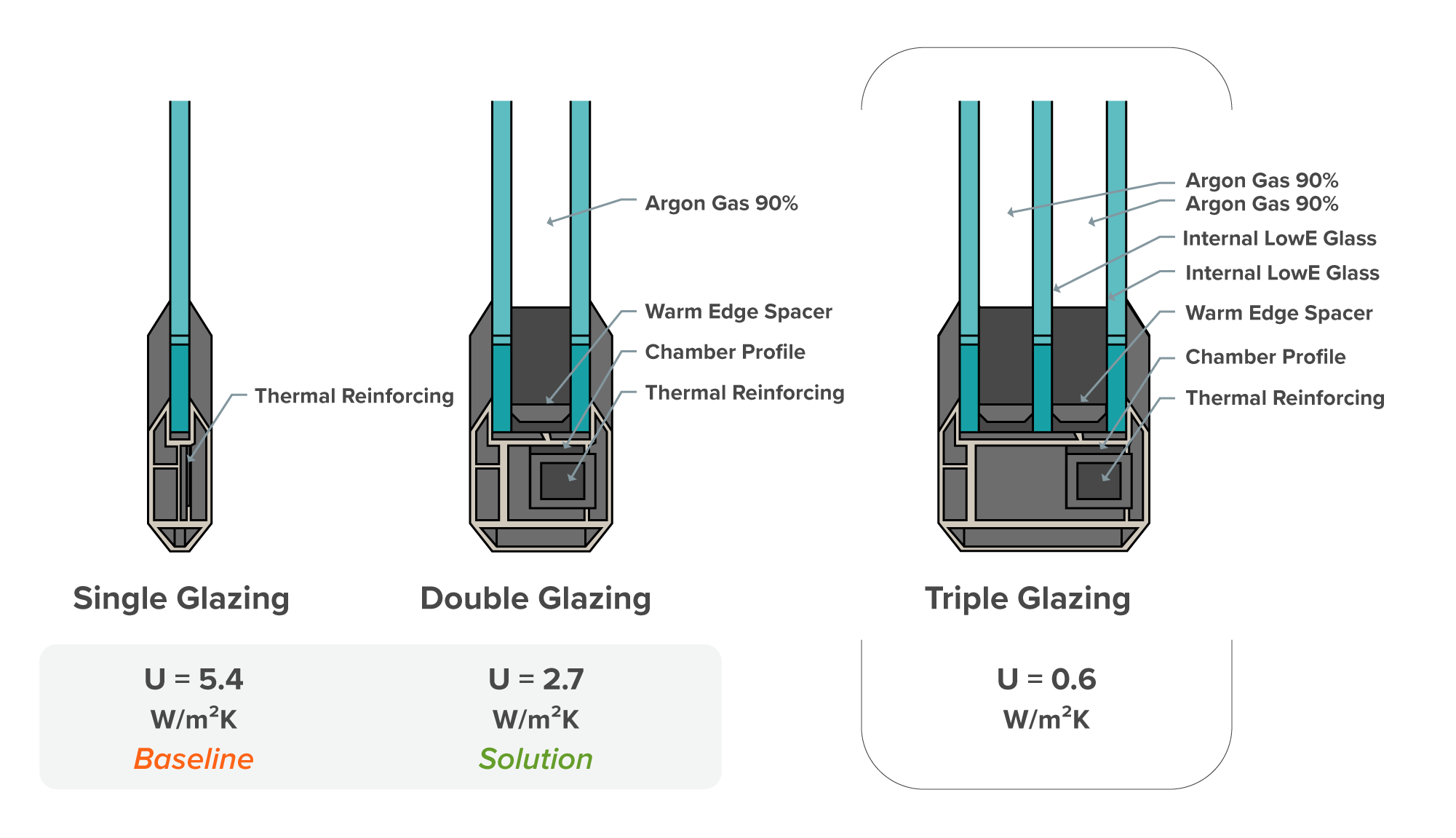
The Improve Windows and Glass solution assesses the impact of retrofitting single-glazed windows in the current (2022) global building stock, focusing on scaling up the use of double glazing as the minimum. Retrofitting extends the lifespan of building components and helps these buildings remain in use. The U-value of 2.7 W/m2K we used for double glazing during our analysis also includes other double pane window types with similar U-values such as secondary glazing where a second window is added to the outside of the existing one.

Figure 2. Multiple-glazed windows reduce heat transmission better than single glazed windows and so create less demand for GHG-producing fuels. Modified from Aguilar-Santana et al. (2020) and Moghaddam et al. (2023).

Image
A description of different glazing types.

Sources: Aguilar-Santana, J. L., Jarimi, H., Velasco-Carrasco, M., & Riffat, S. (2020). Review on window-glazing technologies and future prospects. International Journal of Low-Carbon Technologies, 15(1), 112–120; Moghaddam, S. A., Serra, C., Gameiro da Silva, M., & Simões, N. (2023). Comprehensive review and analysis of glazing systems towards nearly zero-energy buildings: Energy performance, thermal comfort, cost-effectiveness, and environmental impact perspectives. Energies, 16(17), Article 6283.

Impact Calculator

Adjust effectiveness and adoption using range sliders to see resulting climate impact potential.

Effectiveness

0.065
t CO2-eq (100-yr)/m2 windows minimum double-glazed/yr
25th
percentile
0.04
75th
percentile
0.13
0.065
median

Adoption

1.99×10¹⁰
m2 windows minimum double-glazed
Low
3.29×10¹⁰
High
4.0×10¹⁰
1.99×10¹⁰
current
Achievable Range

Climate Impact

1.29
Gt CO₂-eq/yr (100-yr)
05
which is the equivalent of
2.19%
of global emissions

The Details

Current State

Each 1 m2 of single-glazed window glass in buildings that is upgraded to double glazing has the potential to cut GHG emissions by approximately 0.07 t CO₂‑eq/yr (20-yr and 100-yr basis).

To determine the solution’s effectiveness (Table 1), we evaluated the emissions cut from reducing space heating and space cooling. Since studies often capture different U-value ratings for similar window glass, we weighted the energy saved (kWh/yr) from improving the glass using consistent U-values for the baseline and solution (see Figure 2). Thereafter, we weighted the energy impact by the total area of glass substituted (m2) to determine the savings intensity (kWh/m2/yr) and multiplied the estimate by emission intensities of heating and cooling fuels based on the IEA’s world energy balances data (IEA, 2024).

This solution cuts CO₂, methane, and nitrous oxide emissions by reducing the amount of fossil fuels used for heating and for producing electricity used for cooling. The analysis includes studies from countries representative of heating-dominated and cooling-dominated climates such as the United States (Calautit et al., 2025) and Malaysia (Balasbaneh et al., 2022), respectively. Notably, the solution is also effective in other climates (Magraoui et al., 2025).

Table 1. Effectiveness at reducing emissions.

Unit: t CO₂‑eq /m2/yr, 100-yr basis

25th percentile 0.043
Mean 0.095
Median (50th percentile) 0.065
75th percentile 0.13

Our estimate of the cost per unit climate impact (Table 2) indicates that replacing single-glazed windows with double-glazed windows in buildings globally results in considerable savings of approximately US$123/t CO₂‑eq.

We found that the solution’s initial cost varies considerably, from about US$31/m2 in Malaysia (Balasbaneh et al., 2022) to US$257–684/m2 in France (Harkouss et al., 2018), highlighting regional price differences that could affect adoption. Ultimately, we chose an initial cost of approximately US$144/m2 for double glazing. Using the cost of single glazing we found in studies from different regions (Aruta et al., 2025; Krarti & Ihm, 2016), our analysis determined a baseline initial cost of approximately US$35/m2. While the solution cost is more than four times the baseline, less energy is used for space heating or cooling, reducing the annual operating cost from US$23/m2 to approximately US$12/m2. After amortizing the initial cost over 30 years, the solution resulted in a net savings of US$8/m2/yr, compared with the baseline.

During our analysis, we normalized the initial cost by the baseline and solution U-value (see Figure 2) to ensure consistency. We assumed the initial cost includes the glass component alone, but some of our sources were ambiguous about the scope of the investment and may have also included frames and installation costs. To determine the cost per adoption unit, we weighted the amount of energy consumed for heating and cooling in each data source using the total area of windows upgraded in the respective case study buildings. The analysis does not include revenues because building owners typically do not generate any revenue from window glass installed. 

Table 2. Cost per unit of climate impact.

Unit: 2023 US$/t CO₂‑eq , 100-yr basis

Median -123

We found no definitive data on the solution’s learning rate. While the adoption of double glazing grows, some studies have reported rising cost of glass in recent periods (MLI Building Products, 2023). In an assessment of regional float glass price trends, Procurement Resource (n.d.) argued that rising material, energy, and labor costs amid other economic pressures are driving up the cost of glass. Since modern windows are often made using float glass (Asahi India Glass Ltd., 2025), the initial cost could become more expensive.

Speed of action refers to how quickly a climate solution physically affects the atmosphere after it is deployed. This is different from speed of deployment, which is the pace at which solutions are adopted.

At Project Drawdown, we define the speed of action for each climate solution as emergency brake, gradual, or delayed.

Improve Windows and Glass is a GRADUAL climate solution. It has a steady, linear impact on the atmosphere.

Adoption

To determine the current adoption of double-glazed windows, we first estimated the total amount of window glass installed in buildings by applying window-to-floor area ratios from studies to the currently existing 198.1 billion m2 residential and 54.6 billion m2 nonresidential building floor space (IEA, 2023f). This yielded approximately 23.3 billion mand 42.2 billion m2 of window glass installed in high-income countries (HICs) and low- and middle-income countries (LMICs), respectively (IEA, 2023c). 

We found limited data for the proportion of minimum double-glazed windows in HICs. The U.S. Energy Information Administration (U.S. EIA, 2023) reported that 80 million housing units (65%) in the U.S. have double-glazed windows installed. Percentages reported for other countries include 88% of housing units in the United Kingdom (Department for Levelling Up, Housing and Communities, 2023), 90% in Canada (Natural Resources Canada, n.d.), and 15% in Australia (Paarhammer, n.d.). Using these percentages, we estimated a 76% (median) solution adoption rate in HICs.

Since we found no definitive data for the solution’s adoption in LMICs, and considering a few LMICs have building energy codes that either mandate or encourage the use of higher performing windows (Gaum, 2023; Gaum & Laubscher, 2022), we assumed that double-glazed windows represent a conservative underestimate of 5%. 

All told, we estimate that as of 2022, installed double-glazed windows in buildings cover roughly 19.9 billion m2 globally (Table 3).

Table 3. Current (2022) adoption level.

Unit: m2 windows minimum double-glazed

25th percentile 14,300,000,000
Mean 17,100,000,000
Median (50th percentile) 19,900,000,000
75th percentile 22,700,000,000

According to the Department for Levelling Up, Housing and Communities (2023), the percentage of UK homes that have double-glazed windows increased by 9% between 2012 and 2022. Similarly, adoption grew by about 6% in five years (2015–2020) in the United States (U.S. EIA, 2018). Using these countries as representatives, this growth translates to approximately 438–448 million m2 of double-glazed or better windows being added every year in HICs.

We found limited data for adoption trends in LMICs. Based on our assumption for the current adoption in LMICs, we assumed that the percentage adoption of double-glazed windows grew by 4% over 10 years (2012–2022). This assumption, which is likely a conservative underestimate, translates to an annual addition of about 178 million m2/yr of double glazing.

Based on these findings, we estimate that the adoption of double glazing or better windows has grown globally by nearly 622 million m2 annually (Table 4).

Historically, the bulk of the solution’s adoption has occurred in HICs. However, the Global Alliance for Buildings and Construction, IEA, and the United Nations Environment Programme (UNEP) emphasize that adopting double-glazed windows is a necessary sustainability strategy for the building sector, especially in Africa and LMICs (GlobalABC/IEA/UNEP, 2020). This indicates considerable potential for scaling the solution, with 76% of the global building sector’s growth in the past 12 years occurring in LMICs (IEA, 2023f), where there has been less adoption of double glazing or better windows.

Table 4. 2010–2022 adoption trend.

Unit: m2/yr

25th percentile 620,000,000
Mean 622,000,000
Median (50th percentile) 622,000,000
75th percentile 624,000,000

We estimated an adoption ceiling (Table 5) of approximately 46.7 billion m2 of double-glazed windows globally. For this adoption scenario, 90% and 61% of window glass that existed in 2022 will be retrofitted to double-glazed or better by 2050 in buildings in HICs and buildings in LMICs, respectively.

In our analysis, we used the current double-glazed windows ratio of 90% in Canada (Natural Resources Canada, n.d) as a benchmark for the building sector’s adoption ceiling in HICs. For buildings in LMICs, we used the IEA’s recommended 2%/yr retrofit rate (IEA, 2022b) over 28 years (2022–2050). This estimated 56% growth was added to the current adoption of 5% to determine the region’s adoption ceiling. The analysis results in about 21 billion m2 and 26 billion m2 of double-glazed windows installed in buildings in HICs and LMICs, respectively.

Table 5. Adoption ceiling.

Unit: m2 windows minimum double-glazed

Estimate 46,700,000,000

Our analysis estimated a low achievable adoption of approximately 32.9 billion m2 of double-glazed or better windows installed in buildings globally (Table 6). For this scenario, we estimate that the percentage of windows that were at minimum double-glazed as of 2022 in buildings in HICs (76%) and buildings in LMICs (5%) grows to 81% and 33%, respectively.

Under the high achievable scenario, 86% of window glass in buildings in HICs and 47% of window glass in buildings in LMICs is at minimum double-glazed. This translates to a total of nearly 40.0 billion m2 of double glazing or better installed by 2050.

The achievable adoption scenarios are largely driven by the growth that is possible in LMICs. We assumed a retrofit rate of 1%/yr for the Achievable – Low scenario, which is the current global retrofit rate in the building industry (IEA, 2022b); for Achievable – High, we used 1.5%/yr. We also assumed that the current (2022) building stock will still be in use by 2050.

Table 6. Range of achievable adoption levels.

Unit: m2 windows minimum double-glazed

Current adoption 19,900,000,000
Achievable – low 32,900,000,000
Achievable – high 40,000,000,000
Adoption ceiling 46,700,000,000

Impacts

The current adoption of double-glazed windows in buildings reduces global GHG emissions by approximately 1.3 Gt CO₂‑eq/yr on a 100-yr and 20-yr basis (Table 7). If the low achievable adoption scenario is reached, this solution could potentially cut about 2.1 Gt CO₂‑eq/yr (100-yr and 20-yr basis). The high achievable scenario would decrease global emissions 2.6 Gt CO₂‑eq/yr year (100-yr and 20-yr basis). We estimated that the adoption ceiling could avoid up to 3.0 Gt CO₂‑eq/yr of emissions on a 100-yr basis (3.1 Gt CO₂‑eq/yr, 20-yr basis).

This solution only accounts for the impact of retrofitting the building stock that exists as of 2022. However, the current global built floor area (252.7 billion m2) is projected to grow by an additional 183 billion m2, by 2050 (IEA, 2022a; 2023b). This means a possible addition of 1.6 billion m2 of new window glass every year, indicating that the potential for scaling the climate impact exists.

Table 7. Climate impact at different levels of adoption.

Unit: Gt CO₂‑eq/yr, 100-yr basis

Current adoption 1.3
Achievable – low 2.1
Achievable – high 2.6
Adoption ceiling 3.0

Income and Work

While multi-glazed windows are often more of an initial investment than single-pane windows, improved performance of these windows is associated with more energy and cost savings (Menzies & Wherrett, 2005). Regional climates often affect the most appropriate window type and the amount of savings (Karabay & Arici, 2012). In residential buildings, double-glazed windows can add value to homes and increase property values (Aroul & Hansz, 2011). 

Health

Reductions in air pollution due to lower heating and cooling demand decrease exposures to pollutants such as mercury and fine particulate matter generated from fossil fuel–based power plants, improving the health of nearby communities (U.S. Environmental Protection Agency [EPA], 2025). These pollutants have been linked to increased morbidity from cardiovascular and respiratory disease, asthma, infections, and cancer (Gasparotto & Martinello, 2021) and to increased risk of mortality (Henneman et al., 2023). 

Better-performing windows can benefit health through improved thermal comfort (Bulut et al., 2021). When combined with other measures to reduce cooling loads, double-glazed windows can help with the risk of indoor heat stress (Ren et al., 2014). Improved windows may also reduce condensation and mold growth in buildings (Lozinsky et al., 2025). Residents of households with double-glazed windows have reported improvements in noise insulation after retrofitting single-pane windows (Bulut et al., 2021). 

Air Quality

Higher-performing glass can reduce air pollution by lowering gas and electricity demand for heating and cooling, which can decrease pollutants such as CO₂, nitrogen oxides, methane, mercury, and fine particulate matter generated from fossil fuel–based power plants (U.S. EPA, 2025).

Other

Our analysis for this solution focused on the U-value of the glass component alone. It did not include other parameters such as the material type of the window frames or coatings on windows, though these also impact space heating and cooling energy use (Owolabi et al., 2023). We ensured that the data used in our analysis aligned with our approach (i.e., indicated the impact of solely substituting double-glazed or better glass for single-glazed). Due to limited data, we assumed that current adoption in LMICs is 5%. The adoption scenarios and climate impact may be influenced if the actual percentage is higher or lower.

A window’s orientation impacts the solar heat gain. Thus, the influence of upgrading to double-glazing on heating or cooling loads is affected by window placement. We found limited data that incorporates orientation and did not account for this difference.

Recently, some studies have indicated concerns about the payback period of upgrading to double glazing for building owners (Calautit et al., 2025), especially in LMICs, where higher initial costs could be a barrier. Creative initiatives such as incentive schemes can improve the payback period (Aruta et al., 2025). 

Faulty installation could compromise the expected benefits of double glazing. It could also lead to condensation on the inner pane if the sealant deteriorates, affecting visibility, aesthetics, and performance and resulting in a potential shorter lifespan than single glazing (Duan et al., 2021; Likins-White, 2023). Additional costs may be incurred when attempting to secure adequate expertise and equipment to ensure proper handling and installation (DIY Double Glaze, n.d.). Depending on the extent of the retrofits, this may drive up construction costs, which is a concern for building developers. However, it also represents opportunities to improve available technical expertise in regions where these services are unavailable or underdeveloped.

Manufacturing double-glazed or better windows generates more industrial sector emissions than does manufacturing single-glazed windows due to the additional materials used. However, life-cycle analysis studies such as Balasbaneh et al. (2022) compared different glazing options ranging from single to triple glazing and determined that the emissions reduced by using better windows outweighs the embodied emissions. Although it is outside the scope of this solution, window frames account for as much as 46–80% of a window's embodied emissions, especially when using conventional window frame materials such as polyvinyl chloride and aluminum (Saadatian et al., 2021). Despite the higher embodied emissions, the emissions reductions from implementing the solution are substantial.

Reinforcing

The Improve Windows and Glass solution reduces the amount of space heating and cooling required. This may reduce the required size and complexity of heating and cooling systems, making them more economically accessible.

Upgrading window glass can motivate building owners to improve other elements of the building envelope. This could improve the cost efficiency of the upgrades when approached holistically. 

Competing

The potential climate impact of deploying these solutions could be lower due to the reduced amount of space heating and cooling required in buildings from improving window glass.

Consensus of effectiveness in reducing GHG emissions: High

Improving windows and glass helps optimize the amount of heating required in buildings by reducing heat loss. Calautit et al. (2025) reported that energy used for heating in a United Kingdom residence dropped nearly 23% after reducing the glass U-value from 5.6 W/m2K to 2.8 W/m2K. Using the same building parameters, the study tested the impact of reducing the U-value by 1.35 W/m2K in the climatic conditions of Netherlands, Japan, United States, Sweden and Australia. The outcomes were similar, with about a 10–12% reduction in heating loads (Calautit et al., 2025). The results from Yuk et al. (2024), Magraoui et al. (2025), and Ahmed et al. (2025) further support these findings. 

Similarly, the solution reduces heat gained from the outdoors into buildings, thereby cutting cooling loads. Gomaa et al. (2025) reported that energy use in a Saudi Arabian residence was reduced by 1,265 kWh/yr (49%) after improving the glass U-value from 5.6 to 0.9 W/m2K (84%). Es-sakali et al. (2022) recorded 36% less electricity consumed after reducing the U-value by 1.44 W/m2K in Morocco’s climate.

The results presented in this document summarize findings from 10 original studies reflecting current evidence from 13 countries. We recognize this limited geographic scope creates bias, and hope this work inspires research and data sharing on this topic in underrepresented regions. The studies we found used simulations to assess the impact of retrofitting windows due to the inherent difficulty of real-world experiments. However, we used studies that include field measurements and calibration of the building simulations to validate their models.

Take Action

Looking to get involved? Below are some key actions for this solution that can get you started, arranged according to different roles you may play in your professional or personal life.

These actions are meant to be starting points for involvement and are not intended to be prescriptive or necessarily suggest they are the most important or impactful actions to take. We encourage you to explore and get creative!

Lawmakers and Policymakers

  • Set clear and measurable targets for building efficiency, emissions reduction, and the deployment of improved windows.
  • Enact holistic policy plans and building codes to reduce GHG emissions from buildings through improved windows and framing systems.
  • Set public procurement standards for windows and glass, using double-glazed windows, at minimum, for public buildings.
  • Amend building codes to include minimum requirements based on window performance; gradually increase the standards over time if necessary.
  • Periodically update codes, policies, and public guidance to keep pace with research and development.
  • Make double-glazed windows the minimum standard option through a range of policy interventions, including regulations, subsidies, and educational programs where relevant; extend incentives to high performing secondary-, double- or triple-glazed windows, if relevant.
  • Offer financial incentives such as subsidies, tax credits, and grants for consumers, manufacturers, start-ups, and improved window installers.
  • Ensure financial incentives reach, and offer additional incentives for, low- and middle-income communities.
  • Ensure financial incentives cover both new installations and retrofits.
  • Create financial disincentives such as higher taxes and fines for lower performing windows.
  • Subsidize workforce or skills development and/or work with businesses to identify gaps and needs such as technical knowledge or the advantages of new technology.
  • Invest in research and development to improve window design, manufacturing, adoption, supply chain access, and circularity.
  • Create green building certification schemes and/or public-private partnerships that offer information, training, and general support for improved windows.
  • Offer educational resources, one-stop shops for windows, and demonstrations for installation and retrofits; offer tours of model builds that feature improved windows for commercial and private developers, highlighting the cost savings, and environmental benefits.

Further information:

Practitioners

  • Finance or develop only new construction and retrofits that use improved windows and other low-carbon practices.
  • Take advantage of financial incentives such as subsidies, tax credits, and grants for installing improved windows.
  • Seek or negotiate preferential loan agreements for developers using improved windows and other climate-friendly practices.
  • Use double-glazed windows as the most basic standard and offer a variety of better-performing options such as triple-glazed.
  • Work with designers and architects who integrate efficient windows and other efficient materials into their designs.
  • Integrate improved window designs into construction databases, including listing prices, thermal insulation properties, and environmental benefits.
  • Advocate for financial incentives, improved building codes, and educational programs advancing the use of improved windows.
  • Use educational resources, one-stop shops for retrofitting and weatherization, installation demonstrations, and tours of model builds.
  • Conduct research to improve the manufacturing, adoption, supply chain access, and circularity of windows.
  • Create or join green building certification schemes, green building councils, and/or public-private partnerships that offer information, training, and general support for improving windows.

Further information:

Business Leaders

  • Finance only new construction and retrofits that use improved windows and other low-carbon practices.
  • Expand product lines to include improved window designs.
  • Integrate improved window designs into construction databases, listing prices, thermal insulation properties, and environmental benefits.
  • Invest in research and development to improve window design, manufacturing, adoption, supply chain access, and circularity.
  • Advocate for financial incentives, improved building codes, and educational programs advancing the use of improved windows.
  • Join green building certification schemes and/or public-private partnerships that offer information, training, and general support for improved windows.
  • Create long-term purchasing agreements with improved window manufacturers to support stable demand and improve economies of scale.
  • Create or join green building certification schemes, green building councils, and/or public-private partnerships that offer information, training, and general support for improved windows.

Further information:

Nonprofit Leaders

  • Finance or develop only new construction and retrofits that use improved windows and other low-carbon practices.
  • Advocate for clear and measurable public targets for building efficiency, emissions reduction, and deployment of improved windows.
  • Advocate for holistic policy plans and building codes to reduce GHG emissions from buildings that include improved windows and framing systems.
  • Advocate for financial incentives, improved building codes, and educational programs advancing the use of improved windows.
  • Conduct research to improve window design, manufacturing, adoption, supply chain access, and circularity.
  • Work with businesses for workforce or skills development.
  • Offer educational resources, one-stop shops for windows, and demonstrations for installation and retrofits; offer tours of model builds that feature improved windows for commercial and private developers, highlighting the cost savings and environmental benefits.
  • Create, join, or administer green building certification schemes and/or public-private partnerships that offer information, training, and general support for improved windows.

Further information:

Investors

  • Finance only new construction and retrofits that use improved windows and other low-carbon practices.
  • Invest in research and development and start-ups to improve window design, manufacturing, adoption, supply chain access, and circularity.
  • Issue green bonds to invest in projects that use improved windows and integrate other climate-friendly construction practices.
  • Offer preferential loan agreements for developers using improved windows and other climate-friendly practices.
  • Join green building certification schemes and/or public-private partnerships that offer information, training, and general support for improved windows.

Further information:

Philanthropists and International Aid Agencies

  • Finance only new construction and retrofits that use improved windows and other low-carbon practices.
  • Offer grants for developers using improved windows and other climate-friendly practices.
  • Create financing programs for private construction in low-income or under-resourced communities requiring the use of improved windows.
  • Advocate for clear and measurable public targets for building efficiency, emissions reduction, and the deployment of improved windows.
  • Advocate for holistic policy plans and building codes to reduce GHG emissions from buildings that include improved windows and framing systems.
  • Advocate for financial incentives, improved building codes, and educational programs for improved windows.
  • Fund research to improve window design, manufacturing, adoption, supply chain access, and circularity.
  • Offer educational resources, one-stop shops for retrofitting and weatherization, installation demonstrations, and tours of model builds for commercial and private developers, highlighting the cost savings and environmental benefits.
  • Create, join, or administer green building certification schemes and/or public-private partnerships that offer information, training, and general support for improved windows.

Further information:

Thought Leaders

  • Advocate for clear and measurable public targets for building efficiency, emissions reduction, and the deployment of improved windows.
  • Advocate for holistic policy plans and building codes to reduce GHG emissions from buildings that include improved windows and framing systems.
  • Advocate for financial incentives, improved building codes, and educational programs for improved windows.
  • Conduct research to improve window design, manufacturing, adoption, supply chain access, and circularity.
  • Contract with businesses for workforce or skills development.
  • Offer or support educational resources, one-stop shops for retrofitting and weatherization, installation demonstrations, and tours of model builds for commercial and private developers, highlighting the cost savings and environmental benefits of improved windows.
  • Create, join, or administer green building certification schemes and/or public-private partnerships that offer information, training, and general support for improved windows.

Further information:

Technologists and Researchers

  • Research and develop high-performance window technologies such as vacuum glazing, aerogel applications, potential integration of solar photovoltaic glass, and the use of unconventional gases to fill multi-pane windows and improve performance.
  • Create improved alternatives to common practices for air and vapor sealing.
  • Find alternative materials for spacers with reduced thermal conductivity in double- and triple-glazed windows.
  • Research and develop alternative window frame designs to improve thermal performance, structural insulating materials, and improve ease of installation (e.g., out-of-the-box window installation kits).
  • Improve efficiency of the window manufacturing process, supply chain access, and the circular economy of glass.

Communities, Households, and Individuals

  • Finance or develop only new construction and retrofits that use improved windows and other low-carbon practices.
  • Take advantage of financial incentives such as subsidies, tax credits, and grants for installing improved windows.
  • Advocate for clear and measurable public targets for building efficiency, emissions reduction, and the deployment of improved windows.
  • Advocate for holistic policy plans and building codes to reduce GHG emissions from buildings that include improved windows and framing systems.
  • Advocate for financial incentives, improved building codes, and educational programs for improved windows.
  • Organize local “green home tours” and open houses to showcase climate-friendly builds, fostering demand by highlighting cost savings and environmental benefits of improved windows.
  • Capture community feedback and share it with local policymakers to address barriers such as permitting logistics or up-front costs, helping to shape policies that drive adoption.
  • Create, join, or administer green building certification schemes and/or public-private partnerships that offer information, training, and general support for improved windows.

Further information:

“Take Action” Sources

References

Aguilar-Santana, J. L., Jarimi, H., Velasco-Carrasco, M., & Riffat, S. (2020). Review on window-glazing technologies and future prospects. International Journal of Low-Carbon Technologies, 15(1), 112–120. Link to source: https://doi.org/10.1093/ijlct/ctz032

Ahmed, A. E., Suwaed, M. S., Shakir, A. M., & Ghareeb, A. (2025). The impact of window orientation, glazing, and window-to-wall ratio on the heating and cooling energy of an office building: The case of hot and semi-arid climate. Journal of Engineering Research, 13(1), 409–422. Link to source: https://doi.org/10.1016/j.jer.2023.10.034

Arasteh, D., Selkowitz, S., Apte, J., & LaFrance, M. (2006). Zero energy windows. Lawrence Berkeley National Laboratory. Link to source: https://escholarship.org/uc/item/2zp5m6x8

Aroul, R., & Hansz, J. A. (2011). The role of dual-pane windows and improvement age in explaining residential property values. Journal of Sustainable Real Estate, 3(1), 142–161. Link to source: https://doi.org/10.1080/10835547.2011.12091822

Aruta, G., Ascione, F., Iovane, T., & Mastellone, M. (2025). Double-skin façades for the refurbishment of historic buildings: Energy-economic feasibility for different types of glazing and ventilation rates. Journal of Building Engineering, 103, Article 112125. Link to source: https://doi.org/10.1016/j.jobe.2025.112125

Asahi India Glass Ltd. (2025, April 25). Top benefits of float glass in modern homesLink to source: https://www.aisglass.com/blog/top-benefits-of-float-glass-in-modern-homes/

Balali, A., Yunusa-Kaltungo, A., & Edwards, R. (2023). A systematic review of passive energy consumption optimisation strategy selection for buildings through multiple criteria decision-making techniques. Renewable and Sustainable Energy Reviews, 171, Article 113013. Link to source: https://doi.org/10.1016/j.rser.2022.113013

Balasbaneh, A. T., Yeoh, D., Ramli, M. Z., & Valdi, M. H. T. (2022). Different alternative retrofit to improving the sustainability of building in tropical climate: Multi-criteria decision-making. Environmental Science and Pollution Research, 29(27), 41669–41683. Link to source: https://doi.org/10.1007/s11356-022-18647-8

Basok, B., Davydenko, B., Novikov, V., Pavlenko, A. M., Novitska, M., Sadko, K., & Goncharuk, S. (2022). Evaluation of heat transfer rates through transparent dividing structures. Energies, 15(13), Article 4910. Link to source: https://doi.org/10.3390/en15134910

Bulut, M., Wilkinson, S., Khan, A., Jin, X.-H., & Lee, C. L. (2021). Perceived benefits of retrofitted residential secondary glazing: An exploratory Australian study. International Journal of Building Pathology and Adaptation, 39(5), 720–733. Link to source: https://doi.org/10.1108/IJBPA-09-2020-0083

Calautit, J. K., Sun, H., Li, J., Dik, A., & Mohammadi, M. (2025). Keeping it simple: Field testing and techno-economic assessment of a low-cost secondary quad glazing for enhanced energy efficiency in buildings [Corrected proof]. Energy and Built Environment. Link to source: https://doi.org/10.1016/j.enbenv.2025.03.004

Cuce, E., & Riffat, S. B. (2015). Aerogel-assisted support pillars for thermal performance enhancement of vacuum glazing: A CFD research for a commercial product. Arabian Journal for Science and Engineering, 40(8), 2233–2238. Link to source: https://doi.org/10.1007/s13369-015-1727-5

Delmastro, C., & Chen, O. (2023, July 11). Energy system: Buildings. International Energy Agency. Link to source: https://www.iea.org/energy-system/buildings

Department for Levelling Up, Housing and Communities. (2023, December 14). Accredited official statistics chapter 5: Energy efficiency. GOV.UK. Link to source: https://www.gov.uk/government/statistics/chapters-for-english-housing-survey-2022-to-2023-headline-report/chapter-5-energy-efficiency#contents

DIY Double Glaze. (n.d.). 6 problems with double glazed windows and how you can resolve them. Retrieved September 13, 2025, from Link to source: https://www.diydoubleglaze.com.au/6-problems-with-double-glazed-windows-and-how-you-can-resolve-them/

Duan, Q., Hinkle, L., Wang, J., Zhang, E., & Memari, A. (2021). Condensation effects on energy performance of building window systems. Energy Reports, 7, 7345–7357. Link to source: https://doi.org/10.1016/j.egyr.2021.10.096

Es-sakali, N., Kaitouni, S. I., Laasri, I. A., Mghazli, M. O., Cherkaoui, M., & Pfafferott, J. (2022). Assessment of the energy efficiency for a building energy model using different glazing windows in a semi-arid climate. Proceedings of the 13th International Renewable Energy Congress (IREC), 1–5. Link to source: https://doi.org/10.1109/IREC56325.2022.10001934

Gasparotto, J., & Da Boit Martinello, K. (2021). Coal as an energy source and its impacts on human health. Energy Geoscience, 2(2), 113–120. Link to source: https://doi.org/10.1016/j.engeos.2020.07.003

Gaum, T. (2023). Building energy codes in the Global South: Comparing selected variables to develop a decision-making model to address climate-change guidelines [Spreadsheet]. SLIM3. Link to source: https://docs.google.com/spreadsheets/d/1aP4zaeDvfwSI-3Abuj8Z_VUUEHJzjMZS/edit?gid=988383392#gid=988383392

Gaum, T., & Laubscher, J. (2022). Building energy codes: Reviewing the status of implementation strategies in the Global South. International Journal of Built Environment and Sustainability, 9(1), 39–53. Link to source: https://doi.org/10.11113/ijbes.v9.n1.871

Global Alliance for Buildings and Construction, International Energy Agency, & the United Nations Environment Programme. (2020). GlobalABC regional roadmap for buildings and construction in Africa 2020-2050: Towards a zero-emission, efficient and resilient buildings and construction sector [Report]. International Energy Agency. Link to source: https://globalabc.org/sites/default/files/inline-files/Africa_Buildings%20Roadmap_FINAL_1.pdf

Gomaa, M. M., Abdallah, A. S. H., Aloshan, M. A., & Ragab, A. (2025). A comparative analysis of advanced glazing technologies for energy-efficient buildings in Jeddah city, Saudi Arabia. Buildings, 15(9), Article 1477. Link to source: https://doi.org/10.3390/buildings15091477

Gustavsen, A., Grynning, S., Arasteh, D., Jelle, B. P., & Goudey, H. (2011). Key elements of and material performance targets for highly insulating window frames. Energy and Buildings, 43(10), 2583–2594. Link to source: https://doi.org/10.1016/j.enbuild.2011.05.010

Harkouss, F., Fardoun, F., & Biwole, P. H. (2018). Multi-objective optimization methodology for net zero energy buildings. Journal of Building Engineering, 16, 57–71. Link to source: https://doi.org/10.1016/j.jobe.2017.12.003

Henneman, L., Choirat, C., Dedoussi, I., Dominici, F., Roberts, J., & Zigler, C. (2023). Mortality risk from United States coal electricity generation. Science382(6673), 941–946. Link to source: https://doi.org/10.1126/science.adf4915

Hermelink, A., von Manteuffel, B., & Grözinger, J. (2017). Minimum performance requirements for window replacement in the residential sector [Report]. ECOFYS. Link to source: https://glassforeurope.com/wp-content/uploads/2018/04/Minimum-performance-requirements-for-window-replacement-in-the-residential-sector.pdf

International Energy Agency. (2018). The future of cooling: Opportunities for energy-efficient air conditioningLink to source: https://www.iea.org/reports/the-future-of-cooling

International Energy Agency. (2022a, September 1). Global buildings sector CO2 emissions and floor area in the net zero scenario, 2020-2050Link to source: https://www.iea.org/data-and-statistics/charts/global-buildings-sector-co2-emissions-and-floor-area-in-the-net-zero-scenario-2020-2050

International Energy Agency. (2022b). Renovation of near 20% of existing building stock to zero-carbon-ready by 2030 is ambitious but necessaryLink to source: https://www.iea.org/reports/renovation-of-near-20-of-existing-building-stock-to-zero-carbon-ready-by-2030-is-ambitious-but-necessary

International Energy Agency. (2023b, June 15). Energy consumption in buildings by fuel in the net zero scenario, 2010-2030. Link to source: https://www.iea.org/data-and-statistics/charts/energy-consumption-in-buildings-by-fuel-in-the-net-zero-scenario-2010-2030-2

International Energy Agency. (2023c, June 15). Global floor area and buildings energy intensity in the net zero scenario, 2010-2030. Link to source: https://www.iea.org/data-and-statistics/charts/global-floor-area-and-buildings-energy-intensity-in-the-net-zero-scenario-2010-2030

International Energy Agency. (2023d). Space cooling: Net zero emissions guideLink to source: https://www.iea.org/reports/space-cooling-2

International Energy Agency. (2023e). Space heating: Net zero emissions guideLink to source: https://www.iea.org/reports/space-heating

International Energy Agency. (2023f, July 11). Total floor area by use in the net zero scenario, 2010-2030. Link to source: https://www.iea.org/data-and-statistics/charts/total-floor-area-by-use-in-the-net-zero-scenario-2010-2030-2

International Energy Agency. (2024). World energy balancesLink to source: https://www.iea.org/data-and-statistics/data-product/world-energy-balances

Janssens, C. (2021, September 27). Minimum energy performance requirements for window replacement in the 28 EU member states. Glassonweb. Link to source: https://www.glassonweb.com/article/minimum-energy-performance-requirements-window-replacement-28-eu-member-states 

Karabay, H., & Arici, M. (2012). Multiple pane window applications in various climatic regions of Turkey. Energy and Buildings, 45, 67–71. Link to source: https://doi.org/10.1016/j.enbuild.2011.10.020

Krarti, M., & Ihm, P. (2016). Evaluation of net-zero energy residential buildings in the MENA region. Sustainable Cities and Society, 22, 116–125. Link to source: https://doi.org/10.1016/j.scs.2016.02.007

Li, N., Meng, Q., Zhao, L., Li, H., Wang, J., Zhang, N., Wang, P., & Lu, S. (2023). Thermal performance study of multiple thermal insulating glazings with polycarbonate films as interval layers. Journal of Building Engineering, 76, Article 107159. Link to source: https://doi.org/10.1016/j.jobe.2023.107159

Likins-White, M., Tenent, R. C., & Zhai, Z. (2023). Degradation of insulating glass units: Thermal performance, measurements and energy impacts. Buildings, 13(2), Article 551. Link to source: https://doi.org/10.3390/buildings13020551

Lozinsky, C. H., Casquero-Modrego, N., & Walker, I. S. (2025). The health and indoor environmental quality impacts of residential building envelope retrofits: A literature review. Building and Environment, 270, Article 112568. Link to source: https://doi.org/10.1016/j.buildenv.2025.112568

Magraoui, C., Derradji, L., Hamid, A., Oukaci, S., Limam, A., & Merabtine, A. (2025). A smart roller shutters control for enhancing thermal comfort and sustainable energy efficiency in office buildings. Sustainability, 17(5), Article 2116. Link to source: https://doi.org/10.3390/su17052116

Menzies, G. F., & Wherrett, J. R. (2005). Multiglazed windows: Potential for savings in energy, emissions and cost. Building Services Engineering Research & Technology26(3), 249–258. Link to source: https://doi.org/10.1191/0143624405bt132tn

MLI Building Products. (2023, February 27). Are glass prices set to rise in 2023? Link to source: https://www.mlibuildingproducts.co.uk/glass-prices-rise-2023/

Moghaddam, S. A., Serra, C., Gameiro da Silva, M., & Simões, N. (2023). Comprehensive review and analysis of glazing systems towards nearly zero-energy buildings: Energy performance, thermal comfort, cost-effectiveness, and environmental impact perspectives. Energies, 16(17), Article 6283. Link to source: https://doi.org/10.3390/en16176283

Natural Resources Canada. (n.d.). Table 4.5a – Windows by region. Government of Canada. Retrieved July 23, 2025, from Link to source: https://oee.nrcan.gc.ca/corporate/statistics/neud/dpa/showTable.cfm?type=SH&sector=aaa&juris=ca&year=2019&rn=35&page=1

Owolabi, A. B., Suh, D., & Pignatta, G. (2023). Investigating the energy use in an Australian building: A case study of a west-facing apartment in Sydney. Ain Shams Engineering Journal, 14(8), Article 102040. Link to source: https://doi.org/10.1016/j.asej.2022.102040

Paarhammer. (n.d.). New building regulations coming soon. Paarhammer windows and doors. Retrieved August 15, 2025, from Link to source: https://www.paarhammer.com.au/blog/new-building-regulations-coming-soon

Pistochini, T., Dichter, M., Chakraborty, S., Dichter, N., & Aboud, A. (2022). Greenhouse gas emission forecasts for electrification of space heating in residential homes in the US. Energy Policy, 163, Article 112813. Link to source: https://doi.org/10.1016/j.enpol.2022.112813

Procurement Resource. (n.d.). Float glass price trend and forecast. Retrieved September 19, 2025, from Link to source: https://www.procurementresource.com/resource-center/glass-price-trends

Ren, Z., Wang, X., & Chen, D. (2014). Heat stress within energy efficient dwellings in Australia. Architectural Science Review, 57(3), 227–236. Link to source: https://doi.org/10.1080/00038628.2014.903568

Richardson, J. (2024, December 31). CO2 carbon savings of a heat pump and their environmental cost. The Renewable Energy Hub UK. Link to source: https://www.renewableenergyhub.co.uk/main/heat-pumps-information/co2-carbon-savings-of-a-heat-pump-and-their-environmental-cost#:~:text=Fluorinated%20hydrocarbons%20such%20as%20HFCs,warming%20potential

Ritchie, H. (2024). Air conditioning causes around 3% of greenhouse gas emissions. How will this change in the future? Our World in Data. Link to source: https://archive.ourworldindata.org/20251125-173858/air-conditioning-causes-around-greenhouse-gas-emissions-will-change-future.html 

Saadatian, S., Freire, F., & Simões, N. (2021). Embodied impacts of window systems: A comparative assessment of framing and glazing alternatives. Journal of Building Engineering, 35, Article 102042. Link to source: https://doi.org/10.1016/j.jobe.2020.102042

Saint-Gobain. (2018). Solar & thermal 1e thermal insulation. Link to source: https://www.saint-gobain-glass.co.uk/wp-content/uploads/2022/05/Solar-Thermal-1E-Thermal-Insulation-19-09-2018.pdf

Salazar, S. L., Simá, E., Vargas-López, R., Yang, R., Li, D., & Hernández-López, I. (2024). Assessing different glazing types for energy savings and CO2 reduction in a tropical climate: A comparative study. Journal of Building Engineering, 82, Article 108188. Link to source: https://doi.org/10.1016/j.jobe.2023.108188

Shah, B., Bhandari, M., & Tang, M. (2024). Importance of window installation in residential building envelopes having continuous external insulation in order to realize energy efficiency. Energies, 17(17), Article 4273. Link to source: https://doi.org/10.3390/en17174273

U.S. Energy Information Administration. (2018, May). 2015 Residential Energy Consumption Survey (RECS) survey data: Housing characteristics tables - structural and geographic characteristics - by housing unit type (HC2.1). Retrieved August 15, 2025, from Link to source: https://www.eia.gov/consumption/residential/data/2015/hc/php/hc2.1.php

U.S. Energy Information Administration. (2023). Table HC2.1 Structural and geographic characteristics of U.S. homes by housing unit type, 2020Link to source: https://www.eia.gov/consumption/residential/data/2020/hc/pdf/HC%202.1.pdf

U.S. Environmental Protection Agency. (2024). Climate change indicators in the United StatesLink to source: https://www.epa.gov/system/files/documents/2024-07/climate_indicators_2024.pdf 

U.S. Environmental Protection Agency. (2025). Power sector programs – Progress report. Link to source: https://www.epa.gov/power-sector/progress-report

Yuk, H., Choi, J. Y., Yang, S., & Kim, S. (2024). Balancing preservation and utilization: Window retrofit strategy for energy efficiency in historic modern building. Building and Environment, 259, Article 111648. Link to source: https://doi.org/10.1016/j.buildenv.2024.111648


Credits

Lead Fellow

  • Henry Igugu, Ph.D.

Contributors

  • Ruthie Burrows, Ph.D.

  • James Gerber, Ph.D.

  • Daniel Jasper

  • Alex Sweeney

Internal Reviewers

  • Sarah Gleeson, Ph.D.

  • Heather McDiarmid, Ph.D.

  • Amanda D. Smith, Ph.D.

  • Greenhouse gas quantity expressed relative to CO₂ with the same warming impact over 100 years, calculated by multiplying emissions by the 100-yr GWP for the emitted gases.

  • Greenhouse gas quantity expressed relative to CO with the same warming impact over 20 years, calculated by multiplying emissions by the 20-yr GWP for the emitted gases.

  • 8th World Congress on Conservation Agriculture

  • Reducing greenhouse gas concentrations in the atmosphere by preventing or reducing emissions.

  • Air conditioning

  • The process of increasing acidity.

  • The extent to which emissions reduction or carbon removal is above and beyond what would have occurred without implementing a particular action or solution.

  • An upper limit on solution adoption based on physical or technical constraints, not including economic or policy barriers. This level is unlikely to be reached and will not be exceeded.

  • The quantity and metric to measure implementation for a particular solution that is used as the reference unit for calculations within that solution.

  • A composting method in which organic waste is processed in freestanding piles that can be aerated actively with forced air or passively by internal convection.

  • The interactions of aerodynamic forces and flexible structures, often including the stucture's control system.

  • A process in which microbes break down organic materials in the presence of oxygen. This process converts food and green waste into nutrient-rich compost.

  • Establishment of new forests in areas that did not historically support forests.

  • Farming practices that work to create socially and ecologically sustainable food production.

  • Addition of trees and shrubs to crop or animal farming systems.

  • Artificial intelligence

  • Spread out the cost of an asset over its useful lifetime.

  • A process in which microorganisms break down organic material in the absence of oxygen. Methane and CO₂ are the main byproducts.

  • A crop that live one year or less from planting to harvest; also called annual.

  • aerated static piles

  • Electric power delivered at a steady, around-the-clock rate, to cover power demand that exists at all times. Baseload power is typically supplied by high availability, low operating-cost plants, such as nuclear or geothermal.

  • black carbon

  • Solar panels that generate electricity from sunlight captured on both sides, increasing energy output by reflecting light from the ground and surroundings.

  • Made from material of biological origin, such as plants, animals, or other organisms.

  • A renewable energy source generated from organic matter from plants and/or algae.

  • An energy source composed primarily of methane and CO that is produced by microorganisms when organic matter decomposes in the absence of oxygen.

  • Carbon stored in biological matter, including soil, plants, fungi, and plant products (e.g., wood, paper, biofuels). This carbon is sequestered from the atmosphere but can be released through decomposition or burning.

  • Living or dead renewable matter from plants or animals, not including organic material transformed into fossil fuels. Peat, in early decay stages, is partially renewable biomass.

  • Biogas refined to the same quality as natural gas. CO₂ and impurities are removed, and the biomethane can be distributed and used in existing natural gas technologies.
     

  • A type of carbon sequestration that captures carbon from CO via photosynthesis and stores it in soils, sediments, and biomass, distinct from sequestration through chemical or industrial pathways.

  • A synthetic organic compound used to make a type of hard, clear plastic for food and drink packaging and many consumer goods.

  • A climate pollutant, also called soot, produced from incomplete combustion of organic matter, either naturally (wildfires) or from human activities (biomass or fossil fuel burning).

  • A secure, decentralized way of digitally tracking transactions that could be used to improve the transparency and efficiency of carbon markets. 

  • A global initiative launched by Germany and the IUCN in 2011 to restore 150 Mha of land by 2020 and 350 Mha by 2030.

  • High-latitude (>50°N or >50°S) climate regions characterized by short growing seasons and cold temperatures.

  • bisphenol A

  • Revenue from carbon credits reserved for payout to land- and rights-holders in the event of a disturbance such as a fire; similar to insurance scheme.

  • The components of a building that physically separate the indoors from the outdoor environment.

  • Businesses involved in the sale and/or distribution of solution-related equipment and technology, and businesses that want to support adoption of the solution.

  • Compound annual growth rate

  • A chemical reaction involving heating a solid to a high temperature; to make cement clinker, limestone is calcined into lime in a process that requires high heat and produces CO.

  • The ratio of the actual electricity an energy technology generates over a period of time to the maximum it could have produced if it operated continuously at full capacity.

  • A four-wheeled passenger vehicle.

  • Average number of people traveling in a car per trip.

  • Technologies that collect CO before it enters the atmosphere, preventing emissions at their source. Collected CO can be used onsite or in new products, or stored long term to prevent release.

  • A greenhouse gas that is naturally found in the atmosphere. Its atmospheric concentration has been increasing due to human activities, leading to warming and climate impacts.

  • Total GHG emissions resulting from a particular action, material, technology, or sector.

  • Amount of GHG emissions released per activity or unit of production. 

  • A marketplace where carbon credits are purchased and sold. One carbon credit represents activities that avoid, reduce, or remove one metric ton of GHG emissions.

  • A colorless, odorless gas released during the incomplete combustion of fuels containing carbon. Carbon monoxide can harm health and be fatal at high concentrations.

  • The time it takes for the emissions reduction from a measure to equal the emissions invested in implementing the measure.

  • Activities or technologies that pull CO out of the atmosphere, including enhancing natural carbon sinks and deploying engineered sinks.

  • Long-term storage of carbon in soils, sediment, biomass, oceans, and geologic formations after removal of CO from the atmosphere or CO capture from industrial and power generation processes.

  • carbon capture and storage

  • carbon capture, utilization, and storage

  • Cooling degree days

  • A binding ingredient in concrete responsible for most of concrete’s life-cycle emissions. Cement is made primarily of clinker mixed with other mineral components.

  • chlorofluorocarbon

  • Processes that use chemical reactions or heat to break down plastic waste into basic molecular components or feedstocks that can then be used to make new plastic products.

  • Process that uses chemical reactions or heat to break down plastic waste into basic molecular components that can be used to make new plastic products.

  • methane

  • A system in which resources, materials, and products are used for as long as possible through reuse, repair, refurbishment, and recycling.

  • Energy sources that have little to no negative environmental or climate impacts during operation relative to fossil fuel–based energy sources.

  • Gases or particles that have a planet-warming effect when released to the atmosphere. Some climate pollutants also cause other forms of environmental damage.

  • A binding ingredient in cement responsible for most of the life-cycle emissions from cement and concrete production.

  • A waste management process where waste is made into the same original product, preserving quality and value so materials can be reused multiple times while keeping resources in continuous use.

  • A system that encompasses both forward supply chains (from producer to consumer) and reverse logistics for reuse, recycling, or proper disposal.

  • Neighbors, volunteer organizations, hobbyists and interest groups, online communities, early adopters, individuals sharing a home, and private citizens seeking to support the solution.

  • A solution that potentially lowers the benefit of another solution through reduced effectiveness, higher costs, reduced or delayed adoption, or diminished global climate impact.

  • The average annual rate at which a value grows over a specified period, assuming profits are reinvested and growth occurs steadily each year.

  • Funding with substantially more generous terms than market loans (typically due to lower interest rates, longer repayment periods, or partial grants) used to support projects with public or development benefits.

  • A farming system that combines reduced tillage, cover crops, and crop rotations.

  • The proportion of water used or applied that is evaporated, transpired, or incorporated into a product and therefore is not returned to the local hydrological system through runoff or leaching.

  • A risk-sharing financial agreement in which two parties (e.g., renewable generator, government) guarantee a fixed price (e.g., electricity price). If market prices fluctuate, one party pays the other the difference.

  • Persistent long, thin clouds that form behind aircraft when water vapor in the exhaust condenses, then freezes into ice crystals at high altitudes. 

  • A measure of the total space cooling demand to maintain an indoor temperature below 24 °C

  • carbon dioxide

  • A  measure standardizing the warming effects of greenhouse gases relative to CO. CO-eq is calculated as quantity (metric tons) of a particular gas multiplied by its GWP.

  • carbon dioxide equivalent

  • Plant materials left over after a harvest, such as stalks, leaves, and seed husks.

  • A granular material made by crushing broken or waste glass.

  • direct air capture

  • Financial agreements in which government creditors forgive a portion of debt in exchange for specific conservation commitments.

  • The process of cutting greenhouse gas emissions (primarily CO) from a particular sector or activity.

  • An industrial process that removes printing ink from used or waste paper fibers, creating clean pulp that can be turned into new paper products.

  • A solution that works slower than gradual solutions and is expected to take longer to reach its full potential.

  • Microbial conversion of nitrate into inert nitrogen gas under low-oxygen conditions, which produces the greenhouse gas nitrous oxide as an intermediate compound.

  • Greenhouse gas emissions produced as a direct result of the use of a technology or practice.

  • Electric power that can be increased, decreased, or turned on/off to match real-time fluctuations in grid conditions. Typically supplied by fast-responding plants such as natural gas, hydroelectric, or battery storage.

  • A system of underground distribution pipes that supply heat from centralized sources to a large number of buildings for space and water heating or industrial use.

  • A window consisting of two glass panes separated by a sealed gap and typically filled with air or an inert gas to improve the heat flow resistance.

  • A waste management system that transforms waste into different products of lower quality and value, making materials harder to recycle again and limiting reuse.

  • Flexible benchmarks derived from independent, publicly available, frequently updated data sets.

  • European Energy Agency

  • Ability of a solution to reduce emissions or remove carbon, expressed in CO-eq per installed adoption unit. Effectiveness is quantified per year when the adoption unit is cumulative over time.

  • Enhanced geothermal system

  • Exajoule (one quintillion joules)

  • A process that uses electric current to drive a reaction, such as using electricity to split water molecules into hydrogen and oxygen.

  • Produced by electrolysis.

  • Greenhouse gas emissions accrued over the lifetime of a material or product, including as it is produced, transported, used, and disposed of.

  • Solutions that work faster than gradual solutions, front-loading their impact in the near term.

  • Methane produced by microbes in the digestive tracts of ruminant livestock, such as cattle, sheep and goats.

  • Environmental Protection Agency

  • Extended Producer Responsibility

  • expanded polystyrene

  • Environmental Research & Education Foundation

  • environmental, social, and governance

  • exchange-traded fund

  • A process triggered by an overabundance of nutrients in water, particularly nitrogen and phosphorus, that stimulates excessive plant and algae growth and can harm aquatic organisms.

  • Electric vehicle

  • An ecological process that releases water into the atmosphere as a gas from soil and ice (evaporation) and plants (transpiration).


  • The scientific literature that supports our assessment of a solution's effectiveness.

  • A policy framework that assigns responsibility to producers for the end-of-life servicing of their products.

  • A group of human-made molecules that contain fluorine atoms. They are potent greenhouse gases with GWPs that can be hundreds to thousands times higher than CO.

  • Food, agriculture, land, and ocean

  • Food and Agriculture Organization of the United Nations

  • feed conversion ratio

  • The efficiency with which an animal converts feed into increased body mass, measured as the ratio of the weight of the feed given to weight gain. Lower FCR means less feed for the same growth.

  • Raw material inputs for manufacturing, processing, and managing waste.

  • Containing or consisting of iron.

  • A measure of fishing activity over time and area, commonly measured by number of trips, vessel time, or gear deployed.

  • A solar PV system with panels mounted at a constant angle.

  • Glass is manufactured by floating molten glass on a molten tin bath, producing a smooth, flat product with high optical clarity, often used for window applications.

  • food loss and waste

  • Food discarded during pre-consumer supply chain stages, including production, harvest, and processing.

  • Food discarded during pre-consumer supply chain stages, including production, harvest, and processing, along with food discarded wt the retail and consumer stages of the supply chain.

  • Food discarded at the retail and consumer stages of the supply chain.

  • Combustible materials found in Earth's crust that can be burned for energy, including oil, natural gas, and coal. They are formed from decayed organisms through prehistoric geological processes.

  • Free, prior, and informed consent

  • A principled process of working with Indigenous communities that requires consent from Indigenous peoples for any decision, action, or activity that impacts their community and/or lands.

  • Unintentional leaks of gases or vapor into the atmosphere.

  • A group of countries representing the majority of the world's population, trade, and GDP. There are 19 member countries plus the European Union and the African Union

  • A design or approach to policy, programs, or activities that addresses the different situations, roles, needs, and interests of women, men, girls, and boys.

  • Manipulating the environment to influence the quantities or impact of climate pollutants in the atmosphere.

  • greenhouse gas

  • Global Horizontal Irradiance

  • gigajoule or billion joules

  • The glass layers or panes in a window.

  • A measure of how effectively a gas traps heat in the atmosphere relative to CO. GWP converts greenhouse gases into CO-eq emissions based on their 20- or 100-year impacts.

  • A solution that has a steady impact on the atmosphere. Effectiveness is expected to be constant over time rather than having a higher impact in the near or long term.

  • A system that uses the slope of a field and furrows, borders, or flooding to apply water without pumping.

  • Hydrogen produced from natural gas, most commonly by combining heated steam with methane. Producing grey hydrogen emits CO₂ and leaks methane. Most hydrogen made today is grey.

  • A fixed income debt instrument focused on sustainable projects. Green bonds work in the same manner as traditional bonds and may be issued by corporations, financial institutions, and governments.

  • A fixed income debt instrument focused on sustainable projects. They work in the same manner as traditional bonds and may be issued by corporations, financial institutions, and governments.

  • Hydrogen gas made through electrolysis using electricity produced onsite using renewable energy sources.

  • The practice of charging more for renewable energy than for conventional energy to cover added costs .

  • Biomass discarded during landscaping and gardening.

  • A gas that traps heat in the atmosphere, contributing to climate change.

  • The makeup of electricity generation on a power grid, showing the share contributed by various energy sources (e.g., coal, natural gas, nuclear, wind, solar, hydro) relative to total electricity production.

  • A process by which GHGs dissolved in groundwater are released to the atmosphere when the groundwater is extracted from the aquifer.

  • metric gigatons or billion metric tons

  • global warming potential

  • A low-carbon steel-making technology that uses hydrogen from water, direct reduction of iron, and electric arc furnaces. 

  • hectare

  • household air pollution

  • A sector or process that is exceptionally challenging to decarbonize, often because of a lack of mature technology options.  

  • hydrochlorofluorocarbon

  • Number of years a person is expected to live without disability or other limitations that restrict basic functioning and activity.

  • A measure of the total space heating demand to maintain an indoor temperature above 18 °C

  • A unit of land area comprising 10,000 square meters, roughly equal to 2.5 acres.

  • Hybrid electric car

  • hydrofluorocarbon

  • hydrofluoroolefin

  • hydrofluoroolefin

  • high-income countries

  • Metal waste that is produced at a mill or foundry during the metal production process and recycled internally.

  • Particles and gases released from use of polluting fuels and technologies such as biomass cookstoves that cause poor air quality in and around the home.

  • heating, ventilation, air conditioning, and refrigeration

  • Organic compounds that contain hydrogen and carbon.

  • Human-made F-gases that contain hydrogen, fluorine, and carbon. They typically have short atmospheric lifetimes and GWPs hundreds or thousands times higher than CO

  • Human-made F-gases that contain hydrogen, fluorine, and carbon, with at least one double bond. They have low GWPs and can be climate-friendly alternatives to HFC refrigerants.

  • Hydrogen is a gas that can be a fuel, feedstock, or means of storing energy. It generates water instead of GHG when burned, but the process of producing it can emit high levels of GHGs. 

  • A recycling process that separates fibers from contaminants for reuse. Paper or cardboard is mixed with water to break down fibrous materials into pulp.

  • internal combustion engine

  • International Energy Agency

  • Aerobic decomposition of organic waste in a sealed container or bin/bay system. 

  • Greenhouse gas emissions produced as a result of a technology or practice but not directly from its use.

  • A solid block of purified silicon formed by melting and crystallizing raw silicon; it serves as the base material for slicing into wafers used in solar cells.

  • Device used to power vehicles by the intake, compression, combustion, and exhaust of fuel that drives moving parts.

  • The annual discount rate that balances net cash flows for a project over time. Also called IRR, internal rate of return is used to estimate profitability of potential investments.

  • Individuals or institutions willing to lend money in search of a return on their investment.

  • Intergovernmental Panel on Climate Change

  • Indigenous peoples’ land

  • Integrated pest management.

  • internal rate of return

  • The timing and amount of irrigation water applied.

  • International Union for Conservation of Nature

  • The most comprehensive global list of species threatened with extinction, maintained by the International Union for Conservation of Nature.

  • International agreement adopted in 2016 to phase down the use of high-GWP HFC F-gases over the time frame 2019–2047.

  • A measure of energy equivalent to the energy delivered by 1,000 watts of power over one hour.

  • kiloton or one thousand metric tons

  • kilowatt-hour

  • The intentional or unintentional act of property use crossing ownership boundaries without permission.

  • A land-holding system, e.g. ownership, leasing, or renting. Secure land tenure means farmers or other land users will maintain access to and use of the land in future years.

  • Gases, mainly methane and CO, created by the decomposition of organic matter in the absence of oxygen.

  • levelized cost of electricity

  • leak detection and repair

  • Regular monitoring for fugitive methane leaks throughout oil and gas, coal, and landfill sector infrastructure and the modification or replacement of leaking equipment.

  • Relocation of emissions-causing activities outside of a mitigation project area rather than a true reduction in emissions.

  • The rate at which solution costs decrease as adoption increases, based on production efficiencies, technological improvements, or other factors.

  • Percent decrease in costs per doubling of adoption.

  • A metric describing the expected break-even cost of generating electricity per megawatt-hour ($/MWh), combining costs related to capital, operation, and fuel (if used) and dividing by total output over the generator's lifetime.

  • landfill gas

  • Greenhouse gas emissions from the sourcing, production, use, and disposal of a technology or practice.

  • A process that converts biomass, plastics, or other solid wastes into liquid fuel or chemicals.

  • The total weight of an organism before any meat processing.

  • low- and middle-income countries

  • liquefied petroleum gas

  • land use change

  • A measure of the amount of light produced by a light source per energy input.

  • live weight

  • Mobility as a Service

  • marginal abatement cost curve

  • Livestock grazing practices that strategically manage livestock density, grazing intensity, and timing. Also called improved grazing, these practices have environmental, soil health, and climate benefits, including enhanced soil carbon sequestration.

  • A tool to measure and compare the financial cost and abatement benefit of individual actions based on the initial and operating costs, revenue, and emission reduction potential.

  • Defined by the International Union for Conservation of Nature as: "A clearly defined geographical space, recognised, dedicated and managed, through legal or other effective means, to achieve the long-term conservation of nature with associated ecosystem services and cultural values." References to PAs here also include other effective area-based conservation measures defined by the IUCN. 

  • The transfer of economic activity or environmental impact from one area to another as a result of conservation activities, often having the effect of reducing or offsetting intended benefits.

  • The transfer of economic activity or environmental impact from one location to another as a result of conservation activities, often having the effect of reducing or offsetting intended benefits.

  • A facility that receives recyclable waste from residential, commercial, and industrial sources; separates, processes, and prepares them; and then sells them to manufacturers for reuse in new products.

  • A measure of energy equivalent to the energy delivered by one million watts of power over one hour.

  • A greenhouse gas with a short lifetime and high GWP that can be produced through a variety of mechanisms including the breakdown of organic matter.

  • A measure of mass equivalent to 1,000 kilograms (~2,200 lbs).

  • million hectares

  • The natural process by which microbes convert matter to energy, often producing CO₂ or other GHGs as a byproduct.

  • Soils mostly composed of inorganic materials formed through the breakdown of rocks. Most soils are mineral soils, and they generally have less than 20% organic matter by weight.

  • A localized electricity system that independently generates and distributes power. Typically serving limited geographic areas, mini-grids can operate in isolation or interconnected with the main grid.

  • Reducing the concentration of greenhouse gases in the atmosphere by cutting emissions or removing CO.

  • megajoule or one million joules

  • Digital platform that integrates transport modes such as public transit, carpooling, and bike sharing into a single service, allowing users to plan, book, and pay for multimodal trips through one application.

  • Percent of trips made by different passenger and freight transportation modes.

  • Marine Protected Area

  • materials recovery facility

  • Municipal solid waste

  • megaton or million metric tons

  • Materials discarded from residential and commercial sectors, including organic waste, glass, metals, plastics, paper, and cardboard.

  • megawatt

  • Megawatt-hour

  • micro wind turbine

  • square meter kelvins per watt (a measure of thermal resistance, also called R-value)

  • nitrous oxide

  • The enclosed housing at the top of a wind turbine tower that contains the main mechanical and electrical components of the turbine.

  • A commitment from a country to reduce national emissions and/or sequester carbon in alignment with global climate goals under the Paris Agreement, including plans for adapting to climate impacts.

  • A gaseous form of hydrocarbons consisting mainly of methane.

  • Chemicals found in nature that are used for cooling and heating, such as CO, ammonia, and some hydrocarbons. They have low GWPs and are ozone friendly, making them climate-friendly refrigerants.

  • Microbial conversion of ammonia or ammonium to nitrite and then to nitrate under aerobic conditions.

  • A group of air pollutant molecules composed of nitrogen and oxygen, including NO and NO.

  • A greenhouse gas produced during fossil fuel combustion and agricultural and industrial processes. NO is hundreds of times more potent than CO at trapping atmospheric heat, and it depletes stratospheric ozone.

  • Metals or alloys that do not contain significant amounts of iron.

  • Social welfare organizations, civic leagues, social clubs, labor organizations, business associations, and other not-for-profit organizations.

  • A material or energy source that relies on resources that are finite or not naturally replenished at the rate of consumption, including fossil fuels like coal, oil, and natural gas.

  • nitrogen oxides

  • nitrous oxide

  • The process of increasing the acidity of seawater, primarily caused by absorption of CO from the atmosphere.

  • Organisation for Economic Co-operation and Development

  • An agreement between a seller who will produce future goods and a purchaser who commits to buying them, often used as project financing for producers prior to manufacturing.

  • Waste made of plant or animal matter, including food waste and green waste.

  • Systems to connect buyers with a network of smallholder farmers to stabilize supply and demand (sometimes called "contract farming.”

  • organic waste

  • Protected Area

  • A certification that verifies a metric ton of packaging waste has been recovered and is being exported for reprocessing.

  • A certification that verifies a metric ton of packaging waste has been recovered and reprocessed.

  • Productive use of wet or rewetted peatlands that does not disturb the peat layer, such as for hunting, gathering, and growing wetland-adapted crops for food, fiber, and energy.

  • A legally protected area that lacks effective enforcement or management, resulting in minimal to no conservation benefit.

  • Airborne particles composed of solids and liquids.

  • A measure of transporting one passenger over a distance of one kilometer.

  • Incentive payments to landowners or managers to conserve natural resources and promote healthy ecological functions or ecosystem services.

  • Small, hardened pieces of plastic made from cooled resin that can be melted to make new plastic products.

  • The longevity of any greenhouse gas emission reductions or removals. Solution impacts are considered permanent if the risk of reversing the positive climate impacts is low within 100 years.

  • Packaging waste export recovery note

  • Advanced solar cells combining perovskite and silicon layers to capture more of the solar spectrum, achieving higher efficiency than conventional silicon cells.

  • Payments for ecosystem services

  • A mixture of hydrocarbons, small amounts of other organic compounds, and trace amounts of metals used to produce products such as fuels or plastics.

  • Per- and polyfluoroalkyl substances, a class of synthetic chemicals that do not degrade easily in the environment. They can pollute the environment and can have negative impacts on human health.

  • Reduce the use of a material or practice over time.

  • Eliminate the use of a material or practice over time.

  • Plug-in hybrid electric car

  • Private, national, or multilateral organizations dedicated to providing aid through in-kind or financial donations.

  • An atmospheric reaction among sunlight, VOCs, and nitrogen oxide that leads to ground-level ozone formation. Ground-level ozone, a component of smog, harms human health and the environment.

  • The process by which certain materials, such as those in solar cells, convert sunlight into electricity by releasing electrons.

  • The process by which sunlight is converted into electricity. When light hits certain materials, such as those in solar panels, it mobilizes electrons, creating an electric current.

  • A family of synthetic organic compounds used to make plastics softer, more flexible, and durable. They are added to a wide range of plastics for consumer and industrial uses.

  • polyisocyanurate

  • The adjustment of turbine blade angles around their long axis in which a control system rotates blades slightly forward or backward to regulate wind capture and optimize electricity generation.

  • passenger kilometer

  • particulate matter

  • Particulate matter 2.5 micrometers or less in diameter that can harm human health when inhaled.

  • Elected officials and their staff, bureaucrats, civil servants, regulators, attorneys, and government affairs professionals.

  • System in a vehicle that generates power and delivers it to the wheels. It typically includes an engine and/or motor, transmission, driveshaft, and differential.

  • Purchase Power Agreements

  • Purchase Power Agreement.

  • People who most directly interface with a solution and/or determine whether the solution is used and/or available. 

  • A substance that is the starting material for a chemical reaction that forms a different substance.

  • Extraction of naturally occurring resources from the Earth, including mining, logging, and oil and gas refining. These resources can be used in raw or minimally processed forms to produce materials.

  • The process of converting inorganic matter, including carbon dioxide, into organic matter (biomass), primarily by photosynthetic organisms such as plants and algae.

  • Packaging waste recovery note

  • Defined by the International Union for the Conservation of Nature as "A clearly defined geographical space, recognised, dedicated and managed, through legal or other effective means, to achieve the long-term conservation of nature with associated ecosystem services and cultural values". References to PAs here also include other effective area-based conservation measures defined by the IUCN. 

  • A process that separates and breaks down wood and other raw materials into fibers that form pulp, the base ingredient for making paper products.

  • polyurethane

  • Long-term contract between a company (the buyer) and a renewable energy producer (the seller).

  • Long-term contracts between a company (the buyer) and a renewable energy producer (the seller).

  • photovoltaic

  • research and development

  • A situation in which improvements in efficiency or savings lead to consumers increasing consumption, partially or fully offsetting or exceeding the emissions or cost benefits.

  • renewable energy certificate

  • Chemical or mixture used for cooling and heating in refrigeration, air conditioning, and heat pump equipment. Refrigerants absorb and release heat as they move between states under changing pressure.

  • The amount of refrigerant needed for a particular refrigeration, air conditioning, or heat pump system.

  • A group of approaches to farming and ranching that emphasizes enhancing the health of soil by restoring its carbon content and providing other benefits to the farm and surrounding ecosystem.

  • A solution that can increase the beneficial impact of another solution through increased effectiveness, lower costs, improved adoption, enhanced global climate impact, and/or other benefits to people and nature.

  • A material or energy source that relies on naturally occuring and replenishing resources such as plant matter, wind, or sunlight.

  • A market-based instrument that tracks ownership of renewable energy generation.

  • The moldable form of raw plastic material, created by melting down waste or virgin plastics and serving as the building block for creating new plastic goods.

  • The process of moving items from end users (e.g., consumers) back to the sellers or manufacturers to reuse, recycle, or dispose of. This can include transportation, cleaning, sorting, and more.

  • Hiring a vehicle to take a passenger or passengers to a particular destination.

  • U.N. treaties to combat climate change, biodiversity loss, and desertification. They include the U.N. Framework Convention on Climate Change (UNFCCC), the Convention on Biological Diversity (CBD), and the U.N. Convention to Combat Desertification (UNCCD).

  • A class of animals with complex stomachs that can digest grass. Most grazing livestock are ruminants including cows, sheep, and goats along with several other species.

  • sustainable aviation fuel

  • A wetland ecosystem regularly flooded by tides and containing salt-tolerant plants, such as grasses and herbs.

  • An ecosystem characterized by low-density tree cover that allows for a grass subcanopy.

  • Very large or small numbers are formatted in scientific notation. A positive exponent multiplies the number by powers of ten; a negative exponent divides the number by powers of ten.

  • Seasonal coefficient of performance

  • Sustainable Development Goals

  • Average units of heat energy released for every unit of electrical energy consumed, used to measure heat pump efficiency.

  • A single pane window (glass and frame) added to an existing single-glazed window, converting the unit into double glazing, with each pane independently operable.

  • A practice in which multiple utility companies own and operate high-voltage power lines, sharing both costs and benefits.

  • A window consisting of one glass pane without any additional insulating layers.

  • Small-scale family farmers and other food producers, often with limited resources, usually in the tropics. The average size of a smallholder farm is two hectares (about five acres).

  • soil organic carbon

  • The process of using direct, real-world observations to verify, validate, and/or improve data and models about social systems, often using in-person observations in the field.

  • Carbon stored in soils, including both organic (from decomposing plants and microbes) and inorganic (from carbonate-containing minerals).

  • Carbon stored in soils in organic forms (from decomposing plants and microbes). Soil organic carbon makes up roughly half of soil organic matter by weight.

  • Biologically derived matter in soils, including living, dead, and decayed plant and microbial tissues. Soil organic matter is roughly half carbon on a dry-weight basis.

  • Reducing global warming by increasing how much of the sun's radiation is reflected back to space and/or decreasing how much of the Earth's radiative heat is trapped in the atmosphere. 

  • soil organic matter

  • A substance that takes up another liquid or gas substance, either by absorbtion or adsorption.

  • sulfur oxides

  • sulfur dioxide

  • The rate at which a climate solution physically affects the atmosphere after being deployed. At Project Drawdown, we use three categories: emergency brake (fastest impact), gradual, or delayed (slowest impact).

  • Climate regions between latitudes 23.4° to 35° above and below the equator characterized by warm summers and mild winters.

  • A polluting gas produced primarily from burning fossil fuels and industrial processes that directly harms the environment and human health.

  • A group of gases containing sulfur and oxygen that predominantly come from burning fossil fuels. They contribute to air pollution, acid rain, and respiratory health issues.

  • Processes, people, and resources involved in producing and delivering a product from supplier to end customer, including material acquisition.

  • Sport utility vehicle

  • metric ton

  • metric tons

  • Technology developers, including founders, designers, inventors, R&D staff, and creators seeking to overcome technical or practical challenges.

  • Climate regions between 35° to 50° above and below the equator characterized by moderate mean annual temperatures and distinct seasons, with warm summers and cold winters.

  • A measure of energy equivalent to the energy delivered by one trillion watts of power over one hour.

  • trifluoroacetic acid

  • trifluoroacetic acid

  • A measure of how well a material prevents heat flow, often called R-value or RSI-value for insulation. A higher R-value means better thermal performance.

  • A measure of the rate of heat flow or heat transfer through a material or building component. A lower U-value means better thermal performance.

  • Individuals with an established audience for their work, including public figures, experts, journalists, and educators.

  • Charges for disposal of materials paid to facility operators. Fees can be charged per ton of waste disposed or based on economic indicators such as the Consumer Price Index.

  • A solar PV systems with panels that move automatically to follow the sun’s path, maximizing energy capture and improving efficiency over fixed systems.

  • A window consisting of three panes of glass separated by two insulating inert gas-filled layers, providing more heat flow resistance than single or double glazing.

  • Low-latitude (23.4°S to 23.4°N) climate regions near the Equator characterized by year-round high temperatures and distinct wet and dry seasons.

  • Terawatt, equal to 1,000 gigawatts

  • terawatt-hour

  • United Nations

  • United Nations Environment Programme

  • U.S. Composting Council

  • Self-propelled machine for transporting passengers or freight on roads.

  • A measure of one vehicle traveling a distance of one kilometer.

  • Aerobic decomposition of organic waste by earthworms and microorganisms.

  • vehicle kilometer

  • volatile organic compound

  • Gases made of organic, carbon-based molecules that are readily released into the air from other solid or liquid materials. Some VOCs are greenhouse gases or can harm human health.

  • watt (a measure of power or energy transfer.)

  • Watts per square meter Kelvin

  • A thin, flat slice of silicon cut from an ingot and processed to create individual solar cells that convert sunlight into electricity.

  • Landscape waste, storm debris, wood processing residues, and recovered post-consumer wood.

  • A framework for waste management that ranks options by their sustainability: 1) prevent (do not purchase unnecessary waste), 2) reduce, 3) reuse, 4) recycle, 5) recover, 6) dispose.

  • A measure of power equal to one joule per second.

  • Using strategies such as insulation, air sealing, ventilation, and moisture control to upgrade a building’s exterior structure, making indoors more comfortable and energy efficient.

  • Aerobic decomposition of organic waste in long, narrow rows called windrows. Windrows are generally twice as long as they are wide.

  • A subset of forest ecosystems that may have sparser canopy cover,  smaller-stature trees, and/or trees characterized by basal branching rather than a single main stem.

  • extruded polystyrene

  • The rotation of the nacelle (the enclosed housing at the top of a wind turbine tower that contains the main mechanical and electrical components of the turbine) so that the rotor blades are always facing directly into the wind.

  • year-over-year

  • year

Support Climate Action

Drawdown Delivered

Join the 85,000+ subscribers discovering how to drive meaningful climate action around the world! Every other week, you'll get expert insights, cutting-edge research, and inspiring stories.

Receive biweekly email newsletter updates from Project Drawdown. Unsubscribe at any time.