
Peatlands are diverse ecosystems characterized by waterlogged, carbon-rich soils consisting of partially decomposed dead plant material (Figure 1). Because decomposition occurs very slowly under low oxygen, waterlogged conditions, large amounts of partially decomposed plant material accumulated over millennia in peatlands. These carbon-rich ecosystems occupy only 3–4% of land area (Xu et al., 2018; United Nations Environment Programme [UNEP], 2022), but store an estimated 600 Gt carbon (~2,200 Gt CO₂‑eq), roughly twice as much carbon as is stored in forest biomass globally (UNEP, 2022; Yu et al., 2010; Pan et al., 2024). Approximately 12% of global peatlands (~57 Mha) have been drained or otherwise degraded for agriculture, forestry, peat extraction, or other uses. Restoration of degraded peatlands through revegetation and rewetting (returning to a waterlogged state; Evans et al., 2021) reduces ongoing emissions and can restore the ability of the ecosystem to sequester carbon.
Restore Peatlands
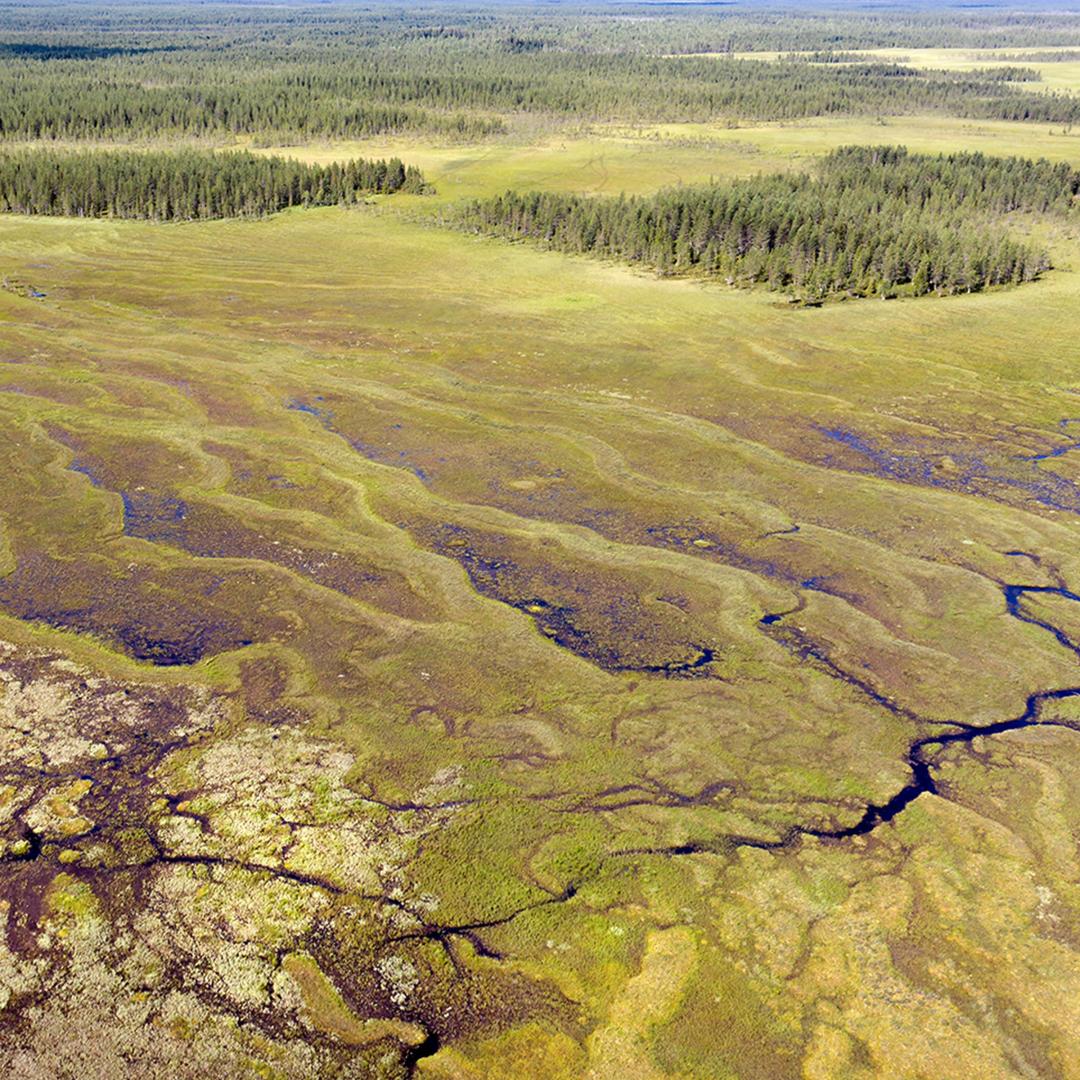
Peatland restoration is the process of returning peat-forming vegetation and natural hydrologic conditions to degraded peatlands. Restoration of peatlands stops GHG emissions from peat degradation and removes carbon through sequestration in biomass and peat.
This solution focuses on non-coastal peatlands that have been drained, cleared of vegetation, harvested for peat, or otherwise degraded. Coastal peatlands are addressed in the Restore Mangrove Ecosystems and Restore Salt Marsh Ecosystems solutions.
Solution Basics
ha under restoration
Climate Impact
CO₂ , N₂O
Solution Basics
ha under restoration
Climate Impact
CO₂ , N₂O
Solution Basics
ha under restoration
Climate Impact
CO₂ , N₂O
Solution Basics
ha under restoration
Climate Impact
CO₂ , N₂O
Additional Benefits
Overview
Figure 1. These photos show the diversity of peatlands that occur in different places, including a fen peatland and meadow complex in California (top left), a peat swamp in Indonesia (top right), a peat fen and forest in Canada (bottom left), and a peat bog in New Hampshire (bottom right).
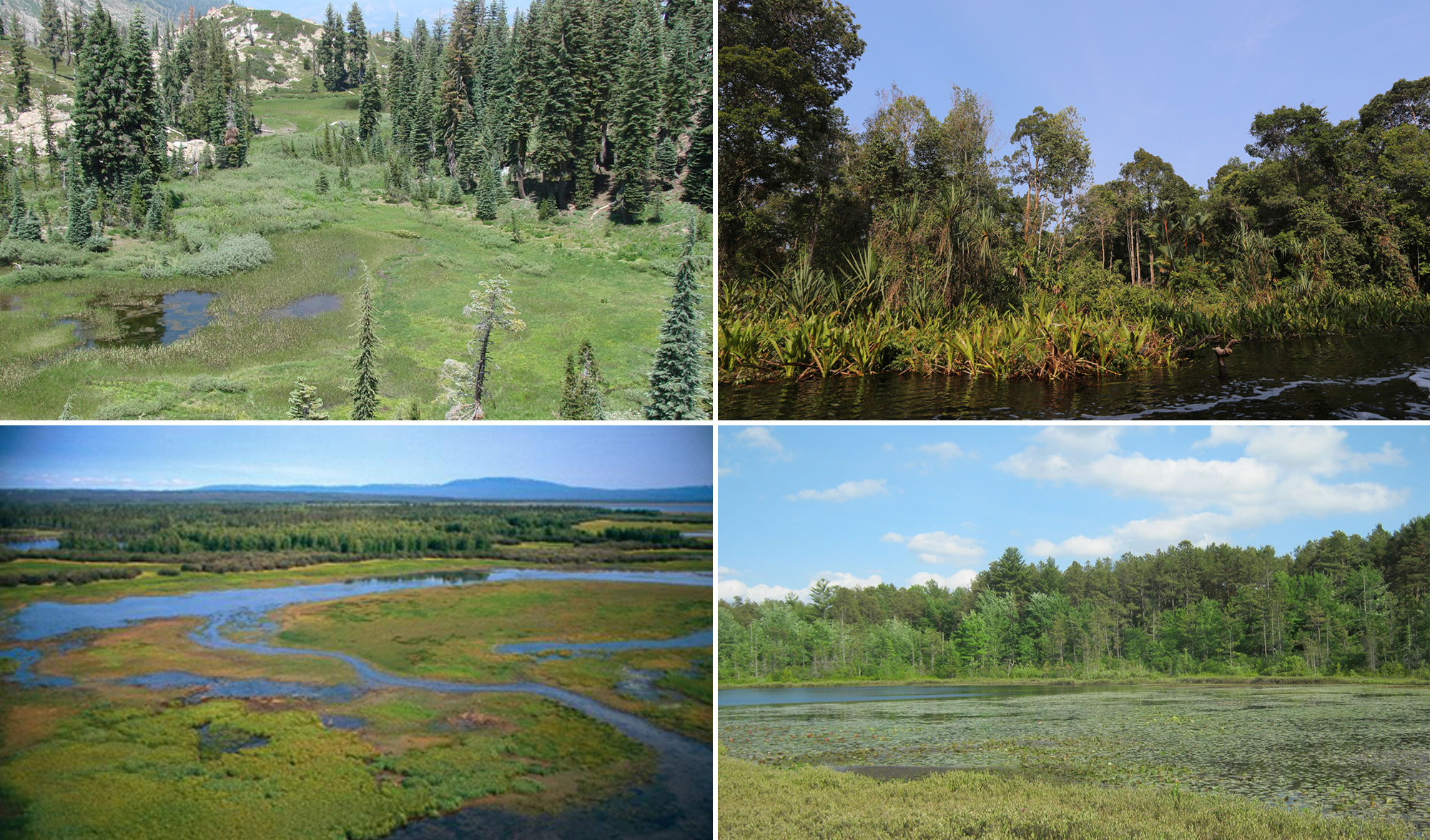
Photo credits: Catie and Jim Bishop | U.S. Department of Agriculture; Rhett A. Butler; Garth Lenz; Linnea Hanson | U.S. Department of Agriculture
Draining and/or clearing peatlands increases CO₂ emissions, nitrous oxide emissions, and losses of dissolved carbon through waterways while also reducing carbon sequestration and methane emissions. CO₂ from peat decomposition is the largest source of GHG emissions from degraded peatlands (Intergovernmental Panel on Climate Change [IPCC] Task Force on National Greenhouse Gas Inventories, 2014; UNEP, 2022). When accumulated organic matter in the peat layer is exposed to air, it begins decomposing more rapidly, emitting CO₂ (Figure 2). Removal of overlying vegetation produces additional GHG emissions while also slowing or stopping carbon uptake and continued peat formation. Whereas emissions from vegetation removal occur rapidly following disturbance, peat decomposition and associated emissions can continue for centuries depending on environmental conditions and peat thickness (Leifield & Menichetti, 2018). Peatland restoration halts these emissions and, eventually, can restore the ecosystem's ability to take up carbon (Doelman et al., 2023; Humpenöder et al., 2020; Mander et al., 2024; Mander et al., 2025; Strack et al., 2022).
Peatland disturbance and restoration also have complex impacts on nitrous oxide emissions, methane emissions, and carbon loss through waterways (Figure 2; IPCC Task Force on National Greenhouse Gas Inventories, 2014; UNEP, 2022). Intact peatlands are a methane source because methane-producing microbes thrive under waterlogged conditions, so restoring peatlands typically increases methane emissions (Evans et al., 2021; Günther et al., 2020; Huang et al., 2021; Mander et al., 2024). However, restoration typically reduces nitrous oxide emissions from oxidation of the peat layer.
Figure 2. Intact peatlands (left) are a net greenhouse gas sink, sequestering carbon in peat through photosynthesis but also emitting methane due to waterlogged soils. Drained peatlands (right) are a GHG source, producing emissions from peat decomposition and drainage canals. Modified from the International Union for the Conservation of Nature (IUCN) UK Peatland Programme (2024).
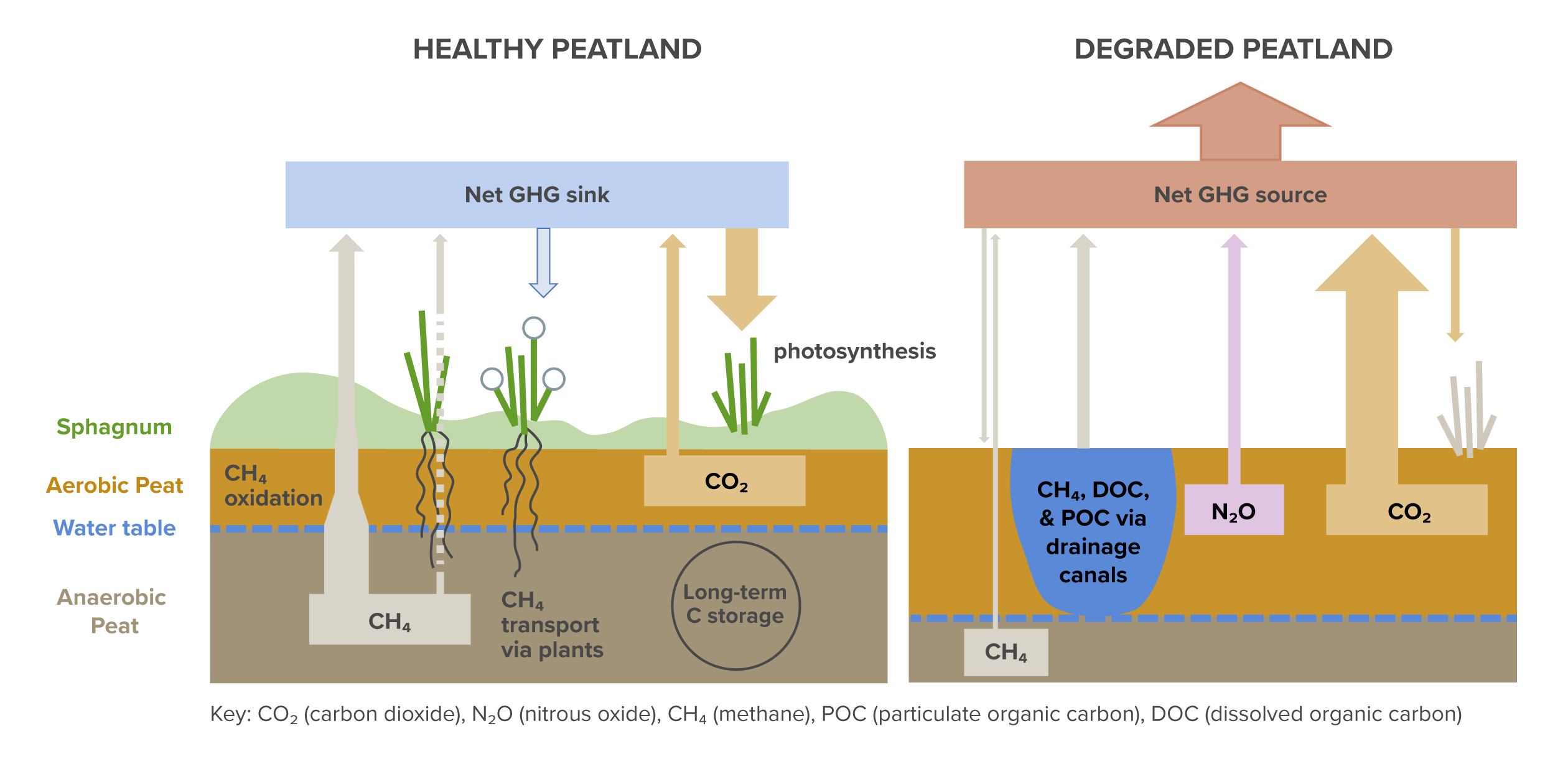
Source: IUCN UK Peatland Programme. (2024, July 10). New briefing addresses the peatlands and methane debate.
Peatlands can be restored to native vegetation or used for paludiculture, the practice of growing crops or trees in saturated conditions (Tan et al., 2021; Temmink et al., 2026). We assume that effective restoration involves both rewetting and re-establishment of perennial vegetation, and in this assessment we did not differentiate between carbon dynamics on peatlands restored to native vegetation and those on peatlands used for paludiculture. Because peatland emissions dynamics, total peatland areas, and the degraded peatland area all vary geographically, we evaluated tropical, subtropical, temperate, and boreal regions separately in this analysis. Most peatlands occur in boreal regions (~310 Mha, or 64% of the total), with another 25% (~121 Mha) in tropical regions (UNEP, 2022; Protect Peatlands). These regions also contain the largest areas of degraded peatlands that can be restored (26 Mha and 19 Mha, respectively; UNEP, 2022).
Halting the ongoing drainage and degradation of peatlands through effective protection, which is covered in Protect Peatlands, is an essential complement to restoration (Austin et al., 2025).
Impact Calculator
Effectiveness
Adoption
Climate Impact
Effectiveness
Adoption
Climate Impact
Effectiveness
Adoption
Climate Impact
Effectiveness
Adoption
Climate Impact
The Details
Current State
Effectiveness
Using the IPCC’s Tier 1 methodology (IPCC Task Force on National Greenhouse Gas Inventories, 2014), we estimated the net effectiveness of peatland restoration at 19.0–56.0 t CO₂‑eq /ha/yr (100-yr basis), depending on the climate zone (Table 1a–d).
The primary pathway by which peatland restoration reduces emissions is by slowing or stopping CO₂ emissions associated with loss of peat through oxidation. Because peat oxidation occurs more rapidly in warmer climates, the effectiveness of restoration is higher in tropical and subtropical regions than in temperate and boreal regions (IPCC Task Force on National Greenhouse Gas Inventories, 2014). We estimated that drained peatlands emit 15.1–49.7 t CO₂‑eq /ha/yr, while restored peatlands can range from carbon sinks (–1.6 t CO₂‑eq /ha/yr on average in the boreal) to small sources (0.5 t CO₂‑eq /ha/yr on average in temperate areas). However, site-level variability is high, with a recent review reporting values ranging from a sink of –42 t CO₂‑eq /ha/yr (in a restored Canadian sphagnum bog) to a source of 8 t CO₂‑eq /ha/yr (at a restored German sphagnum paludiculture site) (Mander et al., 2024; Oestmann et al., 2022; Strack et al., 2014).
Peatland restoration influences GHG emissions from several other pathways as well:
- Revegetation can increase carbon sequestration in biomass. Here, we included carbon uptake in vegetation only for degraded peatlands that were originally forested (Olson et al., 2001) and are currently used for agriculture (UNEP, 2022), using reforestation carbon uptake rates from Robinson et al. (2025) and Busch et al. (2024) (see Restore Forests). Carbon uptake from reforestation on peatlands contributes 3.2–8.3 t CO₂‑eq /ha/yr (100-yr basis) on average within each climate zone, with larger emissions benefits in warmer climates.
- Nitrous oxide emissions associated with peat oxidation are reduced (IPCC Task Force on National Greenhouse Gas Inventories, 2014).
- Off-site CO₂ emissions from losses of dissolved organic carbon through drainage canals and surface waterways are reduced (IPCC Task Force on National Greenhouse Gas Inventories, 2014).
- Methane emissions arising from drainage canals are eliminated when canals are filled (IPCC Task Force on National Greenhouse Gas Inventories, 2014). However, methane emissions from canals can persist if they are simply blocked or partially filled (Peacock et al., 2021). These emissions remain uncertain, and our effectiveness estimates rely on the optimistic assumption that canals are fully filled, eliminating canal methane emissions.
- Methane emissions from the peat itself typically increase as the peat returns to an anoxic state. Methane emissions from the surface of restored peatlands are estimated at 1.5–5.7 t CO₂‑eq /ha/yr (100-yr basis), compared to 0.1–0.2 t CO₂‑eq /ha/yr (100-yr basis) for drained peatlands (IPCC Task Force on National Greenhouse Gas Inventories, 2014). This increase in methane emissions is included in the effectiveness estimates.
- Restoring peatlands currently used for crop production can displace that production and expansion of agricultural land use elsewhere, producing emissions from land use change (Burney et al., 2010; Lobell & Villoria, 2023). We used a very simple approach to estimate emissions from this indirect land use change, assuming that the production lost from peatland restoration is replaced on non-peat ecosystems within the same climate zone at the average yield (see Methodology for additional details). These indirect land use change emissions, ranging from 1.7–4.9 t CO₂‑eq /ha/yr across ecosystems, slightly reduce the effectiveness of restoring peatlands.
Table 1. Effectiveness at reducing emissions and, in some cases, removing carbon.
Unit: t CO₂‑eq /ha/yr, 100-yr basis
| Estimate | 19.0 |
Unit: t CO₂‑eq /ha/yr, 100-yr basis
| Estimate | 29.7 |
Unit: t CO₂‑eq /ha/yr, 100-yr basis
| Estimate | 47.8 |
Unit: t CO₂‑eq /ha/yr, 100-yr basis
| Estimate | 56.0 |
Cost
The costs of peatland restoration are highly uncertain and variable. We estimated that the median cost of peatland restoration is approximately US$55/t CO₂‑eq (2023 US$), or US$1,884/ha restored (Table 2). These estimates are based on data from only three countries. In Scotland, peatland restoration costs are submitted as part of the Peatland Action Programme, which provides grants for peat restoration (Glenk et al., 2022). Based on data from 300 sites, they report a median cost of US$1,884/ha (equal to US$55/t CO₂‑eq , 100-year basis). In the United States, the U.S. Department of Agriculture developed models of restoration costs based on contracts with agricultural landowners for wetland restoration through the Wetlands Reserve Program, with costs ranging from US$170/ha to US$6,100/ha depending on the region. All other cost data used in our calculations are from Indonesia, with estimates ranging from US$237/ha to more than US$25,000/ha (Hansson & Dargusch 2018; Tan et al., 2022). Peatland restoration costs include the costs of restoring the natural hydrologic condition and of revegetation, and depend largely on the size of canals that must be dammed or filled (Hansson & Dargusch 2018). These estimates do not include forgone revenues from economic uses of drained peatlands, nor do they include potential new revenues from paludiculture, tourism, or ecosystem service payments.
Table 2. Cost per unit of climate impact.
Unit: 2023 US$/t CO₂‑eq , 100-yr basis
| Median | 55 |
Learning Curve
We define a learning curve as falling costs with increased adoption. There is no evidence that the costs of peatland rewetting and revegetation will fall with increasing adoption. Therefore, there is no learning curve for this solution.
Speed of Action
Speed of action refers to how quickly a climate solution physically affects the atmosphere after it is deployed. This is different from speed of deployment, which is the pace at which solutions are adopted.
At Project Drawdown, we define the speed of action for each climate solution as emergency brake, gradual, or delayed. Restore Peatlands is a GRADUAL climate solution, because the primary mode of action is a reduction in emissions that would otherwise occur on an annual basis over a long time. It has a steady, linear impact on the atmosphere.
Adoption
Current Adoption
Data on the current adoption of peatland restoration are very sparse, noncentralized, and largely not validated. Therefore, we do not provide a global estimate of the currently restored area. We found two countries for which there are national-scale estimates of restored area. The United Kingdom’s Peatland Programme reports that restoration activities were undertaken on 254,254 ha of peatland between the 1990s and 2024 (IUCN UK Peatland Programme, 2024). In Indonesia, the Ministry of Environment and Forestry reported 3.7 Mha of peatland restoration in a 2022 report based on estimates of the area with a water table depth of 40 cm or less as of December, 2021. However, only 6,000 of these ha were reported to have undergone some form of vegetation restoration, and water table depth is a limited proxy for peatland restoration status because it fluctuates substantially over time due to natural variability in water supplies. For instance, the area meeting the water table threshold had fallen to just 0.5 Mha by June 2022 (Jong, 2023; The Gecko Project, 2022). Based on published estimates, it seems likely that the peatland area that has been successfully restored is in the range of 0.5–5Mha.
Adoption Trend
Peatland restoration data are very limited and rarely temporally resolved. The available data are insufficient to calculate an adoption trend for this solution.
Adoption Ceiling
We estimated the adoption ceiling for peatland restoration to be 56.9 Mha (Table 3). This is the area of peatland that has been drained or converted to other land uses (UNEP, 2022) and represents ~12% of the total global peatland area. Approximately 37.8 Mha of drained peatlands are currently used for agriculture (croplands or grazing), 18.1 Mha are used for forestry, and 1.0 Mha are used for peat extraction (UNEP, 2022). Although restoring peatlands will involve displacing some of these activities to other lands. Though drained peatlands can be particularly high-yielding (Lloyd et al., 2023), these are relatively small areas in the context of global land use. For example, agricultural peatlands (including both croplands and grazing lands) represent less than 3% of total global croplands, which were estimated to cover ~1,500 Mha circa 2020 (Tubiello et al., 2023). Indirect land use change emissions arising from relocation of croplands are accounted for in our effectiveness estimates.
Drained peatlands are concentrated in boreal (26.3 Mha) and tropical regions (18.5 Mha), with smaller areas in temperate (9.9 Mha) and subtropical (2.1 Mha) regions (UNEP, 2022). The proportion of peatlands that have been drained is largest in temperate regions (28%), followed by the tropics (15%), subtropics (14%), and then the boreal (8%).
These values reflect best estimates of drained peatland area from the Global Peatland Assessment (UNEP, 2022). However, there is substantial uncertainty in the distribution of intact and drained peatlands, and efforts to map global peatlands are ongoing (Melton et al., 2022; Minasny et al., 2024).
Table 3. Adoption ceiling.
Unit: ha available for restoration
| Estimate | 26,300,000 |
Unit: ha available for restoration
| Estimate | 9,930,000 |
Unit: ha available for restoration
| Estimate | 2,140,000 |
Unit: ha available for restoration
| Estimate | 18,500,000 |
Unit: ha available for restoration
| Estimate | 56,900,000 |
Achievable Adoption
We assumed an achievable range of 25–50% of the adoption ceiling, equal to 14.2 – 28.4 Mha of peatland restoration (Table 4a–e).
The momentum behind peatland restoration has been growing rapidly over the past several decades, including major international efforts such as the U.N. Decade on Ecosystem Restoration (2021–2030), the Global Peatlands Initiative, and the Peatland Breakthrough (Global Peatlands Initiative, 2025; UNEP, 2022; Wetlands International, 2025). Our estimate of the high achievable level of peatland restoration roughly aligns with the 30 Mha target of the Peatland Breakthrough, a global initiative to guide peatland restoration through unified targets and restoration principles that was launched at COP30 (Global Peatlands Initiative, 2025). Given that the current area successfully restored is likely in the range of 0.5–5 Mha, both the low and high achievable estimates will require an ambitious expansion of peatland restoration.
Peatland restoration will very likely need to be directly incentivized through payments for ecosystem services such as emissions reductions, water quality, flood management, and/or biodiversity to achieve this level of adoption (Bonn et al., 2014). Paludiculture, or using restored peatlands for production of commodities that tolerate saturated conditions, may also boost restoration (Mander et al., 2024; Tan et al., 2021; Ziegler et al., 2021). In temperate and lower boreal regions, paludiculture is typically characterized by herbaceous vegetation, including cattails, reeds, canary grass, sedges, and alder, used for grazing or biomass and by cultivation of sphagnum for horticultural use (Temmink et al., 2026). Additional research is needed to develop suitable paludiculture systems for restored tropical peatlands (Uda et al., 2020), which are typically characterized by tree cover rather than herbaceous plants. Sustainable gathering and hunting of native peatland species is a form of paludiculture that has been practiced by indigenous communities for centuries, and tree crops such as sago and jelutong show some potential for economically viable paludiculture (Tan et al., 2021; Ziegler et al, 2021).
Table 4. Range of achievable adoption levels.
Unit: ha
| Current adoption | NA |
| Achievable – low | 6,560,000 |
| Achievable – high | 13,100,000 |
| Adoption ceiling | 26,300,000 |
Unit: ha
| Current adoption | NA |
| Achievable – low | 2,480,000 |
| Achievable – high | 4,960,000 |
| Adoption ceiling | 9,930,000 |
Unit: ha
| Current adoption | NA |
| Achievable – low | 535,000 |
| Achievable – high | 1,070,000 |
| Adoption ceiling | 2,140,000 |
Unit: ha
| Current adoption | NA |
| Achievable – low | 4,630,000 |
| Achievable – high | 9,260,000 |
| Adoption ceiling | 18,500,000 |
Unit: ha
| Current adoption | NA |
| Achievable – low | 14,200,000 |
| Achievable – high | 28,400,000 |
| Adoption ceiling | 56,900,000 |
Impacts
Climate Impact
We estimated that peatland restoration could reduce emissions by 0.48 Gt CO₂‑eq/yr at the low-achievable adoption scenario, 0.97 Gt CO₂‑eq/yr at the high-achievable adoption scenario, and 1.93 Gt CO₂‑eq/yr at the adoption ceiling (Table 5a–e). Our estimate of the climate impact at the adoption ceiling is approximately in line with literature estimates of annual emissions from drained peatlands (e.g., 1.98 Gt CO₂‑eq/yr from Leifield and Menichetti [2018]).
Although the total area available for restoration is largest in the boreal biome, more than half of the adoption ceiling climate impact occurs in the tropics due to larger per-hectare emissions reductions from peatland restoration in warmer climates. Restoration in boreal regions is estimated to provide 26% of the climate impact at the adoption ceiling, with an additional 15% and 5% of the climate impact available through temperate and subtropical peatland restoration, respectively.
Table 5. Climate impact at different levels of adoption.
Unit: Gt CO₂‑eq/yr, 100-year basis
| Current adoption | NA |
| Achievable – low | 0.125 |
| Achievable – high | 0.249 |
| Adoption ceiling | 0.498 |
Unit: Gt CO₂‑eq/yr, 100-year basis
| Current adoption | NA |
| Achievable – low | 0.074 |
| Achievable – high | 0.148 |
| Adoption ceiling | 0.295 |
Unit: Gt CO₂‑eq/yr, 100-year basis
| Current adoption | NA |
| Achievable – low | 0.026 |
| Achievable – high | 0.051 |
| Adoption ceiling | 0.102 |
Unit: Gt CO₂‑eq/yr, 100-year basis
| Current adoption | NA |
| Achievable – low | 0.259 |
| Achievable – high | 0.518 |
| Adoption ceiling | 1.037 |
Unit: Gt CO₂‑eq/yr, 100-year basis
| Current adoption | NA |
| Achievable – low | 0.483 |
| Achievable – high | 0.966 |
| Adoption ceiling | 1.932 |
Additional Benefits
Extreme Weather Events
Peatland restoration can help communities adapt to extreme weather, though restored peatlands may be more sensitive than undisturbed peatlands to extreme weather (Loisel & Gallego-Sala, 2022). Because peatlands regulate water flows, they can reduce the risk of droughts and floods (IUCN, 2021; Ritson et al., 2016). Evidence suggests that peatlands can cool the immediate environment, lowering daytime temperatures and reducing daily temperature extremes (Dietrich & Behrendt, 2022; Helbig et al., 2020; Worrall et al., 2022).
Income and Work
Peatlands support the livelihoods of nearby communities, especially those in low- and middle-income countries. In the peatlands of the Amazon and Congo basins, fishing livelihoods depend on aquatic wildlife (Thornton et al., 2020). Peatlands in the Peruvian Amazon provide important goods for trade, such as palm fruit and timber and are used for hunting (Schulz et al., 2019). Peatlands can also support the livelihoods of women, allowing them to access more economic opportunities and contributing to gender equality. For example, in Indonesia women use raw materials from peatlands to create mats sold for use in significant events such as births, weddings, and burials (Goib et al., 2018). Selling commodities made from peatland materials increases household income and can increase the position of women to make decisions in a household (Goib et al., 2018).
Restoring peatlands may come with some trade-offs to livelihoods if it prevents other productive uses. Paludiculture may help local communities to maintain their livelihoods on restored peatlands (Temmink et al., 2026; Yuwati & Pratiwi, 2022). Case studies in Southeast Asia have found that community-led restoration projects that consider local context and livelihoods are more successful than conventional restoration projects (Terzano et al., 2022).
Peatlands mitigate exposure to air pollution and can save money from reduced health-care expenditures (Kiely et al., 2021).
Health
When peatlands are drained, they are susceptible to fire, and rewetting reduces fire risk (Salmayenti et al., 2026). Peatland fires can contribute to air pollution because of the way these fires smolder (Uda et al., 2019). Smoke and pollutants, particularly PM2.5, from peatland fires can harm respiratory health and lead to premature mortality (Marlier et al., 2019). A study in Indonesia estimated peatland fires contribute to the premature mortality of about 33,100 adults and about 2,900 infants annually (Hein et al., 2022). Researchers have linked exposure to PM2.5 from peatland fires to increased hospitalizations, asthma, and lost workdays (Hein et al., 2022).
Nature Protection
Peatlands support diverse flora and wildlife (UNEP, 2022; Minayeva et al., 2017; Posa et al., 2011), including many rare and threatened species (Posa et al., 2011). A study of Indonesian peat swamps found that the IUCN Red List classified approximately 45% of mammals and 33% of birds living in these ecosystems as threatened, vulnerable, or endangered (Posa et al., 2011). Peatlands also support a variety of insect species (Spitzer & Danks, 2006). Because of their sensitivity to environmental changes, some peatland insects can act as indicators of peatland health and play a role in conservation (Spitzer & Danks, 2006).
While restored peatlands are more biodiverse than degraded ecosystems, restored peatlands are often less biodiverse than intact peatlands (Renou-Wilson et al., 2019). For example, a large study of peatlands in Europe found that rewetting increased biodiversity of peatlands, but plant composition was different from natural, intact peatlands (Kreyling et al., 2021). Biodiversity benefits have also been identified in European paludiculture systems, though more research on the biodiversity impacts of paludiculture is needed (Martens et al., 2023).
Water Resources
Peatlands can filter water pollutants and improve water quality and are important sources of potable water (Minayeva et al., 2017). Xu et al. (2018a) estimated that peatlands store about 10% of freshwater globally, not including glacial water. Peatlands provide potable water for about 71.4 million people, primarily in the United Kingdom and Ireland (Xu et al., 2018a).
Water Quality
For a description of water quality benefits, please refer to the “water resources” subsection above.
Other
Caveats
GHG emissions dynamics of rewetted peatlands remain uncertain because they can be highly variable depending on site level factors, such as land use history, type of restoration interventions, and environmental conditions (Mander et al., 2024).
Effective peatland restoration faces many barriers, including cost of restoration, disruption to economic use, willingness of local community and landowners to support restoration, and technical challenges, particularly on severely subsided sites (Andersen et al., 2017; Harrison et al., 2020; Lestari et al., 2024; Zeng et al., 2020).
Peatland restoration, like other nature-based climate solutions, faces concerns related to the permanence of emissions reductions and carbon sequestration (Loisel & Gallego-Sala, 2022; Turetsky et al., 2015). Restored peatlands are vulnerable to drainage or clearing, which can be mitigated by coupling restoration with long-term protections. Restored peatlands are also vulnerable to natural disturbances, such as fires and droughts, though they tend to be more resilient than drained peatlands (Granath et al., 2016).
Risks
Where peatland restoration involves removing agricultural or forestry land from economic use, it risks compromising the livelihoods of local communities (Lestari et al., 2024; Merten et al., 2021; Ward et al., 2020). Close collaboration with local communities can facilitate procedural equity and enable positive, durable outcomes for both the ecosystem and the community (e.g., Toumbourou et al., 2024). Additionally, restoring peatlands can trigger displacement of production activities onto other lands, resulting in land clearing elsewhere (i.e., leakage). We account for the emissions impacts of leakage in our effectiveness calculations. While restoration can reduce emissions associated with agriculture locally, these emissions can occur elsewhere if the production area shifts. Paludiculture can reduce the risk of negative economic impacts and leakage (Mander et al., 2024; Tan et al., 2021; Ziegler et al., 2021).
Though healthy peatlands provide water quality benefits, peatland rewetting can mobilize nutrients and other contaminants into surface waters (Breznikar et al., 2024; Heuts et al., 2026; Silverthorn et al., 2026; van der Laan). Studies have found increases in phosphorus, nitrogen, and heavy metal loads from peatland rewetting, though effects are mixed. Water quality monitoring and appropriate mitigation near restoration sites can help manage water quality risks (e.g. Hoffman et al., 2026).
Trade-offs
Peatland restoration can divert resources from other climate solutions, including protecting intact peatlands. Preventing peatland drainage is typically more cost effective and offers larger emissions benefits than does peatland restoration (see Protect Peatlands). Restoration should therefore complement, rather than compete with, efforts to reduce further disturbance of intact peatlands.
Interactions with Other Solutions
Reinforcing
Peatland restoration can improve the health and function of adjacent ecosystems that are being protected or restored.
Competing
These solutions are all suitable to implement on degraded peatland, and thus are in competition with restoration.
Evidence Base
Consensus of effectiveness in reducing emissions from disturbed peatlands: High
Consensus of effectiveness in providing substantial net GHG removal in the near future after accounting for increases in methane emissions: Low
Degraded peatlands currently emit an estimated 1.3–1.9 Gt CO₂ ‑eq/yr (excluding fires), equal to ~2–4% of total global GHG emissions (Leifield and Menichetti, 2018; UNEP, 2022). Leifeld et al. (2019) projected that without protection or restoration, drained peatlands could produce enough emissions to consume 12–41% of the remaining emissions budget for keeping warming below 1.5–2.0 °C. Peatland drainage had produced a cumulative 80 Gt CO₂ ‑eq by 2015, equal to nearly 16 months’ worth of total global emissions (60.3 Gt CO₂‑eq/yr as of 2024).
Peatland rewetting and restoration has been widely shown to stop ongoing CO₂ emissions from oxidation of drained peat and reduce lateral transport of carbon through waterways (Günther et al., 2020; Mander et al., 2024; Wilson et al., 2016). The net emissions reduction in rewetted relative to drained conditions is clear and consistent, despite large variability in the magnitude of carbon uptake and methane and nitrous oxide emissions following rewetting. While many restored peatlands regain their capacity to act as net carbon sinks, some sites remain emissions sources for decades following rewetting (Strack & Zuback 2013; Vanselow-Algan et al., 2015; Wilson et al., 2016).
The results presented in this document summarize findings from 19 reviews, meta-analyses, and global databases reflecting current evidence for peatland restoration. The majority of the non-global literature is focused on Indonesia, the United Kingdom, and Northern Europe. We recognize this limited geographic scope creates bias, and hope this work inspires research and data sharing on this topic in underrepresented regions.
Take Action
Looking to get involved? Below are some key actions for this solution that can get you started, arranged according to different roles you may play in your professional or personal life.
These actions are meant to be starting points for involvement and are not intended to be prescriptive or necessarily suggest they are the most important or impactful actions to take. We encourage you to explore and get creative!
Lawmakers and Policymakers
- Conduct comprehensive surveys and scientific assessments of national peatlands; work with scientists to identify which peatlands are most at risk of irreversible damage, which are likely to remain intact, and which are suitable candidates for restoration using combined techniques from fields such as paleoecology, ecology, and climate science.
- Set clear, evidence-based guidelines, definitions, and goals for restoration; incorporate peatland restoration goals into national climate plans; set comprehensive definitions of restoration that address rewetting, revegetation, revitalization, and reducing fires.
- Coordinate peatland restoration horizontally (e.g., across agencies) and vertically (e.g., across subnational, national, and international levels), ensuring an inclusive process for local and Indigenous communities.
- Ensure public procurement uses peat-free products and supply chains.
- Ban or regulate intact peatland draining; require or incentivize filling or blocking existing canals while compensating farmers for income losses; use sustainable, environmentally friendly, and durable materials to block canals.
- Grant protected status to peatlands in the process of being restored to help mitigate future land conversions; seek to connect restoration projects with existing protected areas; ensure robust enforcement mechanisms; streamline the process for granting legal protections for peatlands.
- Strengthen land tenure laws; grant Indigenous communities full property rights and autonomy; support Indigenous communities in monitoring and managing peatland restoration projects; encourage or require the demarcation of property, communal boundaries, and protected areas to help solidify and clarify land tenure rights.
- Ensure projects operating in or with Indigenous communities only do so under free, prior, and informed consent (FPIC); codify FPIC into legal systems.
- Create financial incentives for peatland restoration and paludiculture, such as direct payments, payment for ecosystem services (PES), tax breaks, and/or cash prizes for meeting restoration metrics; use an array of indicators for payments and incentives, such as emissions reductions, water levels, water quality, flood management, biodiversity, and impacts on livelihoods; ensure incentives allow for long timelines and outweigh the opportunity costs of land conversion; earmark financial incentives and assistance for low- and middle-income communities; offer similar incentives for improving land management in buffer zones (e.g., agroforestry or silvopasture).
- Co-design peatland restoration projects with the local community; ensure community engagement starts early and is transparent, inclusive, and ongoing; solicit feedback – including from opposition groups – on regulations, legal definitions, financing, monitoring, and enforcement; incorporate gender-responsive frameworks; build consensus on contentious but necessary elements of restoration such as canal filling and blocking; ensure finalized projects address relevant sociological and ecological considerations.
- Co-manage peatland restoration with local communities; offer proven pathways to improve livelihoods; provide opportunities for technical training and ongoing support for farmers and landowners using paludiculture or restoring peatlands; tailor restoration to each site, taking into account sociological, hydrological, and ecological dynamics.
- Create regulations that eliminate harmful land use (e.g., growing oil palm and mining) on peatlands and the use of peat for electricity generation and horticulture; ensure suitable climate-friendly alternatives for crop production and peat use are in place before implementing bans.
- Create strong, enforceable regulations to ensure carbon markets cannot exploit Indigenous or peatland communities; require strong transparency mechanisms for carbon market agreements; work with industry to create high-integrity carbon markets; facilitate co-designing carbon markets agreements with Indigenous- and/or community-led processes.
- Establish or help local communities develop processes for legal grievances, dispute resolution, and restitution.
- Conduct proactive land use planning with the local community to help protect restoration into the future; avoid placing structures such as wind turbines on peatlands.
- Work with insurance institutions to provide products for farmers transitioning their land for peatland restoration or for those who are improving land management in buffer zones (e.g., agroforestry or silvopasture).
- Ensure regulations allow and encourage a variety of legal models for peatland restoration, such as cooperatives.
- Create educational programs that work with schools, universities, NGOs, and the general public to inform communities how to participate in peatland restoration; expand extension services and offer one-stop shops to improve technical capacity for peatland restoration and paludiculture; maintain demonstration projects and ongoing knowledge-sharing platforms with local and Indigenous communities; create a national database for restoration projects to monitor, evaluate, document, and share best practices.
- Join, support, or create certification schemes that advance peatland restoration and fire management; offer financial support for these programs and for smallholder farmers and low- and middle-income communities to participate.
- Join, create, or participate in public-private partnerships dedicated to peatland restoration, mobilizing financing, knowledge transfers, general education, and other relevant areas.
Further information:
- Info brief: The peatland breakthrough science-based framework for global peatland targets & guiding principles. Global Peatlands Initiative (2025)
- Government relations and public policy job function action guide. Project Drawdown (2022)
- Legal job function action guide. Project Drawdown (2022)
- Global peatlands assessment: The state of the world’s peatlands: Evidence for action toward the conservation, restoration, and sustainable management of peatlands. UNEP (2022)
Practitioners
- Conduct and/or work with policymakers to create comprehensive surveys and scientific assessments of national peatlands; work with scientists to identify which peatlands are most at risk of irreversible damage, which are likely to remain intact, and which are suitable candidates for restoration using combined techniques from fields such as paleoecology, ecology, and climate science.
- Help policymakers set clear, evidence-based guidelines, definitions, and goals for restoration; urge policymakers to incorporate peatland restoration goals into national climate plans; help set comprehensive definitions of restoration that address rewetting, revegetation, revitalization, and reducing fires.
- Coordinate peatland restoration with local communities, neighboring jurisdictions, nonprofits, and other stakeholders; ensure coordination is cross-sectoral and includes agricultural, food security, human rights, and educational considerations.
- Advocate for protected status for peatlands in the process of being restored to help mitigate future land conversions; seek to connect restoration projects with existing protected areas; advocate for curtailments or bans on drainage and concession licenses for damaging activities such as growing oil palm, mining, and logging in and near peatlands.
- Take advantage of financial incentives for peatland restoration and paludiculture, such as direct payments, PES, tax breaks, and/or cash prizes for meeting restoration metrics.
- Co-design and co-manage peatland restoration projects with the local community; ensure community engagement starts early and is transparent, inclusive, and ongoing; solicit feedback – including from opposition groups – on regulations, legal definitions, financing, monitoring, and enforcement; incorporate gender-responsive frameworks; build consensus on contentious but necessary elements of restoration, such as canal filling or blocking; ensure finalized projects address relevant sociological, agriculture, and ecological considerations.
- Restore peatlands using well-rounded, thoroughly integrated approaches that address how to rewet, revegetate, revitalize, and reduce fires in areas under restoration.
- Manage the water table, fill or block canals, and monitor the hydrology of areas being restored; use sustainable, environmentally friendly, and durable materials to block canals.
- Prioritize protecting intact areas and biodiversity, avoiding further degradation, planting native species, and restoring forests; help enforce bans on draining peatlands; work with local communities to identify key drivers of degradation and viable solutions.
- Develop or support opportunities for ecotourism for restored peatlands.
- Help develop markets for sustainable products through paludiculture; identify sustainable substitutes for current agricultural products; work with policymakers and industry leaders to solidify supply chains.
- Monitor and evaluate restoration progress using multiple metrics, including emissions reductions, water levels and quality, flood management, biodiversity, and impacts on livelihoods; ensure baseline measurements and clear goals are part of restoration; use technology such as satellite imagery to monitor water table depth, clearance, and other related variables.
- Use agroforestry, silvopasture, and other sustainable practices in peatland buffer zones to improve protection and access to income-generating opportunities.
- Demarcate your property, communal boundaries, and protected areas to help solidify and clarify land tenure rights; encourage other stakeholders to do the same.
- Ensure projects operating in or with Indigenous communities only do so under FPIC; help codify FPIC into legal systems.
- Help create fire management regulations; help develop fire-resistance in restored areas through increased forest cover and improved environmental conditions; design methods for land clearance that avoid burning; help resolve land tenure and related disputes; educate the public on how to reduce fire use and risks of wildfires; help detect and extinguish fires.
- Conduct proactive land use planning with the local community to help protect restoration into the future; avoid placing structures such as wind turbines on peatlands.
- Work with insurance institutions to provide products for farmers transitioning their land for peatland restoration or for those who are improving land management in buffer zones (e.g., agroforestry or silvopasture).
- Create educational programs that work with schools, universities, NGOs, and the general public to inform communities how to participate in peatland restoration; collaborate with extension services and offer one-stop shops to improve technical capacity for peatland restoration and paludiculture; maintain demonstration projects and ongoing knowledge-sharing platforms with local and Indigenous communities; help create a national database for restoration projects to monitor, evaluate, document, and share best practices.
- Join, support, or create certification schemes that advance peatland restoration and fire management; offer financial support for these programs and for smallholder farmers and low- and middle-income communities to participate.
- Join, create, or participate in public-private partnerships dedicated to peatland restoration, mobilizing financing, knowledge transfers, general education, and other relevant areas.
Further information:
- Info brief: The peatland breakthrough science-based framework for global peatland targets & guiding principles. Global Peatlands Initiative (2025)
- Global peatlands assessment: The state of the world’s peatlands: Evidence for action toward the conservation, restoration, and sustainable management of peatlands. UNEP (2022)
Business Leaders
- Create peat-free supply chains, using data, other information, and the latest technology to inform product sourcing; use sustainable materials from paludiculture and peatland restoration in product lines and/or packaging; develop markets and supply chains for native species products; innovate other sustainable uses for resources from paludiculture.
- Develop or support ecotourism opportunities for restored peatlands.
- Integrate peat-free business policies and practices into net-zero strategies.
- Develop financial instruments to invest in peatland restoration focusing on supporting Indigenous communities and smallholder farmers.
- Conduct proactive land-use planning to avoid infrastructure or development projects that may interfere with peatland restoration or incentivize drainage.
- Invest in and support Indigenous and local communities’ capacity for peatland restoration, legal protection, and public relations; amplify the voices of local communities and civil society to promote robust media coverage.
- Only purchase carbon credits from high-integrity, verifiable carbon markets and do not use them as replacements for decarbonizing operations.
- Co-design carbon markets with Indigenous- and/or community-led processes; work with practitioners to create high-integrity carbon markets; require strong transparency mechanisms for carbon market agreements; help create strong, enforceable regulations to ensure carbon markets cannot exploit Indigenous communities or smallholder farmers.
- Support programs that educate the public on relevant regulations and how to use forest resources sustainably.
- Leverage political influence to advocate for stronger peatland restoration and protection policies at national and international levels, especially policies that reduce incentives to drain intact peatlands.
- Offer company grants to suppliers to improve resource management and support peatland restoration within your supply chain.
- Offer incubator services for smallholder farmers restoring peatlands and practicing paludiculture; offer pro bono business advice or general support for community restoration projects.
- Enter into outgrower schemes to support smallholder farmers using paludiculture; make long-term commitments to help stabilize projects.
- Donate to local peatland restoration initiatives; use an internal carbon fee or set aside a percentage of revenue to fund relevant projects.
- Offer employee professional development funds to be used for certification in peatland restoration or related fields such as circular economies.
- Join, support, or create certification schemes that advance peatland restoration and fire management; offer financial support for these programs and for smallholder farmers and low- and middle-income communities to participate.
- Join, create, or participate in public-private partnerships dedicated to peatland restoration, mobilizing financing, knowledge transfers, general education, and other relevant areas.
Further information:
- Info brief: The peatland breakthrough science-based framework for global peatland targets & guiding principles. Global Peatlands Initiative (2025)
- Climate solutions at work. Project Drawdown (2021)
- Drawdown-aligned business framework. Project Drawdown (2021)
- Global peatlands assessment: The state of the world’s peatlands: Evidence for action toward the conservation, restoration, and sustainable management of peatlands. UNEP (2022)
- Investing in peatlands. Wetlands International (2024)
Nonprofit Leaders
- Use peat-free products in operations; use, promote, and develop markets for sustainable products from peatlands under restoration; identify sustainable substitutes for agricultural products such as palm oil commonly produced on peatlands; work with policymakers and industry leaders to solidify supply chains.
- Administer or co-manage peatland restoration projects; help establish or support organizations and community management associations to implement and/or monitor restoration projects; if co-managing, consider using alternatives to corporate business structures, such as cooperatives, to facilitate management and mitigate risk.
- Provide or facilitate environmental legal assistance for stakeholders involved in peatland restoration activities; advocate for protected status for peatlands under restoration; urge regulators to strengthen land tenure designations and rights; establish or co-design conflict resolution mechanisms.
- Conduct and/or work with policymakers to create comprehensive surveys and scientific assessments of peatlands; work with scientists to identify which peatlands are most at risk of irreversible damage, which are likely to remain intact, and which are suitable candidates for restoration using combined techniques from fields such as paleoecology, ecology, and climate science.
- Help policymakers set clear, evidence-based guidelines, definitions, and goals for restoration; urge policymakers to incorporate peatland restoration goals into national climate plans; help set comprehensive definitions of restoration that address rewetting, revegetation, revitalization, and reducing fires.
- Coordinate peatland restoration with local communities, neighboring jurisdictions, nonprofits, and other stakeholders; ensure coordination is cross-sectoral and includes agricultural, food security, human rights, and educational considerations.
- Advocate for protected status for peatlands in the process of being restored to help mitigate future land conversions; seek to connect restoration projects with existing protected areas.
- Take advantage of financial incentives for peatland restoration and paludiculture, such as direct payments, PES, tax breaks, and/or cash prizes for meeting restoration metrics.
- Co-design and co-manage peatland restoration projects with the local community; ensure community engagement starts early and is transparent, inclusive, and ongoing; solicit feedback – including from opposition groups – on regulations, legal definitions, financing, monitoring, and enforcement; incorporate gender-responsive frameworks; build consensus on contentious but necessary elements of restoration such as canal filling or blocking; ensure finalized projects address relevant sociological, agriculture, and ecological considerations.
- Urge regulators to strengthen land tenure laws; advocate for and amplify the voices of Indigenous communities seeking full property rights and autonomy; encourage or assist with the demarcation of property, communal boundaries, and protected areas to help solidify and clarify land tenure rights.
- Help ensure projects operating in or with Indigenous communities only do so under FPIC; help codify FPIC into legal systems.
- Advocate for public financial incentives for peatland restoration and paludiculture, such as direct payments, PES, tax breaks, and/or cash prizes for meeting restoration metrics; recommend using an array of indicators for payments and incentives such as emissions reductions, water levels and quality, flood management, biodiversity, and impacts on livelihoods; help ensure incentives allow for long timelines and outweigh the opportunity costs of land conversion; urge policymakers to earmark financial incentives and assistance for low- and middle-income communities; recommend similar incentives for improving land management in buffer zones (e.g., agroforestry or silvopasture).
- Co-design peatland restoration projects with the local community; ensure community engagement starts early and is transparent, inclusive, and ongoing; solicit feedback – including from opposition groups – on regulations, legal definitions, financing, monitoring, and enforcement; incorporate gender-responsive frameworks; build consensus on contentious but necessary elements of restoration such as canal filling or blocking; ensure finalized projects address relevant sociological, agriculture, and ecological considerations.
- Call on regulators to reduce and eventually eliminate harmful land use (e.g., planting oil palm and mining) on peatlands and the use of peat for electricity generation and horticulture; help project administrators identify suitable climate-friendly alternatives for crop production and peat before regulations take effect.
- Co-design carbon markets with Indigenous- and/or community-led processes; work with practitioners to create high-integrity carbon markets; require strong transparency mechanisms for carbon market agreements; help create strong, enforceable regulations to ensure carbon markets cannot exploit Indigenous or peatland communities.
- Establish or help local communities develop processes for legal grievances, dispute resolution, and restitution.
- Conduct proactive land use planning with the local community to help protect restoration into the future; help the community avoid placing structures such as wind turbines on peatlands.
- Work with policymakers and insurance institutions to provide products for farmers transitioning their land for peatland restoration or for those who are improving land management in buffer zones (e.g., agroforestry or silvopasture).
- Monitor and evaluate restoration projects using multiple metrics, including emissions reductions, water levels, water quality, flood management, biodiversity, and impacts on livelihoods; ensure baseline measurements and clear goals are part of restoration; use technology such as satellite imagery to monitor water table depth, clearance, and other related variables.
- Create educational programs that work with schools, universities, other NGOs, and the general public to inform communities how to participate in peatland restoration; collaborate with extension services and offer one-stop shops to improve technical capacity for peatland restoration and paludiculture; maintain demonstration projects and ongoing knowledge-sharing platforms with local and Indigenous communities; help create a national database for restoration projects to monitor, evaluate, document, and share best practices.
- Join, support, or create certification schemes that advance peatland restoration and fire management; offer financial support for these programs and for smallholder farmers and low- and middle-income communities to participate.
- Join, create, or participate in public-private partnerships dedicated to peatland restoration, mobilizing financing, knowledge transfers, general education, and other relevant areas.
Further information:
- Info brief: The peatland breakthrough science-based framework for global peatland targets & guiding principles. Global Peatlands Initiative (2025)
- Global peatlands assessment: The state of the world’s peatlands: Evidence for action toward the conservation, restoration, and sustainable management of peatlands. UNEP (2022)
Investors
- Create peat-free investment portfolios using data, information, and the latest technology to inform investments.
- Invest in peatland restoration and related initiatives such as monitoring, management, and enforcement mechanisms; use long-term time horizons and integrate the full spectrum of benefits generated by restoration (e.g., improved resilience; reduced risk of landslides, flooding, drought, and fires; improvements to local health; and healthier ecosystem services) into investment decisions.
- Invest in bioeconomy products derived from paludiculture and supply chains using or supporting sustainable paludiculture products; invest in ecotourism projects supporting peatland restoration.
- Invest in green bonds or high-integrity carbon credits for peatland restoration; provide financing for sustainable land use; offer concessional loans or favorable financial products to smallholder farmers and Indigenous communities.
- Co-design carbon markets with Indigenous- and/or community-led processes; work with practitioners to create high-integrity carbon markets; require strong transparency mechanisms for carbon market agreements; help create strong, enforceable regulations to ensure carbon markets cannot exploit Indigenous or peatland communities.
- Ensure investments operating in or with Indigenous communities only do so under FPIC.
- Support peatland restoration managers, other investors, and NGOs by sharing data, information, and frameworks that successfully avoid investments that drive peatland drainage and degradation.
- Require portfolio companies to eliminate peatland drainage and/or harmful practices from their supply chains.
- Join, support, or create certification schemes that advance peatland restoration and fire management; offer financial support for these programs and for smallholder farmers and low- and middle-income communities to participate.
- Join, create, or participate in public-private partnerships dedicated to peatland restoration, mobilizing financing, knowledge transfers, general education, and other relevant areas.
Further information:
- Info brief: The peatland breakthrough science-based framework for global peatland targets & guiding principles. Global Peatlands Initiative (2025)
- Global peatlands assessment: The state of the world’s peatlands: Evidence for action toward the conservation, restoration, and sustainable management of peatlands. UNEP (2022)
- Investing in peatlands. Wetlands International (2024)
Philanthropists and International Aid Agencies
- Use peat-free products in operations; use and/or promote sustainable products from peatlands under restoration; help develop markets for sustainable products through paludiculture; identify sustainable substitutes for current agricultural products; work with policymakers and industry leaders to solidify supply chains.
- Provide grants to peatland restoration and related initiatives such as monitoring, management, and enforcement mechanisms; use long-term time horizons and integrate the full spectrum of benefits generated by restoration (e.g., improved resilience; reduced risk of landslides, flooding, drought, and fires; improvements to local health; and healthier ecosystem services) into grantmaking decisions.
- Administer or co-manage peatland restoration projects; help establish or support organizations and community management associations to implement and/or monitor restoration projects; if co-managing, consider using alternatives to corporate business structures, such as cooperatives, to facilitate management and mitigate risk.
- Provide grants or favorable financing for companies using bioeconomy products derived from paludiculture and supply chains using or supporting sustainable paludiculture products; support ecotourism projects connected to peatland restoration.
- Offer or purchase green bonds or high-integrity carbon credits for peatland restoration; provide financing for sustainable land use; offer grants, concessional loans, or favorable financial products to smallholder farmers and Indigenous communities.
- Co-design carbon markets with Indigenous- and/or community-led processes; work with practitioners to create high-integrity carbon markets; require strong transparency mechanisms for carbon market agreements; help create strong, enforceable regulations to ensure carbon markets cannot exploit Indigenous or peatland communities.
- Ensure restoration in or with Indigenous communities is under FPIC.
- Support peatland restoration managers, other investors, and NGOs by sharing data, information, and frameworks that successfully avoid investments that drive peatland drainage and degradation.
- Provide or facilitate environmental legal assistance for stakeholders involved in peatland restoration; advocate for protected status for peatlands under restoration; urge regulators to strengthen land tenure designations and rights; establish or co-design conflict resolution mechanisms.
- Commission and/or work with policymakers to create comprehensive surveys and scientific assessments of national peatlands; work with scientists to identify which peatlands are most at risk of irreversible damage, which are likely to remain intact, and which are suitable candidates for restoration using combined techniques from fields such as paleoecology, ecology, and climate science.
- Help policymakers set clear, evidence-based guidelines, definitions, and goals for restoration; urge policymakers to incorporate peatland restoration goals into national climate plans; help set comprehensive definitions of restoration that address rewetting, revegetation, revitalization, and reducing fires.
- Coordinate peatland restoration with local communities, neighboring jurisdictions, nonprofits, and other stakeholders; ensure coordination is cross-sectoral and includes agricultural, food security, human rights, and educational considerations.
- Advocate for protected status for peatlands in the process of being restored to help mitigate future land conversions; seek to connect restoration projects with existing protected areas.
- Co-design and co-manage peatland restoration projects with the local community; ensure community engagement starts early and is transparent, inclusive, and ongoing; solicit feedback – including from opposition groups – on regulations, legal definitions, financing, monitoring, and enforcement; incorporate gender-responsive frameworks; build consensus on contentious but necessary elements of restoration such as canal filling or blocking; ensure finalized projects address relevant sociological, agriculture, and ecological considerations.
- Urge regulators to strengthen land tenure laws; advocate for and amplify the voices of Indigenous communities seeking full property rights and autonomy; encourage or assist with the demarcation of property, communal boundaries, and protected areas to help solidify and clarify land tenure rights.
- Advocate for public financial incentives for peatland restoration and paludiculture, such as direct payments, PES, tax breaks, and/or cash prizes for meeting restoration metrics; recommend using an array of indicators for payments and incentives such as emissions reductions, water levels, water quality, flood management, biodiversity, and impacts on livelihoods; help ensure incentives allow for long timelines and outweigh the opportunity costs of land conversion; urge policymakers to earmark financial incentives and assistance for low- and middle-income communities; recommend similar incentives for improving land management in buffer zones (e.g., agroforestry or silvopasture).
- Call on regulators to reduce and eventually eliminate harmful land use (e.g., growing oil palm and mining) on peatlands and the use of peat for electricity generation and horticulture; help project administrators identify suitable climate-friendly alternatives for crop production and peat before regulations take effect.
- Establish or help local communities develop processes for legal grievances, dispute resolution, and restitution.
- Conduct proactive land use planning with the local community to help protect restoration into the future; help the community avoid placing structures such as wind turbines on peatlands.
- Work with policymakers and insurance institutions to provide products for farmers transitioning their land for peatland restoration or for those who are improving land management in buffer zones (e.g., agroforestry or silvopasture).
- Monitor and evaluate restoration projects using multiple metrics, including emissions reductions, water levels, water quality, flood management, biodiversity, and impacts on livelihoods; ensure baseline measurements and clear goals are part of restoration; use technology such as satellite imagery to monitor water table depth, clearance, and other related variables.
- Create educational programs that work with schools, universities, other NGOs, and the general public to inform communities how to participate in peatland restoration; collaborate with extension services and offer one-stop shops to improve technical capacity for peatland restoration and paludiculture; maintain demonstration projects and ongoing knowledge-sharing platforms with local and Indigenous communities; help create a national database for restoration projects to monitor, evaluate, document, and share best practices.
- Join, support, or create certification schemes that advance peatland restoration and fire management; offer financial support for these programs and for smallholder farmers and low- and middle-income communities to participate.
- Join, create, or participate in public-private partnerships dedicated to peatland restoration, mobilizing financing, knowledge transfers, general education, and other relevant areas.
Further information:
- Info brief: The peatland breakthrough science-based framework for global peatland targets & guiding principles. Global Peatlands Initiative (2025)
- Global peatlands assessment: The state of the world’s peatlands: Evidence for action toward the conservation, restoration, and sustainable management of peatlands. UNEP (2022)
Thought Leaders
- Help lead peatland restoration projects; establish or support organizations and community management associations to implement and/or monitor restoration projects; consider using alternatives to corporate business structures, such as cooperatives, to facilitate management and mitigate risk.
- Use and/or promote sustainable products from peatlands under restoration; help develop markets for sustainable products deriving from paludiculture; identify sustainable substitutes for current agricultural products; work with policymakers and industry leaders to solidify supply chains.
- Take advantage of financial incentives for peatland restoration and paludiculture, such as direct payments, PES, tax breaks, and/or cash prizes for meeting restoration metrics.
- Provide or facilitate environmental legal assistance for stakeholders involved in peatland restoration; advocate for protected status for peatlands under restoration; urge regulators to strengthen land tenure designations and rights; establish or co-design conflict resolution mechanisms.
- Conduct and/or work with policymakers to create comprehensive surveys and scientific assessments of national peatlands; work with scientists to identify which peatlands are most at risk of irreversible damage, which are likely to remain intact, and which are suitable candidates for restoration using combined techniques from fields such as paleoecology, ecology, and climate science.
- Help policymakers set clear, evidence-based guidelines, definitions, and goals for restoration; urge policymakers to incorporate peatland restoration goals into national climate plans; help set comprehensive definitions of restoration that address rewetting, revegetation, revitalization, and reducing fires.
- Coordinate peatland restoration with local communities, neighboring jurisdictions, nonprofits, and other stakeholders; ensure coordination is cross-sectoral and includes agricultural, food security, human rights, and educational considerations.
- Co-design and co-manage peatland restoration projects with the local community; ensure community engagement starts early and is transparent, inclusive, and ongoing; solicit feedback – including from opposition groups – on regulations, legal definitions, financing, monitoring, and enforcement; incorporate gender-responsive frameworks; build consensus on contentious but necessary elements of restoration such as canal filling or blocking; ensure finalized projects address relevant sociological, agriculture, and ecological considerations.
- Urge regulators to strengthen land tenure laws; advocate for and amplify the voices of Indigenous communities seeking full property rights and autonomy; encourage or assist with the demarcation of property, communal boundaries, and protected areas to help solidify and clarify land tenure rights.
- Help ensure projects operating in or with Indigenous communities only do so under FPIC; help codify FPIC into legal systems.
- Advocate for public financial incentives for peatland restoration and paludiculture, such as direct payments, PES, tax breaks, and/or cash prizes for meeting restoration metrics; recommend using an array of indicators for payments and incentives such as emissions reductions, water levels, water quality, flood management, biodiversity, and impacts on livelihoods; help ensure incentives allow for long timelines and outweigh the opportunity costs of land conversion; urge policymakers to earmark financial incentives and assistance for low- and middle-income communities; recommend similar incentives for improving land management in buffer zones (e.g., agroforestry or silvopasture).
- Call on regulators to reduce and eventually eliminate harmful land use (e.g., growing oil palm and mining) on peatlands and the use of peat for electricity generation and horticulture; help project administrators identify suitable climate-friendly alternatives for crop production and peat before regulations take effect.
- Co-design carbon markets with Indigenous- and/or community-led processes; work with practitioners to create high-integrity carbon markets; require strong transparency mechanisms for carbon market agreements; help create strong, enforceable regulations to ensure carbon markets cannot exploit Indigenous or peatland communities.
- Establish or help local communities develop processes for legal grievances, dispute resolution, and restitution.
- Conduct proactive land use planning with the local community to help protect restoration into the future; help the community avoid placing structures such as wind turbines on peatlands.
- Work with policymakers and insurance institutions to provide products for farmers transitioning their land for peatland restoration or for those who are improving land management in buffer zones (e.g., agroforestry or silvopasture).
- Monitor and evaluate restoration projects using multiple metrics, including emissions reductions, water levels and quality, flood management, biodiversity, and impacts on livelihoods; ensure baseline measurements and clear goals are part of restoration; use technology such as satellite imagery to monitor water table depth, clearance, and other related variables.
- Create educational programs that work with schools, universities, other NGOs, and the general public to inform communities how to participate in peatland restoration; collaborate with extension services and offer one-stop shops to improve technical capacity for peatland restoration and paludiculture; maintain demonstration projects and ongoing knowledge-sharing platforms with local and Indigenous communities; help create a national database for restoration projects to monitor, evaluate, document, and share best practices.
- Join, support, or create certification schemes that advance peatland restoration and fire management; offer financial support for these programs and for smallholder farmers and low- and middle-income communities to participate.
- Join, create, or participate in public-private partnerships dedicated to peatland restoration, mobilizing financing, knowledge transfers, general education, and other relevant areas.
Further information:
- Info brief: The peatland breakthrough science-based framework for global peatland targets & guiding principles. Global Peatlands Initiative (2025)
- Global peatlands assessment: The state of the world’s peatlands: Evidence for action toward the conservation, restoration, and sustainable management of peatlands. UNEP (2022)
Technologists and Researchers
- Collect, analyze, and publish data on existing restoration projects; distill best practices and lessons learned.
- Model and monitor various restoration techniques; conduct baseline assessments and comprehensive monitoring of peatlands over a wide geography and time period; track a variety of indicators for local peatland restoration, such as emissions reductions, water levels and quality, flood management, biodiversity, and impacts on livelihoods; share results with practitioners, policymakers, and the public.
- Improve regional and global maps of peatlands; identify which are suitable for restoration, which are vulnerable, and which may not be capable of being restored; map these regions over time to show improvements and/or land use changes.
- Improve systems for returning hydrological function and biodiversity to restored peatlands; examine roles of native vegetation and conditions that enable cultivation; research the sequencing of reintroducing native species to peatlands to understand which species can help stabilize the environment and which are more sensitive to conditions.
- Research practices related to peatland restoration, such as diversifying genetics for isolated populations.
- Improve paludiculture systems for restored tropical peatlands; improve profitability, feasibility, and productivity of paludiculture systems, especially, for smallholder farmers; assess trade-offs for using paludiculture; develop and standardize comprehensive methods for monitoring and evaluating paludiculture systems, including social, hydrological, biological, and climate dynamics.
- Develop uses for paludicultural crops, examining both the roles of vegetation in restoration and potential uses in a circular economy; develop methods of integrating paludiculture with other related climate solutions such as agroforestry and silvopasture.
- Help develop machinery to improve cost-efficiency of restoration and paludiculture.
- Develop methods to control and/or stop the regeneration of nonnative species and trees in peatlands under restoration.
- Quantify climate, social, environmental, and financial benefits of restored peatlands to inform and encourage long-term investments.
- Facilitate international cooperation, capacity building, and research for peatland restoration in underserved areas.
- Research and model the impacts of fire, fire management, and protective measures on peatland restoration.
- Co-design peatland restoration with local communities, policymakers, and other stakeholders.
Further information:
- Info brief: The peatland breakthrough science-based framework for global peatland targets & guiding principles. Global Peatlands Initiative (2025)
- Global peatlands assessment: The state of the world’s peatlands: Evidence for action toward the conservation, restoration, and sustainable management of peatlands. UNEP (2022)
Communities, Households, and Individuals
- Start a peatland restoration project in your community or create a business that uses projects derived from paludiculture and/or restored peatlands; consider using alternatives to corporate business structures, such as cooperatives, to facilitate management and mitigate risk.
- Help monitor local efforts to improve peatland management; volunteer with a local agency or nonprofit to help restore peatlands.
- Advocate for protected status for peatlands in the process of being restored to help mitigate future land conversions.
- Urge regulators to strengthen land tenure laws; advocate for and/or support Indigenous communities’ full property rights and autonomy; support work to manage, monitor, and enforce land tenure rights for peatland projects.
- Help ensure projects operating in or with Indigenous communities only do so under FPIC; advocate to codify FPIC into legal systems.
- Co-design and co-manage peatland restoration projects with your local community; ensure community engagement starts early and is transparent, inclusive, and ongoing; solicit feedback – including from opposition groups – on regulations, legal definitions, financing, monitoring, and enforcement; incorporate gender-responsive frameworks; build consensus on contentious but necessary elements of restoration, such as canal filling or blocking; ensure finalized projects address relevant sociological, agriculture, and ecological considerations.
- Call on regulators to reduce and eventually eliminate harmful land use (e.g., growing oil palm and mining) on peatlands and the use of peat for electricity generation and horticulture; help project administrators identify suitable climate-friendly alternatives for crop production and peat before regulations take effect.
- If relevant, demarcate peatlands on your property; encourage and/or assist others with the demarcation of property, communal boundaries, and areas under restoration to help solidify and clarify land tenure rights.
- Help educate your community about the process of obtaining land recognition.
- Work with extension services to develop local capacity in peatland restoration, especially in community-led monitoring and evaluation; establish knowledge-sharing initiatives with Indigenous peoples.
- Join, support, or create certification schemes that advance peatland restoration and fire management.
- Join, create, or participate in public-private partnerships dedicated to peatland restoration, mobilizing financing, knowledge transfers, general education, and other relevant areas.
- Reduce consumption of products commonly produced on degraded peatlands, such as palm oil and peat moss.
Further information:
- Info brief: The peatland breakthrough science-based framework for global peatland targets & guiding principles. Global Peatlands Initiative (2025)
- Global peatlands assessment: The state of the world’s peatlands: Evidence for action toward the conservation, restoration, and sustainable management of peatlands. UNEP (2022)
“Take Action” Sources
- An overview of the progress and challenges of peatland restoration in Western Europe. Andersen et al. (2017)
- Mismatch between global importance of peatlands and the extent of their protection. Austin et al. (2025)
- Investing in nature: Developing ecosystem service markets for peatland restoration. Bonn et al. (2014)
- The role of peatland degradation, protection and restoration for climate change mitigation in the SSP scenarios. Doelman et al. (2023)
- Success of Indonesian peatland restoration in doubt as fire season sets in. The Gecko Project (2023)
- Info brief: The peatland breakthrough science-based framework for global peatland targets & guiding principles. Global Peatlands Initiative (2025)
- Tropical forest and peatland conservation in Indonesia: Challenges and directions. Harrison et al. (2020)
- Indonesia's peatland restoration claims in question as fires flare up. Jong (2023)
- Opportunities and risk management of peat restoration in Indonesia: Lessons learned from peat restoration actors. Lestari et al. (2024)
- Ecological resilience of restored peatlands to climate change. Loisel & Gallego-Sala (2022)
- Climate change mitigation on tropical peatlands: A triple burden for smallholder farmers in Indonesia. Merten et al. (2021)
- Mapping and monitoring peatland conditions from global to field scale. Minasny et al. (2024)
- Tropical peatlands under siege: The need for evidence-based policies and strategies. Murdiyarso et al. (2019)
- Kewajiban pemulihan gambut di wilayah konsesi belum sepenuhnya diimplementasikan. Pandu (2021)
- The potential of peatlands as nature-based climate solutions. Strack et al. (2022)
- Paludiculture as a sustainable land use alternative for tropical peatlands: A review. Tan et al. (2021)
- Principles for equitable and resilient tropical peatland restoration in Central Kalimantan, Indonesia. Toumbourou et al. (2024)
- Towards better use of Indonesian peatlands with paludiculture and low-drainage food crops. Uda et al. (2020)
- Global peatlands assessment: The state of the world’s peatlands: Evidence for action toward the conservation, restoration, and sustainable management of peatlands. UNEP (2022)
- High methane emissions dominated annual greenhouse gas balances 30 years after bog rewetting. Vanselow-Algan et al. (2015)
- Smallholder perceptions of land restoration activities: Rewetting tropical peatland oil palm areas in Sumatra, Indonesia. Ward et al. (2020)
- Investing in peatlands. Wetlands International (2024)
- Wet peatland utilisation for climate protection – An international survey of paludiculture innovation. Ziegler et al. (2021)
References
Andersen, R., Farrell, C., Graf, M., Muller, F., Calvar, E., Frankard, P., Caporn, S., & Anderson, P. (2017). An overview of the progress and challenges of peatland restoration in Western Europe. Restoration Ecology, 25(2), 271–282. Link to source: https://doi.org/10.1111/rec.12415
Austin, K. G., Elsen, P. R., Coronado, E. N. H., DeGemmis, A., Gallego-Sala, A. V., Harris, L., Kretser, H. E., Melton, J. R., Murdiyarso, D., Sasmito, S. D., Swails, E., Wijaya, A., Winton, R. S., & Zarin, D. (2025). Mismatch between global importance of peatlands and the extent of their protection. Conservation Letters, 18(1), Article e13080. Link to source: https://doi.org/10.1111/conl.13080
Bonn, A., Reed, M. S., Evans, C. D., Joosten, H., Bain, C., Farmer, J., Emmer, I., Couwenberg, J., Moxey, A., Artz, R., Tanneberger, F., von Unger, M., Smyth, M.-A., & Birnie, D. (2014). Investing in nature: Developing ecosystem service markets for peatland restoration. Ecosystem Services, 9, 54–65. Link to source: https://doi.org/10.1016/j.ecoser.2014.06.011
Breznikar, A., Pönisch, D. L., Lorenz, M., Jurasinski, G., Rehder, G., & Voss, M. (2024). Rewetting effects on nitrogen cycling and nutrient export from coastal peatlands to the Baltic Sea. Biogeochemistry, 167(7), 967–987. Link to source: https://doi.org/10.1007/s10533-024-01149-9
Burney, J. A., Davis, S. J., & Lobell, D. B. (2010). Greenhouse gas mitigation by agricultural intensification. Proceedings of the National Academy of Sciences, 107(26), 12052–12057. Link to source: https://doi.org/10.1073/pnas.0914216107
Busch, J., Bukoski, J. J., Cook-Patton, S. C., Griscom, B., Kaczan, D., Potts, M. D., Yi, Y., & Vincent, J. R. (2024). Cost-effectiveness of natural forest regeneration and plantations for climate mitigation. Nature Climate Change, 14(9), 996–1002. Link to source: https://doi.org/10.1038/s41558-024-02068-1
Dietrich, O., & Behrendt, A. (2022). Wet grassland sites with shallow groundwater conditions: effects on local meteorological characteristics. Water, 14(21), Article 21. Link to source: https://doi.org/10.3390/w14213560
Doelman, J. C., Verhagen, W., Stehfest, E., & Vuuren, D. P. van. (2023). The role of peatland degradation, protection and restoration for climate change mitigation in the SSP scenarios. Environmental Research: Climate, 2(3), Article 035002. Link to source: https://doi.org/10.1088/2752-5295/acd5f4
Evans, C. D., Peacock, M., Baird, A. J., Artz, R. R. E., Burden, A., Callaghan, N., Chapman, P. J., Cooper, H. M., Coyle, M., Craig, E., Cumming, A., Dixon, S., Gauci, V., Grayson, R. P., Helfter, C., Heppell, C. M., Holden, J., Jones, D. L., Kaduk, J., … Morrison, R. (2021). Overriding water table control on managed peatland greenhouse gas emissions. Nature, 593(7860), 548–552. Link to source: https://doi.org/10.1038/s41586-021-03523-1
Global Peatlands Initiative. (2025). Info brief: The peatland breakthrough science-based framework for global peatland targets & guiding principles. Link to source: https://globalpeatlands.org/resource-library/info-brief-peatland-breakthrough-science-based-framework-global-peatland-targets
Goib, B. K., Fitriani, N., Wicaksono, S., & Chitra, J. (2018). Restoring peat, improving welfare, and empowering women: Can we have it all? Link to source: https://wri-indonesia.org/en/insights/restoring-peat-improving-welfare-and-empowering-women-can-we-have-it-all
Granath, G., Moore, P. A., Lukenbach, M. C., & Waddington, J. M. (2016). Mitigating wildfire carbon loss in managed northern peatlands through restoration. Scientific Reports, 6(1), Article 28498. Link to source: https://doi.org/10.1038/srep28498
Günther, A., Barthelmes, A., Huth, V., Joosten, H., Jurasinski, G., Koebsch, F., & Couwenberg, J. (2020). Prompt rewetting of drained peatlands reduces climate warming despite methane emissions. Nature Communications, 11(1), Article 1644. Link to source: https://doi.org/10.1038/s41467-020-15499-z
Harrison, M. E., Ottay, J. B., D’Arcy, L. J., Cheyne, S. M., Anggodo, Belcher, C., Cole, L., Dohong, A., Ermiasi, Y., Feldpausch, T., Gallego-Sala, A., Gunawan, A., Höing, A., Husson, S. J., Kulu, I. P., Soebagio, S. M., Mang, S., Mercado, L., Morrogh-Bernard, H. C., … van Veen, F. J. F. (2020). Tropical forest and peatland conservation in Indonesia: Challenges and directions. People and Nature, 2(1), 4–28. Link to source: https://doi.org/10.1002/pan3.10060
Hein, L., Spadaro, J. V., Ostro, B., Hammer, M., Sumarga, E., Salmayenti, R., Boer, R., Tata, H., Atmoko, D., & Castañeda, J.-P. (2022). The health impacts of Indonesian peatland fires. Environmental Health, 21(1), Article 62. Link to source: https://doi.org/10.1186/s12940-022-00872-w
Helbig, M., Waddington, J. M., Alekseychik, P., Amiro, B., Aurela, M., Barr, A. G., Black, T. A., Carey, S. K., Chen, J., Chi, J., Desai, A. R., Dunn, A., Euskirchen, E. S., Flanagan, L. B., Friborg, T., Garneau, M., Grelle, A., Harder, S., Heliasz, M., … Schulze, C. (2020). The biophysical climate mitigation potential of boreal peatlands during the growing season. Environmental Research Letters, 15(10), Article 104004. Link to source: https://doi.org/10.1088/1748-9326/abab34
Heuts, T. S., Van Der Scheer, O. E., Harpenslager, S. F., Van Diggelen, J. M. H., Smolders, A. J. P., & Fritz, C. (2026). Phosphorus saturation ratio predicts phosphorus mobilization in peat and mineral soils after rewetting. Ecological Engineering, 230, Article 108019. Link to source: https://doi.org/10.1016/j.ecoleng.2026.108019
Hoffmann, C. C., Petersen, R. J., Genieys, A., Ovesen, N. B., Kjeldgaard, A., Egemose, S., & Zak, D. (2026). Reduced phosphorus loss in a pump‐drained wetland after harvesting and rewetting. Journal of Environmental Quality, 55(2), Article e70163. Link to source: https://doi.org/10.1002/jeq2.70163
Huang, Y., Ciais, P., Luo, Y., Zhu, D., Wang, Y., Qiu, C., Goll, D. S., Guenet, B., Makowski, D., De Graaf, I., Leifeld, J., Kwon, M. J., Hu, J., & Qu, L. (2021). Tradeoff of CO2 and CH4 emissions from global peatlands under water-table drawdown. Nature Climate Change, 11(7), 618–622. Link to source: https://doi.org/10.1038/s41558-021-01059-w
Humpenöder, F., Karstens, K., Lotze-Campen, H., Leifeld, J., Menichetti, L., Barthelmes, A., & Popp, A. (2020). Peatland protection and restoration are key for climate change mitigation. Environmental Research Letters, 15(10), Article 104093. https://doi.org/10.1088/1748-9326/abae2a
IPCC Task Force on National Greenhouse Gas Inventories. (2014). 2013 supplement to the 2006 IPCC guidelines for national greenhouse gas inventories: Wetlands (T. Hiraishi, T. Krug, K. Tanabe, N. Srivastava, J. Baasansuren, M. Fukuda, & T. G. Troxler, Eds.). Intergovernmental Panel on Climate Change. Link to source: https://www.ipcc.ch/site/assets/uploads/2018/03/Wetlands_Supplement_Entire_Report.pdf
IUCN. Peatlands and Climate Change (IUCN Issues Briefs). (2021). Link to source: https://iucn.org/sites/default/files/2022-04/iucn_issues_brief_peatlands_and_climate_change_final_nov21.pdf
Jong, H. N. (2023). Indonesia's peatland restoration claims in question as fires flare up. Mongabay. Link to source: https://news.mongabay.com/2023/10/indonesias-peatland-restoration-claims-in-question-as-fires-flare-up/
Kiely, L., Spracklen, D. V., Arnold, S. R., Papargyropoulou, E., Conibear, L., Wiedinmyer, C., Knote, C., & Adrianto, H. A. (2021). Assessing costs of Indonesian fires and the benefits of restoring peatland. Nature Communications, 12(1), Article 7044. Link to source: https://doi.org/10.1038/s41467-021-27353-x
Kreyling, J., Tanneberger, F., Jansen, F., van der Linden, S., Aggenbach, C., Blüml, V., Couwenberg, J., Emsens, W.-J., Joosten, H., Klimkowska, A., Kotowski, W., Kozub, L., Lennartz, B., Liczner, Y., Liu, H., Michaelis, D., Oehmke, C., Parakenings, K., Pleyl, E., … Jurasinski, G. (2021). Rewetting does not return drained fen peatlands to their old selves. Nature Communications, 12(1), Article 5693. Link to source: https://doi.org/10.1038/s41467-021-25619-y
Leifeld, J., & Menichetti, L. (2018). The underappreciated potential of peatlands in global climate change mitigation strategies. Nature Communications, 9(1), Article 1071. Link to source: https://doi.org/10.1038/s41467-018-03406-6
Leifeld, J., Wüst-Galley, C., & Page, S. (2019). Intact and managed peatland soils as a source and sink of GHGs from 1850 to 2100. Nature Climate Change, 9(12), 945–947. Link to source: https://doi.org/10.1038/s41558-019-0615-5
Lestari, N. S., Rochmayanto, Y., Salminah, M., Novita, N., Asyhari, A., Gangga, A., Ritonga, R., Yeo, S., & Albar, I. (2024). Opportunities and risk management of peat restoration in Indonesia: Lessons learned from peat restoration actors. Restoration Ecology, 32(1), Article e14054. Link to source: https://doi.org/10.1111/rec.14054
Lloyd, I. L., Thomas, V., Ofoegbu, C., Bradley, A. V., Bullard, P., D’Acunha, B., Delaney, B., Driver, H., Evans, C. D., Faulkner, K. J., Fonvielle, J. A., Francksen, R. M., Friday, L. E., Hose, G., Kaduk, J., Manning, F. R., Morrison, R., Novo, P., Page, S. E., … Balzter, H. (2023). State of Knowledge on UK Agricultural Peatlands for Food Production and the Net Zero Transition. Sustainability, 15(23), Article 16347. Link to source: https://doi.org/10.3390/su152316347
Lobell, D. B., & Villoria, N. B. (2023). Reduced benefits of climate-smart agricultural policies from land-use spillovers. Nature Sustainability, 6, 941–948. Link to source: https://doi.org/10.1038/s41893-023-01112-w
Loisel, J., & Gallego-Sala, A. (2022). Ecological resilience of restored peatlands to climate change. Communications Earth & Environment, 3(1), Article 208. Link to source: https://doi.org/10.1038/s43247-022-00547-x
Mander, Ü., Espenberg, M., Melling, L., & Kull, A. (2024). Peatland restoration pathways to mitigate greenhouse gas emissions and retain peat carbon. Biogeochemistry, 167(4), 523–543. Link to source: https://doi.org/10.1007/s10533-023-01103-1
Mander, Ü., Öpik, M., & Espenberg, M. (2025). Global peatland greenhouse gas dynamics: State of the art, processes, and perspectives. New Phytologist, 246(1), 94–102. Link to source: https://doi.org/10.1111/nph.20436
Marlier, M. E., Liu, T., Yu, K., Buonocore, J. J., Koplitz, S. N., DeFries, R. S., Mickley, L. J., Jacob, D. J., Schwartz, J., Wardhana, B. S., & Myers, S. S. (2019). Fires, smoke exposure, and public health: An integrative framework to maximize health benefits from peatland restoration. GeoHealth, 3(7), 178–189. Link to source: https://doi.org/10.1029/2019GH000191
Martens, H. R., Laage, K., Eickmanns, M., Drexler, A., Heinsohn, V., Wegner, N., Muster, C., Diekmann, M., Seeber, E., Kreyling, J., Michalik, P., & Tanneberger, F. (2023). Paludiculture can support biodiversity conservation in rewetted fen peatlands. Scientific Reports, 13(1), 18091. Link to source: https://doi.org/10.1038/s41598-023-44481-0
Melton, J. R., Chan, E., Millard, K., Fortier, M., Winton, R. S., Martín-López, J. M., Cadillo-Quiroz, H., Kidd, D., & Verchot, L. V. (2022). A map of global peatland extent created using machine learning (Peat-ML). Geoscientific Model Development, 15(12), 4709–4738. Link to source: https://doi.org/10.5194/gmd-15-4709-2022
Merten, J., Nielsen, J. Ø., Rosyani, & Faust, H. (2021). Climate change mitigation on tropical peatlands: A triple burden for smallholder farmers in Indonesia. Global Environmental Change, 71, Article 102388. Link to source: https://doi.org/10.1016/j.gloenvcha.2021.102388
Minasny, B., Adetsu, D. V., Aitkenhead, M., Artz, R. R. E., Baggaley, N., Barthelmes, A., Beucher, A., Caron, J., Conchedda, G., Connolly, J., Deragon, R., Evans, C., Fadnes, K., Fiantis, D., Gagkas, Z., Gilet, L., Gimona, A., Glatzel, S., Greve, M. H., … Zak, D. (2024). Mapping and monitoring peatland conditions from global to field scale. Biogeochemistry, 167(4), 383–425. Link to source: https://doi.org/10.1007/s10533-023-01084-1
Minayeva, T. Yu., Bragg, O. M., & Sirin, A. A. (2017). Towards ecosystem-based restoration of peatland biodiversity. Mires and Peat, 19, 1–36. Link to source: https://doi.org/10.19189/MaP.2013.OMB.150
Murdiyarso, D., Lilleskov, E., & Kolka, R. (2019). Tropical peatlands under siege: The need for evidence-based policies and strategies. Mitigation and Adaptation Strategies for Global Change, 24(4), 493–505. Link to source: https://doi.org/10.1007/s11027-019-9844-1
Oestmann, J., Dettmann, U., Düvel, D., & Tiemeyer, B. (2022). Experimental warming increased greenhouse gas emissions of a near-natural peatland and Sphagnum farming sites. Plant and Soil, 480(1), 85–104. Link to source: https://doi.org/10.1007/s11104-022-05561-8
Olson, D. M., Dinerstein, E., Wikramanayake, E. D., Burgess, N. D., Powell, G. V. N., Underwood, E. C., D’amico, J. A., Itoua, I., Strand, H. E., Morrison, J. C., Loucks, C. J., Allnutt, T. F., Ricketts, T. H., Kura, Y., Lamoreux, J. F., Wettengel, W. W., Hedao, P., & Kassem, K. R. (2001). Terrestrial ecoregions of the world: A new map of life on Earth: A new global map of terrestrial ecoregions provides an innovative tool for conserving biodiversity. BioScience, 51(11), 933–938. Link to source: https://doi.org/10.1641/0006-3568(2001)051[0933:TEOTWA]2.0.CO;2
Pan, Y., Birdsey, R. A., Phillips, O. L., Houghton, R. A., Fang, J., Kauppi, P. E., Keith, H., Kurz, W. A., Ito, A., Lewis, S. L., Nabuurs, G.-J., Shvidenko, A., Hashimoto, S., Lerink, B., Schepaschenko, D., Castanho, A., & Murdiyarso, D. (2024). The enduring world forest carbon sink. Nature, 631(8021), 563–569. Link to source: https://doi.org/10.1038/s41586-024-07602-x
Peacock, M., Audet, J., Bastviken, D., Futter, M. N., Gauci, V., Grinham, A., Harrison, J. A., Kent, M. S., Kosten, S., Lovelock, C. E., Veraart, A. J., & Evans, C. D. (2021). Global importance of methane emissions from drainage ditches and canals. Environmental Research Letters, 16(4), Article 044010. Link to source: https://doi.org/10.1088/1748-9326/abeb36
Posa, M. R. C., Wijedasa, L. S., & Corlett, R. T. (2011). Biodiversity and conservation of tropical peat swamp forests. BioScience, 61(1), 49–57. Link to source: https://doi.org/10.1525/bio.2011.61.1.10
Renou-Wilson, F., Moser, G., Fallon, D., Farrell, C. A., Müller, C., & Wilson, D. (2019). Rewetting degraded peatlands for climate and biodiversity benefits: Results from two raised bogs. Ecological Engineering, 127, 547–560. Link to source: https://doi.org/10.1016/j.ecoleng.2018.02.014
Ritson, J. P., Bell, M., Brazier, R. E., Grand-Clement, E., Graham, N. J. D., Freeman, C., Smith, D., Templeton, M. R., & Clark, J. M. (2016). Managing peatland vegetation for drinking water treatment. Scientific Reports, 6(1), Article 36751. Link to source: https://doi.org/10.1038/srep36751
Robinson, N., Drever, C. R., Gibbs, D. A., Lister, K., Esquivel-Muelbert, A., Heinrich, V., Ciais, P., Silva-Junior, C. H. L., Liu, Z., Pugh, T. A. M., Saatchi, S., Xu, Y., & Cook-Patton, S. C. (2025). Protect young secondary forests for optimum carbon removal. Nature Climate Change, 15, 793–800. Link to source: https://doi.org/10.1038/s41558-025-02355-5
Salmayenti, R., Holden, J., Baird, A. J., Rigby, R., & Spracklen, D. V. (2026). Tropical peatland restoration reduces fire occurrence. Geophysical Research Letters, 53(11), Article e2025GL121564. Link to source: https://doi.org/10.1029/2025GL121564
Schulz, C., Martín Brañas, M., Núñez Pérez, C., Del Aguila Villacorta, M., Laurie, N., Lawson, I. T., & Roucoux, K. H. (2019). Uses, cultural significance, and management of peatlands in the Peruvian Amazon: Implications for conservation. Biological Conservation, 235, 189–198. Link to source: https://doi.org/10.1016/j.biocon.2019.04.005
Silverthorn, T., Aberg, D., Baker, F., Bell, C., Evans, C. D., Gurd, C., Holman, I., Howell, G., McEwen, A., Morrison, R., Oakley, J., Southon, F., & Peacock, M. (2026). Land‐use effects on surface water quality in temperate lowland peatlands. Global Change Biology, 32(7), Article e70988. Link to source: https://doi.org/10.1111/gcb.70988
Spitzer, K., & Danks, H. V. (2006). Insect biodiversity of boreal peat bogs. Annual Review of Entomology, 51, 137–161. Link to source: https://doi.org/10.1146/annurev.ento.51.110104.151036
Strack, M., Davidson, S. J., Hirano, T., & Dunn, C. (2022). The Potential of Peatlands as Nature-Based Climate Solutions. Current Climate Change Reports, 8(3), 71–82. Link to source: https://doi.org/10.1007/s40641-022-00183-9
Strack, M., Keith, A. M., & Xu, B. (2014). Growing season carbon dioxide and methane exchange at a restored peatland on the Western Boreal Plain. Ecological Engineering, 64, 231–239. Link to source: https://doi.org/10.1016/j.ecoleng.2013.12.013
Strack, M., & Zuback, Y. C. A. (2013). Annual carbon balance of a peatland 10 yr following restoration. Biogeosciences, 10(5), 2885–2896. Link to source: https://doi.org/10.5194/bg-10-2885-2013
Tan, Z. D., Lupascu, M., & Wijedasa, L. S. (2021). Paludiculture as a sustainable land use alternative for tropical peatlands: A review. Science of The Total Environment, 753, Article 142111. Link to source: https://doi.org/10.1016/j.scitotenv.2020.142111
Temmink, R. J. M., Lång, K., Vroom, R. J. E., Leifeld, J., Fritz, C., Zeug, W., Thrän, D., Kleinspehn, C., Gaudig, G., Neubert, J., Kreyling, J., Rhymes, J. M., Evans, C. D., Kotowski, W., Nordt, A., & Tanneberger, F. (2026). Agriculture on wet peatlands: The sustainability potential of paludiculture. Agricultural Systems, 231, Article 104561. Link to source: https://doi.org/10.1016/j.agsy.2025.104561
Terzano, D., Attorre, F., Parish, F., Moss, P., Bresciani, F., Cooke, R., & Dargusch, P. (2022). Community-led peatland restoration in Southeast Asia: 5Rs approach. Restoration Ecology, 30(8), Article e13642. Link to source: https://doi.org/10.1111/rec.13642
The Gecko Project. (2023). Success of Indonesian peatland restoration in doubt as fire season sets in. Link to source: https://thegeckoproject.org/articles/success-of-indonesian-peatland-restoration-in-doubt-as-fire-season-sets-in/
Thornton, S. A., Setiana, E., Yoyo, K., Dudin, Yulintine, Harrison, M. E., Page, S. E., & Upton, C. (2020). Towards biocultural approaches to peatland conservation: The case for fish and livelihoods in Indonesia. Environmental Science & Policy, 114, 341–351. Link to source: https://doi.org/10.1016/j.envsci.2020.08.018
Toumbourou, T. D., Lestari, S., Yuwati, T. W., Treby, S., Winarno, B., Rachmanadi, D., Idrus, N. I., Sakuntaladewi, N., Budiningsih, K., Grover, S. P. P., & Rawluk, A. (2024). Principles for equitable and resilient tropical peatland restoration in Central Kalimantan, Indonesia. Restoration Ecology, 32(7), Article e14221. Link to source: https://doi.org/10.1111/rec.14221
Tubiello, F. N., Conchedda, G., Casse, L., Hao, P., De Santis, G., & Chen, Z. (2023). A new cropland area database by country circa 2020. Earth System Science Data, 15(11), 4997–5015. Link to source: https://doi.org/10.5194/essd-15-4997-2023
Uda, S. K., Hein, L., & Atmoko, D. (2019). Assessing the health impacts of peatland fires: A case study for Central Kalimantan, Indonesia. Environmental Science and Pollution Research, 26(30), 31315–31327. Link to source: https://doi.org/10.1007/s11356-019-06264-x
Uda, S. K., Hein, L., & Adventa, A. (2020). Towards better use of Indonesian peatlands with paludiculture and low-drainage food crops. Wetlands Ecology and Management, 28(3), 509–526. Link to source: https://doi.org/10.1007/s11273-020-09728-x
UNEP. (2022). Global peatlands assessment: The state of the world’s peatlands: Evidence for action toward the conservation, restoration, and sustainable management of peatlands. Link to source: https://www.unep.org/resources/global-peatlands-assessment-2022
van der Laan, A., van Dijk, J., Rebel, K. T., & Wassen, M. J. (2024). Rewet without regret? Nutrient dynamics in fen peat exposed to different rewetting degrees. Biogeochemistry, 167(5), 705–721. Link to source: https://doi.org/10.1007/s10533-024-01139-x
Vanselow-Algan, M., Schmidt, S. R., Greven, M., Fiencke, C., Kutzbach, L., & Pfeiffer, E.-M. (2015). High methane emissions dominated annual greenhouse gas balances 30 years after bog rewetting. Biogeosciences, 12(14), 4361–4371. Link to source: https://doi.org/10.5194/bg-12-4361-2015
Ward, C., Stringer, L. C., Warren-Thomas, E., Agus, F., Crowson, M., Hamer, K., Hariyadi, B., Kartika, W. D., Lucey, J., McClean, C., Nurida, N. L., Petorelli, N., Pratiwi, E., Saad, A., Andriyani, R., Ariani, T., Sriwahyuni, H., & Hill, J. K. (2020). Smallholder perceptions of land restoration activities: Rewetting tropical peatland oil palm areas in Sumatra, Indonesia. Regional Environmental Change, 21(1), Article 1. Link to source: https://doi.org/10.1007/s10113-020-01737-z
Wetlands International. (2025). The Peatland Breakthrough: Science-Based Framework for Global Peatland Targets and Guiding Principles. Link to source: https://www.wetlands.org/the-peatland-breakthrough/
Wilson, D., Farrell, C. A., Fallon, D., Moser, G., Müller, C., & Renou-Wilson, F. (2016). Multiyear greenhouse gas balances at a rewetted temperate peatland. Global Change Biology, 22(12), 4080–4095. Link to source: https://doi.org/10.1111/gcb.13325
Worrall, F., Howden, N. J. K., Burt, T. P., Rico-Ramirez, M. A., & Kohler, T. (2022). Local climate impacts from ongoing restoration of a peatland. Hydrological Processes, 36(3), Article e14496. Link to source: https://doi.org/10.1002/hyp.14496
Xu, J., Morris, P. J., Liu, J., & Holden, J. (2018a). Hotspots of peatland-derived potable water use identified by global analysis. Nature Sustainability, 1(5), 246–253. Link to source: https://doi.org/10.1038/s41893-018-0064-6
Xu, J., Morris, P. J., Liu, J., & Holden, J. (2018b). PEATMAP: Refining estimates of global peatland distribution based on a meta-analysis. CATENA, 160, 134–140. Link to source: https://doi.org/10.1016/j.catena.2017.09.010
Yu, Z., Loisel, J., Brosseau, D. P., Beilman, D. W., & Hunt, S. J. (2010). Global peatland dynamics since the Last Glacial Maximum. Geophysical Research Letters, 37(13). Link to source: https://doi.org/10.1029/2010GL043584
Yuwati, T. W., & Pratiwi, D. (2022). Paludiculture: Peatland utilization for food security. IOP Conference Series: Earth and Environmental Science, 1107(1), Article 012075. Link to source: https://doi.org/10.1088/1755-1315/1107/1/012075
Zeng, Y., Sarira, T. V., Carrasco, L. R., Chong, K. Y., Friess, D. A., Lee, J. S. H., Taillardat, P., Worthington, T. A., Zhang, Y., & Koh, L. P. (2020). Economic and social constraints on reforestation for climate mitigation in Southeast Asia. Nature Climate Change, 10(9), 842–844. Link to source: https://doi.org/10.1038/s41558-020-0856-3
Ziegler, R., Wichtmann, W., Abel, S., Kemp, R., Simard, M., & Joosten, H. (2021). Wet peatland utilisation for climate protection – An international survey of paludiculture innovation. Cleaner Engineering and Technology, 5, Article 100305. Link to source: https://doi.org/10.1016/j.clet.2021.100305
Credits
Lead Fellow
Avery W. Driscoll, Ph.D.
Contributors
Ruthie Burrows, Ph.D.
James Gerber, Ph.D.
Daniel Jasper
Alex Sweeney
Internal Reviewers
Christina Richardson, Ph.D.
Christina Swanson, Ph.D.
Paul C. West, Ph.D.