Sector Color
FD6317

Deploy Utility-Scale Hydropower

Sector
Electricity
Image
Image
Peatland
Coming Soon
On
Description for Social and Search
Deploy Utility-Scale Hydropower is a Worthwhile climate solution.
Solution in Action
Speed of Action
Caveats
Risks
Consensus
Trade-offs
Action Word
Deploy
Solution Title
Utility-Scale Hydropower
Classification
Worthwhile

Lawmakers and Policymakers

Practitioners

Business Leaders

Nonprofit Leaders

Investors

Philanthropists and International Aid Agencies

Thought Leaders

Technologists and Researchers

Communities, Households, and Individuals

Coming Soon Label
Coming Soon

Deploy Advanced Geothermal Energy

Sector
Electricity
Image
Image
An image of an enhanced geothermal energy facility
Coming Soon
Off

Key Takeaways

  • Advanced geothermal energy uses directional drilling and hydraulic fracturing to generate baseload and dispatchable electricity and heat from Earth’s subsurface heat. 
  • Accessible geothermal resources suitable for advanced geothermal energy occur across the globe. 
  • If technology improvements continue, advanced geothermal systems could supply around 15% of the world’s electricity by 2050.
  • Large-scale deployment of advanced geothermal energy is still in its early stages, but the technology is advancing rapidly and is emerging as one of the most promising options for reliable, utility-scale, clean energy that can complement wind and solar, strengthen grid resilience, and provide heat for district heating and industrial uses.
  • Challenges for further development and deployment of advanced geothermal energy systems include high development and drilling costs, risk from geological uncertainty due to limited geophysical data in many regions, safety and environmental concerns, and public acceptance.
Summary

Advanced geothermal energy is an emerging clean energy technology that harnesses the Earth’s subsurface heat to generate emissions-free baseload and dispatchable electricity and heat. Unlike traditional geothermal systems that tap naturally occurring hot water or steam reservoirs, advanced geothermal systems (AGS) use a range of technologies, including directional drilling and hydraulic fracturing, to access or create artificial geothermal reservoirs through which they circulate water or other fluids. Accessible geothermal resources suitable for AGS occur across the globe and, if technology improvements continue, advanced geothermal systems could supply around 15% of the world’s electricity by 2050. However, to progress from pilot stage to commercialization, the industry needs more demonstration projects to address high upfront costs, technical challenges, and environmental and safety concerns, and to generate greater policy support to facilitate deployment. Based on our assessment, advanced geothermal energy is a potentially high-impact climate solution that we will “Keep Watching.”

Description for Social and Search
Enhanced geothermal energy is an emerging clean energy technology that harnesses the Earth’s subsurface heat to generate emissions-free baseload and dispatchable electricity.
Overview

What is our assessment?

Advanced geothermal systems (AGS) are emerging as one of the most promising technologies for reliable, utility-scale, zero-carbon energy that can complement wind and solar, strengthening grid resilience, and providing heat for district heating and industrial uses. The technology, which is built on an existing base of technical and industrial expertise and capacity, is advancing rapidly through major R&D efforts, pilot projects and, just recently, small scale commercial operations. While large-scale deployment is still in its early stages and challenges remain around cost, execution, and social acceptance, we expect meaningful progress by the 2030s. For now, we will “Keep Watching” this solution.

Plausible Could it work? Yes
Ready Is it ready? No
Evidence Are there data to evaluate it? Limited
Effective Does it consistently work? Yes
Impact Is it big enough to matter? Yes
Risk Is it risky or harmful? No
Cost Is it cheap? No

What is it?

Advanced geothermal systems (AGS) are a suite of renewable energy technologies that extract heat from deep within the Earth’s crust to generate electricity, provide high-temperature heat for industrial processes or district heating, and enable geothermal energy storage by storing heat underground. Unlike traditional geothermal systems that tap naturally occurring hot water or steam reservoirs, such as geysers or volcanic areas, AGS access geothermal heat by drilling into the earth, injecting and circulating water (or other fluids) through hot, dry rock formations underground, and then recovering the heated fluid or steam to generate electricity before reinjecting it back underground. Circulation of the water between the surface and the geothermal reservoir can be a in closed loop system, where the water or other fluid is contained within pipes throughout the heat exchange circulation cycle, or in an open loop, enhanced geothermal system (EGS) where the subsurface rocks are hydraulically fractured, or “fracked,” to increase permeability and allow water to flow between an injection well and a production well.

Does it work?

Electricity and heat production by an advanced geothermal power plant emits virtually no greenhouse gases. Analysis by the National Renewable Energy Laboratory showed that the median life cycle emissions from enhanced geothermal power plants were 32 g CO₂‑eq/kWh, just 6% of the median life cycle emissions from a natural gas power plant, with most of the emissions generated during construction rather than operation. Geothermal energy has been used for more than a century, but AGS that use the directional and horizontal drilling and hydraulic fracturing techniques developed by the oil and gas industry to access previously inaccessible underground heat resources are relatively new. To date, several small-scale and experimental AGS projects have successfully produced electricity, and in December 2025, the first commercial plant for electricity and heat production delivered electricity to the grid in Germany. 

Why are we excited?

Advanced geothermal energy systems are a potentially transformative climate solution for several reasons. First, they could massively expand clean energy availability. AGS can be deployed in almost any region with hot subsurface rocks. Experts estimate the Earth’s accessible geothermal resources are staggeringly large, and that tapping just 0.1% of the heat under our feet could meet global energy needs for millennia. If technology improvements continue, advanced geothermal could supply around 15% of the world’s electricity by 2050. Second, unlike solar and wind energy, advanced geothermal power plants produce steady baseload power, dispatchable power, and even energy storage. Currently, coal and gas power plants are commonly used to provide stability and backup power to electricity grids around the world. AGS can provide the same energy benefits, complementing wind and solar energy by providing firm capacity and grid stability services to a renewable-heavy electricity grid, without the harmful climate impacts. Third, AGS plants have a relatively small land footprint and can potentially be sited near demand centers (including repurposing old fossil plant sites), improving energy security for regions with limited solar or wind resources.

Recent technological breakthroughs have improved the prospects for AGS. The application of directional drilling and hydraulic fracturing techniques has produced higher fluid flow rates and extended reservoir life. This has dramatically increased the heat extraction per well, overcoming previous limitations and boosting the energy output and economics of AGS. Industry reports show drilling rates in hot rock have increased by 300–500% in the last few years, slashing upfront costs. A recent U.S. Department of Energy report projects that the cost of next-generation geothermal projects, including AGS, will fall below that of other baseload power sources such as nuclear and natural gas with carbon capture and storage (CCS) by 2035. Other projections suggest that geothermal electricity could drop to around US$50/MWh by the 2030s, competitive with other renewables and nuclear. Finally, AGS leverage a skilled workforce and supply chain from the oil and gas sector. The necessary drilling rigs, subsurface imaging, and engineering expertise already exist, which could help scale up AGS faster than entirely new industries.

Why are we concerned?

Despite its promise, AGS face several challenges that temper its near-term prospects. To bridge the gap from pilot stage to commercialization, the industry needs more demonstration projects, case studies of success, and greater public trust. This is challenging because advanced geothermal projects today have high upfront capital costs, primarily due to deep drilling and, for EGS, hydraulic stimulation expenses, as well as high operational costs. Current AGS electricity is also far more expensive than conventional renewables, often hundreds of dollars per MWh. Until these costs decline, the industry may struggle to attract the investment financing needed to scale up. Moreover, the geological uncertainty in any given project is high because limited geophysical data in many regions makes it hard to pinpoint the best spots to drill. Developers must invest in exploration with no guarantee of finding an adequate resource, so early projects carry a significant risk of cost overruns.

Safety and environmental concerns also pose challenges. In some types of geologies, enhanced geothermal systems, which use hydraulic fracturing to create the heat exchange reservoirs and circulate fluid underground, can trigger small earthquakes. Some EGS have been halted after local earthquakes caused alarm and minor damage. Because they use water and circulate hot brines, AGS could pose risks for groundwater contamination or water consumption in arid regions, although geothermal system designs that use closed-loop systems or non-potable water can avoid these problems. Finally, geothermal projects often face regulatory and logistical hurdles and lengthy permitting processes. In many countries, regulatory regimes and incentives have focused on solar, wind, and even nuclear, while geothermal energy (and especially AGS) has received comparatively little support. This means AGS developers may struggle with financing and grid access due to policy gaps or obstacles. 

Solution in Action

References

Aghahosseini, A., & Breyer, C. (2020). From hot rock to useful energy: A global estimate of enhanced geothermal systems potential. Applied Energy, 279, Article 115769. Link to source: https://doi.org/10.1016/J.APENERGY.2020.115769

Akindipe, D. F., Smith, M., Witter, E., et al. (2026). 2025 U.S. Geothermal Market Report. (Technical Report No. NLR/TP-5700-91898). National Laboratory of the Rockies. https://docs.nrel.gov/docs/fy26osti/91898.pdf

Blankenship, D., Gertler, C., Kamaludeen, M., O’Connor, M., & Porse, S. (2024). Pathways to Commercial Liftoff: Next-Generation Geothermal Power. U.S. Department of Energy. Link to source: https://cdn.catf.us/wp-content/uploads/2025/06/09154348/doe-liftoff-nextgen-geothermal.pdf

Boretti, A. (2025). Enhanced geothermal systems: Potential, challenges, and a realistic path to integration in a sustainable energy future. Next Energy, 8, Article 100332. Link to source: https://doi.org/10.1016/J.NXENER.2025.100332

Eberle, A., Heath, G. A., Carpenter Petri, A. C., & Nicholson, S. R. (2017). Systematic review of life cycle greenhouse gas emissions from geothermal electricity. (Technical Report No. NREL/TP-6A20-68474). National Renewable Energy Laboratory. Link to source: https://docs.nrel.gov/docs/fy17osti/68474.pdf

EnergyNews247 (2025). Eavor’s Geothermal System to Come Online in Germany. Link to source: https://energynews247.com/eavors-geothermal-system-to-come-online-in-germany/

Heath, G., O'Donoughue, P., & Whitaker, M. (2012). Life cycle GHG emissions from conventional natural gas power generation: Systematic review and harmonization (Presentation No. NREL/PR-6A20-57229). National Renewable Energy Laboratory. Link to source: https://docs.nrel.gov/docs/fy13osti/57229.pdf

Horne, R., Genter, A., McClure, M., Ellsworth, W., Norbeck, J., & Schill, E. (2025). Enhanced geothermal systems for clean firm energy generation. Nature Reviews Clean Technology, 1(2), 148–160. Link to source: https://doi.org/10.1038/S44359-024-00019-9 

International Energy Agency. (2024). The future of geothermal energy. Link to source: https://www.iea.org/reports/the-future-of-geothermal-energy

Kah, M. & Kleinberg, R. (2025, April 7). The potential contribution of enhanced geothermal systems to future power supply: Roundtable summary. Center on Global Energy Policy at Columbia Columbia University SIPA. Link to source: https://www.energypolicy.columbia.edu/publications/the-potential-contribution-of-enhanced-geothermal-systems-to-future-power-supply-roundtable-summary/ 

Lipton, J. & Seligman. A. (2025). Powering the future: What 50 years of enhanced geothermal teaches us today. Clean Air Task Force. Link to source: https://www.catf.us/wp-content/uploads/2025/08/CATF-EGS-Trend-Analysis-Report.pdf 

Kassem, M. A., & Moscariello, A. (2025). Geothermal energy: A sustainable and cost-effective alternative for clean energy production and climate change mitigation. Sustainable Futures, 10, Article 101247. Link to source: https://www.sciencedirect.com/science/article/pii/S2666188825008081 

McKasy, M., Yeo, S. K., Zhang, J. S., Cacciatore, M. A., Allen, H. W., & Su, L. Y. F. (2025). Support for regulation of enhanced geothermal systems research: examining the role of familiarity, credibility, and social endorsement. Geothermal Energy, 13(1), 1–21. Link to source: https://doi.org/10.1186/S40517-025-00346-5

Nath, F., Mahmood, M. N., Ofosu, E., & Khanal, A. (2024). Enhanced geothermal systems: A critical review of recent advancements and future potential for clean energy production. Geoenergy Science and Engineering, 243, Article 213370. Link to source: https://doi.org/10.1016/J.GEOEN.2024.213370 

Ricks, W., & Jenkins, J. D. (2025). Pathways to national-scale adoption of enhanced geothermal power through experience-driven cost reductions. Joule, 9(7), Article 101971. Link to source: https://doi.org/10.1016/J.JOULE.2025.101971 

U.S. Department of Energy. (n.d.). Enhanced Geothermal Systems. Retrieved October 20, 2025, from Link to source: https://www.energy.gov/eere/geothermal/enhanced-geothermal-systems 

Zastrow, M. (2019, March 22). South Korea accepts geothermal plant probably caused destructive quake. Nature. Link to source: https://doi.org/10.1038/D41586-019-00959-4 

Credits

Lead Fellow 

  • Michael Dioha, Ph.D.

Internal Reviewer

  • Christina Swanson, Ph.D.
  • Megan Matthews, Ph.D.
Speed of Action
Caveats
Risks
Consensus
Trade-offs
Action Word
Deploy
Solution Title
Advanced Geothermal Energy
Classification
Keep Watching

Lawmakers and Policymakers

Practitioners

Business Leaders

Nonprofit Leaders

Investors

Philanthropists and International Aid Agencies

Thought Leaders

Technologists and Researchers

Communities, Households, and Individuals

Updated Date
Coming Soon Label
Coming Soon

Use Carbon Capture & Storage on Fossil Fuel Power Plants

Sector
Electricity
Image
Image
Power plant emissions
Coming Soon
Off

Key Takeaways

  • Carbon capture and storage (CCS) reduces operational GHG emissions from fossil-fuel power plants by capturing CO₂ from the plants’ exhaust flue and durably stored it.
  • CCS technology is available, but it is expensive, energy-intensive, and has rarely met its target goals. After 30 years of pilot and commercial projects, nearly all power plant CCS projects have been canceled or put on hold.
  • Large-scale deployment of CCS would likely drive continued production and use of coal and gas and could delay or crowd out deployment of wind, solar, and geothermal energy, slowing the clean energy transition.
Summary

Carbon capture and storage (CCS) reduces the operational GHG emissions from fossil fuel power plants by selectively capturing CO₂ from the plant’s exhaust flue, preventing it from entering the atmosphere. The captured CO₂ is then concentrated, compressed, and permanently stored underground. The carbon capture technology is effective and available, but it is expensive and energy-intensive. Globally, emissions from coal and gas power plants are still increasing, potentially making retrofitting newer plants with CCS an appealing emissions reduction strategy. However, despite 30 years of pilot and commercial projects, most power plant CCS projects have failed. While CCS can cut CO₂ emissions, large-scale deployment of this technology on fossil-fueled power plants will likely drive continued production and use of coal and gas. Based on this risk, as well as the availability of cheaper, clean energy alternatives for power generation, we conclude that using CCS on fossil fuel power plants is “Not Recommended” as a climate solution.

Description for Social and Search
Using carbon capture and storage on fossil fuel power plants is not recommended for myriad reasons, including costs and risks.
Overview

What is our assessment?

Using CCS on fossil-fueled power plants will reduce electricity production emissions, but it is more expensive, more energy-intensive, and more polluting than readily available, cheaper, and cleaner alternatives like wind, solar, and geothermal. Based on this, and the risk that large-scale deployment of CCS on fossil-fueled power plants could drive continued production and use of coal and gas, we conclude that using CCS on fossil fuel power plants is “Not Recommended” as a climate solution.

Plausible Could it work? Yes
Ready Is it ready? Yes
Evidence Are there data to evaluate it? Yes
Effective Does it consistently work? No
Impact Is it big enough to matter? Yes
Risk Is it risky or harmful? Yes
Cost Is it cheap? No

What is it?

Carbon capture and storage (CCS) is a technology that reduces GHG emissions from fossil fuel-powered electricity generation facilities by selectively capturing CO₂ from the power plant’s exhaust flue, preventing it from entering the atmosphere. The captured CO₂ is then concentrated, compressed, and permanently stored underground. There are other commercially available CCS technologies, such as pre-combustion capture and oxy-fuel combustion, but these are used almost exclusively for industrial processes like gas processing and cannot be readily retrofitted to existing power plants. CCS can also be applied to capture CO₂ from other industrial facilities that generate emissions from fuel combustion or production processes, like cement or ethanol production plants, or from biomass energy power plants. Instead of permanent storage, captured CO₂ can also be used as a chemical precursor for the manufacture of other products or for enhanced oil recovery, but, compared with geologic storage, these post-capture uses of CO₂ emit GHGs, thereby reducing or eliminating the emissions reduction efficacy of CCS. 

Does it work?

The technology and chemistry for the selective capture of CO₂ from the exhaust of a power plant are effective. There are numerous chemical, membrane, and cryogenic methods for capturing CO₂, but monoethanolamine (MEA) is the predominant commercially available chemical absorbent currently in use in power plants with CCS. CO₂ capture efficiency varies with the type of reactive absorbent material and plant operations. Most CCS installations target 90% CO₂ capture rates, although actual capture rates are usually lower. CCS infrastructure is large, and the process of capturing CO₂ from power plant exhaust is complex, expensive, and energy-intensive. CCS requires the flue gas to be pumped to different parts of the power plant, the CO₂ to be captured and then separated from the sorbent material, and the concentrated CO₂ to be compressed for transport and storage. Energy for all these processes comes from the power plant. Various studies estimate CCS consumes at least 15–25% of the plant’s total generation capacity, with most of the energy used to separate the CO₂ and regenerate the sorbent material. 

CCS has been used in pilot studies and commercial operations in a few dozen coal and natural gas power plants since the late 1990s. Despite the functional effectiveness of the technology, use of CCS to reduce power plant emissions has not been broadly adopted, and most CCS projects initiated in the past three decades have failed or been discontinued. Based on various assessments and projections, deployment of CCS on power plants has consistently lagged behind its expected contribution to emissions reduction. There are currently only four power plants with CCS in operation in the world, less than 0.05% of the global fossil-fueled power plant fleet. According to a 2021 study, only 10% of proposed CCS projects for power plants have actually been implemented. Based on another study, 78% of all power plant and industrial manufacturing CCS pilot and demonstration plants with a project size greater than 0.3 Mt CO₂ /yr have been cancelled or put on hold. 

Why are we excited?

Globally, emissions from coal- and gas-fired power plants are still increasing, primarily in China and India, where large numbers of new thermal power plants have been built in the last two decades. Given the typical 30- to 45-year operational lifespan for coal and gas power plants, retrofitting these newer plants with CCS could substantially reduce their operational emissions while also allowing plant owners and investors to recover their investments. Installation of CCS to reduce emissions can also be prioritized for power plants located near places with geologic storage and where alternative electricity generation options are limited. There is a large amount of research underway to develop and test alternative carbon capture technologies, most aimed at increasing carbon capture efficiencies and reducing energy demands and costs. Other research on the factors contributing to the failure of most CCS projects to date may lead to the development of regulations and policies that require or incentivize the use of CCS for power plants, which could increase the current low implementation and success rates for this emissions reduction technology. 

Why are we concerned? 

While CCS can reduce the operational CO₂ emissions from fossil-fueled power plants, large-scale deployment of this technology will likely drive continued production and use of coal and gas. Even before fossil fuels are burned, extraction, transport, and processing generate substantial GHG emissions, particularly for gas. Therefore, in addition to perpetuating the fossil fuel industry, even 90% efficient CCS reduces only a fraction of the life cycle emissions from coal and gas. 

Widespread deployment of CCS in the electricity sector could also delay or crowd out deployment of wind, solar, and geothermal energy, slowing the clean energy transition that is already underway. Beyond these risks, the three-decade-long failure of power plant CCS to make the transition from pilot-scale science and technology to large-scale commercial deployment reflects its systemic problems and limitations. Unlike wind and solar energy, which have seen costs decline rapidly with development and deployment, CCS on power plants shows little evidence of a learning curve. It remains very expensive and very energy-intensive. A large-scale CCS demonstration project can cost more than US$1 billion to build and, in addition to its operational costs, CCS consumes at least 15–25% of the energy that the plant could otherwise sell to customers. CCS-related energy requirements could mean that a power company would need to build an additional power plant to compensate for reduced electricity deliveries from every four of its power plants equipped with CCS. 


Due to these high project risks and costs, as well as the lack of regulations and policies to require or support CCS on power plants, public and private investments in the technology have been falling. Despite all this, recent research shows that the vast majority of lobbying spending for government support of CCS comes from fossil fuel interests, which have publicly stated that they view the technology as a strategy to extend society’s use of fossil fuels. Finally, in contrast to most other climate solutions that provide other benefits to natural systems or human well-being, CCS on power plants does nothing to address or alleviate the current harm from toxic air pollution produced by fossil-fueled power plants.

Solution in Action

References

Abdulla, A., Hanna, R., Schell, K. R., Babacan, O., & Victor, D. G. (2020). Explaining successful and failed investments in US carbon capture and storage using empirical and expert assessments. Environmental Research Letters, 16(1), 014036. Link to source: https://iopscience.iop.org/article/10.1088/1748-9326/abd19e?trk=public_post_comment-text

Caesary, D., Kim, H., & Nam, M. J. (2025). Cost effectiveness of carbon capture and storage based on probability estimation of social cost of carbon. Applied Energy, 377, 124542. Link to source: https://www.sciencedirect.com/science/article/abs/pii/S0306261924019251

Corcuera, E. G. T., & Petrakopoulou, F. (2025). Evaluating the impact of CO2 capture and storage on total efficiency: A lifecycle analysis. Cleaner Engineering and Technology, 101002. Evaluating the impact of CO2 capture and storage on total efficiency: A lifecycle analysis - ScienceDirect

Dabbs, B., Anchondo, C., & Marshall, C. (2023) The complete guide to CCS and the EPA power plant rule. Energywire, E&E News, May 10, 2023. The complete guide to CCS and the EPA power plant rule - E&E News by POLITICO

Drugman, D. (2023) Big Oil’s Been Secretly Validating Critics’ Concerns about Carbon Capture. DeSmog. Big Oil’s Been Secretly Validating Critics’ Concerns about Carbon Capture - DeSmog 

Durmaz, T. (2018). The economics of CCS: Why have CCS technologies not had an international breakthrough?. Renewable and Sustainable Energy Reviews, 95, 328-340. The economics of CCS: Why have CCS technologies not had an international breakthrough? - ScienceDirect

Gibbons, B. (2024) In Illinois, a massive taxpayer-funded carbon capture project fails to capture about 90 percent of plant’s emissions. Oil and Gas Watch, Environmental Integrity Project. Link to source: https://news.oilandgaswatch.org/post/in-illinois-a-massive-taxpayer-funded-carbon-capture-project-fails-to-capture-about-90-percent-of-plants-emissions 

Gonzales, V., Krupnick, A. and Dunlap, L. (2020) Carbon Capture and Storage 101. Resources for the Future. Link to source: https://media.rff.org/documents/CCS_101.pdf

Grubert, E., & Sawyer, F. (2023). US power sector carbon capture and storage under the Inflation Reduction Act could be costly with limited or negative abatement potential. Environmental Research: Infrastructure and Sustainability, 3(1), 015008. Link to source: https://iopscience.iop.org/article/10.1088/2634-4505/acbed9

Gulden, L. E., & Harvey, C. (2025). Tracing sources of funds used to lobby the US government about carbon capture, use, and storage. Environmental Science & Policy, 171, 104171. Link to source: https://www.sciencedirect.com/science/article/pii/S146290112500187X

Guo, J. X., & Huang, C. (2020). Feasible roadmap for CCS retrofit of coal-based power plants to reduce Chinese carbon emissions by 2050. Applied Energy, 259, 114112. Link to source: https://www.sciencedirect.com/science/article/abs/pii/S0306261919317994

Herzog, H. & Krol, A. (2025) Carbon Capture. MIT Climate Portal.  “Carbon Capture” Carbon Capture | MIT Climate Portal 

Herzog, H. & MIT Climate Portal Writing Team. (2024) If a fossil fuel power plant uses carbon capture and storage, what percent of the energy it makes goes to the CCS equipment? MIT Climate Portal. If a fossil fuel power plant uses carbon capture and storage, what percent of the energy it makes goes to the CCS equipment? | MIT Climate Portal

Hiar. C. (2023) Oil companies want to remove carbon from the air — using taxpayer dollars. Climatewire, E&E News, July, 13, 2023. Oil companies want to remove carbon from the air — using taxpayer dollars - E&E News by POLITICO

International Energy Agency (2020) The role of CCUS in low-carbon power systems. The role of CCUS in low-carbon power systems. subsection How carbon capture technologies support the power transition – The role of CCUS in low-carbon power systems – Analysis - IEA

International Energy Agency (2023). Emissions from Oil and Gas Operations in Net Zero Transitions: A World Energy Outlook Special Report on the Oil and Gas Industry and COP28. Link to source: https://iea.blob.core.windows.net/assets/2f65984e-73ee-40ba-a4d5-bb2e2c94cecb/EmissionsfromOilandGasOperationinNetZeroTransitions.pdf

International Energy Agency (2025) Global Energy Review 2025: CO2 Emissions. CO2 Emissions – Global Energy Review 2025 – Analysis - IEA

Jacobson, M. Z., Fu, D., Sambor, D. J., & Muhlbauer, A. (2025). Energy, health, and climate costs of carbon-capture and direct-air-capture versus 100%-wind-water-solar climate policies in 149 countries. Environmental Science & Technology, 59(6), 3034-3045. Energy, Health, and Climate Costs of Carbon-Capture and Direct-Air-Capture versus 100%-Wind-Water-Solar Climate Policies in 149 Countries | Environmental Science & Technology 

Jacobson, M. Z. (2019). The health and climate impacts of carbon capture and direct air capture. Energy & Environmental Science, 12(12), 3567-3574. The health and climate impacts of carbon capture and direct air capture

Liu, S., Li, H., Zhang, K., & Lau, H. C. (2022). Techno-economic analysis of using carbon capture and storage (CCS) in decarbonizing China's coal-fired power plants. Journal of Cleaner Production, 351, 131384. Techno-economic analysis of using carbon capture and storage (CCS) in decarbonizing China's coal-fired power plants - ScienceDirect

Loria, P., & Bright, M. B. (2021). Lessons captured from 50 years of CCS projects. The Electricity Journal, 34(7), 106998. Link to source: https://www.sciencedirect.com/science/article/abs/pii/S1040619021000890

Ma, J., Li, L., Wang, H., Du, Y., Ma, J., Zhang, X., & Wang, Z. (2022). Carbon capture and storage: history and the road ahead. Engineering, 14, 33-43. Carbon Capture and Storage: History and the Road Ahead - ScienceDirect

Mackler, S., Fishman, X., & Broberg, D. (2021). A policy agenda for gigaton-scale carbon management. The Electricity Journal, 34(7), 106999. A policy agenda for gigaton-scale carbon management - ScienceDirect

National Energy Technology Laboratory. (2018). Carbon Capture and Storage Database (Washington, DC: U.S. Department of Energy). Link to source: https://netl.doe.gov/carbon-management/carbon-storage/worldwide-ccs-database

Osman, A. I., Hefny, M., Abdel Maksoud, M. I. A., Elgarahy, A. M., & Rooney, D. W. (2021). Recent advances in carbon capture storage and utilisation technologies: a review. Environmental Chemistry Letters, 19(2), 797-849. Recent advances in carbon capture storage and utilisation technologies: a review

Patel, S. (2024) Capturing Progress: The State of CCS in the Power Sector. POWER Magazine. Link to source: https://www.powermag.com/capturing-progress-the-state-of-ccs-in-the-power-sector/

Peridas, G., & Schmidt, B. M. (2021). The role of carbon capture and storage in the race to carbon neutrality. The Electricity Journal, 34(7), 106996. Link to source: https://www.sciencedirect.com/science/article/pii/S1040619021000877

Rathi, A. K. A., & Rathi, J. A. (2025). CO2 capture: a concise, comprehensive overview of recent research trends. Academia Environmental Sciences and Sustainability, 2(2). Rathi and Rathi 2025 CO2_capture_a_concise_comprehensive_overview.pdf

Scott, M. & Slavin, T. (2023)  Fossil-fuel industry embrace raises alarm bells over direct air capture. Reuters, October 10, 2023. Fossil-fuel industry embrace raises alarm bells over direct air capture | Reuters

Singh, S. P., Ku, A. Y., Macdowell, N., & Cao, C. (2022). Profitability and the use of flexible CO2 capture and storage (CCS) in the transition to decarbonized electricity systems. International Journal of Greenhouse Gas Control, 120, 103767. Profitability and the use of flexible CO2 capture and storage (CCS) in the transition to decarbonized electricity systems - ScienceDirect

Stephens, J. C. (2014). Time to stop investing in carbon capture and storage and reduce government subsidies of fossil‐fuels. Wiley Interdisciplinary Reviews: Climate Change, 5(2), 169-173. Time to stop investing in carbon capture and storage and reduce government subsidies of fossil‐fuels - Stephens - 2014 - WIREs Climate Change - Wiley Online Library

Wang, N., Akimoto, K., & Nemet, G. F. (2021). What went wrong? Learning from three decades of carbon capture, utilization and sequestration (CCUS) pilot and demonstration projects. Energy Policy, 158, 112546. What went wrong? Learning from three decades of carbon capture, utilization and sequestration (CCUS) pilot and demonstration projects - ScienceDirect

Credits

Lead Researcher

  • Christina Swanson, Ph.D.

Internal Reviewers

  • Sarah Gleeson, Ph.D.
Speed of Action
Caveats
Additional Benefits
Risks
Consensus
Trade-offs
Action Word
Use
Solution Title
Carbon Capture & Storage on Fossil Fuel Power Plants
Classification
Not Recommended
Updated Date
Coming Soon Label
Coming Soon

Deploy Small Modular Nuclear Reactors

Sector
Electricity
Image
Image
Exterior of a small modular nuclear facility
Coming Soon
Off
Summary

Small modular nuclear reactors (SMRs) are advanced reactors designed to produce low-carbon electricity using smaller units that are factory-fabricated. SMRs aim to overcome the safety, cost, and scalability challenges of traditional large-scale nuclear power. They offer benefits such as passive safety systems, lower capital investment, and the potential to be deployed flexibly in remote or underserved regions. However, commercial deployment is limited, the costs remain uncertain, and long-term nuclear waste and proliferation concerns persist. We “Keep Watching” SMRs as a promising climate solution still in development that has not yet proven its readiness for large-scale implementation.

Description for Social and Search
Small modular nuclear reactors (SMRs) are advanced reactors designed to produce low-carbon electricity using smaller units that are factory-fabricated. SMRs aim to overcome the safety, cost, and scalability challenges of traditional large-scale nuclear power.
Overview

What is our assessment?

Based on our analysis, SMRs are a plausible and potentially impactful climate solution, but they are not yet ready for widespread deployment. The core technology is credible and carries significant potential for reducing GHG emissions. However, readiness, cost certainty, and deployment evidence are still lacking. For now, we will “Keep Watching” SMRs.

Plausible Could it work? Yes
Ready Is it ready? No
Evidence Are there data to evaluate it? No
Effective Does it consistently work? Yes
Impact Is it big enough to matter? Yes
Risk Is it risky or harmful? No
Cost Is it cheap? No

What is it?

Small modular nuclear reactors (SMRs) are advanced reactors that produce low-carbon electricity by harnessing the heat from nuclear fission, an established and well-understood physical process. The innovation of SMRs lies primarily in their design. Typically smaller than traditional reactors, with a capacity of less than 300 megawatts (MW), SMRs are factory-built for enhanced quality control. This design allows them to be delivered to installation sites more quickly and potentially at a lower cost compared to conventional reactors, which typically range in capacity from about 700 MW to over 1,600 MW. While SMRs are generally considered "utility-scale" in their capacity, their smaller size makes them a viable option for smaller-scale applications, such as large micro-grids. These reactors can be assembled in a modular fashion, allowing incremental capacity additions. Additionally, some SMR designs boast enhanced safety features, including passive cooling systems that can function without external power sources, reducing the risks associated with reactor overheating or meltdowns. Currently, several countries are planning the deployment of SMRs, particularly China and the United States. Given their modular nature, several African countries, such as Ghana, are also looking toward SMRs to address their energy access deficits. Based on current plans, the International Energy Agency expects several countries to have multiple SMRs installed and operational by around 2030.

Does it work?

The physics behind SMRs is sound, and their potential as low-carbon energy sources is also scientifically valid, as they do not emit GHG emissions during operation. Several pilot SMR projects have also been launched. SMRs have yet to move beyond the demonstration phase to widespread commercial adoption. No SMR is currently deployed at the scale necessary to reduce global emissions measurably. Furthermore, independent, peer-reviewed empirical data on long-term operational performance, scalability, and cost remain sparse. While several countries, including the United States, Hungary, China, and Ghana, have announced plans or are discussing deploying SMRs within the next decade, those plans are still in the preparatory stages.

Why are we excited?

SMRs have several features that make them appealing as a potential climate solution. If scaled appropriately, they could displace fossil-fuel-based power generation and reduce carbon emissions significantly. Projected deployment scenarios by the Nuclear Energy Agency suggest that by 2050, the global SMR market could reach 375 gigawatts of installed capacity, avoiding up to 15 Gt of cumulative CO₂ emissions. Their smaller size and modular nature reduce financial risk, making them potentially more accessible to developing countries or smaller utilities. They are also flexible in siting and can complement variable renewable energy sources like solar and wind by providing reliable baseload or backup power. Additionally, SMRs could help decarbonize hard-to-electrify sectors like process heat in industry or remote energy systems. These attributes have prompted excitement among proponents who see SMRs as a scalable, flexible, and resilient solution for emissions-free power. 

Why are we concerned?

Despite their promise, SMRs face several challenges that limit their readiness for large-scale deployment. Safety remains a concern – not necessarily because of design flaws, but because any nuclear reactor carries inherent risks. Waste disposal and the potential for proliferation of nuclear materials remain persistent issues. Regulatory hurdles are also significant, as existing frameworks are often geared toward conventional reactors and may slow the licensing of newer designs. The cost of SMRs is another outstanding question. Recent analyses by Wood Mackenzie suggest that SMRs could cost US$6,000 to US$8,000 per kilowatt of capacity, which is well above the costs of utility-scale solar (US$1,448) or onshore wind (US$2,098). Deployment timelines also pose a challenge. Given the urgency of climate action, technologies that cannot be deployed at scale within the next 10–15 years may offer limited near-term benefits. A recent study by the Institute for Energy Economics and Financial Analysis opines that SMRs are still too costly, too time-consuming to construct, and too risky to significantly impact the transition away from fossil fuels in the next decade. While peer-reviewed academic studies have been conducted, a comprehensive, independent evaluation of large-scale deployment remains absent.

Solution in Action

References

Asuega, A., Limb, B. J., & Quinn, J. C. (2023). Techno-economic analysis of advanced small modular nuclear reactors. Applied Energy, 334, 120669. Link to source: https://doi.org/10.1016/J.APENERGY.2023.120669

Hussein, E. M. A. (2020). Emerging small modular nuclear power reactors: A critical review. Physics Open, 5, 100038. Link to source: https://doi.org/10.1016/J.PHYSO.2020.100038

IEA. (2025). The Path to a New Era for Nuclear Energy. Link to source: https://www.iea.org/reports/the-path-to-a-new-era-for-nuclear-energy

Midgley, E. (2023). Decarbonizing Industries with the Help of Small and Micro Nuclear Reactors | IAEA. Link to source: https://www.iaea.org/bulletin/decarbonizing-industries-with-the-help-of-small-and-micro-nuclear-reactors

Sam, R., Sainati, T., Hanson, B., & Kay, R. (2023). Licensing small modular reactors: A state-of-the-art review of the challenges and barriers. Progress in Nuclear Energy, 164, 104859. Link to source: https://doi.org/10.1016/J.PNUCENE.2023.104859

Sovacool, B. K., Andersen, R., Sorensen, S., Sorensen, K., Tienda, V., Vainorius, A., Schirach, O. M., & Bjørn-Thygesen, F. (2016). Balancing safety with sustainability: assessing the risk of accidents for modern low-carbon energy systems. Journal of Cleaner Production, 112, 3952–3965. Link to source: https://doi.org/10.1016/J.JCLEPRO.2015.07.059

Van Hee, N., Peremans, H., & Nimmegeers, P. (2024). Economic potential and barriers of small modular reactors in Europe. Renewable and Sustainable Energy Reviews, 203. Link to source: https://doi.org/10.1016/j.rser.2024.114743

Vanatta, M., Patel, D., Allen, T., Cooper, D., & Craig, M. T. (2023). Technoeconomic analysis of small modular reactors decarbonizing industrial process heat. Joule, 7(4), 713–737. Link to source: https://doi.org/10.1016/J.JOULE.2023.03.009

World Nuclear Association. (2024). Small Nuclear Power Reactors. Link to source: https://world-nuclear.org/information-library/nuclear-fuel-cycle/nuclear-power-reactors/small-nuclear-power-reactors 

Credits

Lead Fellow 

  • Michael Dioha, Ph.D.

Internal Reviewer

  • Christina Swanson, Ph.D.
Speed of Action
Caveats
Additional Benefits
Risks
Consensus
Trade-offs
Action Word
Deploy
Solution Title
Small Modular Nuclear Reactors
Classification
Keep Watching
Updated Date
Coming Soon Label
Coming Soon

Deploy Nuclear Fusion

Sector
Electricity
Image
Image
A graphic showing the inside of a nuclear fusion reactor
Coming Soon
Off
Summary

Nuclear fusion combines two elements in a nuclear reaction to form a larger element and release energy that can be used to generate electricity. Nuclear fusion has been researched since the 1950s, but there have been no nuclear fusion plants built to date. Globally, electricity production mainly relies on fossil fuels, with an increasing portion being generated by renewable sources such as wind and solar. However, wind and solar alone are unable to provide baseload electricity (the minimum amount of electric power delivered to an electrical grid) due to their intermittent nature, and energy storage is required for grid reliability. Advantages of nuclear fusion include reducing reliance on fossil fuels for electricity generation, producing emission-free electricity during operation, being inherently safer than nuclear fission, generating minimal nuclear waste, and providing baseload power. Disadvantages include technical challenges, high costs, and uncertainty around regulations. We will “Keep Watching” nuclear fusion, but it is currently unproven and extremely expensive.

Description for Social and Search
Nuclear fusion combines two elements in a nuclear reaction to form a larger element and release energy that can be used to generate electricity. Nuclear fusion has been researched since the 1950s, but there have been no nuclear fusion plants built to date.
Overview

What is our assessment?

Based on our analysis, nuclear fusion is a promising alternative form of electricity generation, but it is still at a theoretical stage and will not be ready for large-scale deployment within the next 10–15 years, when it could have the most impact on meeting global climate targets. We will “Keep Watching” this potential climate solution.

Plausible Could it work? Yes
Ready Is it ready? No
Evidence Are there data to evaluate it? Limited
Effective Does it consistently work? No
Impact Is it big enough to matter? Yes
Risk Is it risky or harmful? No
Cost Is it cheap? No

What is it?

Nuclear fusion is the process by which two individual elements are fused together into a single larger element using high pressure and temperature; this reaction releases large amounts of energy. This is the same reaction that happens in stars such as the sun. The energy from the fusion reaction can then be harnessed to produce electricity without emitting GHGs. Nuclear fusion power plants are best suited for centralized, large-scale generation (500 MW–1.2 GW of electricity output).

Does it work?

Nuclear fusion experiments have been carried out that prove the scientific principle is sound. However, only in recent years have experiments succeeded in producing more energy than was needed to initiate and sustain the fusion reaction. There have been no nuclear fusion power plants built to date, and it is unlikely that nuclear fusion–powered electricity generation will be ready for deployment before 2050.

Why are we excited?

Nuclear fusion energy offers several advantages as a solution to climate change, including high power density, the ability to deliver “firm” power (i.e., power that can be relied upon to meet demand when needed), and no GHG emissions. In addition, the most commonly used fuel for nuclear fusion – hydrogen – is readily accessible, there is no risk of a nuclear meltdown, and the process produces relatively little nuclear waste, meaning the risk of nuclear proliferation is almost nonexistent. Some research suggests that nuclear fusion could provide up to 15% of total electricity production either by replacing existing centralized power plants (e.g., oil and gas, coal, nuclear fission) that have reached end-of-life or to satisfy growing demand for electricity as access and electrification increase.

Why are we concerned?

Nuclear fusion is not considered remotely close to being ready to deploy as a climate solution. It faces many technical challenges, including uncertainties related to fusion reactor design and optimal fuel types. The costs for nuclear fusion–produced electricity are highly uncertain and are expected to grow compared to existing estimates. Current estimates for nuclear fusion energy costs exceed US$150/MWh, nearly double the 2020 price per MWh for other energy sources. There are also large uncertainties about the policy environment for nuclear fusion plants, which could hinder both development and deployment. Currently, projections suggest that nuclear fusion reactors could be introduced between 2050 and 2060. This means that even under optimistic conditions, nuclear fusion is unlikely to make a significant contribution to meeting 2050 emissions reduction targets. 

Solution in Action

References

Barbarino, M. (2020). A brief history of nuclear fusion. Nature Physics, 16, 890–893. Link to source: https://www.nature.com/articles/s41567-020-0940-7 

Barbarino, M. (2023, August 3). What is nuclear fusion? IAEA. Link to source: https://www.iaea.org/newscenter/news/what-is-nuclear-fusion 

Foster, J., Lux, H., Knight, S., Wolff, D., & Muldrew, S. I. (2024). Extrapolating costs to commercial fusion power plants. IEEE, 52(9), 3772–3777. Link to source: https://doi.org/10.1109/TPS.2024.3362428 

Kembleton, R. (2019). Nuclear fusion: What of the future. Managing Global Warming, 199–220. Link to source: https://www.sciencedirect.com/science/article/abs/pii/B9780128141045000053 

Lerede, D., Nicoli, M., Savoldi, L., & Trotta, A. (2023). Analysis of the possible contribution of different nuclear fusion technologies to the global energy transition. Energy Strategy Reviews, 49. Link to source: https://www.sciencedirect.com/science/article/pii/S2211467X23000949 

Lindley, B. Roulstone, T., Locatelli, G., & Rooney, M. (2023). Can fusion energy be cost-competitive and commercially viable? An analysis of magnetically confined reactors. Energy Policy, 177. Link to source: https://www.sciencedirect.com/science/article/abs/pii/S0301421523000964 

Lopes Cardozo, N. J., Lange, A. G. G., & Kramer, G. J. (2016). Fusion: Expensive and taking forever? Journal of Fusion Energy, 35, 94–101. Link to source: https://link.springer.com/article/10.1007/s10894-015-0012-7 

Meschini, S., Laviano, F., Ledda, F., Pettinari, D., Testoni, R., Torsello, D., & Panella, B. (2023). Frontiers, 11. Link to source: https://www.frontiersin.org/journals/energy-research/articles/10.3389/fenrg.2023.1157394/full 

MIT Energy Initiative. (2024). The role of fusion energy in a decarbonized electricity system. Massachusetts Institute of Technology. Link to source: https://energy.mit.edu/wp-content/uploads/2024/09/MITEI_FusionReport_091124_final_COMPLETE-REPORT_fordistribution.pdf 

Tokimatsu, K., Fujino, J., Konishi, S., Ogawa, Y., & Yamaji, K. (2003). Role of nuclear fusion in future energy systems and the environment under future uncertainties. Energy Policy, 31(8), 775–797. Link to source: https://www.sciencedirect.com/science/article/abs/pii/S0301421502001271 

Credits

Lead Fellow

  • Jason Lam

Contributor

  • James Gerber, Ph.D.

Internal Reviewer

  • Christina Swanson, Ph.D.
Speed of Action
Caveats
Additional Benefits
Risks
Consensus
Trade-offs
Action Word
Deploy
Solution Title
Nuclear Fusion
Classification
Keep Watching
Updated Date
Coming Soon Label
Coming Soon

Deploy Agrivoltaics

Sector
Electricity
Image
Image
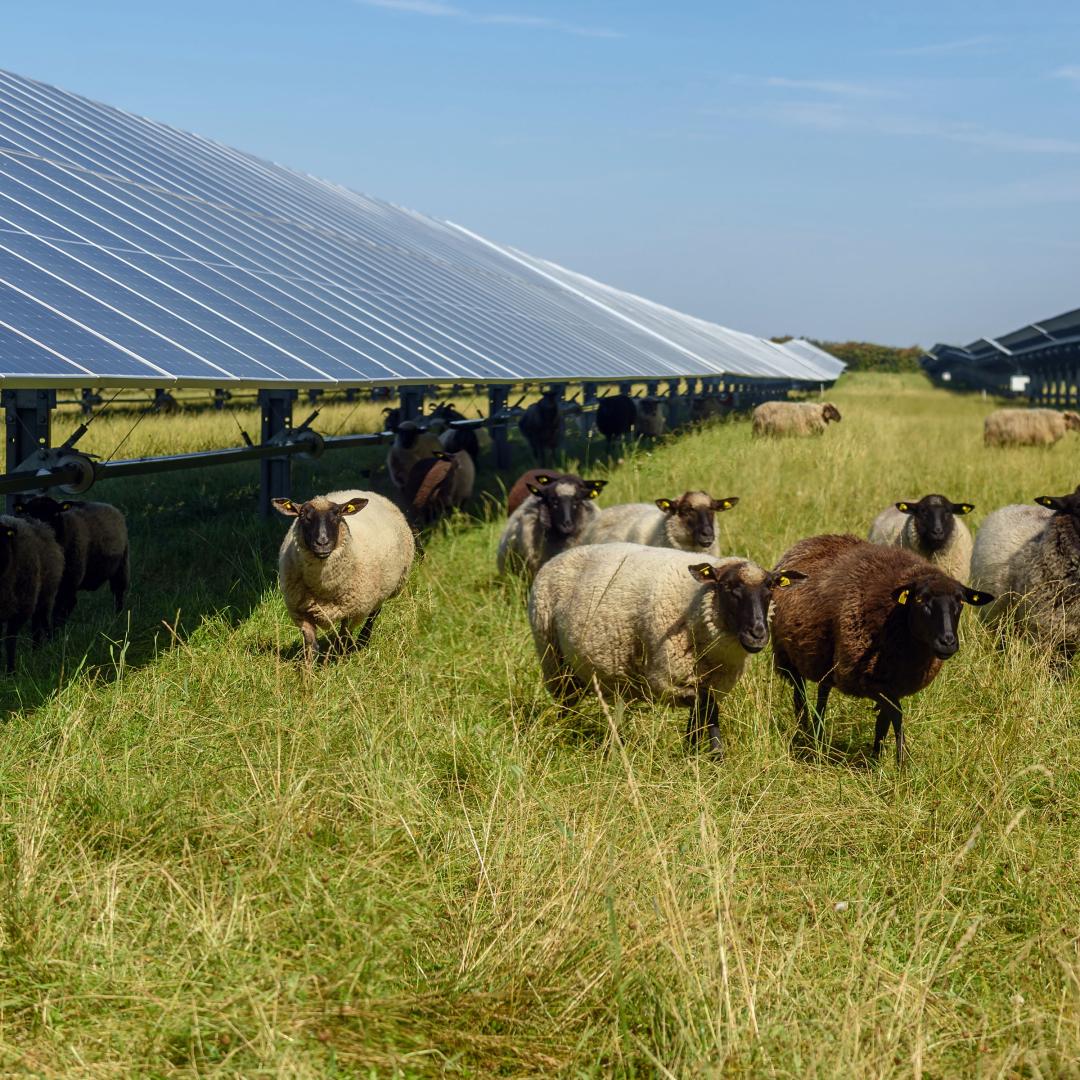
Sheep in a pasture with solar panels
Coming Soon
On

Key Takeaways

  • Deploying agrivoltaics on just 1% of global agricultural land could offset 21 PWh/yr of electricity demand, equivalent to total global electricity consumption in 2019.
  • Agrivoltaics systems generate clean, renewable electricity without displacing agricultural activities, potentially increasing overall land use efficiency up to 200%.
  • By shading crops and livestock, solar panels installed as part of an agrivoltaics system moderate soil temperatures and reduce evapotranspiration, improving agricultural water-use efficiency by 150–300% compared with conventional farming.
  • Agrivoltaics can diversify income sources for farmers and expand rural employment opportunities.
  • Agrivoltaic systems have the greatest adoption potential in arid, dry, and land-constrained regions – particularly Africa, the Asia-Pacific, and South and Central America – where solar resources are abundant and the crop-protection benefits of shading are most pronounced.
Summary

Agrivoltaics is the dual use of land for simultaneous solar photovoltaic (PV) power generation and agricultural production. It reduces GHG emissions by shifting electricity production from fossil fuels to renewables. Agrivoltaic systems can be categorized by system type, PV configuration, module tilt, and agricultural activity. These systems operate at both utility and distributed scales. We consider all combinations of system type, PV structure, module tilt, and agricultural activity in this solution.

Description for Social and Search
​​Agrivoltaics makes it possible to grow food and generate clean solar power on the same land. It can improve land-use efficiency, stabilize crop yields in suitable climates, and add new revenue for farmers.
Overview

Electricity generation accounts for an estimated 23% of GHG emissions on a 100-year basis (Clarke et al., 2022), with fossil fuel–based sources supplying more than 60% of electricity generated in 2023 (International Energy Agency [IEA], 2024b). Since solar PV is a clean and renewable resource, agrivoltaics produces electricity without contributing to GHG emissions or air pollution during operation. Unlike conventional utility-scale solar PV, which often competes with agriculture for space, agrivoltaics combines solar PV electricity generation and agricultural production without requiring additional land use change or sacrificing arable land (Trommsdorff et al., 2025).

The primary climate benefit is the reduction of CO₂ emissions and smaller amounts of methane and nitrous oxide from displacing fossil fuel–based electricity from the grid. This solution quantifies only emissions avoided through electricity generation and does not include emissions from agricultural activities beneath or between the solar panels.

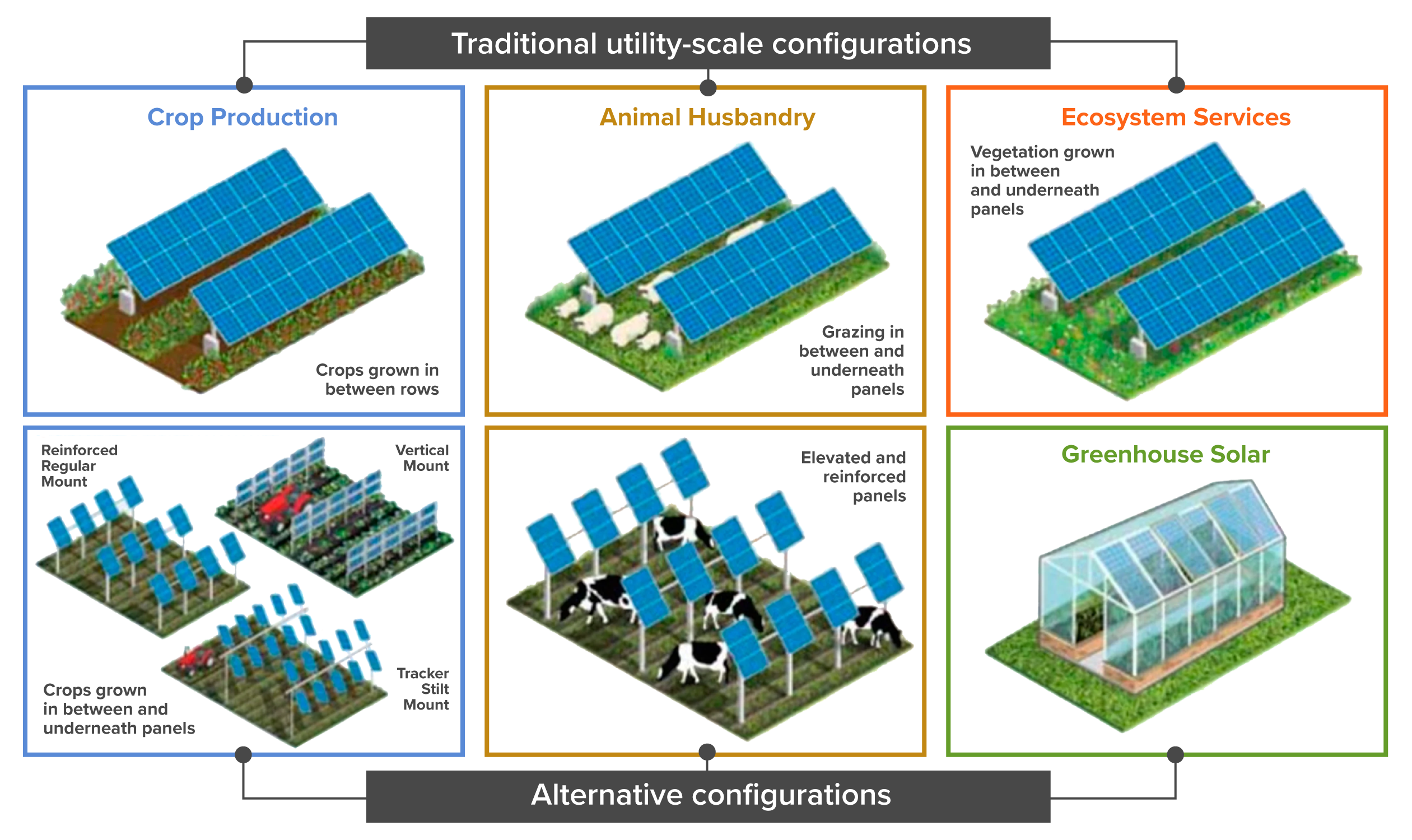
Agrivoltaic systems come in several configurations to coexist with different agricultural activities, including crop production, animal husbandry or grazing, ecosystem services, aquaculture, and pollinator habitat (Macknick et al., 2022). As shown in Figure 1, these systems range from standard ground-mounted arrangements – with crops growing between rows or livestock grazing underneath – to more specialized alternative designs such as elevated panels, vertical bifacial mounts, stilt-mounted trackers, and solar-integrated greenhouses. Overhead configurations elevate panels 2–6 meters above ground to allow standard farm operations while providing shade and weather protection for crops or livestock. Interspace (or interrow) configurations leave wide alleys between ground-mounted PV arrays for vegetation. Rooftop and structure-mounted configurations place panels on greenhouses, barns, or other farm infrastructure, using rigid or flexible panels (Campana et al., 2025; Macknick et al., 2022; Solar Power Europe, 2024a; Trommsdorff et al., 2021).

Each configuration involves different trade-offs between energy output, crop performance, land compatibility, and cost (Campana et al., 2025; Horowitz et al., 2020; Trommsdorff et al., 2025). Well-designed systems often achieve higher overall productivity with a land equivalent ratio exceeding 1 (Trommsdorff et al., 2025). Successful implementation typically requires partnerships among farmers, agricultural cooperatives, solar developers, and utilities, supported by government policies such as subsidies, tax credits, or zoning support (Trommsdorff et al., 2025). 

Figure 1. Agrivoltaic configurations range from standard ground-mounted arrangements (top row) to more specialized alternative designs (bottom row), including elevated overhead systems, vertical mounts, stilt-mounted trackers, and solar-integrated greenhouses. These systems can support agricultural activities – including crop production, grazing, ecosystem services, and habitats – on the same land. 

Image
Diagram demonstrating Agrivoltaic configurations

Source: Macknick, J., et al. (2022). The 5 Cs of agrivoltaic success factors in the United States: Lessons from the InSPIRE research study (No. NREL/TP-6A20-83566). National Renewable Energy Laboratory (NREL), Golden, Colo. (United States). Copyrighted.

Solution in Action

References

Abel, D., Holloway, T., Harkey, M., Rrushaj, A., Brinkman, G., Duran, P., Janssen, M., & Denholm, P. (2018). Potential air quality benefits from increased solar photovoltaic electricity generation in the Eastern United States. Atmospheric Environment, 175, 65–74. Link to source: https://doi.org/10.1016/j.atmosenv.2017.11.049

Adeh, E. H., Good, S. P., Calaf, M., & Higgins, C. W. (2019). Solar PV power potential is greatest over croplands. Scientific Reports, 9, Article 11442. Link to source: https://doi.org/10.1038/s41598-019-47803-3

Agostini, A., Colauzzi, M., & Amaducci, S. (2021). Innovative agrivoltaic systems to produce sustainable energy: An economic and environmental assessment. Applied Energy, 281, 116102. Link to source: https://doi.org/10.1016/j.apenergy.2020.116102

Agrivoltaics Map (National Laboratory of the Rockies). (n.d.). [Dataset]. InSPIRE. Retrieved April 13, 2026, from Link to source: https://openei.org/wiki/InSPIRE/Agrivoltaics_Map

Ahmad, M., Zeeshan, M., & Khan, J. A. (2023). Life cycle multi-objective (geospatial, techno-economic, and environmental) feasibility and potential assessment of utility scale photovoltaic power plants. Energy Conversion and Management, 291. https://doi.org/10.1016/j.enconman.2023.117260

Amaducci, S., Yin, X., & Colauzzi, M. (2018). Agrivoltaic systems to optimise land use for electric energy production. Applied Energy, 220, 545–561. Link to source: https://doi.org/10.1016/j.apenergy.2018.03.081

Andrew, A. C., Higgins, C. W., Smallman, M. A., Graham, M., & Ates, S. (2021). Herbage yield, lamb growth and foraging behavior in agrivoltaic production system. Frontiers in Sustainable Food Systems, Volume 5-2021. Link to source: https://www.frontiersin.org/journals/sustainable-food-systems/articles/10.3389/fsufs.2021.659175

Asa’a, S., Reher, T., Rongé, J., Diels, J., Poortmans, J., Radhakrishnan, H. S., van der Heide, A., Van de Poel, B., & Daenen, M. (2024). A multidisciplinary view on agrivoltaics: Future of energy and agriculture. Renewable and Sustainable Energy Reviews, 200, 114515. Link to source: https://doi.org/10.1016/j.rser.2024.114515

Badza, K., Soro, Y. M., & Sawadogo, M. (2023). Life cycle assessment of a 33.7 MW solar photovoltaic power plant in the context of a developing country. Sustainable Environment Research, 33(1), 1–15. https://doi.org/10.1186/S42834-023-00201-X

Baik, E., Chawla, K. P., Jenkins, J. D., Kolster, C., Patankar, N. S., Olson, A., Benson, S. M., & Long, J. C. S. (2021). What is different about different net-zero carbon electricity systems? Energy and Climate Change, 2, Article 100046. Link to source: https://doi.org/10.1016/j.egycc.2021.100046 

Barron-Gafford, G. A., Pavao-Zuckerman, M. A., Minor, R. L., Sutter, L. F., Barnett-Moreno, I., Blackett, D. T., Thompson, M., Dimond, K., Gerlak, A. K., Nabhan, G. P., & Macknick, J. E. (2019). Agrivoltaics provide mutual benefits across the food–energy–water nexus in drylands. Nature Sustainability, 2(9), 848–855. Link to source: https://doi.org/10.1038/s41893-019-0364-5

Beck, M., Bopp, G., Goetzberger, A., Obergfell, T., Reise, C., & Schindele, S. (2012). Combining PV and food crops to agrophotovoltaic – optimization of orientation and harvest [PDF]. 27th European Photovoltaic Solar Energy Conference and Exhibition; 4096-4100, 5 pages, 6000 kb. Link to source: https://doi.org/10.4229/27THEUPVSEC2012-5AV.2.25

Bhatta, G., Lohani, S. P., Kc, M., Bhandari, R., Palit, D., & Anderson, T. (2025). Harnessing solar PV potential for decarbonization in Nepal: A GIS based assessment of ground-mounted, rooftop, and agrivoltaic solar systems for Nepal. Energy for Sustainable Development, 85, 101618. Link to source: https://doi.org/10.1016/j.esd.2024.101618

Biswas, A., Qiu, M., Braun, D., Dominici, F., & Mork, D. (2025). Quantifying effects of solar power adoption on CO2 emissions reduction. Science Advances, 11, Article eadq5660. https://doi.org/10.1126/sciadv.adq5660

Brown, T. & Reichenberg, L. (2021). Decreasing market value of variable renewables can be avoided by policy action. Energy Economics, 100, Article 105354. Link to source: https://doi.org/10.1016/j.eneco.2021.105354 

Buonocore, J. J., Hughes, E. J., Michanowicz, D. R., Heo, J., Allen, J. G., & Williams, A. (2019). Climate and health benefits of increasing renewable energy deployment in the United States*. Environmental Research Letters, 14(11), 114010. Link to source: https://doi.org/10.1088/1748-9326/ab49bc

Busch, C., & Wydra, K. (2023). Life cycle assessment of an agrivoltaic system with conventional potato production. Journal of Renewable and Sustainable Energy, 15(4), 043501. Link to source: https://doi.org/10.1063/5.0156779

Campana, P. E., Macknick, J., Croci, M., Elkadeem, M. R., Gorjian, S., Pascaris, A., Cuppari, R. I., Amaducci, S., Liu, W., Trommsdorff, M., Sturchio, M. A., Muller, O., Agostini, A., Chatzipanagi, A., Scognamiglio, A., & Zhang, J. (2025). Scientific frontiers of agrivoltaic cropping systems. Nature Reviews Clean Technology, 1(11), 801–821. Link to source: https://doi.org/10.1038/s44359-025-00110-9

Carvalho Fonsêca, V. D. F., De Andrade Culhari, E., Moura, G. A. B., Nascimento, S. T., Milan, H. M., Neto, M. C., & Maia, A. S. C. (2023). Shade of solar panels relieves heat load of sheep. Applied Animal Behaviour Science, 265, 105998. Link to source: https://doi.org/10.1016/j.applanim.2023.105998

Chirinda, N., Leonard, S. A., Bierbaum, R., & Whaley, C. (2024). Agrivoltaics. STAP. Link to source: http://www.stapgef.org/resources/advisory-documents/agrivoltaics

Christ, M., & Wagner, M. (2025). Integrating solar energy into German vineyards: A geospatial framework for identifying agrivoltaic potential. Agronomy, 15(9), 2174. Link to source: https://doi.org/10.3390/agronomy15092174

Clarke, L., Wei, Y.-M., De La Vega Navarro, A., Garg, A., Hahmann, A. N., Khennas, S., Azevedo, I. M. L., Löschel, A., Singh, A. K., Steg, L., Strbac, G., & Wada, K. (2022). Energy systems. In P. R. Shukla, J. Skea, R. Slade, A. Al Khourdajie, R. van Diemen, D. McCollum, M. Pathak, S. Some, P. Vyas, R. Fradera, M. Belkacemi, A. Hasija, G. Lisboa, S. Luz, & J. Malley (Eds.), Climate change 2022: Mitigation of climate change. Contribution of Working Group III to the Sixth Assessment Report of the Intergovernmental Panel on Climate Change (pp. 613–746). Cambridge University Press. Link to source: https://doi.org/10.1017/9781009157926.008

Cuppari, R. I., Branscomb, A., Graham, M., Negash, F., Smith, A. K., Proctor, K., Rupp, D., Tilahun Ayalew, A., Getaneh Tilaye, G., Higgins, C. W., & Najm, M. A. (2024). Agrivoltaics: Synergies and trade-offs in achieving the sustainable development goals at the global and local scale. Applied Energy, 362, 122970. Link to source: https://doi.org/10.1016/j.apenergy.2024.122970

Daniels, T. L. (2023). The development of utility-scale solar projects on US agricultural land: Opportunities and obstacles. Socio-Ecological Practice Research, 5(2), 205–213. Link to source: https://doi.org/10.1007/s42532-023-00139-9

de Falco, M., Sarrica, M., Scognamiglio, A., & Fasanelli, R. (2025). What does agrivoltaics mean? A study on social representations shared by experts and the press in Italy. Energy Research & Social Science, 119, 103918. Link to source: https://doi.org/10.1016/j.erss.2024.103918

Dinesh, H., & Pearce, J. M. (2016). The potential of agrivoltaic systems. Renewable and Sustainable Energy Reviews, 54, 299–308. Link to source: https://doi.org/10.1016/j.rser.2015.10.02

DNV. (2024). Energy transition outlook 2024. Link to source: https://brandcentral.dnv.com/original/gallery/10651/files/original/5c2470ac-597c-43f9-87dd-4e6b238d7845.pdf

Dupraz, C., Marrou, H., Talbot, G., Dufour, L., Nogier, A., & Ferard, Y. (2011). Combining solar photovoltaic panels and food crops for optimising land use: Towards new agrivoltaic schemes. Renewable Energy, Renewable Energy: Generation & Application, 36(10), 2725–2732. Link to source: https://doi.org/10.1016/j.renene.2011.03.005

Ember. (n.d.). Global electricity trends. In Global Electricity Review 2024. Link to source: https://ember-energy.org/latest-insights/global-electricity-review-2024/global-electricity-trends/

Ember. (2024, August 29). Empowering farmers in Central Europe: The case for agri-PV. Link to source: https://ember-energy.org/latest-insights/empowering-farmers-in-central-europe-the-case-for-agri-pv

Fan, T., Trommsdorff, M., Gölz, S., & He, J. (2022, June 17). Agrivoltaics in China: A Study of the Current State of Agrivoltaics Development, Governmental Support Schemes, and Stakeholder Groups’ Perspectives and Acceptance based on Expert Interviews. 3rd Agrivoltaics Conference & Exhibition 2022. Agrivoltaics Conference 2022. Link to source: https://publica.fraunhofer.de/entities/publication/afa41072-9cc3-4ee1-97c9-f2027d6c7a2b

FAO. (2023). Land statistics and indicators 2000–2021 (Brief No. 71). Link to source: https://openknowledge.fao.org/server/api/core/bitstreams/5c8b2707-1bcf-4c29-90e2-3487e583f71e/content#:~:text=Page%203,over%20the%20past%20two%20decades.

Firoozi, A. A., Firoozi, A. A., & Maghami, M. R. (2025). Harnessing photovoltaic innovation: Advancements, challenges, and strategic pathways for sustainable global development. Energy Conversion and Management: X, 27, 101058. Link to source: https://doi.org/10.1016/J.ECMX.2025.101058 

Ferreira Junior, R. A., Torres, I. C., De Souza, L. F. L., Dos Santos, M. A., Cavalcante, M. A. A., Tiba, C., & De Souza, J. L. (2025). Agrophotovoltaic systems in sugarcane crop − A Brazilian case study. Energy Conversion and Management, 344, 120307. Link to source: https://doi.org/10.1016/j.enconman.2025.120307

Fraunhofer Institute of Solar Energy ISE. (2024, July). Study: Levelized cost of electricity - Renewable energy technologies [PDF]. Link to source: https://www.ise.fraunhofer.de/en/publications/studies/cost-of-electricity.html

Gadhiya, G. A., & Chakraborty, S. (2025). Agrivoltaics in the Andaman and Nicobar Islands: Assessing the geo-spatial potential for sustainable development. Energy for Sustainable Development, 88, 101807. Link to source: https://doi.org/10.1016/j.esd.2025.101807

Gagnon, P., & O’Shaughnessy, E. (2024). Consequential analysis of the greenhouse gas emissions impacts of actions that influence the electric grid: The theory and practice of using marginal emissions rates (Report No. TP-6A40-91580). National Renewable Energy Laboratory. Link to source: https://doi.org/10.2172/24816

Gallagher, C. L., & Holloway, T. (2020). Integrating air quality and public health benefits in U.S. decarbonization strategies. Frontiers in Public Health, Volume 8-2020. Link to source: https://www.frontiersin.org/journals/public-health/articles/10.3389/fpubh.2020.563358

Horowitz, K., Ramasamy, V., Macknick, J., & Margolis, R. (2020). Capital costs for dual-use photovoltaic installations: 2020 benchmark for ground-mounted PV systems with pollinator-friendly vegetation, grazing, and crops (Report No. TP-6A20-77811). National Renewable Energy Laboratory. Link to source: https://doi.org/10.2172/1756713

Hwang, K.-W., & Lee, C.-Y. (2024). Estimating the deterministic and stochastic levelized cost of the energy of fence-type agrivoltaics. Energies, 17(8), 1932. Link to source: https://doi.org/10.3390/en17081932

International Energy Agency. (2024a). World Energy Outlook 2024. Link to source: https://www.iea.org/reports/world-energy-outlook-2024

International Energy Agency. (2024b). World energy balances—Data product. Link to source: https://www.iea.org/data-and-statistics/data-product/world-energy-balance

International Renewable Energy Agency. (2025). Renewable power generation costs in 2024. Link to source: https://www.irena.org/-/media/Files/IRENA/Agency/Publication/2025/Jul/IRENA_TEC_RPGC_in_2024_2025.pdf 

International Renewable Energy Agency. (2026). Renewable power generation costs in 2025. Link to source: https://www.irena.org/-/media/Files/IRENA/Agency/Publication/2026/Jul/IRENA_TEC_RPGC_in_2025_2026.pdf

Intergovernmental Panel on Climate Change. (2023). Climate change 2023: Synthesis report. Contribution of Working Groups I, II and III to the Sixth Assessment Report of the Intergovernmental Panel on Climate Change (Core Writing Team, H. Lee, & J. Romero, Eds.). Link to source: https://doi.org/10.59327/IPCC/AR6-9789291691647. 

Jung, D., Gareis, G. H., Staiger, A., & Salmon, A. (2022). Effects of soiling on agrivoltaic systems: Results of a case study in Chile. AIP Conference Proceedings, 2635(1), 020001. Link to source: https://doi.org/10.1063/5.0107943

Keiner, D., Walter, L., Bogdanov, D., Peters, I. M., & Breyer, C. (2025). Assessing the impact of bifacial solar photovoltaics on future power systems based on capacity-density-optimised power plant yield modelling. Solar Energy, 295, 113543. Link to source: https://doi.org/10.1016/j.solener.2025.113543

Laub, M., Pataczek, L., Feuerbacher, A., Zikeli, S., & Högy, P. (2022). Contrasting yield responses at varying levels of shade suggest different suitability of crops for dual land-use systems: A meta-analysis. Agronomy for Sustainable Development, 42(3), 51. Link to source: https://doi.org/10.1007/s13593-022-00783-7

Lytle, W., Meyer, T. K., Tanikella, N. G., Burnham, L., Engel, J., Schelly, C., & Pearce, J. M. (2021). Conceptual design and rationale for a new agrivoltaics concept: Pasture-raised rabbits and solar farming. Journal of Cleaner Production, 282, 124476. Link to source: https://doi.org/10.1016/j.jclepro.2020.124476

Mamun, M. A. A., Dargusch, P., Wadley, D., Zulkarnain, N. A., & Aziz, A. A. (2022). A review of research on agrivoltaic systems. Renewable and Sustainable Energy Reviews, 161, 112351. Link to source: https://doi.org/10.1016/j.rser.2022.112351

Macknick, J., Hartmann, H., Barron-Gafford, G., Beatty, B., Burton, R., Seok-Choi, C., Davis, M., Davis, R., Figueroa, J., Garrett, A., Hain, L., Herbert, S., Janski, J., Kinzer, A., Knapp, A., Lehan, M., Losey, J., Marley, J., MacDonald, J., … Walston, L. (2022). The 5 Cs of agrivoltaic success factors in the United States: Lessons from the InSPIRE research study (Report No. TP-6A20-83566). National Renewable Energy Laboratory. Link to source: https://doi.org/10.2172/1882930

Mahim, T. M., Rahman, M. M., & Huda, A. S. N. (2026). Review of the challenges and prospects in agrivoltaics. Advanced Energy and Sustainability Research, 7(1), e202500227. Link to source: https://doi.org/10.1002/aesr.202500227

Maia, A. S. C., Culhari, E. D. A., Fonsêca, V. D. F. C., Milan, H. F. M., & Gebremedhin, K. G. (2020). Photovoltaic panels as shading resources for livestock. Journal of Cleaner Production, 258, 120551. Link to source: https://doi.org/10.1016/j.jclepro.2020.120551

Malu, P. R., Sharma, U. S., & Pearce, J. M. (2017). Agrivoltaic potential on grape farms in India. Sustainable Energy Technologies and Assessments, 23, 104–110. Link to source: https://doi.org/10.1016/j.seta.2017.08.004

Masson, G., l’Epine, M. de, & Kaizuka, I. (2024). Trends in PV applications 2024. IEA PVPS. Link to source: https://iea-pvps.org/trends_reports/trends-in-pv-applications-2024/

McCall, J., Staie, B., Carron, W., & Jamison, J. (2024). Initial feasibility assessment of agrivoltaics in Jackson County, IL (Report No. TP-6A20-88816). National Renewable Energy Laboratory. Link to source: https://doi.org/10.2172/2335896

Mehedi, T. H., Gemechu, E., & Kumar, A. (2022). Life cycle greenhouse gas emissions and energy footprints of utility-scale solar energy systems. Applied Energy, 314, 118918. Link to source: https://doi.org/10.1016/J.APENERGY.2022.118918

Millstein, D., Wiser, R., Bolinger, M., & Barbose, G. (2017). The climate and air-quality benefits of wind and solar power in the United States. Nature Energy, 2(9), Article 17134. Report #: ARTN 17134. Link to source: http://dx.doi.org/10.1038/nenergy.2017.134

Millstein, D., O’Shaughnessy, E., & Wiser, R. (2024). Climate and air quality benefits of wind and solar generation in the United States from 2019 to 2022. Cell Reports Sustainability, 1(6), 100105. Link to source: https://doi.org/10.1016/j.crsus.2024.100105

Montedonico, M., Pando, D., Santillán, V. A., Guevara, M. Á., Salazar, K. P., Mezzomo, W., Butrón, N., Solís, N., & Díaz, A. (2026). Perspectivas De La Energía Agrivoltaica En América Latina. Link to source: https://ideathinktank.org.mx/wp-content/uploads/2026/03/DocumentoTecnico_PerspectivasDeLaAgrovoltaicaEnAmericaLatina.pdf

 Morash, J. D., & Pavao-Zuckerman, M. (2026). Regional dynamics of agrivoltaics adoption: Stakeholder perceptions and barriers in Maryland, USA. Energy Policy, 210, 115066. Link to source: https://doi.org/10.1016/j.enpol.2025.115066

National Renewable Energy Laboratory. (2021). Life Cycle Greenhouse Gas Emissions from Electricity Generation: Update. Link to source: https://docs.nlr.gov/docs/fy21osti/80580.pdf

National Laboratory of the Rockies. (2024, November 21). Lighting the Way for Agrivoltaics: How NREL Empowers Communities To Capture the Benefits of Solar Energy, Agriculture, and Ecosystems | NLR. Link to source: https://www.nlr.gov/news/feature/2024/lighting-the-way-for-agrivoltaics

Pandey, G., Lyden, S., Franklin, E., Millar, B., & Harrison, M. T. (2025). A systematic review of agrivoltaics: Productivity, profitability, and environmental co-benefits. Sustainable Production and Consumption, 56, 13–36. Link to source: https://doi.org/10.1016/j.spc.2025.03.006

Pascaris, A. S., Schelly, C., Burnham, L., & Pearce, J. M. (2021). Integrating solar energy with agriculture: Industry perspectives on the market, community, and socio-political dimensions of agrivoltaics. Energy Research & Social Science, 75, 102023. Link to source: https://doi.org/10.1016/j.erss.2021.102023

Patel, U., Gadhiya, G., & Chauhan, P. (2023). Case Study on Power Generation from Agrivoltaic System in India. International Journal of Environment and Climate Change, 13, 1447–1454. Link to source: https://doi.org/10.9734/IJECC/2023/v13i92375

Pehl, M., Arvesen, A., Humpenöder, F., Popp, A., Hertwich, E. G., & Luderer, G. (2017). Understanding future emissions from low-carbon power systems by integration of life-cycle assessment and integrated energy modelling. Nature Energy 2017 2:12, 2(12), 939–945. Link to source: https://doi.org/10.1038/s41560-017-0032-9

Pincelli, I. P., Hinkley, J., & Brent, A. (2024). Carbon, materials and energy footprint of a utility-scale solar plant in Aotearoa New Zealand. Solar Energy, 273, 112535. Link to source: https://doi.org/10.1016/J.SOLENER.2024.112535

Scarano, A., Curci, L. M., Semeraro, T., Calisi, A., Lenucci, M. S., Santino, A., Basset, A., & De Caroli, M. (2025). Agrivoltaics as a sustainable strategy to enhance food security under water scarcity. Horticulturae, 11(4), 401. Link to source: https://doi.org/10.3390/horticulturae11040401 

Seay-Fleming, C., Swanson, T., Gerlak, A. K., Pavao-Zuckerman, M. A., Andrews, H., Moore, K., & Barron-Gafford, G. A. (2025). Cultivating engagement: Public participation in agrivoltaics planning and design. Energy Research & Social Science, 127, 104273. Link to source: https://doi.org/10.1016/j.erss.2025.104273

Smith, B. L., Sekar, A., Mirletz, H., Heath, G., & Margolis, R. (2024). An updated life cycle assessment of utility-scale solar photovoltaic systems installed in the United States. Link to source: https://www.nrel.gov/docs/fy24osti/87372.pdf

Smith, M. (2024). Dual-use solar photovoltaics: Emerging applications and issues for congress (No. R48197). Congressional Research Service. Link to source: https://www.congress.gov/crs-product/R48197

Sojib Ahmed, M., Rezwan Khan, M., Haque, A., & Ryyan Khan, M. (2022). Agrivoltaics analysis in a techno-economic framework: Understanding why agrivoltaics on rice will always be profitable. Applied Energy, 323, 119560. Link to source: https://doi.org/10.1016/j.apenergy.2022.119560

Solar Power Europe. (2024a). Agrisolar handbook. Link to source: https://www.solarpowereurope.org/insights/thematic-reports/agrisolar-handbook-1

Solar Power Europe. (2024b). New agrisolar digital map presents over 200 projects across Europe—SolarPower Europe. Link to source: https://www.solarpowereurope.org/press-releases/new-agrisolar-digital-map-presents-over-200-projects-across-europe

Sorensen, A., Nogeire, T., & Hunter, M. (2022). Potential placement of utility-scale solar installations on agricultural lands in the U.S. to 2040. American Farmland Trust. Link to source: https://farmlandinfo.org/wp-content/uploads/sites/2/2023/03/AFT_FUT2040-solar-white-paper.pdf

Suri, D., de Chalendar, J. & Azevedo, I.M.L. (2025). Assessing the real implications for CO2 as generation from renewables increases. Nature Communications, 16, Article 7124. Link to source: https://doi.org/10.1038/s41467-025-59800-4

Swanson, T., Seay-Fleming, C., Gerlak, A. K., & Barron-Gafford, G. A. (2025). “Enough is enough, we like our farms”: The role of landscape ideology in shaping perceptions of solar energy and agrivoltaics in the rural American Southwest. Journal of Rural Studies, 114, 103572. Link to source: https://doi.org/10.1016/j.jrurstud.2025.103572

Trommsdorff, M., Kang, J., Reise, C., Schindele, S., Bopp, G., Ehmann, A., Weselek, A., Högy, P., & Obergfell, T. (2021). Combining food and energy production: Design of an agrivoltaic system applied in arable and vegetable farming in Germany. Renewable and Sustainable Energy Reviews, 140, 110694. Link to source: https://doi.org/10.1016/j.rser.2020.110694

Trommsdorff, M., Campana, P. E., Macknick, J., Fernández Solas, A., Gorjian, S., & Tsanakas, I. (2025). Dual Land Use for Agriculture and Solar Power Production: Overview and Performance of Agrivoltaic Systems. International Energy Agency Photovoltaic Power Systems Programme. Link to source: https://doi.org/10.69766/XAEU5008

United Nations Conference on Trade and Development UNCTAD. (2023, October 4). Italy—Adopts €2.61 billion schemes to support agrivoltaic energy production and agro-industrial development | Investment Policy Monitor | UNCTAD Investment Policy Hub. Link to source: https://investmentpolicy.unctad.org/investment-policy-monitor/measures/4543/italy-adopts-2-61-billion-schemes-to-support-agrivoltaic-energy-production-and-agro-industrial-development

U.S. Department of Energy. (n.d.). Solar photovoltaic system cost benchmarks. Energy.Gov. Retrieved March 11, 2026, from  Link to source: https://www.energy.gov/eere/solar/solar-photovoltaic-system-cost-benchmarks

Walsh, K. B., Stedman, R., & Kay, D. (2026). Imagining agrivoltaics: Farmer expectations for co-locating solar energy and agricultural production in Western New York. Energy Research & Social Science, 137, 104789. Link to source: https://doi.org/10.1016/j.erss.2026.104789

Walston, L. J., Mishra, S. K., Hartmann, H. M., Hlohowskyj, I., McCall, J., & Macknick, J. (2018). Examining the potential for agricultural benefits from pollinator habitat at solar facilities in the United States. Environmental Science & Technology, 52(13), 7566–7576. Link to source: https://doi.org/10.1021/acs.est.8b00020

Williams, H. J., Wang, Y., Yuan, B., Wang, H., & Zhang, K. M. (2025). Rethinking agrivoltaic incentive programs: A science-based approach to encourage practical design solutions. Applied Energy, 377, 124272. Link to source: https://doi.org/10.1016/j.apenergy.2024.124272

Williams, H. J., Wang, Y., & Zhang, K. M. (2024, June). Advantages and disadvantages of vertical solar racking for agrivoltaic systems. World Agrivoltaics Conference. Link to source: https://www.osti.gov/biblio/25305

Yeligeti, M., Hu, W., Scholz, Y., Stegen, R., & von Krbek, K. (2023). Cropland and rooftops: The global undertapped potential for solar photovoltaics. Environmental Research Letters, 18(5), 054027. Link to source: https://doi.org/10.1088/1748-9326/accc47

Zhang, X., & Ma, X. (2026). Vectorized agrivoltaics dataset in China from 2010 to 2022. Scientific Data, 13(1), 116. Link to source: https://doi.org/10.1038/s41597-025-06305-w

Zubi, G., Parag, Y., & Wald, S. (2024). Implications of large-scale PV integration on grid operation, costs, and emissions: Challenges and proposed solutions. Energies 2025, Vol. 18, Page 130, 18(1), 130. Link to source: https://doi.org/10.3390/EN18010130 

Credits

Lead Fellow

  • Al-Amin Bugaje, Ph.D.

Contributors

  • Ruthie Burrows, Ph.D.

  • James Gerber, Ph.D.

  • Daniel Jasper

  • Alex Sweeney

Internal Reviewers

  • Amanda D. Smith, Ph.D.

  • Christina Swanson, Ph.D.

  • Megan Matthews, Ph.D.

Effectiveness

We estimate that agrivoltaics reduces GHG emissions by 720 t CO₂‑eq /MW/yr (730 t CO₂‑eq /MW/yr, 20-year basis) (Table 1). This assumes that newly installed agrivoltaics displace an equivalent MWh of the 2023 global electricity grid mix (estimated at 530 kg CO₂‑eq /MWh (540 kg CO₂‑eq /MWh, 20-year basis; IEA, 2024b; see Methodology: Appendix A for calculation details). We used a median capacity factor of 15% based on country-level estimates (Ember, 2024; Ferreira Junior et al., 2025; McCall et al., 2024; Patel et al., 2023; Williams et al., 2024) to convert annual emissions reductions from per MWh to per MW installed capacity. 

Actual avoided emissions will depend on local grid conditions and the specific power sources displaced (see Methodology: Appendix A). Studies in the U.S. show that from 2007–2015, solar deployment avoided approximately 0.5 t CO₂ /MWh (613 t CO₂ /MW/yr; Millstein et al., 2017) emissions, and a 15% increase in deployment avoided 8.54 Mt CO₂ /yr (Biswas et al., 2025). 

Although solar PV emits negligible GHGs during operations, emissions arise during manufacturing, transportation, installation, maintenance, and decommissioning. However, these embodied emissions are paid back in approximately 1–2 yr (Badza et al., 2023; M. Ahmad et al., 2023; Mehedi et al., 2022; Pincelli et al., 2024; Smith et al., 2024). While total life-cycle emissions remain far below those of fossil fuels (National Renewable Energy Laboratory [NREL], 2021; Smith et al., 2024), decarbonizing industrial supply chains is essential to maximize climate impact (Pehl et al., 2017). In our analysis, we focused solely on emissions avoided during electricity generation. Carbon payback time, embodied life-cycle emissions, and on-farm agricultural emissions from ruminant grazing were excluded from the effectiveness and climate impact estimates. 

Table 1. Effectiveness at reducing emissions. 

Unit: t CO₂‑eq /MW/yr, 100-yr basis

Estimate 720
Left Text Column Width
Cost

We estimated a mean levelized cost of electricity (LCOE) for agrivoltaics of US$69/MWh based on industry reports and journal articles (Bhatta et al., 2025; Fraunhofer ISE, 2024; Gadhiya & Chakraborty, 2025; Hwang & Lee, 2024; Sojib Ahmed et al., 2022; U.S. Department of Energy [U.S. DOE], n.d.; see Methodology: Appendix A for details). LCOE values represent the average cost of producing one MWh of electricity over the operational lifetime of a power plant, allowing investors to compare their expected revenue to a standard set of costs. This cost metric has been used by international agencies for cost comparison across generation technologies, incorporating installed capital costs, operation and maintenance, project lifespan, and energy output. The agrivoltaics LCOE describes costs to utility-scale generators and does not include agricultural output.

The LCOE for agrivoltaics is generally higher than that for utility-scale solar PV (Trommsdorff et al., 2025), due to higher capital expenditure requirements for overhead configurations and specialized partially see-through PV modules. However, agrivoltaics has a lower LCOE than distributed solar PV. For instance, a study conducted by the U.S. DOE (n.d.) showed that the LCOE of distributed solar PV was US$142/MWh (0.006 MWdc system) compared to agrivoltaics’ US$75/MWh (3 MWdc system). In the same study, a 100 MWdc utility-scale solar PV had an LCOE of US$47/MWh. These costs do not consider any subsidies or revenue. 

In practice, revenues and costs will vary based on the ownership model structure. In developer-owned models, farmers receive fixed lease payments of US$250–2,500 per acre, while the solar provider bears the up-front cost (Daniels, 2022; Trommsdorff et al., 2025). In farmer-owned models, the farmers incur the initial investment burden and generate revenue by selling power to the grid or reducing their on-farm energy bills (Pandey et al., 2025).

Methods and Supporting Data

Learning Curve

Agrivoltaics does not have an empirically derived learning rate. The technology has only scaled meaningfully since the early 2010s, and its configurations vary too widely for a clean cost reduction curve to be fitted to the data. However, agrivoltaics is built from several existing technologies with well-understood learning dynamics. 

We estimated the current global learning rate for module costs at about 34% (DNV, 2024; Masson, 2024). This high rate is heavily influenced by the accelerated growth of solar PV from 2012–2022; however, this number comes down over a longer period of time. Projections suggest it will slow to around 17% by 2050 as cost components stabilize and the largest gains from scaling are realized (DNV, 2024). Because agrivoltaic systems draw their modules from the same global supply chain as any other solar PV project, we expect that they inherit this curve directly.

What distinguishes agrivoltaics economically from utility-scale solar PV is the cost premium of its elevated or specialized mounting structures, more complex permitting, dual-use legal frameworks, and crop-specific engineering (Trommsdorff et al., 2025). These components follow slower learning curves than electronics, constrained by manufacturing scale-up and standardization of elevated racking/tracking systems. However, hardware innovations such as vertical bifacial or open-source designs, module reuse from decommissioned plants, and policy incentives (feed-in tariffs, grants, regulatory clarity) have potential to accelerate deployment and cross-sector learning (Pandey et al., 2025). 

Speed of Action

Speed of action refers to how quickly a climate solution physically affects the atmosphere after it is deployed. This is different from speed of deployment, which is the pace at which solutions are adopted.

At Project Drawdown, we define the speed of action for each climate solution as emergency brake, gradual, or delayed.

Deploy Agrivoltaics is a GRADUAL climate solution. It has a steady, linear impact on the atmosphere. As installed capacity of agrivoltaics increases over time, emissions from electricity generation are expected to decrease assuming solar PV displaces fossil fuel sources.

Caveats

Implementing agrivoltaics requires careful site and crop selection to avoid unintended consequences. In temperate climates, excessive shading can reduce yields of shade-intolerant crops such as wheat, corn, and tomatoes (Pandey et al., 2025). Significant yield declines may displace food production to other land, triggering land conversion and emissions that offset climate gains (Agostini et al., 2021; Wagner et al., 2023). The greatest benefits occur when agrivoltaics is deployed on marginal or low-productivity farmland, where dual-use systems can improve efficiency up to 200% without compromising high yield agriculture (Pandey et al., 2025). 

Farming activities also increase panel soiling from dust, pollen, or harvest residue, necessitating frequent maintenance to prevent energy losses, especially in arid or high-wind regions (Campana et al., 2025; Chirinda et al., 2024; Jung et al., 2022).

We acknowledge the partial overlap of agrivoltaics with utility-scale and distributed solar PV estimates; to avoid double-counting capacity, we treat it as a complementary pathway that expands solar adoption while mitigating land-use competition (Sorensen et al., 2022; Smith, 2024). Policy frameworks that differentiate dual-use systems through incentives, performance standards, or land-use regulations will determine the extent of overlap (Pandey et al., 2025). While proximity to the grid is essential, deployment is limited by transmission capacity and interconnection queue delays (Campana et al., 2025). Large utility-scale projects often face multi-year queues to connect to regional grids, with transmission costs sometimes approaching 50–100% of total project costs (Daniels, 2023; Macknick et al., 2022)

Our assessment assumed that each additional MWh from agrivoltaics displaces an equivalent MWh of the existing grid mix. In reality, avoided emissions vary by regional grid dynamics, marginal generation sources, and the timing and location of production. New solar generation can sometimes displace other renewables rather than fossil-based sources, especially in grids with high existing renewable, nuclear, or geothermal capacity (Baik et al., 2021; Suri et al., 2025). Because agrivoltaics is constrained to agriculturally suitable land – which is unevenly distributed globally – the degree to which these dynamics affect emissions reductions will vary by region. 

Current Adoption

As of 2023, the global installed capacity for agrivoltaics reached approximately 140,000 MW (Table 2). China leads global adoption, accounting for roughly 91% of this estimated total. The U.S. represents 8.4%, while Europe accounts for the remainder (Masson et al., 2024; Solar Power Europe, 2024b; Zhang & Ma, 2026). 

Table 2. Current adoption level (2023).

Unit: MW installed capacity

Estimate 140,000
Left Text Column Width

We estimated this global capacity by aggregating data from industry reports, journal papers, and public datasets across these three regions. However, tracking remains challenging because agrivoltaics deployment estimates partially overlap with utility-scale and distributed solar PV totals. Existing databases often count dual-use projects within broader solar capacity figures, particularly when configurations resemble conventional solar PV systems (Daniels, 2023; Smith, 2024; Sorensen et al., 2022; Trommsdorff et al., 2025). The precise degree of overlap cannot yet be quantified, but developers increasingly adopt dual-use designs to minimize land-use conflict (Campana et al., 2025; Masson et al., 2024; Trommsdorff et al., 2025). While agrivoltaics adoption is present in other regions (e.g., Japan, South Korea, and India), consistent and credible datasets to estimate accurate current adoption and growth trends are limited. Consequently, this estimate likely underestimates current global adoption. 

Adoption Trend

We estimated the median global adoption trend for agrivoltaics at 9,800 MW/yr of additional installed capacity (Table 3) by summing regional adoption values for each year from 2010–2023 and taking the year-to-year difference. Because this analysis relied primarily on data from China and the U.S., the results reflect a geographic distribution skewed toward these leading markets. 

Table 3. Adoption trend (2010–2023).

Unit: MW installed capacity/yr

25th percentile 2300
Mean 9400
Median (50th percentile) 9800
75th percentile 15000
Left Text Column Width

Estimated global agrivoltaics capacity grew roughly 200-fold from 580 MW in 2010 to approximately 140,000 MW in 2023 (Figure 2). While agrivoltaics adoption is still in its early stages – with global installed capacity roughly five times lower than distributed solar PV and seven times lower than utility-scale solar PV – growth is expected to accelerate. Supportive policies in pioneer regions such as Europe, China, Japan, and Korea have driven recent expansion. These policies address both the need for clean energy and the rising climate stresses on farmlands, including heat and drought (Trommsdorff et al., 2025). 

Figure 2. Estimated global adoption of agrivoltaics, 2010–2023.

Sources: Zhang & Ma, 2026; Agrivoltaics Map, n.d.

Enable Download
On

Market momentum has also strengthened over the past decade. From 2010–2015, global agrivoltaics added an average of about 4,100 MW/yr. Post 2015, that rate jumped to around 14,000 MW/yr, fueled by targeted incentives. For instance, agrivoltaics capacity in the United States. more than doubled from 2020–2024 (National Laboratory of the Rockies [NLR], 2024). In Italy, the government launched a competitive bidding process in 2023 to award contracts and funding for 500 MW of agrivoltaics projects (Masson et al., 2024); the country aims to reach 1,000 MW of capacity by 2026 (United Nations Conference on Trade and Development [UNCTAD], 2023). We expect that continued cost declines of elevated structures and bifacial modules and improved profitability (Pandey et al., 2025; Keiner et al., 2025) will drive future adoption.

Adoption Ceiling

We estimated the median technical potential for agrivoltaics to arrive at an adoption ceiling of 250 million MW of installed capacity (Table 4). We determined the adoption ceiling for agrivoltaics by considering the global technical potential of solar PV and the availability of cropland or grazing land suited to shading (Yeligeti et al., 2023).

Table 4. Adoption ceiling.

Unit: MW installed capacity

25th percentile 230,000,000
Mean 250,000,000
Median (50th percentile) 250,000,000
75th percentile 270,000,000
Left Text Column Width

Cropland accounts for only one-third of total agricultural land (Food and Agricultural Organization [FAO], 2023) and global estimates for agrivoltaics across cropland vary depending on assumptions about crop suitability, panel density, and grid access. A global suitability assessment of 18 major crops found approximately 4.64 million km² (464 million ha) of cropland suitable for agrivoltaics in an optimistic scenario, corresponding to a maximum installable capacity of around 217 million MW (Yeligeti et al., 2023). This technological ceiling aligns closely with the analysis of Campana et al. (2025), which projects annual electricity output of 385 PWh (≈ 284 million MW/yr). These optimistic figures assume favorable policy environments, technological advancement in panel design, financing, grid proximity and availability, and adoption of shade-tolerant crop varieties.

Despite the abundant 1.6 billion ha of global arable land (Chirinda et al., 2024), the adoption ceiling is unlikely to be reached due to other constraints (Yeligeti et al., 2023). Considerations for technoeconomic, political, and social effects, including land use changes, economic value of land, and shading effect, determine the actual upper limit for adoption. 

Achievable Adoption

In the low achievable scenario, agrivoltaics is projected to grow more than 20-fold, from 140,000 MW in 2023 to 2.5 million MW in 2050 (Table 5). This scenario accounts for real-world constraints, including fragmented land tenure, uneven grid access, regulatory barriers, and high up-front costs.

Table 5. Range of achievable adoption levels.

Unit: MW installed capacity

Current adoption 140,000
Achievable – low 2,500,000
Achievable – high 5,600,000
Adoption ceiling 250,000,000
Left Text Column Width

In the high achievable scenario, agrivoltaics is projected to grow more than 40-fold, from 140,000 MW in 2023 to 5.6 million MW in 2050 (Table 5). This scenario assumes the continuation of supportive government policies, with adoption primarily constrained by transmission availability. 

We estimated the achievable adoption ranges from scenarios reflecting technical limits (Campana et al., 2025; Yeligeti et al., 2023). These scenarios combine crop suitability and geospatial analysis to estimate annual potential electricity supply from agrivoltaics, constrained by electricity infrastructure. We then applied a mean scaling factor of 9.2% from previous work (Beck et al., 2012; Christ & Wagner, 2025; Trommsdorff et al., 2024) to convert these potential estimates to realizable scenarios. This scaling aligns with historical patterns and complementary international assessments.

Our low and high achievable scenarios fall within the observed market trends, reflecting a still nascent industry with significant but unevenly distributed growth potential.

Beyond the technical and financial considerations, achievable adoption is shaped and often superseded by non-quantitative social forces, where cultural norms, agricultural heritage, and local traditions fundamentally shape stakeholder acceptance (Asa’a et al., 2024; Walsh et al., 2026). Rural residents can perceive solar infrastructure as an industrial intrusion that is incompatible with the pastoral identity and landscape ideology of their communities (de Falco et al., 2025; Mahim et al., 2026; Morash & Pavao-Zuckerman, 2026; Swanson et al., 2025;). If agrivoltaics is framed merely as a technological fix without regard for these cultural values, it can lead to a social gap where broad societal approval for renewables fails to translate into local project success (Pascaris et al., 2021; Walsh et al., 2026).

The achievable adoption range of 2.5–5.6 million MW represents approximately 1–2.3% of the adoption ceiling of 250 million MW. The current adoption is roughly 0.06% of that ceiling. 

The current estimated climate impact of agrivoltaics is approximately 0.1 Gt CO₂‑eq/yr of reduced emissions (Table 6), based on 140,000 MW of global installed capacity and effectiveness of 720 t CO₂‑eq /MW/yr.

Table 6. Climate impact at different levels of adoption.

Unit: Gt CO₂‑eq/yr, 100-yr basis

Current adoption 0.1
Achievable – low 1.80
Achievable – high 4.10
Adoption ceiling 180
Left Text Column Width

Under the low achievable adoption scenario (2.5 million MW), annual emissions reductions could grow to about 1.8 Gt CO₂‑eq/yr.  

In the high achievable scenario (5.6 million MW), reductions could reach approximately 4.1 Gt CO₂‑eq/yr.  

We based the adoption ceiling solely on the technical potential of agrivoltaics, while neglecting social and economic constraints and realistic scenarios of future power demand. The electricity sector in 2023 emitted 15.6 Gt CO₂ ‑eq (International Energy Agency [IEA], 2024b); therefore, even if agrivoltaics could meet all current electricity demand, emissions reductions could not surpass this value without increased demand. Consequently, agrivoltaic systems are unlikely to reach 250 million MW of installed capacity in the next 100 years. But if current grid emissions were to remain constant while capacity increases, GHG emission reductions would be approximately 180 Gt CO₂ ‑eq/yr. This maximum is unrealistic as a forward-looking climate impact because it treats grid carbon intensity as permanently fixed at 2023 levels and ignores future decarbonization and corresponding decreases in marginal avoided emissions. Real-world climate impacts will depend on not only grid decarbonization and policy support, but also on system design choices and regional agricultural contexts.

By using only 1% of global agricultural land, agrivoltaics could offset 21 PWh/yr of electricity demand, equivalent to global electricity consumption in 2019 (Adeh et al., 2019). Even as demand grows, reaching ~29 PWh in 2023 (Ember, n.d.), the opportunity remains massive. 

Additional Benefits

Heat Stress

Daytime air temperatures surrounding agrivoltaics are lower than traditional utility PV systems that are usually installed over gravel (Pandey et al., 2025). This cooling effect is mostly attributed to evapotranspiration from the crops underneath PV panels (Barron-Gafford et al., 2019). 

Income and Work

Agrivoltaics can diversify income sources for farmers (Campana et al., 2025) by allowing them to export excess power to the grid to generate revenue (Dinesh & Pearce, 2016; Trommsdorff et al., 2025). PV revenue often outweighs revenue from agriculture (Malu et al., 2017; Lytle et al., 2021). Because agrivoltaics are more expensive to install than traditional PV systems, they are often installed at larger scales on larger farms (Campana et al., 2025). In these cases, the income and revenue benefits may be shared between the farmer and a third-party investor. 

New roles in installation, maintenance, and agrivoltaics management also create rural employment opportunities, particularly in regions where energy poverty and food insecurity overlap (Chirinda et al., 2024).

Food Security

Because agrivoltaics lower daytime temperatures, they can increase yields of crops that are sensitive to high temperatures, such as fruits and seed-bearing vegetables (Scarano et al., 2025). This is especially pertinent to drought-prone areas, where agrivoltaics have been shown to increase crop yields in water-stressed systems. For example, a study of crop yields in semi-arid southwestern United States found that yields of peppers and cherry tomatoes were double in agrivoltaic systems relative to those under traditional agriculture (Barron-Gafford, 2019). In addition to shade, agrivoltaic systems can protect crops from weather events such as hail and wind (Pandey et al., 2025). Agrivoltaic fields can also be used for livestock grazing, such as cattle and sheep, maintaining meat and dairy production on solar land while panel shading relieves animal heat stress and improves forage digestibility (Andrew et al., 2021).

Energy Availability

The efficiency of PV panels starts to decrease as cell temperatures rise above 25 °C (Chirinda et al., 2024). The cooler temperatures surrounding agrivoltaic systems can increase electricity production per panel (Adeh et al., 2019). In many environments, vegetation below the PV panels provides a cooling effect that boosts annual electricity output by 1–3% (Barron-Gafford et al., 2019).

Health

Solar PV reduces the emission of pollutants such as nitrogen oxides, sulfur dioxide, and PM2.5 from fossil-fuel energy generation (Abel et al., 2018; Millstein et al., 2024; Millstein et al., 2017; Wiser et al., 2016). This offers health benefits, including reduced premature mortality. The magnitude and distribution of these benefits depend on the local electricity grid mix, the fuels used to generate electricity, and atmospheric conditions that determine how far pollutants travel (Buonocore et al., 2019). Regions with a higher proportion of coal-powered electricity generation will often see more health benefits (Buonocore et al., 2019). Pollutants can travel long distances after they are emitted, so air pollution benefits can be widespread (Millstein et al., 2024).

These health benefits often translate into cost savings associated with reductions in hospital admissions, improved respiratory and cardiovascular conditions, and work and school days that might have otherwise been missed due to illness (Millstein et al., 2017; Wiser et al., 2016).

Nature Protection

Agrivoltaic systems that integrate pollinator-friendly habitats can increase pollination and may even increase crop yields in surrounding farmland (Macknick 2022; Walston et al., 2018).

Animal Well-being

Shade from the panels can relieve heat stress for livestock when temperatures are high (Maia et al., 2020; Carvalho Fonsêca et al., 2023) 

Land Resources

Agrivoltaics can help avoid land use conflicts because the PV panels are placed on land already used for agriculture (Swanson et a., 2025). 

Water Resources

Agrivoltaics may reduce water use up to 50% compared to traditional agricultural systems (Scarano et al., 2025). Reduced solar radiation from shading can reduce soil evaporation rates and enhance water savings for crops (Amaducci et al., 2018). Additionally, water used to clean panels and suppress dust can be reused for irrigation (Patel et al., 2019 ).

Air Quality

For air quality benefits, please refer to the “health” section. 

Risks

Large-scale rollout of agrivoltaics carries several risks. Rapid deployment without adequate storage, grid flexibility, or transmission can elevate curtailment rates. This undermines financial returns and emissions reductions, creating financial risks from high solar deployment and integration (Firoozi et al., 2025; Zubi et al., 2024). Higher up-front capital requirements also expose farmers and developers to revenue risk if crop yields decrease or electricity prices fluctuate (Campana et al., 2025). These financial risks can be mitigated with policy levers, including carbon taxes, though different levers are needed at different adoption levels (Brown & Reichenberg, 2021). 

Lack of regulatory clarity regarding dual-use land may stall adoption (Campana et al., 2025). This lack of legal status often leads to reclassification of agricultural land to energy or industrial use, creating ambiguity over property-tax rates and potentially triggering farmland occupation taxes (Chirinda et al., 2024). Furthermore, reclassification can result in the loss of agricultural subsidies, such as the European Union’s Common Agricultural Policy (CAP) payments, and jeopardize eligibility for crop insurance programs (Smith, 2024; Trommsdorff et al., 2025). Without a clear regulatory framework to differentiate agrivoltaics from standard ground-mounted solar, conflicting goals between energy and agricultural ministries can cause substantial administrative delays and financial uncertainty (Chirinda et al., 2024). 

Agricultural and environmental risks include soil compaction from construction and machinery traffic, reducing infiltration, root growth, and long-term soil fertility. This effect is amplified where heavy equipment must navigate under elevated panels (Campana et al., 2025; Chirinda et al., 2024). Poorly managed end-of-life PV components also risk chemical pollution (Chirinda et al., 2024). 

Finally, social and distributive justice risks can impede adoption. Visual landscape impacts and inequitable benefit-sharing between energy developers and tenant farmers can spark opposition and erode community support. The potential displacement of tenant farmers is a major socioeconomic risk (Campana et al., 2025; Chirinda et al., 2024). Because solar developers offer lease rates that significantly outbid traditional agricultural rents, landowners are increasingly incentivized to prioritize energy production over farming (Morash & Pavao-Zuckerman, 2026 Sorensen et al., 2022; Swanson et al., 2025). Furthermore, high solar leases can drive up overall land prices, making it difficult for new or disadvantaged farmers to access land (Morash & Pavao-Zuckerman, 2026). Without inclusive participatory processes and clear land use agreements, agrivoltaics expansion risks eroding social cohesion and economic viability of the farming communities it is intended to sustain (Campana et al., 2025; Trommsdorff et al., 2025). Ensuring that projects reflect local values, such as community stewardship over simple ownership, is crucial to mitigating the risk of eroding social cohesion of agricultural communities (Seay-Fleming et al., 2025; Trommsdorff et al., 2025).

Interactions with Other Solutions

Reinforcing

The microclimate effects of agrivoltaics can reduce the volume of water required to achieve equivalent crop yields, amplifying the impact of farm-level irrigation efficiency improvements. Electricity generated by solar PV can power irrigation pumps.

By reducing evapotranspiration and moderating temperate and water stress on crops, agrivoltaic systems can reduce agricultural water demand. In water-stressed and arid regions, this interaction can improve food system resilience.

Increased availability of renewable energy from agrivoltaics helps reduce emissions from the electricity grid as a whole. Reduced emissions from the electricity grid lead to lower downstream emissions for solutions that rely on electricity use. Deploying agrivoltaics also supports increased integration of wind power technologies by diversifying the renewable energy mix and reducing exposure to wind variability.

Electrification of transportation systems will be more beneficial in reducing global emissions if the underlying grid includes a higher proportion of non-emitting power sources. Electric transportation systems can also reduce curtailment of solar energy through controlled-time charging and other load-shifting technologies.

Competing

Since wind and solar can generate electricity at the same times of day, deploying agrivoltaics could create competition for grid connections, lower daytime electricity revenues, and suppress adoption of additional wind power.

Use of agricultural land for dedicated bioenergy crop production represents a competing land use, albeit agrivoltaics may offer higher combined energy and food productivity per hectare.

Widespread agrivoltaic deployment on high irradiance agricultural land could reduce the land base available for utility-scale concentrated solar in regions where both are technically viable, albeit the two solutions target different land type and scales.

Consensus
Dashboard

Solution Basics

MW installed capacity

t CO₂-eq (100-yr)/unit/yr
720
units
Current 140,000 02.5×10⁶5.6×10⁶
Achievable (Low to High)

Climate Impact

Gt CO₂-eq (100-yr)/yr
Current 0.1 1.84.1
Gradual

CO₂ , CH₄, N₂O

Trade-offs

Agrivoltaics may involve an inherent trade-off between agricultural productivity and energy conversion efficiency. Well-sited and properly designed systems typically cause no significant declines in agricultural productivity and can even stabilize or increase biomass production in certain conditions (Pandey et al., 2025). Poorly designed systems, however, can underperform both stand-alone agriculture and stand-alone PV on key sustainability metrics (Campana et al., 2025; Trommsdorff et al., 2025).

Elevated panels require extra steel and aluminum, increasing embodied emissions by roughly 20% compared with utility-scale solar PV (Busch & Wydra, 2023). These embodied emissions are modest, up to 100 times lower than the operational savings from displacing fossil fuel–based electricity (Pandey et al., 2025). 

The net climate benefit is greatest in carbon-intensive grids. It diminishes, however, where grid decarbonization is already rapid or where yield losses on prime farmland shift food production to other land, triggering indirect land use change emissions (Agostini et al., 2021; Campana et al., 2025). Water-use efficiency and microclimate cooling can partially offset yield penalties in hot, dry climates, but gains may be small or negative in temperate or wet climates (Campana et al., 2025; Pandey et al., 2025). Overall benefits depend on careful siting, crop selection, and policies that offset higher installation costs while avoiding land-use competition.

Action Word
Deploy
Solution Title
Agrivoltaics
Classification
Highly Recommended

Lawmakers and Policymakers

  • Set ambitious long-term renewable energy goals in national climate plans and multilateral agreements; incorporate agrivoltaics into national climate, energy, and agriculture plans. 
  • Create clear and easy-to-understand regulations that support agrivoltaics deployment and attract investment; use flexible definitions to encourage innovation; ground policies in scientific evidence, incorporating the latest data on the impacts to grid stability, microgrids development, soil carbon, biodiversity, and water management; avoid rigid annual yield requirements; allow flexibility in subsidy programs and regulations to give farmers using agrivoltaics greater choice in crop selection.
  • Create clear guidelines for installing and operating agrivoltaics to optimize land productivity while minimizing soil compaction and other environmental impacts.
  • Coordinate agrivoltaic policies horizontally (e.g., across agencies) and vertically (e.g., across subnational, national, and international efforts); align social and environmental safeguards with agrivoltaic policies.
  • Provide financial incentives to developers and farmers, such as subsidies (especially to reduce up-front cost), feed-in tariffs, tax credits, grants, green bonds, waived grid connection fees, and forgivable or concessional loans; gradually reduce subsidies as markets mature; offer farmers increased incentives for farmer-owned systems; prioritize smallholder and low- to middle-income farmers.
  • Streamline permitting procedures for agrivoltaic projects; standardize documents such as templates for power purchase agreements (PPAs).
  • Develop long-term, flexible partnership frameworks with industry, including adaptable or aggregated PPAs, aligned with national decarbonization targets and timelines.
  • Implement or strengthen renewable portfolio standards, clean energy standards, or other similar policy mechanisms with carve-outs for agrivoltaics.
  • Implement carbon taxes and redirect fossil-fuel subsidy savings into agrivoltaics and renewables.
  • Invest in grid-enhancing technologies, flexibility, storage, and transmission infrastructure to manage variable generation.
  • Work with industry to diversify solar panel supply chains; design incentives and policies to stimulate local or regional production, and advance R&D for solar and related equipment, such as batteries.
  • Strengthen labor and human rights laws and standards around solar PV supply chains; invest in enforcement mechanisms – particularly for the extraction and use of critical minerals and panel manufacturing.
  • Strengthen land tenure rights; clarify rules allowing agrivoltaics on agricultural land; differentiate agrivoltaics from conventional ground-mounted solar panels; create supportive policies to deploy agrivoltaic systems for restoring abandoned or contaminated land.
  • Require environmental and health impact assessments before installation and during operation.
  • Co-design agrivoltaic projects with relevant stakeholders; ensure the stakeholder engagement process starts early and is transparent, inclusive, and ongoing; solicit feedback from the local community on location, design, and finance; ensure finalized projects address relevant sociological, agriculture, and ecological considerations.
  • Ensure regulations support diverse development and ownership models (e.g., build-own-operate, public-private partnerships, energy communities, and cooperatives).
  • Establish strong quality control requirements for all stages of deployment, including resource extraction, manufacturing, installation, maintenance, and end-of-life service for solar panels used in agrivoltaics; create certification programs for each stage of the process.
  • Require or encourage manufacturers to provide minimum warranties; establish independent grievance mechanisms to resolve customer disputes and help foster trust in the industry.
  • Work with the private sector on workforce training programs, professional certifications, and capacity development for all project phases.
  • Partner with insurance agencies to develop tailored products for farmers adopting agrivoltaics.
  • Implement strong end-of-life regulations for solar panels, including extended producer responsibility (EPR) for manufacturers; support markets for reuse, refurbishment, and recycling.
  • Join, create, or participate in public-private partnerships dedicated to de-risking markets, deployment, technology transfers, education, and other relevant areas.
  • Expand extension services with agrivoltaics-specific guidance, demonstration projects, and peer learning; work with energy agencies to raise awareness; create accessible one-stop-shop educational programs (online and in-person) on regulations, benefits, and best practices, tailored to local contexts. 

Further information:

Practitioners

  • Farmer / Solar Provider: Take advantage of government incentives such as subsidies, grants, tax credits, or waived-connection fees; as the market matures, gradually reduce reliance on these incentives to create long-term market stability.
  • Solar Provider: Conduct careful planning and thorough consultation with farmers to determine the best installation practices; minimize disruption to farming operations and customize configurations to each farmer’s needs and planting schedules.
  • Farmer / Solar Provider: AMinimize soil compaction during installation and servicing with techniques such as scheduling installations during farming off seasons or using specialized equipment.
  • Solar Provider: Use a variety of panel systems, including vertical, single-axis, and dual-axis tracking systems in addition to fixed-tilt systems; improve optimization strategies for single-axis and dual-axis systems and integrate sun-tracking with agricultural strategies, crop selectivity, and soil and weather monitoring systems.
  • Solar Provider: Offer tools or services to help farmers navigate solar arrays more easily, such as geospatial navigation systems, remote sensors, and vision-assisted navigation systems.
  • Solar Provider: Avoid the use of concrete and permanent structures when installing PV systems on farmland.
  • Solar Provider: Offer a variety of business arrangements for farmers, such as pay-as-you-go build-own-operate models, revenue-sharing agreements, and flat lease payments.
  • Solar Provider: Provide options and guidance to improve visual attractiveness of agrivoltaic systems, such as hedges, strategic spacing, and panel coloring.
  • Solar Provider: Standardize agrivoltaic system designs for different geographies and agriculture applications.
  • Farmer / Solar Provider: Consult on maintenance and cleaning protocols, accounting for food safety, the need to reduce soil compaction, and other relevant environmental or health regulations.
  • Solar Provider: Use geospatial and satellite data to assess landscape, market dynamics, and potential customer base.
  • Solar Provider: Design agrivoltaic minigrid systems for compatibility with the main grid to enable future connection. 
  • Solar Provider: Reduce customer acquisition costs using machine learning models to identify potential customers and eligible sites.
  • Solar Provider / Regulator: Collaborate with the public sector to diversify solar panel supply chains; leverage incentives and policies that stimulate local or regional production and advance R&D.
  • Solar Provider: Ensure supply chains comply with international labor and human rights laws and standards, particularly for the extraction of critical minerals and panel manufacturing.
  • Solar Provider: Work to decarbonize the full life cycle, including supply chains, production, installation, recycling, and disposal.
  • Solar Provider / Regulator: Partner with the public sector and private organizations to develop workforce training programs; ensure capacity development for all stages of deployment, including installation best practices and end-of-life services.
  • Farmer / Solar Provider: Stay abreast of and engage with changing policies, regulations, zoning laws, tax incentives, and related developments to help remove commercial barriers.
  • Farmer / Solar Provider: Join, create, or participate in public-private partnerships dedicated to de-risking markets, deployment, technology transfers, education, and other relevant areas.
  • [Farmer / Solar Provider] Help expand extension services and create educational opportunities, including demonstration projects and peer-to-peer learning, in agrivoltaics; work with energy agencies to raise awareness.

Further information:

Business Leaders

  • Set ambitious long-term renewable energy goals; incorporate agrivoltaics, where feasible, into corporate net-zero strategies.
  • Support long-term, stable contracts (e.g., PPAs) that de-risk investment in agrivoltaic technologies and incentivize local supply chain development.
  • Invest in companies that produce, deploy, or provide end-of-life servicing for solar panels used for agrivoltaic systems; seek to diversify and localize supply chains.
  • Invest in R&D and related technology, such as batteries, navigation systems for farmers, and software to manage agrivoltaic systems.
  • Support workforce development programs, offer employee scholarships, and/or sponsor training for careers in agrivoltaics; help ensure capacity development for all stages of deployment, including installation and end-of-life services.
  • Offer pro bono business advice or general support for community and cooperative agrivoltaic projects.
  • Join, create, or participate in public-private partnerships dedicated to de-risking markets, deployment, technology transfers, education, and other relevant areas.

Further information:

Nonprofit Leaders

  • Advocate for ambitious long-term renewable energy goals in national climate plans and multilateral agreements; help incorporate agrivoltaics into national climate, energy, and agriculture plans. 
  • Operate or support agrivoltaic demonstration projects, equipment testing, certification, market information disclosures, and onsite supervision.
  • Conduct open-access research to improve the performance of solar PVs in agrivoltaic systems; research optimal crops and panel arrangements, forecasting, and related technologies; help standardize models across geographies and agricultural applications. 
  • Advocate for clear and easy-to-understand regulations that enable agrivoltaics deployment and investment; promote flexible definitions to allow for innovation; provide scientific evidence on the impacts to grid stability, microgrids, soil carbon, biodiversity, and water management; recommend avoiding rigid annual yield requirements and allowing farmers flexibility in crop selection in subsidy and insurance programs.
  • Contribute to clear guidelines for installing and operating agrivoltaics to optimize land productivity while minimizing soil compaction and other environmental impacts.
  • Urge governments to coordinate agrivoltaic policies horizontally (e.g., across agencies) and vertically (e.g., across subnational, national, and international efforts); help align social and environmental safeguards with agrivoltaic policies.
  • Advocate for streamlined permitting procedures and standardize documents such as templates for PPAs.
  • Offer financial assistance to farmers, cooperatives, or communities seeking to deploy agrivoltaics; advocate for targeted incentives to developers and farmers, such as subsidies (especially to reduce up-front cost), feed-in tariffs, tax credits, grants, green bonds, waived grid connection fees, and forgivable or concessional loans; recommend subsidies be gradually reduced as the market stabilizes; earmark funds and/or urge governments to earmark incentives for smallholder and low- and middle-income farmers.
  • Advocate for carbon taxes and redirection of fossil fuel subsidies into agrivoltaics and renewables.
  • Urge policymakers to invest in and subsidize grid-enhancing technologies, flexibility, storage, and transmission infrastructure to manage variable generation.
  • Work with policymakers and industry to diversify solar panel supply chains; help design incentives and policies to stimulate local or regional production; urge policymakers to invest in R&D for solar panels and related equipment such as batteries.
  • Help strengthen labor and human rights laws and standards around solar PV supply chains; invest in enforcement mechanisms – particularly for the extraction and use of critical minerals and panel manufacturing.
  • Help strengthen land tenure rights through documentation and advocacy; help policymakers clarify and allow agrivoltaics on agricultural land; differentiate agrivoltaics from conventional ground-mounted solar panels; create supportive policies to deploy agrivoltaic systems for restoring abandoned or contaminated land.
  • Offer services to conduct environmental and health impact assessments before installation and during operations of agrivoltaics.
  • Participate in community feedback sessions and co-design agrivoltaic projects with farmers, developers, and other relevant stakeholders.
  • Help create or support community agrivoltaics using a variety of development models and benefit-sharing arrangements (e.g., build-own-operate, publicly owned businesses, developer-owned businesses, public-private partnerships, energy communities, and cooperatives).
  • Create certification programs for all stages of deployment, including resource extraction, manufacturing, installation, maintenance, and end-of-life service for solar panels used in agrivoltaic systems.
  • Work with policymakers and the private sector to develop workforce training programs; ensure capacity development for all stages of deployment, including end-of-life services; create professional certifications for the full spectrum of roles.
  • Help create strong regulations for end-of-life services for solar panels; advocate for EPR for manufacturers; work with industry to foster a market for used, refurbished, and recycled panels.
  • Join, create, or participate in public-private partnerships dedicated to de-risking markets, deployment, technology transfers, education, and other relevant areas.
  • Help expand extension services and create educational opportunities, including demonstration projects and peer-to-peer learning in agrivoltaics; work with energy agencies to raise awareness.

Further information:

Investors

  • Offer low-interest loans and concessional financing to farmers, panel manufacturers, developers, operators, recyclers, and others involved in agrivoltaics.
  • Invest directly in agrivoltaics projects.
  • Invest in companies that produce, deploy, or provide end-of-life servicing for solar panels used in agrivoltaics; support supply chain localization and diversification.
  • Invest in supportive infrastructures, such as utility companies and grid development.
  • Invest in green bonds and/or explore blended finance structures to mobilize capital for agrivoltaics and enabling infrastructure.
  • Invest in solar panel recycling infrastructure and circular supply chains.
  • Invest in R&D for component technology and related equipment, such as batteries.
  • Help de-risk agrivoltaics adoption in low- and middle-income communities through low-interest loans, concessional financing, and/or favorable terms.
  • Align investments with existing public-private partnerships, voluntary agreements, or voluntary guidance that may apply in the location of the investment.

Further information:

Philanthropists and International Aid Agencies

  • Advocate for ambitious long-term renewable energy goals in national climate plans and multilateral agreements; help incorporate agrivoltaics into national climate, energy, and agriculture plans. 
  • Operate agrivoltaic demonstration projects, equipment testing, certification systems, market information disclosures, and onsite supervision.
  • Offer low-interest loans and concessional financing for farmers, panel manufacturers, developers, operators, recyclers, and others involved in agrivoltaics.
  • Award grants for the development of agrivoltaics projects and/or adjacent areas such as mini-grids.
  • Award grants to or invest in companies that produce, deploy, or provide end-of-life servicing for solar panels used in agrivoltaics; seek to diversify and localize supply chains.
  • Provide financing for supportive infrastructures, such as utility companies and grid development.
  • Invest in green bonds and/or explore blended finance structures to mobilize capital for companies developing or deploying agrivoltaics and supportive infrastructure.
  • Finance recycling infrastructure for solar panels and circular supply chains.
  • Help de-risk transitions to agrivoltaic systems in low- and middle-income communities by earmarking a percentage of grant funds and/or offering low-interest loans, concessional financing, and/or favorable terms.
  • Conduct open-access research to improve the performance of solar PVs in agrivoltaic systems; research optimal crops and panel arrangements, forecasting, and related technologies; help standardize models across geographies and agricultural applications. 
  • Help create clear and easy-to-understand regulations that enable agrivoltaics deployment and investment; promote flexible definitions to allow for innovation; provide scientific evidence for the impacts to grid stability, microgrids, soil carbon, biodiversity, and water management; recommend avoiding rigid annual yield requirements and allowing farmers flexibility in crop selection in subsidy and insurance programs.
  • Contribute to clear guidelines for installing and operating agrivoltaics to optimize land productivity while minimizing soil compaction and other environmental impacts.
  • Urge governments to coordinate agrivoltaic policies horizontally (e.g., across agencies) and vertically (e.g., across subnational, national, and international efforts); help align social and environmental safeguards with agrivoltaic policies.
  • Advocate for streamlined permitting procedures and standardize documents such as templates for PPAs.
  • Call on governments to provide financial incentives to developers and farmers, such as subsidies (especially to reduce up-front cost), feed-in tariffs, tax credits, grants, green bonds, waived grid connection fees, and forgivable or concessional loans; recommend subsidies be gradually reduced as the market stabilizes; urge governments to earmark incentives for smallholder, low- and middle-income farmers.
  • Advocate for carbon taxes and redirection of fossil fuel subsidies into agrivoltaics and renewables.
  • Urge policymakers to invest in and subsidize grid enhancing technologies, flexibility, storage, and transmission infrastructure to manage variable generation.
  • Work with policymakers and industry to diversify solar panel supply chains; help design incentives and policies to stimulate local or regional production and advance R&D for solar panels and related equipment such as batteries.
  • Help strengthen labor and human rights laws and standards around solar PV supply chains; invest in enforcement mechanisms – particularly for the extraction and use of critical minerals and panel manufacturing.
  • Help strengthen land tenure rights through documentation and advocacy; help policymakers clarify and allow agrivoltaics on agricultural land; differentiate agrivoltaics from conventional ground-mounted solar panels; create supportive policies to deploy agrivoltaic systems for restoring abandoned or contaminated land.
  • Offer or support services to conduct environmental and health impact assessments before installation and during operations of agrivoltaics.
  • Participate in community feedback sessions and co-design agrivoltaic projects with farmers, developers, and other relevant stakeholders.
  • Help create or support community agrivoltaics using a variety of development models and benefit-sharing arrangements (e.g., build-own-operate, publicly owned businesses, developer-owned businesses, public-private partnerships, energy communities, and cooperatives).
  • Finance or create certification programs for all stages of deployment, including resource extraction, manufacturing, installation, maintenance, and end-of-life service for agrivoltaic systems. 
  • Work with policymakers and the private sector to develop workforce training programs; ensure capacity development for all stages of deployment, including end-of-life services; create professional certifications for the full spectrum of roles.
  • Help create strong regulations for end-of-life services for solar panels; advocate for EPR for manufacturers; work with industry to foster a market for used, refurbished, and recycled panels.
  • Join, create, or participate in public-private partnerships dedicated to de-risking markets, deployment, technology transfers, education, and other relevant areas.
  • Help expand extension services or create educational opportunities that offer options for deployment, technical guidance, demonstration projects, and peer-to-peer learning opportunities in agrivoltaics; work with energy agencies to raise awareness.

Further information:

Thought Leaders

  • Advocate for ambitious long-term renewable energy goals in national climate plans and multilateral agreements; help incorporate agrivoltaics into national climate, energy, and agriculture plans. 
  • Operate agrivoltaic demonstration projects, equipment testing, certification systems, market information disclosures, and onsite supervision.
  • Conduct open-access research to improve the performance of solar PV in agrivoltaic systems; research optimal crops and panel arrangements, forecasting, and related technologies; help standardize models across geographies and agricultural applications. 
  • Help create clear and easy-to-understand regulations that enable agrivoltaics deployment and investment; promote flexible definitions to allow for innovation; provide scientific evidence on the impacts to grid stability, microgrids, soil carbon, biodiversity, and water management; recommend avoiding rigid annual yield requirements and allowing farmers flexibility in crop selection in subsidy and insurance programs. 
  • Contribute to clear guidelines for installing and operating agrivoltaics to optimize land productivity while minimizing soil compaction and other environmental impacts.
  • Urge governments to coordinate agrivoltaic policies horizontally (e.g., across agencies) and vertically (e.g., across subnational, national, and international efforts); help align social and environmental safeguards with agrivoltaic policies.
  • Advocate for streamlined permitting procedures and standardize documents such as templates for PPAs.
  • Call on governments to provide financial incentives to developers and farmers, such as subsidies (especially to reduce up-front cost), feed-in tariffs, tax credits, grants, green bonds, waived grid connection fees, and forgivable or concessional loans; recommend subsidies be gradually reduced as the market stabilizes; urge policymakers to earmark incentives for smallholder, low- and middle-income farmers.
  • Advocate for carbon taxes and redirection of fossil fuel subsidies into agrivoltaics and renewables.
  • Urge policymakers to invest in and subsidize grid-enhancing technologies, flexibility, storage, and transmission infrastructure to manage variable generation.
  • Help strengthen labor and human rights laws and standards around solar PV supply chains; invest in enforcement mechanisms –particularly, for the extraction and use of critical minerals and panel manufacturing.
  • Help strengthen land tenure rights through documentation and advocacy; help policymakers clarify and allow agrivoltaics on agricultural land; differentiate agrivoltaics from conventional ground-mounted solar panels; create supportive policies to deploy agrivoltaic systems for restoring abandoned or contaminated land.
  • Offer services to conduct environmental and health impact assessments before installation and during operations of agrivoltaics.
  • Participate in community feedback sessions and co-design agrivoltaic projects with farmers, developers, and other relevant stakeholders.
  • Help create certification programs for all stages of deployment, including resource extraction, manufacturing, installation, maintenance, and end-of-life service for agrivoltaic systems.
  • Work with policymakers and the private sector to develop workforce training programs; ensure capacity development for all stages of deployment, including end-of-life services; create professional certifications for the full spectrum of roles.
  • Help create strong regulations for end-of-life services for solar panels; advocate for EPR for manufacturers; work with industry to foster a market for used, refurbished, and recycled panels.
  • Join, create, or participate in public-private partnerships dedicated to de-risking markets, deployment, technology transfers, education, and other relevant areas.
  • Help expand extension services or create educational opportunities that offer options for deployment, technical guidance, demonstration projects, and peer-to-peer learning opportunities in agrivoltaics; work with energy agencies to raise awareness.

Further information:

Technologists and Researchers

  • Design solar panels and mounting systems that reduce material requirements and overall system weight.
  • Research lighter-weight materials for agrivoltaic systems and evaluate their technical, economic, and environmental feasibility. 
  • Advance scientific understanding of optimal crop selection for agrivoltaic systems; improve solar panel wavelength selectivity; develop standardized system configurations for specific geographies and agricultural applications; identify optimal spacing requirements for various arrangements.
  • Research soil compaction impacts in agrivoltaic systems, ways to prevent or minimize it during site preparation and installation, and ways to alleviate or reverse it post-installation – with priority on approaches compatible with ongoing PV operations and long-term soil health.
  • Identify ways to reduce the impact of agrivoltaic systems on satellite signals to improve navigation technology.
  • Improve semi-transparent photovoltaic panels to increase efficiency and reduce costs for agrivoltaic systems.
  • Examine the impacts of agrivoltaics on soil health, water management, biodiversity, and other environmental factors.
  • Create publicly accessible databases of agrivoltaic models, performance data, and best practices.
  • Assess policy frameworks and regulations that enable or inhibit agrivoltaics adoption. 
  • Identify barriers to adoption for farmers; research impacts of agrivoltaics on property value and land classification.
  • Improve and update spatial data on power grid locations and available transmission capacities, especially in rural and underserved areas.
  • Examine the impacts of agrivoltaics on food security, energy access, and rural communities.
  • Advance the use of AI or other technological tools for predictive analytics, yield forecasting, and power system control.
  • Improve recycling infrastructure and scalable technologies to repair, reuse, or recover materials from solar panels.
  • Improve related mining technologies for critical minerals, making the extraction process safer, less disruptive to local communities and ecosystems, and less energy intensive.
  • Develop ways of eliminating, reducing, reusing, and/or safely disposing of hazardous by-products of PV manufacturing.
  • Research social factors that drive community acceptance and the role of agrivoltaics in a fair and just energy transition. 

Further information:

Communities, Households, and Individuals

  • Help create or support community agrivoltaic projects using models such as build-own-operate, public-private partnerships, energy communities, and cooperatives.
  • Take advantage of available government incentives such as subsidies, tax breaks, and forgivable or concessional loans for community agrivoltaic projects.
  • Advocate for ambitious long-term renewable energy goals in national climate plans and multilateral agreements.
  • Call on governments to provide financial incentives to developers and farmers, such as subsidies (especially to reduce up-front cost), feed-in tariffs, tax credits, grants, green bonds, waived grid connection fees, and forgivable or concessional loans; recommend subsidies be gradually reduced as the market stabilizes; urge policymakers to earmark incentives for smallholder, low- and middle-income farmers.
  • Advocate for carbon taxes and the redirection of fossil fuel subsidies into agrivoltaics and renewables.
  • Urge policymakers to invest in and subsidize improvements to grid integration and flexibility, storage, and infrastructure to manage variable generation.
  • Participate in community feedback sessions and co-design agrivoltaic projects with farmers, developers, and other relevant stakeholders.
  • Join, create, or participate in public-private partnerships dedicated to de-risking markets, deployment, technology transfers, education, and other relevant areas.
  • Volunteer with community agrivoltaic projects; participate in public awareness campaigns; share information with your community and networks regarding the benefits of agrivoltaic systems.

Further information:

Evidence Base

Consensus of overall effectiveness of agrivoltaics: High

A wide range of peer-reviewed studies, meta-analyses, and life-cycle assessments provide strong evidence that agrivoltaics reduce GHG emissions. International organizations such as the Intergovernmental Panel on Climate Change (IPCC) and IEA identify rapid solar PV deployment as a critical component in mitigation pathways and net-zero scenarios. Life-cycle assessments show that, despite 20% higher embodied emissions from elevated structures compared with conventional solar PV, agrivoltaic systems deliver significant net emissions reductions by displacing fossil generation while maintaining agricultural output on the same footprint (Agostini et al., 2021; Barron-Gafford et al., 2019; Campana et al., 2025).

There is sufficient evidence that well-sited agrivoltaic systems increase land-use efficiency, and can provide additional benefits including reduced water stress, avoided land-use conflict, and improved solar PV performance in suitable climates (Barron-Gafford et al., 2019; Campana et al., 2025; Dupraz et al., 2011; Trommsdorff et al., 2025). Meta-analyses show manageable yield responses for shade-tolerant or neutral crops, especially in arid and semi-arid regions (Chirinda et al., 2024; Mamun et al., 2022); however yields for shade-intolerant crops or in temperate and humid climates are less consistent. Higher capital costs, site-specific challenges, and limited long-term data beyond two to three growing seasons create economic uncertainty. 

Consensus is mixed regarding net emissions savings of solar PV, given the diurnal nature of solar energy and the need for storage or other energy resources to meet peak evening demand. There is also a lack of global scientific or regulatory consensus regarding the definition of agrivoltaics, with qualification thresholds for which agricultural activities and what level of activity constitutes dual-use land varying substantially across jurisdictions (Trommsdorff et al., 2025).

This summary draws from 5 reviews and meta-analyses, 25 institutional reports, 6 market reports, and 32 original studies covering more than 25 countries, with strongest evidence from Europe, North America, East Asia, and select arid regions. We recognize this limited geographic scope creates bias toward higher-income and temperate-to-arid settings. Further research and data sharing in underrepresented low-income regions is required, where land, water, and energy pressures makes agrivoltaic systems potentially most impactful.

Updated Date
Coming Soon Label
Coming Soon

Deploy Micro Wind Turbines

Sector
Electricity
Image
Coming Soon
Off
Summary

Micro wind turbines harness natural wind to generate electricity. They can operate independently or be connected to a centralized electricity grid, and are useful for small-scale commercial, agricultural, and residential applications. Advantages include reducing reliance on fossil fuels for electricity generation, potential expansion of electrification to rural areas, and improvement in energy equity and independence worldwide. Disadvantages include unpredictable and unreliable electricity generation (especially in urban locations), high cost, and noise pollution. Based on our assessment, we will “Keep Watching” this potential solution.

Description for Social and Search
Micro wind turbines harness natural wind to generate electricity. They can operate independently or be connected to a centralized electricity grid, and are useful for small-scale commercial, agricultural, and residential applications.
Overview

What is our assessment? 

Based on our analysis, micro wind turbines (MWTs) are a promising technology for reducing emissions, but given the limited potential for global adoption and variable financial viability, they do not meet our threshold for global climate solutions (<0.1 Gt CO₂‑eq/yr ). Despite the low climate impact and high costs, Deploy Micro Wind Turbines is an important solution for achieving energy equity. Based on our assessment, we will “Keep Watching” this potential solution.

Plausible Could it work? Yes
Ready Is it ready? Yes
Evidence Are there data to evaluate it? Yes
Effective Does it consistently work? Yes
Impact Is it big enough to matter? No
Risk Is it risky or harmful? No
Cost Is it cheap? No

What is it? 

MWTs are small-scale turbines that rely on natural wind to generate electricity, charge batteries, or power equipment. Specific definitions for MWTs vary from country to country. Our analysis assessed energy production and GHG emissions reduction potential for wind turbines rated to generate a maximum of 100 kW of electrical power. MWTs are actively used for a variety of applications, including telecommunications, lighting, and agriculture. The total installed capacity for MWTs globally as of 2023 is nearly 1.8 GW or 0.002% of utility-scale onshore wind capacity. MWTs are most commonly used in rural settings.

Does it work? 

When connected to a regional or national electricity grid, MWTs can reduce baseline electricity grid emissions by reducing reliance on fossil fuel energy sources. Off-grid MWTs, which accounted for more than 90% of commercial sales in 2019, help electrify industrial and agricultural processes that otherwise may have been powered by fossil fuels, such as diesel or natural gas. Energy production from MWTs is highly dependent on the availability of consistent wind speeds, with the majority of turbines requiring an average wind speed of around 5 m/s to generate electricity. As long as sufficient wind resources are available, MWTs are effective at producing electricity to meet local energy demand and reduce reliance on fossil fuels.

Why are we excited? 

MWTs reduce reliance on fossil fuels for electricity generation, whether they are connected to an electric grid or isolated for local energy use. For grid-connected systems, more available renewable energy sources reduce the need for fossil fuel–based energy generation to meet demand. MWTs isolated from the electricity grid still reduce the local carbon footprint of a household, farm, or commercial building. Globally, the average household consumes approximately 17,000 kWh of electricity annually. Depending on the size of the turbine, local wind energy can produce 1,000–20,000 kWh/yr. Fluctuations in wind speed throughout the day and year can lead to unreliable power output, but this risk can be reduced by integrating batteries or hybrid electricity generation systems, such as combining wind and solar photovoltaics (PV). In addition to emissions reduction, MWTs are crucial tools for expanding electricity access worldwide. Since MWTs can operate independently of an electric grid, they can electrify rural areas where transmission lines are nonexistent or challenging to install. For example, many populations in Africa live in remote areas that could be well-served by installing MWTs to power telecommunications and other local electrification needs. Increasing interest in smart energy systems and Internet of Things technologies presents promising future applications for MWTs.

Why are we concerned? 

While MWTs show potential for expanding electrification, they have a number of limitations compared to other small-scale renewable energy technologies, like solar photovoltaics. First, real-world performance due to wind speed variability and turbulence at installation sites can be unpredictable and is often substantially lower than manufacturers’ power ratings. Second, life-cycle emissions from manufacturing and installation can be more than five times higher for small-scale wind than for large, multi-MW turbines. Energy payback times – the time period for the MWT to generate enough clean energy to offset the energy used during manufacturing and installation – can be long, sometimes exceeding the 20– to 25-year lifetime of the turbine. Third, MWTs are expensive, with up-front costs ranging from approximately US$3,000/kW to more than US$10,000/kW. Even after including financial incentives to partially offset high upfront costs, the levelized cost of electricity (LCOE) for residential MWTs in the United States was estimated at US$0.28/kWh. Not only was this higher than average U.S. residential electricity rates (US$0.1–0.24/kWh), but it was also more than double the LCOE for residential solar PV (US$0.12/kWh). Finally, noise pollution and vibration are environmental concerns for the wide-scale adoption of MWTs in urban areas. In addition, MWT performance can be poor in urban and suburban areas because buildings and other obstacles disrupt airflow. There is a general consensus in the scientific community and commercial market that MWTs are worthwhile electricity sources for many agricultural and industrial applications where cost is less prohibitive, but they remain a niche technology due to uncertain global economic viability and lack of reliable power generation in suburban and urban areas.

Solution in Action

References

Bianchini, A., Bangga, G., Baring-Gould, I., Croce, A., Cruz, J. I., Damiani, R., Erfort, G., Simao Ferreira, C., Infield, D., Nayeri, C. N., Pechlivanoglou, G., Runacres, M., Schepers, G., Summerville, B., Wood, D., & Orrell, A. (2022). Current status and grand challenges for small wind turbine technology. Wind Energy Science, 7(5), 2003–2037. Link to source: https://doi.org/10.5194/wes-7-2003-2022

Global Wind Energy Council. (2024). Global Wind Report 2024. Link to source: https://www.gwec.net/reports/globalwindreport

Ismail, K. A. R., Lino, F. A. M., Baracat, P. A. A., De Almeida, O., Teggar, M., & Laouer, A. (2025). Wind Turbines for Decarbonization and Energy Transition of Buildings and Urban Areas: A Review. Advances in Environmental and Engineering Research, 06(01), 1–59. Link to source: https://doi.org/10.21926/aeer.2501013

Jurasz, J., Bochenek, B., Wieczorek, J., Jaczewski, A., Kies, A., & Figurski, M. (2025). Energy potential and economic viability of small-scale wind turbines. Energy, 322, 135608. Link to source: https://doi.org/10.1016/j.energy.2025.135608

Pacific Northwest National Laboratory. (2024). Distributed wind market report: 2024 edition (PNNL-36057). Wind Energy Technologies Office, Office of Energy Efficiency and Renewable Energy of the U.S. Department of Energy. Link to source: https://www.pnnl.gov/distributed-wind/market-report 

Pitsilka E. & Kasiteropoulou D., (2024). Wind turbines farms applications. A mini review. International Journal of Research in Engineering and Science (IJRES), 12(2), 36-41. Link to source: https://www.ijres.org/papers/Volume-12/Issue-2/12023641.pdf 

Rosato, A., Perrotta, A., & Maffei, L. (2024). Commercial small-scale horizontal and vertical wind turbines: A comprehensive review of geometry, materials, costs and performance. Energies, 17(13), 3125. Link to source: https://doi.org/10.3390/en17133125

Small-Scale Wind Turbines. (2017). In P. A. B. James & A. S. Bahaj, Wind Energy Engineering (pp. 389–418). Elsevier. Link to source: https://doi.org/10.1016/b978-0-12-809451-8.00019-9

Taylor, J., Eastwick, C., Lawrence, C., & Wilson, R. (2013). Noise levels and noise perception from small and micro wind turbines. Renewable Energy, 55, 120–127. Link to source: https://doi.org/10.1016/j.renene.2012.11.031

Tummala, A., Velamati, R. K., Sinha, D. K., Indraja, V., & Krishna, V. H. (2016). A review on small scale wind turbines. Renewable and Sustainable Energy Reviews, 56, 1351–1371. Link to source: https://doi.org/10.1016/j.rser.2015.12.027

Wang, H., Xiong, B., Zhang, Z., Zhang, H., & Azam, A. (2023). Small wind turbines and their potential for internet of things applications. iScience, 26(9), 107674. Link to source: https://doi.org/10.1016/j.isci.2023.107674

World Wind Energy Association. (2025). WWEA Annual Report 2024. World Wind Wind Energy Association. Link to source: https://wwindea.org/AnnualReport2024 

Zajicek, L., Drapalik, M., Kral, I., & Liebert, W. (2023). Energy efficiency and environmental impacts of horizontal small wind turbines in Austria. Sustainable Energy Technologies and Assessments, 59, 103411. Link to source: https://doi.org/10.1016/j.seta.2023.103411 

Credits

Lead Fellow

  • Megan Matthews, Ph.D.

Internal Reviewer

  • Christina Swanson, Ph.D.
Speed of Action
Caveats
Additional Benefits
Risks
Consensus
Trade-offs
Action Word
Deploy
Solution Title
Micro Wind Turbines
Classification
Keep Watching
Updated Date
Coming Soon Label
Coming Soon
Subscribe to Electricity