Perspective  | 

What floats and what sinks when it comes to ocean-based climate solutions?

Image
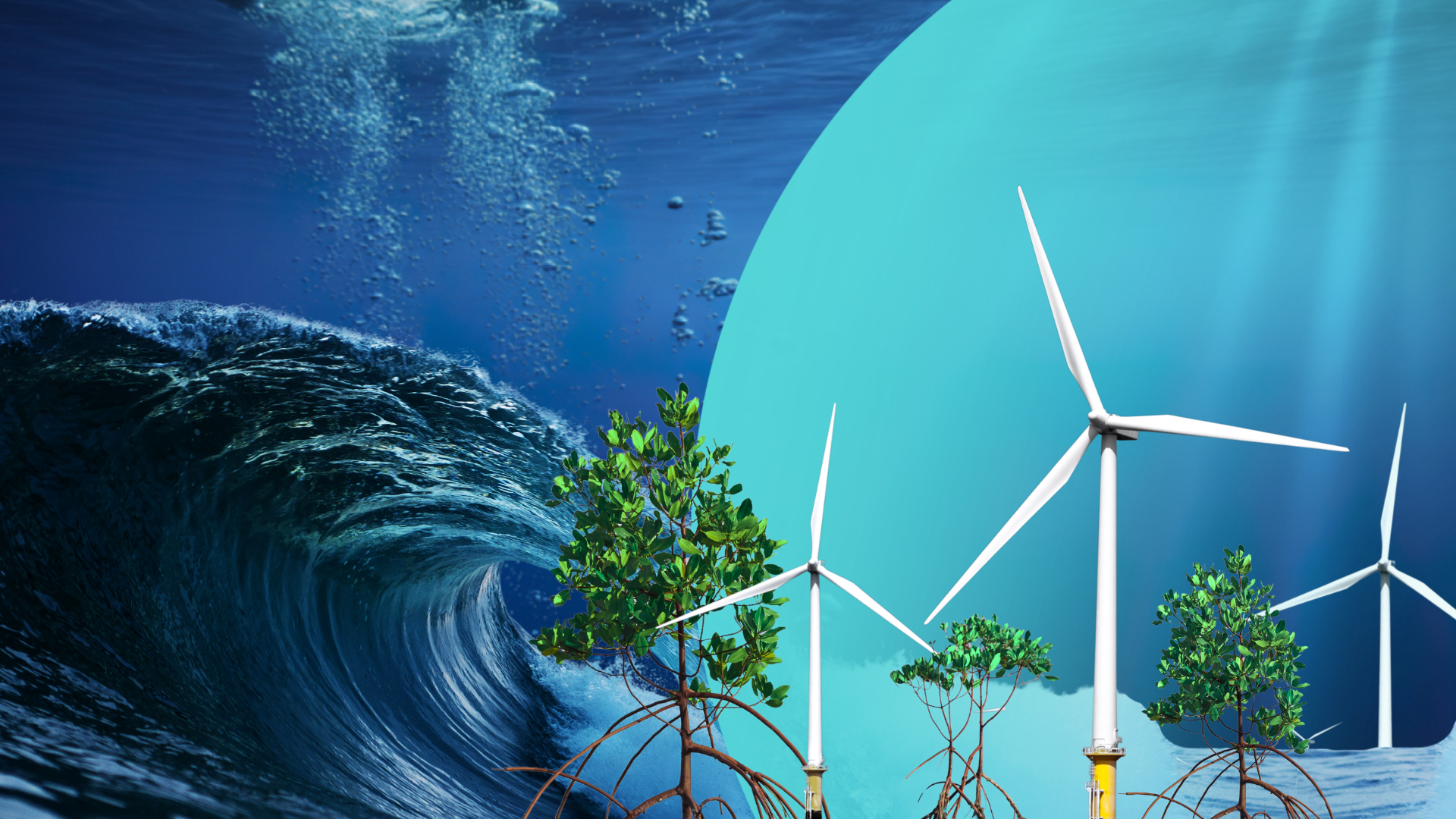
Composite image depicting ocean-based climate solutions

Press Contacts

If you are a journalist and would like to republish Project Drawdown content, please contact press@drawdown.org.

Key Takeaways

  • Ocean climate solutions are highly diverse and at very different stages of readiness.
  • Offshore wind is a top ocean-based climate solution, with an estimated achievable impact of 1.90–3.04 Gt CO2-eq/yr. Protecting coastal wetlands and seaweed ecosystems could save an additional 0.21–0.30 Gt CO₂‑eq/yr.
  • Ocean actions, including restoring ecosystems, reducing overfishing, improving aquaculture and fishing vessel efficiency, and protecting the seafloor, can contribute to climate goals, but their estimated climate impacts are smaller (<0.1 Gt CO₂‑eq/yr ).
  • Other marine CO₂ removal approaches remain highly uncertain. Some approaches may eventually be important, while others are not recommended because expected benefits are low and/or ecological risks are high.
  • Ocean climate funding has grown rapidly, but major multi-billion-dollar gaps persist and recent cuts to ocean observatory infrastructure undermine the ability to evaluate climate action.
  • Ocean solutions are important, but they are only one part of our climate action tool kit. Some of the highest-impact, highest-certainty climate actions available now are outside the ocean.

The oceans store an incredible share, nearly one quarter, of the carbon emitted by humans. Climate solutions that enhance this ability or cut emissions are now receiving growing attention, given their potential to scale to globally meaningful levels of climate action. With many possible ocean climate solutions floating around, which are low-regret actions that we should act on now, and which remain overhyped?  

To answer this, the Drawdown Explorer team took a deep dive and identified more than a dozen ocean-based solutions, ranging from nature-based protection and restoration to marine carbon farming, offshore energy, and engineered carbon removal. My work over the past 15 months as a Food, Agriculture, Land, and Ocean sector fellow, with a focus on coastal and ocean solutions, has given me a cross-sector view of how these approaches compare with others in the ocean sector and beyond. Here's where ocean solutions currently make the cut and where they fall short: 

What’s Ready, What’s Risky?

Of all the ocean solutions we have reviewed so far, only a handful rose to the top, exceeding 0.1 Gt CO₂‑eq/yr in climate impact needed to be highly recommended. The most impactful either cut emissions by reducing fossil fuel use or prevent the loss of ecosystems that remove and store carbon. 

The single biggest opportunity in this space is the deployment of offshore wind.

The single biggest opportunity in this space is the deployment of offshore wind. By replacing fossil fuel–based energy, offshore wind could deliver an estimated achievable impact of 1.90–3.04 Gt CO₂‑eq/yr making it one of the most important mitigation options on land or at sea. However, offshore wind must be sited carefully to avoid disrupting carbon-sequestering ecosystems.

Such ecosystems provide the next best opportunity. Protecting coastal wetlands (salt marshes, seagrasses, mangroves) and seaweed ecosystems from ongoing loss, which has been approaching 1.2–3.5% of their global distribution or more annually, can help prevent the carbon they store from being released while also maintaining their ability to remove carbon. Collectively, protecting coastal and ocean ecosystems could deliver a climate benefit of up to 0.21–0.30 Gt CO₂‑eq/yr, placing them on the low end of our Highly Recommended solutions set despite being frequently touted as a major global climate mitigation strategy. That said, these solutions are well worth deploying because they are ready now and they provide substantial benefits beyond carbon.

Many other ocean climate solutions remain worthwhile despite limitations in scale and climate impact. For instance, restoring coastal wetlands (mangrovessalt marshesseagrasses) and seaweed ecosystemsreducing overfishingprotecting the seafloorimproving fishing vessel efficiency, and improving aquaculture can contribute to climate goals, although their impacts are expected to be much smaller (<0.1 Gt CO₂‑eq/yr each).

More novel marine CO₂ removal approaches remain uncertain, and all face challenges in proving they reliably work, can be scaled, and are cost-effective and low-risk. These include ocean alkalinity enhancement and ocean electrochemistry, which aim to increase the ocean’s capacity to store carbon by altering seawater chemistry, and seaweed farming for food. Such approaches could become more important over time, but they still face major questions.

Others, including ocean biomass sinkingartificial upwelling, and ocean fertilization, are not recommended because they are likely not effective (e.g., artificial upwelling) and/or they manipulate ocean biology, which could create novel, widespread ecological risks that ripple across our oceans and whose effects we don’t yet fully understand but expect to be widespread if deployed at scale. 

The Ocean Funding Gap

Funding to advance ocean climate solutions has grown rapidly in recent years, but it remains insufficient. Offshore wind and ocean protection, which have clear and immediate climate value, need more funding for implementation. Novel marine carbon dioxide removal (mCDR) approaches also require significant additional investment, but in this case to resolve basic questions.

Ocean climate funding, which includes offshore wind as well as early-stage mCDR, increased from about US$31 million in foundation funding in 2018 to US$238 million in 2024. Offshore wind received about US$59 million in foundation funding in 2024 and nearly US$128 million in venture capital funding. However, this is just a fraction of what’s needed for offshore wind, with estimated investment needs of US$100 billion by 2050.

Ocean protection funding shows a different pattern. Funding from all sources is estimated at about US$1.2 billion/yr but has plateaued despite an estimated need of nearly US$16 billion/yr to achieve 30x30, the global target to protect 30% of the ocean by 2030. Foundation funding for protected areas and habitat protection has grown to about US$344 million in 2024 from under US$150 million in 2015, but remains far below the need.
[N]ovel mCDR should not divert funding that can be used to support deployment of proven ocean solutions that are ready now, yet remain severely underfunded. 

On the other hand, mCDR approaches, which largely remain in active research and development, secured about US$25 million in foundation funding in 2024, and mCDR companies have raised at least US$239 million in venture capital funds. This might sound like a lot, but estimates suggest that mCDR research could require roughly US$2.0–2.1 billion over five to 10 years just to address fundamental questions. However, mCDR funding should be selective and prioritize approaches with plausible carbon benefits and low risk. And, most importantly, novel mCDR should not divert funding that can be used to support deployment of proven ocean solutions that are ready now, yet remain severely underfunded. 

Finally, funding for ocean climate solutions must also include support for long-term monitoring needed to track not only the impacts of climate change but also the effects of climate interventions. The dismantling of ocean science observatories directly undermines this ability, and action is needed now to avoid further loss. So, as attention and funding grow in the ocean climate space, we must not lose sight of funding ocean investments that support the shared scientific infrastructure underlying ocean climate action and the proven solutions ready for deployment now.

Beyond the Ocean

My past 15 months as a research fellow with Project Drawdown working on climate solutions across land and sea have also forced me to confront something uncomfortable. The coastal nature-based solutions closest to my own work are not the ones that will move the climate needle fastest at a global scale.

Working across dozens of ocean- and land-based solutions at Project Drawdown has sharpened my view of where the ocean fits into the broader picture. I now recognize that some of the highest-impact, highest-certainty climate actions available right now are not even in the ocean. They are on land: deploying renewable energy (utility-scale and distributed solar energyonshore wind turbines), improving dietsreducing food loss and wastedeploying alternative refrigerantsimproving windows and glass, and protecting forests

The bottom line: The oceans offer proven, impactful climate solutions that deserve additional funding to boost deployment. In addition, we must invest in expanding the shared research infrastructure needed to understand changes in our oceans. But, ultimately, a responsible climate portfolio requires looking across disciplines, sectors, and the land-sea boundary to ensure we prioritize actions in a way that will best protect not only the oceans, but our entire planet.


Christina Richardson, Ph.D., is a coastal hydrologist and biogeochemist who studies the impacts of climate change and other disturbances, like wildfire, on aquatic ecosystems. She has worked on a wide range of projects across the terrestrial-marine nexus. At Project Drawdown, her work focuses on climate solutions at the coast and in the ocean.

This work is published under a Creative Commons CC BY-NC-ND 4.0 license. You are welcome to republish it following the license terms.
 

Press Contacts

If you are a journalist and would like to republish Project Drawdown content, please contact press@drawdown.org.