Surface, ground, and rainwater used for ecological and human use.

Icon

Deploy Utility-Scale Solar PV

Sector
Electricity
Image
Image
Utility-scale solar photovoltaic array
Coming Soon
On
Summary

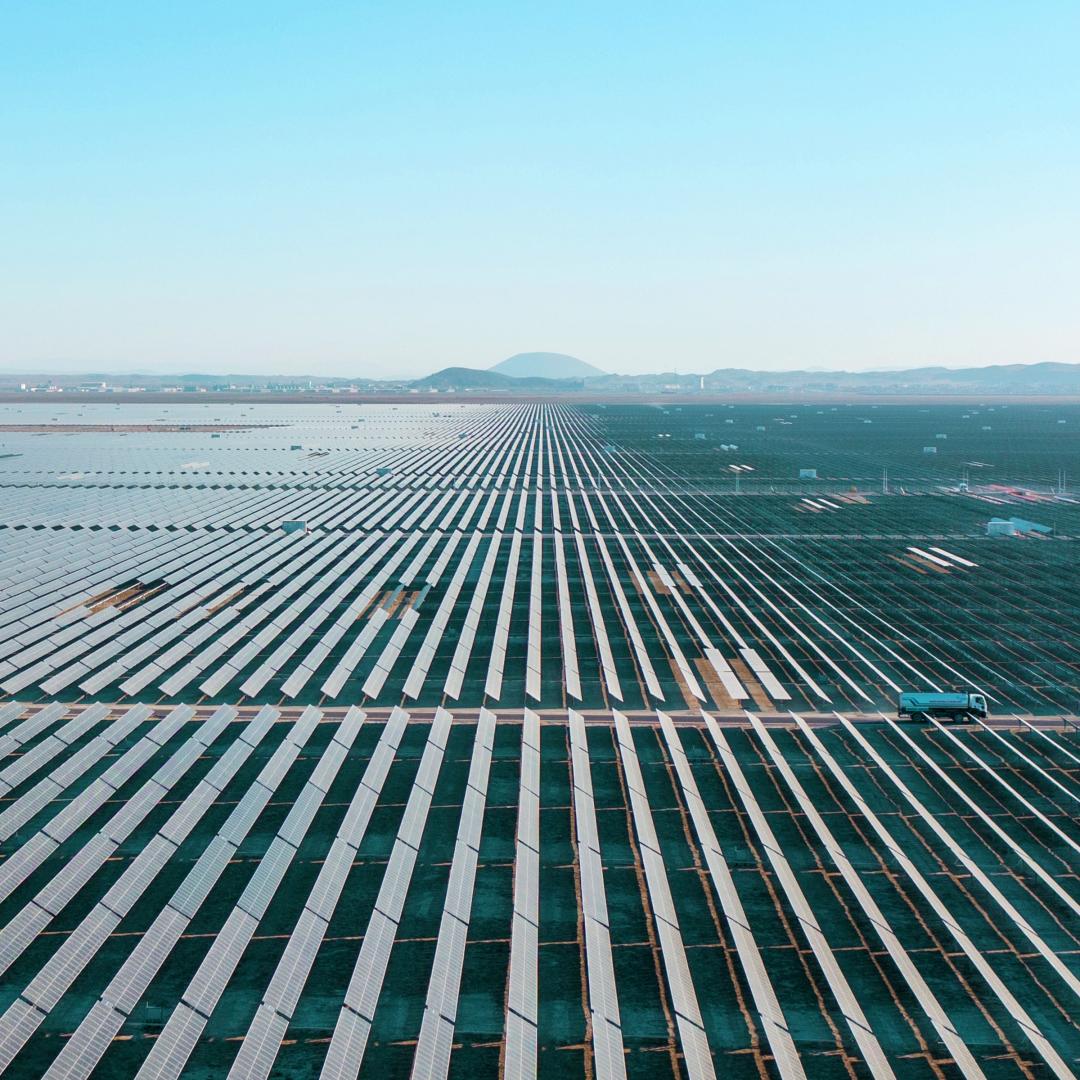
Utility-scale solar PV refers to large solar power systems, typically installed on open land and connected directly to a central electric grid, that generate electricity for widespread distribution. These systems generally have an installed capacity above 1 MW. There are various configurations of utility-scale solar PV systems and we include fixed-tilt and tracking systems in this solution. Systems on cropland are also considered in this solution, but dual production of crops and solar energy on the same land area is analyzed as a separate agrivoltaics solution.

Description for Social and Search
The Deploy Utility-Scale Solar PV solution is coming soon.
Overview

An estimated 23% of GHG emissions on a 100-year basis comes from electricity generation annually (Clarke et al., 2022), and in 2022, more than 60% of global electricity generation came from fossil fuel–based energy sources (International Energy Agency [IEA], 2024b). Since solar is a clean, renewable resource, utility-scale solar PV does not contribute to GHG emissions or air pollution while generating energy. Deploying utility-scale solar PV reduces the need for electricity generation from fossil fuels, which reduces CO₂ emissions, as well as smaller amounts of methane and nitrous oxide

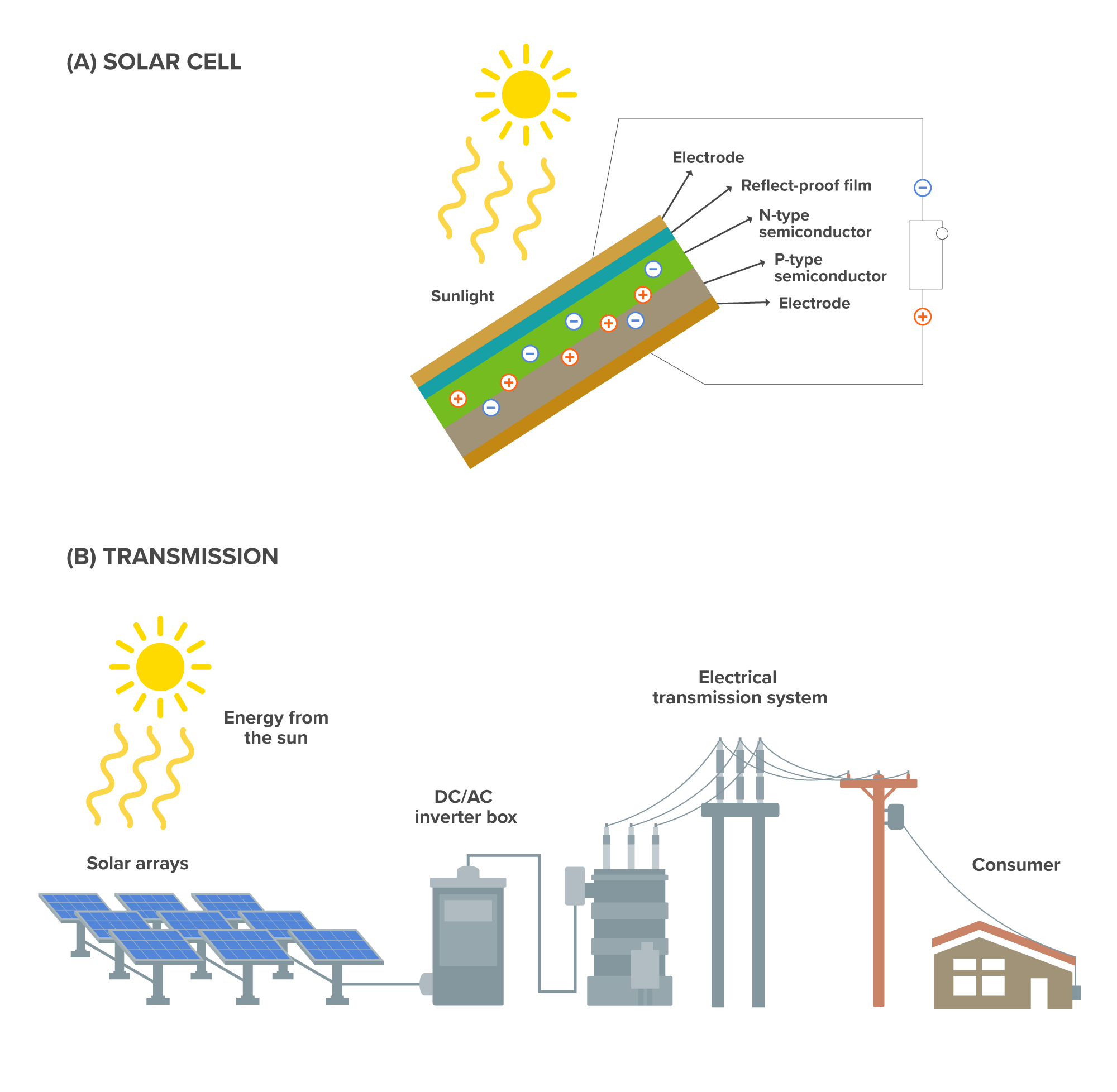
Utility-scale solar PV systems generate electricity by converting sunlight directly into electrical energy through the photovoltaic effect. These systems typically consist of large arrays of solar panels made from semiconductor materials (most commonly crystalline silicon), inverters that convert direct current (DC) electricity to alternating current (AC), structural mounting systems, and transformers. When sunlight strikes the surface of a solar panel, light energy is absorbed and transferred to electrons in the semiconductor material. If the energy is high enough, electrons then move between semiconductor layers producing a flow of electric current (US EIA, 2024). This electricity is routed through inverters, converted into grid-compatible AC power, and delivered to substations and transmission lines (Figure 1). The amount of electricity generated depends on the system size, the intensity of sunlight at the location (solar irradiance), panel efficiency, and the system’s capacity factor. Utility-scale solar PV achieves capacity factors of 9–35%, depending on geography, seasonal variation, and system design (Bolinger et al., 2023). 

There are two main categories of utility-scale systems – fixed-tilt installations, where solar panels are mounted in a static position, and tracking systems, which rotate to follow the sun’s path across the sky, improving energy yield. Newer advances in module design, including bifacial modules and cell technologies such as perovskite-silicon tandem cells, continue to improve system efficiency and lower overall costs of utility-scale solar PV (Gu et al., 2020; Mdallal et al., 2025). 

Utility-scale solar PV generates additional benefits, such as reduced air pollution, lower water use compared to thermal power plants, and relatively fewer public health impacts from energy production. While there are emissions associated with the manufacturing, transportation, and installation of utility-scale solar PV panels, these life-cycle emissions are more than 10 times lower than emissions from fossil fuel–based electricity generation (National Renewable Energy Laboratory [NREL], 2021). These life-cycle emissions are not quantified in this assessment but are typically addressed under industry- or supply chain-focused solutions. Because utility-scale solar PV produces no emissions during operation, the technology contributes significantly to clean energy transitions. 

Figure 1. (a) Anatomy of a solar cell. Two layers of semiconductor material – most commonly crystalline silicone – are sandwiched between electrodes. Both layers together create a silicon wafer. The layers of this silicon wafer are oppositely charged, which creates an electric field at the material interface. When energy from the sun is absorbed, electrons with sufficient energy cross the electric field and flow towards the electrodes, creating an electric current. (b) Solar panels are built by combining multiple solar cells into modules; multiple panels are used in a solar array. After electricity generation, inverters and transmission systems deliver power to consumers. Modified from (a) Husain et al. and (b) Renew Wisconsin.

Image
Diagrams demonstrating components of a solar cell and a utility-scale transmission system

Sources: Husain, A.A., Hasan, W.Z.W., Shafie, S., Hamidon, M.N., & Pandey, S.S. (2018). Renewable and Sustainable Energy Reviews, 94, 779–791; (b) Renew Wisconsin. (2018). Utility-scale solar in Wisconsin.

Abel, D., Holloway, T., Harkey, M., Rrushaj, A., Brinkman, G., Duran, P., Janssen, M., Denholm, P. (2018). Potential air quality benefits from increased solar photovoltaic electricity generation in the Eastern United States. Atmospheric Environment175, 65–74. Link to source: https://doi.org/10.1016/j.atmosenv.2017.11.049 

Adeh, E. H., Good, S. P., Calaf, M., & Higgins, C. W. (2019). Solar PV Power Potential is Greatest Over Croplands. Scientific Reports 2019 9:19(1), 1–6. Link to source: https://doi.org/10.1038/s41598-019-47803-3

Ahmad, A., Power, N., & Finegan, E. (2025). Maximising solar PV potential: A comprehensive review of factors affecting photovoltaic installation and generation in a mild temperate oceanic climate. Solar Energy Advances5, Article 100111. Link to source: https://doi.org/10.1016/J.SEJA.2025.100111 

Ahmad, M., Zeeshan, M., & Khan, J. A. (2023). Life cycle multi-objective (geospatial, techno-economic, and environmental) feasibility and potential assessment of utility scale photovoltaic power plants. Energy Conversion and Management291Link to source: https://doi.org/10.1016/j.enconman.2023.117260

Badza, K., Soro, Y. M., & Sawadogo, M. (2023). Life cycle assessment of a 33.7 MW solar photovoltaic power plant in the context of a developing country. Sustainable Environment Research33(1), 1–15. Link to source: https://doi.org/10.1186/S42834-023-00201-X

Baik, E., Chawla, K. P., Jenkins, J. D., Kolster, C., Patankar, N. S., Olson, A., Benson, S. M., Long, J. C. S. (2021). What is different about different net-zero carbon electricity systems? Energy and Climate Change, 2, Article 100046. Link to source: https://doi.org/10.1016/j.egycc.2021.100046

Bajagain, R., Panthi, G., An, Y.-J., & Jeong, S.-W. (2020). Current Practices on Solar Photovoltaic Waste Management: An Overview of the Potential Risk and Regulatory Approaches of the Photovoltaic Waste. Journal of Korean Society of Environmental Engineers42(12). Link to source: https://doi.org/https://doi.org/10.4491/KSEE.2020.42.12.690

Bamisile, O., Acen, C., Cai, D., Huang, Q., & Staffell, I. (2025). The environmental factors affecting solar photovoltaic output. Renewable and Sustainable Energy Reviews208, Article 115073. Link to source: https://doi.org/10.1016/J.RSER.2024.115073 

Beiter, P., Guillet, J., Jansen, M., Wilson, E., & Kitzing, L. (2024). The enduring role of contracts for difference in risk management and market creation for renewables. Nature Energy9, 20–26. Link to source: https://doi.org/10.1038/s41560-023-01401-w 

Bistline, J.E.T., Watten, A. (2025). Emissions reductions of rooftop solar are overstated by approaches that inadequately capture substitution effects. Nature Climate Change15, 1173–1175. Link to source: https://doi.org/10.1038/s41558-025-02459-y

Bolinger, M., Seel, J., Kemp, J. M., Warner, C., Katta, A., & Robson, D. (2023). Utility-Scale Solar, 2023 Edition: Empirical Trends in Deployment, Technology, Cost, Performance, PPA Pricing, and Value in the United StatesLink to source: https://emp.lbl.gov/publications/utility-scale-solar-2023-edition 

Bolinger, M., Wiser, R., & O’Shaughnessy, E. (2022). Levelized cost-based learning analysis of utility-scale wind and solar in the United States. IScience25(6). Link to source: https://doi.org/10.1016/J.ISCI.2022.104378

Brown, T. & Reichenberg, L. (2021). Decreasing market value of variable renewables can be avoided by policy action. Energy Economics100, Article 105354. Link to source: https://doi.org/10.1016/j.eneco.2021.105354

Buonocore, J. J., Hughes, E. J., Michanowicz, D. R., Heo, J., Allen, J. G., and Williams, A. (2019). Climate and health benefits of increasing renewable energy deployment in the United States. Environmental Research Letters14, Article 114010. Link to source: https://doi.org/10.1088/1748-9326/ab49bc

Chopdar, R. K., Sengar, N., Giri, N. C., & Halliday, D. (2024). Comprehensive review on agrivoltaics with technical, environmental and societal insights. Renewable and Sustainable Energy Reviews197. Article 114416. Link to source: https://doi.org/10.1016/j.rser.2024.114416

Chowdhury, M. S., Rahman, K. S., Chowdhury, T., Nuthammachot, N., Techato, K., Akhtaruzzaman, M., Tiong, S. K., Sopian, K., & Amin, N. (2020). An overview of solar photovoltaic panels’ end-of-life material recycling. Energy Strategy Reviews27, 100431. Link to source: https://doi.org/10.1016/J.ESR.2019.100431

Clarke, L., Wei, Y.-M., De La Vega Navarro, A., Garg, A., Hahmann, A. N., Khennas, S., Azevedo, I. M. L., Löschel, A., Singh, A. K., Steg, L., Strbac, G., & Wada, K. (2022). Energy Systems. In P. R. Shukla, J. Skea, R. Slade, A. Al Khourdajie, R. van Diemen, D. McCollum, M. Pathak, S. Some, P. Vyas, R. Fradera, M. Belkacemi, A. Hasija, G. Lisboa, S. Luz, & J. Malley (Eds.), Climate change 2022: Mitigation of climate change. Contribution of working group III to the sixth assessment report of the intergovernmental panel on climate change (pp. 613–746). Cambridge University Press. Link to source: https://doi.org/10.1017/9781009157926.008

Dato, P., Dioha, M., Hessou, H., Houenou, B., Mukhaya, B., Okyere, M. A., & Odarno, L. (2025). Computation of weighted average cost of capital (WACC) in the power sector for African countries and the implications for country-specific electricity technology cost. Applied Energy397, Article 126333. Link to source: https://doi.org/10.1016/J.APENERGY.2025.126333

de La Beaumelle, N. A., Blok, K., de Chalendar, J. A., Clarke, L., Hahmann, A. N., Huster, J., Nemet, G. F., Suri, D., Wild, T. B., & Azevedo, I. M. L. (2023). The Global Technical, Economic, and Feasible Potential of Renewable Electricity. Annual Review of Environment and Resources48, 419–449. Link to source: https://doi.org/10.1146/ANNUREV-ENVIRON-112321-091140/1

Deng, Y. Y., Haigh, M., Pouwels, W., Ramaekers, L., Brandsma, R., Schimschar, S., Grözinger, J., & de Jager, D. (2015). Quantifying a realistic, worldwide wind and solar electricity supply. Global Environmental Change31, 239–252. Link to source: https://doi.org/10.1016/J.GLOENVCHA.2015.01.005

Diffendorfer, J. E., Sergi, B., Lopez, A., Williams, T., Gleason, M., Ancona, Z., & Cole, W. (2024). The interplay of future solar energy, land cover change, and their projected impacts on natural lands and croplands in the US. Science of The Total Environment947, Article 173872. Link to source: https://doi.org/10.1016/J.SCITOTENV.2024.173872

Dimanchev, E., Gabriel, S. A., Reichenberg, L., & Korpås, M. (2024). Consequences of the missing risk market problem for power system emissions. Energy Economics136, Article 107639. Link to source: https://doi.org/10.1016/j.eneco.2024.107639 

Dioha, M. O. (2025). How can we finance a fair energy transition in Africa? Link to source: https://drawdown.org/insights/how-can-we-finance-a-fair-energy-transition-in-africa

DNV. (2024). Energy transition outlook 2024Link to source: https://brandcentral.dnv.com/original/gallery/10651/files/original/5c2470ac-597c-43f9-87dd-4e6b238d7845.pdf 

Dupont, E., Koppelaar, R., & Jeanmart, H. (2020). Global available solar energy under physical and energy return on investment constraints. Applied Energy257, Article 113968. Link to source: https://doi.org/10.1016/J.APENERGY.2019.113968

Firoozi, A. A., Firoozi, A. A., & Maghami, M. R. (2025). Harnessing photovoltaic innovation: Advancements, challenges, and strategic pathways for sustainable global development. Energy Conversion and Management: X27, Article 101058. Link to source: https://doi.org/10.1016/J.ECMX.2025.101058

Frew, B., Sergi, B., Denholm, P., Cole, W., Gates, N., Levie, D., & Margolis, R. (2021). The curtailment paradox in the transition to high solar power systems. Joule5(5), 1143–1167. Link to source: https://doi.org/10.1016/J.JOULE.2021.03.021

Gadzanku, S., Kramer, A., and Smith, B., L. (2023). An updated review of the solar PV installation workforce literature. National Renewable Energy Laboratory. NREL/TP-7A40-83652. Link to source: https://www.nrel.gov/docs/fy23osti/83652.pdf

Gagnon, P. & O’Shaughnessy, E. (2024). Consequential analysis of the greenhouse gas emissions impacts of actions that influence the electric grid: The theory and practice of using marginal emissions rates. NREL/TP-6A40-91580. National Renewable Energy Laboratory. Link to source: https://www.nrel.gov/docs/fy25osti/91580.pdf

Gallagher, C. L. and Tracey, H. (2020). Integrating air quality and public health benefits in U.S. decarbonization strategies. Frontiers in Public Health8Link to source: https://www.frontiersin.org/journals/public-health/articles/10.3389/fpubh.2020.563358

Giri, N. C., & Mohanty, R. C. (2022). Agrivoltaic system: Experimental analysis for enhancing land productivity and revenue of farmers. Energy for Sustainable Development70, 54–61. Link to source: https://doi.org/10.1016/J.ESD.2022.07.003

Gan, Y., Elgowainy, A., Lu, Z., Kelly, J. C., Wang, M., Boardman, R. D., & Marcinkoski, J. (2023). Greenhouse gas emissions embodied in the U.S. solar photovoltaic supply chain. Environmental Research Letters18(10), Article 104012. Link to source: https://doi.org/10.1088/1748-9326/ACF50D

Gorman, W., Kemp, J. M., Rand, J., Seel, J., Wiser, R., Manderlink, N., Kahrl, F., Porter, K., & Cotton, W. (2025). Grid connection barriers to renewable energy deployment in the United States. Joule9(2), Article 101791. Link to source: https://doi.org/10.1016/j.joule.2024.11.008

Gu, W., Ma, T., Ahmed, S., Zhang, Y., & Peng, J. (2020). A comprehensive review and outlook of bifacial photovoltaic (bPV) technology. Energy Conversion and Management223. Article 113283. Link to source: https://doi.org/10.1016/J.ENCONMAN.2020.113283

Haas, R., Sayer, M., Ajanovic, A., & Auer, H. (2023). Technological learning: Lessons learned on energy technologies. Wiley Interdisciplinary Reviews: Energy and Environment12(2), Article e463. Link to source: https://doi.org/10.1002/WENE.463

Hernandez, R. R., Easter, S. B., Murphy-Mariscal, M. L., Maestre, F. T., Tavassoli, M., Allen, E. B., Barrows, C. W., Belnap, J., Ochoa-Hueso, R., Ravi, S., & Allen, M. F. (2014). Environmental impacts of utility-scale solar energy. Renewable and Sustainable Energy Reviews29, 766–779. Link to source: https://doi.org/10.1016/J.RSER.2013.08.041

International Energy Agency. (2022). Solar PV global supply chainsLink to source: https://www.iea.org/reports/solar-pv-global-supply-chains 

International Energy Agency. (2023). Solar PV power capacity in the Net Zero Scenario, 2015-2030Link to source: https://www.iea.org/data-and-statistics/charts/solar-pv-power-capacity-in-the-net-zero-scenario-2015-2030 

International Energy Agency. (2024a). World Energy Outlook 2024Link to source: https://www.iea.org/reports/world-energy-outlook-2024

International Energy Agency. (2024b). World energy balances—Data product. Link to source: https://www.iea.org/data-and-statistics/data-product/world-energy-balances 

International Energy Agency PVPS. (2023). Trends in photovoltaic applications 2023Link to source: https://iea-pvps.org/wp-content/uploads/2023/10/PVPS_Trends_Report_2023_WEB.pdf

International Energy Agency PVPS. (2024a). Best practices handbook for the collection and use of solar resource data for solar energy applications: Fourth edition 2024 Link to source: https://iea-pvps.org/wp-content/uploads/2024/09/Best-Practices-Handbook-for-the-Collection-and-Use-of-Solar-Resource-Data-for-Solar-Energy-Applications-Fourth-Edition-.pdf

International Energy Agency PVPS. (2024b). Trends in photovoltaic applications 2024Link to source: https://iea-pvps.org/wp-content/uploads/2024/10/IEA-PVPS-Task-1-Trends-Report-2024.pdf

International Energy Agency-ETSAP and IRENA. (2015). Renewable energy integration in power grids: Technology briefLink to source: https://www.irena.org/-/media/Files/IRENA/Agency/Publication/2015/IRENA-ETSAP_Tech_Brief_Power_Grid_Integration_2015.pdf

IPCC. (2023). Climate change 2023: Synthesis report. Contribution of working groups I, II and III to the Sixth Assessment Report of the Intergovernmental Panel on Climate Change [Core Writing Team, H. Lee and J. Romero (eds.)]. IPCC, Geneva, Switzerland. Link to source: https://www.ipcc.ch/report/ar6/syr/downloads/report/IPCC_AR6_SYR_SPM.pdf 

International Renewable Energy Agency. (2019). Future of solar photovoltaic: Deployment, investment, technology, grid integration and socio-economic aspects (A global energy transformation: paper)Link to source: https://www.irena.org/-/media/Files/IRENA/Agency/Publication/2019/Nov/IRENA_Future_of_Solar_PV_2019.pdf

International Renewable Energy Agency. (2024). Renewable power generation costs in 2023Link to source: https://www.irena.org/Publications/2024/Mar/Renewable-capacity-statistics-202

International Renewable Energy Agency. (2024b). Renewable energy capacity statistics 2024—Data product. Link to source: https://www.irena.org/Publications/2024/Mar/Renewable-capacity-statistics-2024

International Renewable Energy Agency. (2025). Renewable power generation costs in 2024Link to source: https://www.irena.org/-/media/Files/IRENA/Agency/Publication/2025/Jul/IRENA_TEC_RPGC_in_2024_2025.pdf

International Renewable Energy Agency and International Labour Organization. (2024). Renewable energy and jobs: Annual review 2024Link to source: https://www.irena.org/-/media/Files/IRENA/Agency/Publication/2024/Oct/IRENA_Renewable_energy_and_jobs_2024.pdf 

International Renewable Energy Agency & International Energy Agency-PVPS. (2016). End-of-life management: Solar photovoltaic panelsLink to source: https://www.irena.org/-/media/Files/IRENA/Agency/Publication/2016/IRENA_IEAPVPS_End-of-Life_Solar_PV_Panels_2016.pdf

Lafitte, A., Sordello, R., Ouédraogo, D. Y., Thierry, C., Marx, G., Froidevaux, J., Schatz, B., Kerbiriou, C., Gourdain, P., & Reyjol, Y. (2023). Existing evidence on the effects of photovoltaic panels on biodiversity: a systematic map with critical appraisal of study validity. Environmental Evidence12(1), 1–25. Link to source: https://doi.org/10.1186/S13750-023-00318-X

Mdallal, A., Yasin, A., Mahmoud, M., Abdelkareem, M. A., Alami, A. H., & Olabi, A. G. (2025). A comprehensive review on solar photovoltaics: Navigating generational shifts, innovations, and sustainability. Sustainable Horizons13, Article 100137. Link to source: https://doi.org/10.1016/J.HORIZ.2025.100137

Mehedi, T. H., Gemechu, E., & Kumar, A. (2022). Life cycle greenhouse gas emissions and energy footprints of utility-scale solar energy systems. Applied Energy314, Article 118918. Link to source: https://doi.org/10.1016/J.APENERGY.2022.118918

Millstein, D., Wiser, R., Bolinger, M., & Barbose, G. (2017). The climate and air-quality benefits of wind and solar power in the United States. Nature Energy2(9), Article 17134. Report #: ARTN 17134. Link to source: http://dx.doi.org/10.1038/nenergy.2017.134

 Millstein, D., O'Shaughnessy, E., & Wiser, R. (2024). Climate and air quality benefits of wind and solar generation in the United States from 2019 to 2022. Cell Reports Sustainability1(6), Article 100105. Link to source: https://doi.org/10.1016/j.crsus.2024.100105

NEA, & IEA. (2020). Projected Costs of Generating ElectricityLink to source: https://www.oecd-nea.org/upload/docs/application/pdf/2020-12/egc-2020_2020-12-09_18-26-46_781.pdf

NREL. (2021). Life Cycle Greenhouse Gas Emissions from Electricity Generation: UpdateLink to source: https://docs.nrel.gov/docs/fy21osti/80580.pdf

Ovaitt, S., Mirletz, H., Seetharaman, S., & Barnes, T. (2022). PV in the circular economy, a dynamic framework analyzing technology evolution and reliability impacts. IScience25(1). Link to source: https://doi.org/10.1016/J.ISCI.2021.103488

Pehl, M., Arvesen, A., Humpenöder, F., Popp, A., Hertwich, E. G., & Luderer, G. (2017). Understanding future emissions from low-carbon power systems by integration of life-cycle assessment and integrated energy modelling. Nature Energy 2017 2:122(12), 939–945. Link to source: https://doi.org/10.1038/s41560-017-0032-9

Peters, I. M. (2025). Strategic Global Deployment of Photovoltaic Technology: Balancing Economic Capacity and Decarbonization Potential. Advances in Atmospheric Sciences42, 261–268. Link to source: https://doi.org/10.1007/s00376-024-4176-9

Pincelli, I. P., Hinkley, J., & Brent, A. (2024). Carbon, materials and energy footprint of a utility-scale solar plant in Aotearoa New Zealand. Solar Energy273, Article 112535. Link to source: https://doi.org/10.1016/J.SOLENER.2024.112535

Reinsch, W. A., & Arrieta-Kenna, S. (2021). A Dark Spot for the Solar Energy Industry: Forced Labor in XinjiangLink to source: https://www.csis.org/analysis/dark-spot-solar-energy-industry-forced-labor-xinjiang

Rivera, N. M., Ruiz-Tagle, J. C., and Spiller, E. (2024). The health benefits of solar power generation: Evidence from Chile. Journal of Environmental Economics and Management126, Article 102999. Link to source: https://doi.org/10.1016/j.jeem.2024.102999

Shyu, C. W., & Yang, T. I. (2025). Socio-technical tensions from community acceptance, energy transition, and energy justice: Lessons from solar photovoltaic projects in Taiwan. Applied Energy384, Article 125415. Link to source: https://doi.org/10.1016/J.APENERGY.2025.125415

Smith, B. L., Sekar, A., Mirletz, H., Heath, G., & Margolis, R. (2024). An Updated Life Cycle Assessment of Utility-Scale Solar Photovoltaic Systems Installed in the United States Link to source: https://www.nrel.gov/docs/fy24osti/87372.pdf

SolarPower Europe. (2025). Global market outlook for solar power 2025-2029 Link to source: https://api.solarpowereurope.org/uploads/Global_Market_Outlook_2025_v1_aaebd9698b.pdf

Suri, D., de Chalendar, J. & Azevedo, I.M.L. (2025). Assessing the real implications for CO2 as generation from renewables increases. Nature Communications16, Article 7124. Link to source: https://doi.org/10.1038/s41467-025-59800-4

Susskind, L., Chun, J., Gant, A., Hodgkins, C., Cohen, J., & Lohmar, S. (2022). Sources of opposition to renewable energy projects in the United States. Energy Policy165, Article 112922. Link to source: https://doi.org/10.1016/J.ENPOL.2022.112922

Tambari, I. T., Dioha, M. O., & Failler, P. (2020). Renewable energy scenarios for sustainable electricity supply in Nigeria. Energy and Climate Change1, Article 100017. Link to source: https://doi.org/10.1016/J.EGYCC.2020.100017

Tawalbeh, M., Al-Othman, A., Kafiah, F., Abdelsalam, E., Almomani, F., & Alkasrawi, M. (2021). Environmental impacts of solar photovoltaic systems: A critical review of recent progress and future outlook. Science of The Total Environment759, Article 143528. Link to source: https://doi.org/10.1016/J.SCITOTENV.2020.143528

Truitt, S., Elsworth, J., Williams, J., Keyser, D., Moe, A., Sullivan, J., and Wu, K. (2022). State-level employment projections for four clean energy technologies in 2025 and 2030. National Renewable Energy Laboratory. NREL/TP-5500-81486. Link to source: https://www.nrel.gov/docs/fy22osti/81486.pdf

US EIA. (2024). Photovoltaics and electricity - U.S. Energy Information Administration (EIA)Link to source: https://www.eia.gov/energyexplained/solar/photovoltaics-and-electricity.php 

van de Ven, D. J., Capellan-Peréz, I., Arto, I., Cazcarro, I., de Castro, C., Patel, P., & Gonzalez-Eguino, M. (2021). The potential land requirements and related land use change emissions of solar energy. Scientific Reports11(1), 1–12. Link to source: https://doi.org/10.1038/S41598-021-82042-5

Wiser, R., Millstein, D., Mai, T., Macknick, J., Carpenter, A., Cohen, S., Cole, W., Frew, B., and Heath, G. (2016). The environmental and public health benefits of achieving high penetrations of solar energy in the United States. Energy113, 472–486. Link to source: https://doi.org/10.1016/j.energy.2016.07.068

Wolak, F. A. (2022). Long-term resource adequacy in wholesale electricity markets with significant intermittent renewables. Environmental and Energy Policy and the Economy3, 155–220. Link to source: https://doi.org/10.1086/717221 

Xu, Z., Li, Y., Qin, Y., & Bach, E. (2024). A global assessment of the effects of solar farms on albedo, vegetation, and land surface temperature using remote sensing. Solar Energy268, Article 112198. Link to source: https://doi.org/10.1016/J.SOLENER.2023.112198

Yavari, R., Zaliwciw, D., Cibin, R., & McPhillips, L. (2022). Minimizing environmental impacts of solar farms: a review of current science on landscape hydrology and guidance on stormwater management. Environmental Research: Infrastructure and Sustainability2(3), Article 032002. Link to source: https://doi.org/10.1088/2634-4505/AC76DD

Zubi, G., Parag, Y., & Wald, S. (2024). Implications of Large-Scale PV Integration on Grid Operation, Costs, and Emissions: Challenges and Proposed Solutions. Energies 2025, 18(1), 130. Link to source: https://doi.org/10.3390/EN18010130

Credits

Lead Fellow

  • Michael Dioha, Ph.D.

Contributors

  • Al-Amin Bugaje, Ph.D.

  • Ruthie Burrows, Ph.D.

  • James Gerber, Ph.D.

  • Daniel Jasper

  • Megan Matthews, Ph.D.

  • Alex Sweeney

Internal Reviewers

  • James Gerber, Ph.D.

  • Amanda D. Smith, Ph.D.

Effectiveness

Table 1. Effectiveness at reducing emissions.

Unit: t CO₂‑eq /MW installed capacity/yr, 100-yr basis

Estimate 760
Left Text Column Width

Based on data provided by the IEA, global emissions from electricity generation accounted for an estimated 530 kg CO₂‑eq /MWh (540 kg CO₂‑eq /MWh, 20-year basis) (IEA, 2024b; IEA, 2024b; see Methodology: Appendix A for calculation details). To convert from MWh to MW, we used the global weighted average capacity factor for utility-scale solar PV of 16.2% (International Renewable Energy Agency [IRENA], 2024). Utility-scale solar PV is estimated to reduce 760 t CO₂‑eq /MW (760 t CO₂‑eq /MW, 20-yr basis) of installed capacity annually (Table 1). 

To estimate the effectiveness of utility-scale solar PV, we assumed that newly installed utility-scale solar PV displaces an equivalent MWh of the global electricity grid mix. We then assumed the reduction in emissions from additional utility-scale solar PV capacity was equal to emissions (per MWh) from the 2023 global electricity grid mix (IEA, 2024b). Finally, we used the utility-scale solar PV capacity factor to convert to annual emissions per MW of installed capacity.

Actual avoided emissions will depend on the condition of the local grid at a particular time and place, including the level of solar already deployed (see Methodology, Appendix A). However, the relative emissions benefit from increased solar deployment depends on the energy sources it potentially displaces. Because solar energy output varies diurnally, demand peaks in the evenings need to be met by stored energy or other energy sources that can provide power as demand increases. In coal-dominated markets, increasing utility-scale solar PV generation could lead to overall increased emissions per MWh, even if coal plants operate less often because coal plants emit more during suboptimal operation and ramp-up/ramp-down phases (Suri et al., 2025). 

During operation, utility-scale solar PV emits negligible GHGs, so we assumed zero emissions per MW of installed capacity. However, emissions arise during manufacturing of components, transportation, installation, maintenance, and decommissioning, and are paid back within approximately 1–2 years (M. Ahmad et al., 2023; Badza et al., 2023; Mehedi et al., 2022; Pincelli et al., 2024; Smith et al., 2024). Studies from many different countries show that total emissions remain far below those of fossil fuel generation (Badza et al., 2023; Pincelli et al., 2024; NREL, 2021; Smith et al., 2024). Manufacturing using coal-intensive grids increases embodied emissions, highlighting the necessity of decarbonizing supply chains (Gan et al., 2023; Pehl et al., 2017).

In our analysis, we focused solely on emissions produced during electricity generation, so carbon payback time and embodied life-cycle emissions were not included in our estimates of effectiveness or climate impacts. 

left_text_column_width
Cost

We estimated a mean levelized cost of electricity (LCOE) for utility-scale solar PV of US$53/MWh based on three industry reports (IEA, 2024; IRENA, 2025; NEA & IEA, 2020; see Methodology: Appendix A for details). LCOE values represent the average cost of producing one MWh of electricity over the operational lifetime of a power plant, allowing investors to compare their expected revenue to a standard set of costs. This cost metric has been used by international agencies for cost comparison across generation technologies, incorporating installed capital costs, operation and maintenance (O&M), project lifespan, and energy output. According to IRENA, between 2010 and 2024 the global weighted average LCOE for utility-scale solar PV fell by 90%, from US$417/MWh to US$43/MWh. This decline was driven by cost reductions across the PV value chain, with module and inverter price declines accounting for 55% of the LCOE drop (IRENA, 2025). Technological advances such as larger wafer sizes, improved ingot growth methods, diamond wire wafering, and new cell architectures supported these changes. Balance-of-system (BoS) hardware contributed another 8%, while engineering, procurement, construction, installation, development, and other soft costs accounted for 28% of the reduction in LCOE (IRENA, 2025). Better financing conditions, improved capacity factors, and lower O&M costs also played a role.

Recent macroeconomic conditions have slightly reversed the downward trend. Between 2023 and 2024, the global weighted average LCOE for utility-scale solar PV increased by 0.6%, with 13 of the 15 largest markets experiencing cost increases ranging from 7% in Poland to 36% in Australia. Higher financing costs from inflation and elevated interest rates helped drive these shifts. Despite these headwinds, utility-scale solar PV remains one of the cheapest options worldwide for generating electricity. Our estimated global mean LCOE (US$53/MWh) is lower than the 2023 weighted average LCOE for fossil fuels, which was US$70–176/MWh (IRENA, 2024a). However, since LCOE excludes revenue, real-world costs of utility-scale solar generation could be higher than estimated here.

left_text_column_width
Methods and Supporting Data

Methods and Supporting Data

Learning Curve

Table 2. Learning rate: drop in cost per doubling of the installed utility-scale solar PV production capacity.

Units: %

25th percentile 30
Mean 34
Median (50th percentile) 34
75th percentile 38
Left Text Column Width

Utility-scale solar PV exhibits a pronounced learning curve, most clearly reflected in the steady decline of solar module prices as global deployment expands. The median learning rate for PV modules is estimated at 34%, meaning module prices fall by roughly one-third with every doubling of installed capacity (Table 2). Our estimated learning rate is based on trends in the past decade, while a longer historical estimate would be lower. According to a single source, significant economies of scale over the last decade have driven an even steeper learning rate of 42% (Masson et al., 2023). According to DNV’s 2024 energy transition outlook, the current global learning rate for module costs is about 26%, but projections suggest this will slow to around 17% by 2050 as cost components stabilize and the largest gains from scaling are realized (DNV, 2024). 

While module prices have seen the most dramatic reductions, similar trends are evident in total system costs. Studies tracking installed costs and LCOE for PV in the United States since 2007 report a 24% learning rate based on normalized LCOE for utility-scale PV, with an accelerated 45% between 2014 and 2020 (Bolinger et al., 2022). Between 2010 and 2023, IRENA (2024) found that utility-scale solar PV achieved the highest global weighted-average learning rate for total installed costs among major renewables at 33.4%. Haas et al. (2023) similarly estimated a 33% learning rate for installed costs between 2010 and 2019. Meanwhile, operational expenditure (OPEX) is also expected to benefit from incremental learning, with DNV (2024) projecting a 9% OPEX-based learning rate through 2050, supported by advances in digital monitoring and maintenance practices. 

The drivers of these declines include economies of scale, technology improvements, and manufacturing efficiencies such as larger wafer formats, improved cell architectures, and advanced wafer processing techniques. Given this strong and sustained learning dynamic, continued global deployment is likely to further reduce costs. However, the pace of cost decline will vary depending on the time period, geographic market conditions, and whether costs are measured at the module level or across the full system.

left_text_column_width
Speed of Action

Speed of action refers to how quickly a climate solution physically affects the atmosphere after it is deployed. This is different from speed of deployment, which is the pace at which solutions are adopted.

At Project Drawdown, we define the speed of action for each climate solution as emergency brake, gradual, or delayed.

Deploy Utility-Scale Solar PV is a GRADUAL climate solution. It has a steady, linear impact on the atmosphere. As installed capacity of utility-scale PV increases over time, emissions from electricity generation are expected to decrease, assuming solar and other renewables displace fossil-fuel sources.

left_text_column_width
Caveats

One limitation of our approach is the assumption that each additional MWh generated by utility-scale solar PV displaces an equivalent MWh of the existing grid mix. This simplification implies that new utility-scale solar PV may at times displace other renewables such as onshore wind, rather than fossil fuel–based sources. In reality, the extent of avoided emissions varies based on regional grid dynamics, marginal generation sources, and the timing and location of electricity production. Utility-scale solar PV displaces a relatively high share of fossil fuel generation in grids where renewables are supported by flexible energy sources, such as natural gas (Suri et al., 2025). However, fossil fuel displacement is lower in coal-dominated grids, grids with significant nuclear or geothermal capacity, or regions where existing renewable capacity is already high (Baik et al., 2021; Bistline & Watten, 2025). 

Implementing utility-scale solar PV involves several caveats. Technically, projects require large areas of suitable land and strong grid connections. Poor siting can reduce output due to shading, dust, or suboptimal solar resource (Bamisile et al., 2025; Sengupta et al., 2024). These challenges can be reduced through careful site selection, use of bifacial modules, use of tracking systems, and improved maintenance practices such as dry-cleaning technologies in arid regions. Another technical caveat is end-of-life management. Cumulative global PV waste is expected to reach 60–78 million metric tons by 2050 (IRENA & IEA-PVPS, 2016), so scaling up recycling infrastructure and circular design is essential (Ovaitt et al., 2022). 

High capital intensity and financing constraints remain important barriers, particularly in emerging markets where high interest rates, policy uncertainty, and limited investor confidence increase project risk. Addressing these challenges often requires stable regulatory frameworks, concessional finance, and public–private partnerships to de-risk investments (Dioha, 2025). Supply-chain concentration also presents a caveat, as China dominates polysilicon and module production (IEA, 2022). 

There are also ecological and social caveats. Large solar farms may compete with agriculture or alter local ecosystems, particularly in sensitive desert or grassland habitats (Hernandez et al., 2014; Lafitte et al., 2023; Xu et al., 2024). Mitigation strategies such as agrivoltaics and siting on degraded land are increasingly used to minimize conflicts and deliver additional benefits (Adeh et al., 2019; Giri & Mohanty, 2022; Tawalbeh et al., 2021; Yavari et al., 2022). Social resistance can also emerge around land rights, visual impacts, or perceived inequitable distribution of project benefits, highlighting the importance of community engagement and benefit-sharing (Shyu & Yang, 2025; Susskind et al., 2022).

left_text_column_width
Current Adoption

Table 3. Current adoption level, 2023.

Units: MW installed capacity

25th percentile 917,000
Mean 918,000
Median (50th percentile) 918,000
75th percentile 918,000
Left Text Column Width

As of 2023, the global installed capacity for utility-scale solar PV reached approximately 918,000 MW (Table 3). We estimated current adoption of utility-scale solar PV based on IEA reports (IEA, 2023; Masson et al., 2024). Although we use 2023 as our baseline for current adoption, in 2024 an estimated additional 308,300 MW of utility-scale solar PV capacity was installed, bringing the global total to 1,226,000 MW or more than 1 TW (IEA, 2023). 

In 2023, utility-scale solar PV accounted for 269.9 GW of new capacity additions, representing 59% of total global solar PV installed capacity that year (Masson et al., 2024). China continues to lead by a wide margin, with more than 435 GW of installed capacity more than half of the global total (Masson et al., 2024). Utility-scale solar PV systems are driving the majority of new additions in several key markets where large projects dominate deployment, including the U.S., India, Spain, and South Korea. By contrast, other regions such as the Middle East and Africa are progressing more slowly, with relatively limited large-scale deployments despite vast solar energy potential (SolarPower Europe, 2025). These disparities highlight the uneven pace of adoption across markets. For further details, see the Geographic Guidance section, which provides regional breakdowns and country-level trends.

left_text_column_width
Adoption Trend

Figure 2. Global adoption of utility-scale solar PV, 2015–2023

Source: International Energy Agency. (2023). Solar PV power capacity in the Net Zero Scenario, 2015-2030. https://www.iea.org/data-and-statistics/charts/solar-pv-power-capacity-in-the-net-zero-scenario-2015-2030 Licence: CC BY 4.0

Enable Download
On

Table 4. Adoption trend, 2015-2023.

Units: MW installed capacity/yr

25th percentile 65,000
Mean 101,000
Median (50th percentile) 82,000
75th percentile 99,000
Left Text Column Width

Global utility-scale solar PV capacity has grown rapidly, expanding from 113 GW in 2015 to about 918 GW by 2023 (Figure 2), reflecting technological progress, supportive policies, and accelerating investment. 

We calculated the global adoption trend by summing global adoption for each year between 2015 and 2023 and taking the year-to-year difference. Comparing year-to-year global adoption, the median global adoption trend was adding 82,000 MW of installed capacity per year, but expansion was unevenly distributed geographically (Table 4, Figure 2). 

Global utility-scale solar PV capacity expanded more than eightfold between 2015 and 2023 (IEA, 2023). Growth was steady during the mid-2010s, averaging about 60–70 GW added per year, but adoption accelerated sharply in 2020, with annual additions climbing from 90 GW to 243 GW in 2023 (IEA, 2023). This means that in 2023 alone, installations were more than double the yearly average of the previous five years, pushing the mean trendline to ~100 GW of annual growth since 2015. The data show a clear shift from incremental to exponential deployment, with utility-scale solar PV now accounting for the majority of global new renewable capacity (IRENA, 2024b).

left_text_column_width
Adoption Ceiling

Table 5. Adoption ceiling: upper limit for adoption level.

Units: MW installed capacity

25th percentile 224,000,000
Mean 252,000,000
Median (50th percentile) 252,000,000
75th percentile 279,000,000
Left Text Column Width

The adoption ceiling for utility-scale solar PV is determined by the technology’s global technical potential, based primarily on solar resource availability. Since sunlight is geographically widespread and virtually inexhaustible, solar PV has one of the highest technical potentials of all renewable energy technologies. However, realistic deployment could vary across regions depending on land use, transmission access, and electricity demand. 

Estimates of utility-scale solar PV potential vary widely across the literature. A meta-analysis found global technical potential ranging from 1.01 × 10² PWh/yr to 1.36 × 10⁴ PWh/yr, spanning two orders of magnitude; the median value was 4.65 × 10² PWh/yr while the average was 2.20 × 10³ PWh/yr (de La Beaumelle et al., 2023). Dupont et al. (2020) estimated the global net potential at 811 EJ/yr (225 PWh/yr) for poly-Si PV and 1,194 EJ/yr (332 PWh/yr) for mono-Si PV, while Deng et al. (2015), using a 1 km² global grid analysis, estimated realistic long-term potentials of 316–2,815 EJ/yr (88–782 PWh/yr). 

Despite the abundant solar resource, the adoption ceiling is unlikely to be reached due to other constraints. Land availability as well as competition with agriculture, urbanization, and protected ecosystems can restrict deployment (Diffendorfer et al., 2024; van de Ven et al., 2021). Grid integration poses another challenge, as high penetration of variable solar requires substantial investment in storage, flexible generation, and transmission to ensure system reliability. Regional solar resource quality, siting regulations, and access to capital further influence adoption (A. Ahmad et al., 2025; Bamisile et al., 2025). Emerging technologies such as agrivoltaics and floating PV can help overcome some of these barriers, bringing practical adoption levels closer to the ceiling (Adeh et al., 2019). 

For our analysis, we estimated the median technical potential, which corresponds to an adoption ceiling of 252 million MW of installed capacity for utility-scale solar PV (Table 5). 

left_text_column_width
Achievable Adoption

Table 6. Range of achievable adoption levels.

Units: MW installed capacity

Current adoption 918,000
Achievable – low 12,000,000
Achievable – high 15,000,000
Adoption ceiling 252,000,000
Left Text Column Width

The IEA’s World Energy Outlook (WEO) 2024 presents several scenarios that explore future energy pathways under different assumptions about policies, technologies, and markets. For this analysis, we define the adoption achievable range for utility-scale solar PV based on the Stated Policies Scenario (STEPS) and the Announced Pledges Scenario (APS) (IEA, 2024). However, the WEO does not explicitly distinguish between utility-scale and distributed solar PV in its projections. To bridge this gap, we conducted a simple linear projection using historical deployment trends to estimate the likely share of utility-scale PV within total solar PV capacity. Our analysis suggests that by 2050, utility-scale solar PV could represent approximately 74% of all solar PV deployment. This finding is consistent with IRENA’s REmap analysis, which projects that utility-scale systems will account for 60–80% of global solar PV capacity by mid-century (IRENA, 2019). Accordingly, for our study we assume that 74% of the IEA’s projected solar PV deployment in 2050 will come from utility-scale systems. This provides a reasonable basis for estimating adoption levels, while aligning with both historical patterns and complementary international assessments.

Achievable – Low 

The low achievable adoption level is based on the Stated Policies Scenario (STEPS), which reflects the current trajectory of utility-scale solar PV expansion under existing and announced policies. In this scenario, assuming utility-scale projects account for 74% of total solar PV capacity, global capacity is projected to grow more than 13-fold; from 918,000 MW in 2023 to approximately 12 million MW by 2050 (Table 6). This corresponds to an average compound annual growth rate (CAGR) of 10%.

Achievable – High 

The high achievable adoption level is based on APS, which assumes the same policy framework as STEPS, plus full realization of announced national energy and climate targets, including net-zero commitments supported by stronger clean energy investments. Under this scenario, utility-scale solar PV capacity is projected to increase approximately 16-fold from 918,000 MW in 2023 to approximately 15 million MW by 2050 (Table 6), requiring a CAGR of 10.8% over the same period. 

Using our adoption ceiling of 252 million MW, the current adoption of utility-scale solar PV constitutes approximately 0.4% of its technical potential. The achievable adoption range, as calculated, lies between 4.8% and 5.9% of this potential.

left_text_column_width

Table 7. Climate impact at different levels of adoption.

Units: Gt CO₂‑eq/yr, 100-yr basis

Current adoption 0.69
Achievable – low 9.20
Achievable – high 11
Adoption ceiling 190
Left Text Column Width

Using baseline global adoption and effectiveness, we estimated the current total climate impact of utility-scale solar PV to be approximately 0.70 Gt CO₂‑eq of reduced emissions per year (Table 7). 

We estimated climate impacts using the emissions from the 2023 baseline electricity grid. Actual emissions reductions could differ depending on how the emissions intensity of electricity generation changes over time. As solar and other renewables grow to represent an increasingly high percentage of power generation sources, grid emissions are expected to decrease over time (DNV, 2024; IEA, 2024a). As a result, the climate impacts presented here are likely overestimates. Assuming global policies on utility-scale solar PV – both existing and announced – are backed with adequate implementation provisions, global adoption could reach 12 million MW by 2050. This would result in an increased emissions reduction of approximately 9.2 Gt CO₂ ‑eq per year. If every nation’s energy and climate targets (including net-zero commitments backed by stronger clean energy investments) are realized, utility-scale solar PV adoption could reach 15 million MW by 2050, leading to an estimated 11 Gt CO₂ ‑eq of reduced emissions per year. 

We based the adoption ceiling solely on the technical potential of utility-scale solar PV, while neglecting social and economic constraints and realistic scenarios of future power demand. Consequently, utility-scale solar PV systems are unlikely to reach 252 million MW of installed capacity in the next 100 years. If the adoption ceiling were reached, annual emission  reductions would be approximately 190 Gt CO₂‑eq per year; however, this is more than three times higher than global annual GHG emissions, so this ceiling doesn't need to be reached to achieve significant mitigation.

left_text_column_width
Additional Benefits

Income and Work

Solar PV can have a strong positive effect on the economy, as it accounts for 44% of renewable energy jobs globally and is the fastest-growing sector of renewable energy employment (IRENA & ILO, 2024). The majority of direct and indirect jobs in solar PV are found in China, followed by the European Union (IRENA & ILO, 2024). In the United States as of 2021, it was estimated that solar PV accounted for about 250,000 full-time jobs, with the majority of these jobs in the installation, project development, and manufacturing sectors (Gadzanku et al., 2023). While about half of solar PV jobs are in the distributed PV sector, utility-scale PV accounts for about 20% of these jobs and is expected to grow as installed capacities grow (Gadzanku et al., 2023). According to a report from NREL, about 509,000–757,000 jobs for both utility- and distributed-scale solar PV are projected to be added in the U.S. by 2030 (Truitt et al., 2022).

Health

Improvements in air quality offer health benefits from reduced air pollution exposure, including reduced premature mortality. The magnitude and distribution of these benefits depend on the local electricity grid mix, the fuels used to generate electricity, and atmospheric conditions that affect how far pollutants travel from emission sources (Buonocore et al., 2019). Regions with a higher proportion of coal-powered electricity generation will see more health benefits when utility-scale PV is deployed (Buonocore et al., 2019). These health benefits often translate into cost savings associated with reductions in hospital admissions, improved respiratory and cardiovascular conditions, and avoidance of lost work and school days (Millstein et al., 2017; Wiser et al., 2016). For example, a study from Chile found that when utility-scale solar PV projects were deployed, there was a reduction in hospital admissions for cardiovascular and respiratory conditions in cities downwind of fossil-fueled electricity plants (Rivera et al., 2024). 

Water Resources

Utility-scale solar PV systems have lower rates of water withdrawals and consumption than other fossil fuel–based electricity generation (Wiser et al., 2016). The majority of water use for PV electricity is for washing and dust suppression on the panels (Hernandez et al., 2014).

Land Resources

Although utility-scale PV projects require large areas of suitable land (see Caveats and Interactions), these projects can utilize degraded lands that may not be suitable for other uses (Diffendorfer et al., 2024; Hernandez et al., 2014).

Air Quality

Solar PV reduces air pollutants released from fossil fuel energy generation, thereby avoiding the emission of pollutants such as nitrogen oxides, sulfur dioxide, and PM2.5 associated with burning coal and natural gas (Abel et al., 2018; Millstein et al., 2024; Millstein et al., 2018; Wiser et al., 2016). Regional differences in the amount and type of air pollutants avoided will vary depending on the fossil fuel type that PV displaces (Gallagher & Holloway, 2020). For example, since coal has different emissions than gas, regions with higher levels of coal-powered electricity will experience different air quality benefits than regions with more gas-powered electricity (Millstein et al., 2017). Depending on meteorological conditions, pollutants can be transported for long distances after they are emitted, so air pollution benefits can be widespread (Millstein et al., 2024).

left_text_column_width
Risks

Several risks accompany the large-scale rollout of utility-scale solar PV. Rapid deployment without adequate storage, grid flexibility, or transmission can elevate curtailment rates, undermining both financial returns and emissions reductions (Firoozi et al., 2025; Zubi et al., 2024). However, financial risk from high solar deployment and integration can be avoided with various policy levers, such as carbon taxes (Brown & Reichenberg, 2021). Different policy levers are necessary at different levels of adoption. The combined impact of higher shares of renewables generating electricity and increased electrification of consumer services can lead to greater risk of the intermittent supply from renewables being unable to meet electricity demand at all hours of the year (Wolak, 2022). Since long-term forecasting of supply is more challenging for technologies like wind and solar, stable electricity prices are not always guaranteed. This higher investment risk can discourage generators from investing in clean energy deployment (Dimanchev et al., 2024) in the absence of policy mechanisms such as contracts-for-difference that can manage investment risks by supporting creation of electricity markets with stable long-term prices (Beiter et al., 2024). 

Concentrated supply chains also create vulnerabilities to trade disruptions, geopolitical tensions, and ethical risks, including documented concerns concerning forced labor in parts of the supply chain (IEA, 2022; Reinsch & Arrieta-Kenna, 2021). Environmental and health risks arise if end-of-life infrastructure and policies are inadequate; billions of metric tons of PV waste could otherwise end up in landfills, with additional concerns in some areas over water usage for panel cleaning or habitat disruption due to poorly sited installations (Bajagain et al., 2020; Chowdhury et al., 2020; IRENA & IEA-PVPS, 2016).

left_text_column_width
Interactions with Other Solutions

Reinforcing

Increased availability of renewable energy from utility-scale solar PV helps reduce emissions from the electricity grid as a whole. Reduced emissions from the electricity grid lead to lower downstream emissions for solutions that rely on electricity use. Deploying utility-scale solar PV also supports increased integration of wind power technologies by diversifying the renewable energy mix and reducing exposure to wind variability.

left_text_column_width

High penetration of utility-scale PV could incentivize increased adoption of automation systems that take advantage of times of high solar generation and lower electricity prices.

left_text_column_width

Electrification of transportation systems will be more beneficial in reducing global emissions if the underlying grid includes a higher proportion of non-emitting power sources. Electric transportation systems can also reduce curtailment of solar energy through controlled-time charging and other load-shifting technologies.

left_text_column_width

Competing

In regions where grid expansion is slow, prioritizing large-scale solar PV plants may delay distributed PV systems that are essential for rural or last-mile electrification.

left_text_column_width

Since wind and solar can generate electricity at the same times of day, deploying utility-scale solar PV could create competition for grid connections, reduce daytime electricity revenues, and suppress adoption of additional wind power.

left_text_column_width

Increased development and installation of utility-scale solar PV requires dedicated land use which limits land availability for other renewable energy technologies, raw material and food production, and conservation programs. For example, utility-scale solar PV competes with the following solutions for land:

left_text_column_width
Dashboard

Solution Basics

MW installed capacity

t CO₂-eq (100-yr)/unit
760
units
Current 918,000 01.2×10⁷1.5×10⁷
Achievable (Low to High)

Climate Impact

Gt CO₂-eq (100-yr)/yr
Current 0.7 9.211
Gradual

CO₂ , CH₄, N₂O, BC

Trade-offs

Utility-scale solar PV delivers substantial net emissions savings, but significant trade-offs persist. Such curtailment often reflects economic policy outcomes and grid integration constraints rather than a technical necessity. Limited integration infrastructure may also necessitate reliance on backup fossil-powered plants, thereby shifting emissions elsewhere in the energy system (Frew et al., 2021). Land use also involves trade-offs, as large projects can disrupt ecosystems or agricultural land, though co-location strategies such as agrivoltaics and usage of degraded lands can help offset these impacts (Chopdar et al., 2024; Giri & Mohanty, 2022). 

The temporal variability of solar energy also creates trade-offs. When demand peaks in evening hours, non-solar energy sources ramp up generation, which could lead to increases in marginal emissions (Gagnon & O’Shaughnessy, 2024). In regions with high solar deployment, increased adoption of distributed PV could displace utility-scale solar generation, since both operate diurnally, resulting in no net reduction in grid emissions (Bistline & Watten, 2025).

left_text_column_width
Action Word
Deploy
Solution Title
Utility-Scale Solar PV
Classification
Highly Recommended
Lawmakers and Policymakers
  • Set ambitious long-term renewable energy goals, and incorporate them into national climate plans and multilateral agreements.
  • Ensure regulatory frameworks around solar are strong and enforced, while also being accessible and timely; coordinate solar power policies horizontally (e.g., across agencies) and vertically (e.g., across subnational, national, and international efforts); seek to align social and environmental safeguards and streamline permitting processes.
  • Adopt and progressively raise renewable energy procurement standards for the public sector to expand demand and investment in utility-scale solar PV.
  • Set renewable energy quotas for power companies; offer expedited permitting processes for renewable energy production, including solar where competitive, while maintaining social and environmental safeguards.
  • Develop long-term, flexible partnership frameworks with industry to align power supply contracts (such as adaptable or aggregated Purchase Power Agreements PPAs) with national decarbonization targets and timelines.
  • Set adjustments for solar power on-grid pricing through schemes such as feed-in tariffs, renewable energy auctions, or other guaranteed pricing methods for solar energy.
  • Offer incentives to manufacturers, operators, developers, and other relevant actors, such as subsidies, feed-in tariffs, auctions, tax credits, and contracts-for-difference; as the market matures and becomes competitive, gradually reduce these incentives to create long-term market stability.
  • Implement carbon taxes and remove subsidies from fossil fuel infrastructure; redirect those funds into renewable energy.
  • Consider using green bonds to finance public projects and/or de-risk markets.
  • Invest in and subsidize improvements to grid integration and flexibility, storage, and transmission infrastructure to manage variable generation; deploy smart grid technologies.
  • Work with industry to diversify supply chains; design incentives and policies to stimulate local or regional production and advance R&D.
  • Provide incentives for consumers to adjust energy use in response to renewable availability and grid conditions, such as through dynamic or demand-responsive pricing models that complement solar PV generation and support decarbonization.
  • Earmark a percentage of financial incentives for low- and middle-income communities and/or countries.
  • Improve labor and human rights laws and environmental standards around solar PV supply chains; enforce standards with industry – particularly for the extraction and use of critical minerals and panel manufacturing.
  • Co-design utility-scale solar projects with the local community; ensure the community engagement process starts early and is transparent, inclusive, and ongoing; solicit feedback from the local community – including from opposition groups – on location, design, finance, and mitigation; ensure finalized projects address relevant sociological, agriculture, and ecological considerations.
  • Ensure projects operating in or with Indigenous communities only do so under free, prior, and informed consent; codify free, prior, and informed consent into legal systems.
  • Encourage utility-scale solar projects to distribute benefits to the local community, such as reduced utility rates; encourage developers to use Community Benefit Agreements (CBAs).
  • Create and/or incentivize pathways for community solar projects, such as community-shared and cooperative business models.
  • Regulate zoning and distance from existing houses, communities, and villages to prevent enclosing these spaces or interfering with the quality of life for local residents; avoid developing on sensitive ecosystems, such as wetlands and forests; require assessments and techniques to protect negative impacts on biodiversity.
  • Ensure strong quality control requirements for all stages of deployment including resource extraction, manufacturing, installation, maintenance, and end-of-life service; create certification programs for each stage of the process.
  • Work with the private sector to develop workforce training programs, ensuring capacity development for all stages of deployment – including end-of-life services.
  • Ensure strong regulations are in place for end-of-life services; enact Extended Producer Responsibility (EPR) for manufacturers; work with industry to foster a market for used, refurbished, and recycled panels.
  • Join, create, or participate in public-private partnerships dedicated to de-risking markets, deployment, technology transfers, education, and other relevant areas.
  • Establish one-stop-shop educational programs that use online and in-person methods to educate the industry and public on regulations, the benefits of solar, best practices for development, and other relevant information: ensure the material is sufficient and appropriate for local contexts, paying particularly close attention to language barriers. 

Further information:

Practitioners
  • Enter into long-term flexible industry agreements, such as PPAs, with both public and private sectors.
  • If possible, work with government bodies, companies, and large institutions to provide renewable energy directly to their operations.
  • Take advantage of government incentives such as subsidies, feed-in tariffs, auctions, tax credits, and contracts-for-difference; as the market matures and becomes competitive, seek to gradually reduce reliance on these incentives to create long-term market stability.
  • Consider using green bonds to finance public projects or de-risk markets.
  • Invest in strengthening grid integration and flexibility through expanded energy storage, upgraded transmission infrastructure, and the deployment of smart grid technologies to effectively manage variable renewable generation.
  • Work with the public sector to diversify supply chains; take advantage of incentives and policies that stimulate local or regional production and advance R&D.
  • Ensure supply chains comply with international labor and human rights laws and standards – particularly, for the extraction of critical minerals and panel manufacturing.
  • Co-design utility-scale solar projects with the local community; ensure the community engagement process starts early and is transparent, inclusive, and ongoing; solicit feedback from the local community – including from opposition groups – on location, design, finance, and mitigation; ensure finalized projects address relevant sociological, agriculture, and ecological considerations.
  • Ensure projects operating in or with Indigenous communities only do so under free, prior, and informed consent; incorporate free, prior, and informed consent into bylaws and/or procedures.
  • Design utility-scale solar projects to support the development of the local community such as reduced utility rates; utilize CBAs.
  • Ensure development is a safe distance from existing houses, communities, and villages to prevent enclosing these spaces or interfering with the quality of life for local residents; avoid developing on sensitive ecosystems, such as wetlands and forests; conduct assessments and deploy techniques to protect negative impacts on biodiversity.
  • Seek to decarbonize the full life cycle including supply chains, production, installation, recycling, and disposal as much as possible.
  • Ensure strong quality control for all stages of deployment, including resource extraction, manufacturing, installation, maintenance, and end-of-life service.
  • Work with the public sector and private organizations to develop workforce training programs, ensuring capacity development for all stages of deployment – including end-of-life services.
  • Adhere to regulations regarding end-of-life servicing; adopt extended producer responsibility and high-integrity end-of-life servicing standards if no policy framework exists.
  • Use bifacial modules, tracking systems, and improved maintenance practices, such as dry-cleaning, when beneficial.
  • Invest directly into and help develop recycling infrastructure for solar panels.
  • Participate in, offer, or explore co-investments in electricity infrastructure (e.g., shared transmission).
  • Grant access to researchers and offer data, when possible, to advance to deployment and refine best practices.
  • Participate in voluntary agreements with government bodies to increase policy support for solar capacity and power generation.
  • Stay abreast of and engage with changing policies, regulations, zoning laws, tax incentives, and related developments to help remove commercial barriers.
  • Join, create, or participate in public-private partnerships dedicated to de-risking markets, deployment, technology transfers, education, and other relevant areas.

Further information:

Business Leaders
  • Set ambitious long term renewable energy goals, incorporate them into corporate net zero strategies.
  • Enter into PPAs, long-term contracts between a company (the buyer) and a renewable energy producer (the seller).
  • Support long-term, stable contracts (e.g., PPAs or contracts-for-difference) that de-risk investment in solar technologies and incentivize local supply chain development.
  • Take advantage of government incentives, such as tax credits, if possible; seek to gradually reduce reliance on these incentives to create long-term market stability.
  • Purchase high-integrity renewable energy certificates (RECs) for solar energy; help create transparent, verified, and reliable REC markets.
  • Invest in companies that produce, deploy, or provide end-of-life servicing for solar panels; seek to diversify and localize supply chains.
  • Invest in R&D and related technology.
  • Support workforce development programs, offer employee scholarships, and/or sponsor training for careers in solar power; ensuring capacity development for all stages of deployment – including end-of-life services.
  • Participate in community engagement processes and co-design utility-scale solar projects with the local community; help educate the public and highlight the local economic benefits of solar and renewable energy.
  • Offer pro bono business advice or general support for community solar projects, such as community-shared and cooperative business models.
  • Join, create, or participate in public-private partnerships dedicated to de-risking markets, deployment, technology transfers, education, and other relevant areas.

Further information:

Nonprofit Leaders
  • Advocate for ambitious long-term national goals on solar and renewable energy; advocate to incorporate them into national climate plans and multilateral agreements.
  • Operate or help with equipment testing and certification systems, market information disclosures, and onsite supervision.
  • Coordinate voluntary agreements between governments and industry to increase utility-scale solar capacity and power generation.
  • Conduct open-access research to improve the performance of solar PVs, forecasting, and related technologies.
  • Advocate for strong regulatory frameworks that are also accessible and timely; recommend coordinated solar power policies – both horizontally (e.g., across agencies) and vertically (e.g., across subnational, national, and international efforts); help align social and environmental safeguards and pursue streamlined permitting processes.
  • Urge governments to provide incentives to manufacturers, operators, developers, and other relevant actors, such as subsidies, feed-in tariffs, auctions, tax credits, and contracts-for-difference; recommend gradual reductions of these incentives to create long-term market stability.
  • Campaign for public investments in improvements to grid integration and flexibility, storage, and transmission infrastructure to manage variable generation.
  • Call for a percentage of public financing to be earmarked for low- and middle-income communities and/or countries.
  • Help improve enforcement of labor and human rights laws and standards around solar PV supply chains – particularly for the extraction and use of critical minerals.
  • Call on governments and developers to use transparent, inclusive, and ongoing community engagement processes to co-design utility-scale solar installations; help solicit community feedback on location, design, finance, mitigation, and distribution of benefits; help ensure finalized projects address relevant sociological, agriculture, and ecological considerations.
  • Advocate and/or support for the use of free, prior, and informed consent with projects operating in or with Indigenous communities; advocate to codify free, prior, and informed consent into legal systems.
  • Advocate for distributed benefits to the local community from utility-scale solar projects, such as reduced utility rates; encourage developers to use CBAs.
  • Help create or support community solar projects, such as community-shared, third-party-owned, and cooperative business models.
  • Advocate for zoning laws to prevent enclosing communities or interfering with the quality of life for local residents; help developers avoid sensitive ecosystems, such as wetlands and forests; conduct site assessments and offer recommendations to prevent or mitigate negative impacts on biodiversity.
  • Create resources and/or standards to improve quality control for all stages of deployment, including resource extraction, manufacturing, installation, maintenance, and end-of-life service; create and/or administer certification programs for each stage of the process.
  • Work with the public and private sectors to develop workforce training programs, ensuring capacity development for all stages of deployment – including end-of-life services.
  • Urge governments and industry to adopt strong regulations for end-of-life services; call for extended producer responsibility; work with industry to foster a market for used, refurbished, or recycled panels.
  • Advocate for carbon taxes and the removal of subsidies from fossil fuel infrastructure; recommend those funds be redirected into renewable energy.
  • Join, create, or participate in public-private partnerships dedicated to de-risking markets, deployment, technology transfers, education, and other relevant areas.
  • Establish one-stop-shop educational programs that use online and in-person methods to educate the industry and public on regulations, the benefits of solar, best practices for development, and other relevant information; ensure the material is sufficient and appropriate for local contexts, paying particularly close attention to language barriers. 

Further information:

Investors
  • Offer low-interest loans and concessional financing for manufacturers, developers, operators, and recyclers.
  • Invest directly in the development of utility-scale solar projects; ensure projects include community engagement processes, seek to distribute benefits, and operate under free, prior, and informed consent when working with Indigenous communities.
  • Invest in companies that produce, deploy, or provide end-of-life servicing for solar panels; seek to diversify and localize supply chains.
  • Invest in supporting infrastructures, such as utility companies, grid development, and access roads.
  • Invest in green bonds and/or explore blended finance structures to mobilize capital for companies developing solar energy or supporting infrastructure.
  • Invest in the recycling infrastructure for solar panels and circular supply chains.
  • Invest in R&D, component technology, and related science, such as forecasting.
  • Help de-risk energy transitions in low- and middle-income countries by offering low-interest loans, concessional financing, and/or favorable terms.
  • Align investments with existing public-private partnerships, voluntary agreements, or voluntary guidance that may apply in the location of the investment (including those that apply to biodiversity).

Further information:

Thought Leaders
  • Advocate for ambitious long-term national goals on solar and renewable energy; advocate to incorporate them into national climate plans and multilateral agreements.
  • Operate or help with equipment testing and certification systems, market information disclosures, and onsite supervision.
  • Conduct open-access research to improve the performance of solar PVs, forecasting, and related technologies.
  • Advocate for strong regulatory frameworks that are also accessible and timely; recommend coordinated solar power policies – both horizontally (e.g., across agencies) and vertically (e.g., across subnational, national, and international efforts); help align social and environmental safeguards and pursue streamlined permitting processes.
  • Urge governments to provide incentives to manufacturers, operators, developers, and other relevant actors, such as subsidies, feed-in tariffs, auctions, tax credits, and contracts-for-difference; recommend gradual reductions of these incentives to create long-term market stability.
  • Campaign for public investments in improvements to grid integration and flexibility, storage, and transmission infrastructure to manage variable generation.
  • Advocate for a percentage of public financing to be earmarked for low- and middle-income communities and/or countries.
  • Help improve enforcement of labor and human rights laws and standards around solar PV supply chains – particularly for the extraction and use of critical minerals.
  • Call on governments and developers to use transparent, inclusive, and ongoing community engagement processes to co-design utility-scale solar installations; help solicit community feedback on location, design, finance, mitigation, and distribution of benefits; help ensure finalized projects address relevant sociological, agriculture, and ecological considerations.
  • Champion and/or support for the use of free, prior, and informed consent with projects operating in or with Indigenous communities; advocate to codify free, prior, and informed consent into legal systems.
  • Advocate for distributed benefits to the local community from utility-scale solar projects, such as reduced utility rates; encourage developers to use CBAs.
  • Help create or support community solar projects, such as community-shared, third-party-owned, and cooperative business models.
  • Advocate for strong regulations for end-of-life services; advocate for extended producer responsibility; work with industry to foster a market for used, refurbished, or recycled panels.
  • Advocate for carbon taxes and the removal of subsidies from fossil fuel infrastructure; recommend those funds be redirected into renewable energy.
  • Join, create, or participate in public-private partnerships dedicated to de-risking markets, deployment, technology transfers, education, and other relevant areas.
  • Establish one-stop-shop educational programs that use online and in-person methods to educate the industry and public on regulations, the benefits of solar, best practices for development, and other relevant information; ensure the material is sufficient and appropriate for local contexts, paying particularly close attention to language barriers. 

Further information:

Technologists and Researchers
  • Continue advancing the performance of monocrystalline and polycrystalline silicon cells.
  • Continue advancing bifacial module designs and next-generation solar cell technologies, including perovskite-silicon tandem cells, organic photovoltaics, dye-sensitized solar cells, and passivated emitter and rear contact cells.
  • Advance energy storage systems technologies, such as battery, hydrogen, gravity-based, and other energy storage systems.
  • Improve manufacturing efficiencies, such as larger wafer formats, improved cell architectures, and advanced wafer processing techniques.
  • Continue developing agrivoltaics; improve scientific understanding of water drainage, runoff, and erosion under and near utility-scale solar PV; develop relevant best practices.
  • Advance technologies for floating solar PV installations; seek scalable solutions relevant for utility-scale.
  • Improve recycling infrastructure and scalable technologies to repair, reuse, or recover materials from solar panels.
  • Create more heat-tolerant PV technologies and systems to reduce heat exposure and/or absorption.
  • Create better protection and cleaning systems for PV to preserve functionality during extreme weather and in extreme environments, particularly in deserts.
  • Improve related mining technologies for critical minerals to be safer, less disruptive to local communities and ecosystems, and less energy-intensive.
  • Develop ways of eliminating, reducing, reusing, and/or safely disposing of hazardous byproducts of the PV manufacturing process.
  • Research and develop analytical tools for land allocation and development taking into account human rights, environmental concerns, energy needs, agricultural demands, and other relevant factors, such as changing weather patterns.
  • Research factors that lead to community acceptance and energy justice for utility-scale solar.
  • Research the impact of utility-scale solar on biodiversity – particularly mammals, amphibians, reptiles, and microorganisms; examine methods to mitigate impacts on biodiversity; research optimal land allocation strategies, comparisons between installation methods and operations, best practices, and the potential for solar installations to provide habitats to some native species; examine relationship with and impacts on invasive species.
  • Research the impacts of floating PV installations on biodiversity – particularly terrestrial or semi-aquatic species.

Further information:

Communities, Households, and Individuals
  • Purchase high-integrity RECs, which track ownership of renewable energy generation.
  • If your utility company offers transparent green pricing – which charges a premium to cover the extra cost of renewable energy – and if it fits your budget, opt into it.
  • Help create or support community solar projects, such as community-shared, third-party-owned, and cooperative business models.
  • Call on governments and developers to use transparent, inclusive, and ongoing community engagement processes; participate in these processes when possible to co-design utility-scale solar installations; provide and help collect feedback on location, design, finance, mitigation, and distribution of benefits; help ensure finalized projects address relevant sociological, agriculture, and ecological considerations.
  • Advocate for a percentage of public financing to be earmarked for low- and middle-income communities and/or countries.
  • Champion and/or support for the use of free, prior, and informed consent with projects operating in or with Indigenous communities; advocate to codify free, prior, and informed consent into legal systems.
  • Advocate for distributed benefits to the local community from utility-scale solar projects, such as reduced utility rates; encourage developers to use CBAs.
  • Participate in public awareness campaigns focused on solar projects; share information with your community and networks.

Further information:

Sources
Evidence Base

Consensus of effectiveness of utility-scale solar PV in reducing greenhouse gas emissions: High

Utility-scale solar PV is firmly established as an efficient and effective electricity source. Increasing availability of energy produced from PV reduces the need for fossil fuel–derived energy sources such as coal and gas, leading to lower GHG emissions from the global electricity sector. The evidence base for utility-scale solar PV is robust and a wide range of peer-reviewed studies, international energy outlooks, and meta-analyses converge on the conclusion that solar PV is a cornerstone of global energy production. The IPCC (IPCC, 2023) identifies solar PV as indispensable in all mitigation scenarios, while the IEA’s World Energy Outlook 2024 (IEA, 2024a) highlights PV as the largest single source of electricity in net-zero aligned pathways. Similarly, IRENA documents how rapid cost declines, performance improvements, and policy support have enabled utility-scale solar PV to become one of the cheapest sources of new electricity in many regions (IRENA, 2025). Utility-scale solar PV projects have particularly benefited from economies of scale and competitive auctions, accelerating their role in global electricity markets (DNV, 2024; Masson et al., 2024).

The technical potential of solar PV refers to the maximum electricity generation achievable given solar resource availability, constrained only by physical and technological factors. Meta-analyses reveal wide ranges from 101 PWh/yr to more than 13,600 PWh/yr (de La Beaumelle et al., 2023). With only 1.29 PWh generated from solar PV in 2023, the sector is still far from its potential ceiling due to multiple barriers (IEA, 2024b). 

Integration into power systems requires significant investment in grid flexibility, storage, and transmission infrastructure to manage variable generation (Frew et al., 2021; IEA-ETSAP and IRENA, 2015; Tambari et al., 2020). Financing barriers, particularly in Africa and parts of the Global South, remain critical, with high capital costs and policy uncertainty slowing adoption despite abundant solar resource (Dato et al., 2025). 

Notwithstanding, there is high scientific agreement on the effectiveness of utility-scale solar PV as a core climate solution. The results presented here summarize findings from six reviews/meta-analyses, 12 research articles, and seven institutional reports, covering evidence from different parts of the world. We acknowledge potential underrepresentation of insights from Sub-Saharan Africa and Latin America, which could introduce regional bias in those regions where utility-scale solar PV deployment potential remains substantially underdeveloped.

left_text_column_width
Updated Date
Subscribe to Water resources