Here’s why assuming massive growth in carbon removal is reckless and unwarranted

Image
A graphic of a can opener over a blue-tinted image of clouds

Key Takeaways

  • Projections for future carbon removal are unrealistically optimistic. Some climate scenarios project removing 10–30 billion metric tons of CO₂ annually by 2100 – a roughly 5,000- to 15,000-fold increase from today – with no scientific justification. 
  • Currently, conventional carbon removal, primarily from forest regrowth, accounts for nearly 2 billion metric tons of CO₂ annually. Novel carbon removal technologies, such as DAC or enhanced rock weathering, remove just 0.002 billion metric tons annually, equivalent to just 17 minutes of global annual greenhouse gas emissions.
  • Assuming future technologies will remove massive quantities of CO₂ risks encouraging “predatory delay” – prioritizing hypothetical future solutions over proven measures to reduce emissions today. Rapid, deep emissions cuts must remain the priority.

When it comes to carbon removal, there’s an old joke that comes to mind.

A physicist, an engineer, and an economist are shipwrecked on a desert island. There’s no food, and they will soon go hungry. Days go by. Then weeks. Finally, almost like a miracle, several cases of canned food wash ashore. They’re saved!

But after the initial euphoria dies down, they realize they have no way to open the cans.

The engineer has an idea. “All we have to do is hit the cans with a rock,” he says, “and they will burst open, and we can eat!” The physicist scoffs and says, “It would be far better to position the cans in the sun, at the right angle, so they will thermally expand, bursting open at the seams.” The economist stands up, snorts, and says, “You’re both idiots! I have the perfect solution.” “Okay,” say the engineer and physicist, “what’s your idea?”

The economist smugly says, “First, assume we have a can opener…”

Sadly, that’s what some people are doing with carbon removal. They imagine, without evidence, that massive levels of carbon removal will magically appear in the future and become a powerful tool for addressing climate change.

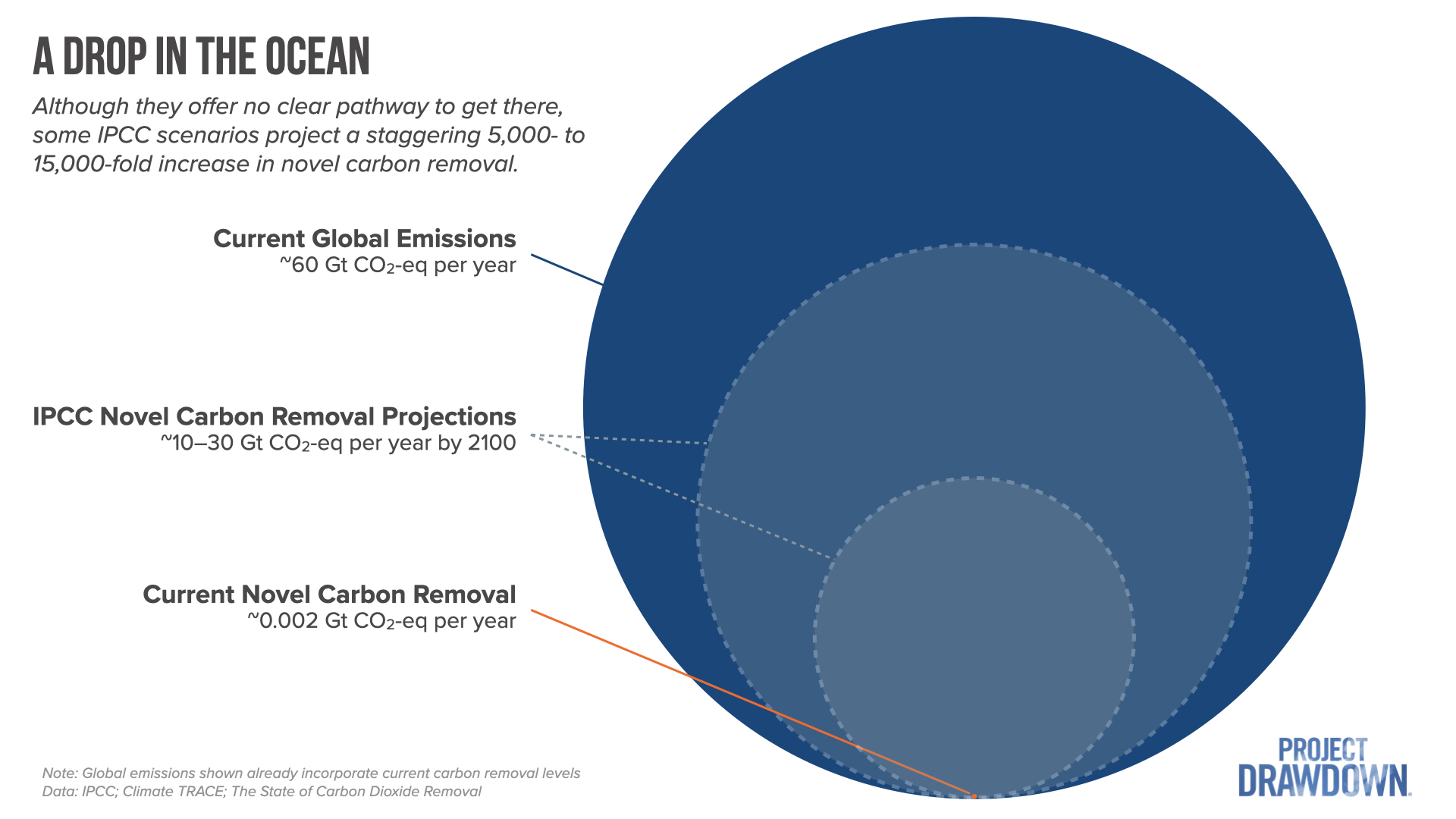
In a recent update, the Intergovernmental Panel on Climate Change (IPCC) includes some eye-watering projections of novel, engineered carbon removal. Among them are a few scenarios that project 10–30 billion metric tons of carbon dioxide removed per year by 2100. That’s a staggering 5,000- to 15,000-fold increase from today, with no real justification for how they arrived at those numbers.

While these scenarios are made to sound scientific – coming out of so-called “integrated assessment” economic models – they are not. They are nothing more than wild guesses about how the world could change over the coming decades. They rest on no testable scientific hypotheses or empirical evidence and are basically bedtime stories about the future, complete with fictional numbers.

But the stories we tell have consequences, especially when they dress up fiction as fact. They can distract us from the immediate work of stopping climate change, which requires cutting emissions quickly and deeply while protecting natural carbon sinks.

17 minutes

How much of annual greenhouse gas emissions are currently removed by novel technologies

Moreover, magical thinking about massive levels of carbon removal can fuel a kind of “predatory delay,” where the promise of future technologies (which typically never arrive) is favored over definitive action today.

It’s time to set the record straight on carbon removal so we can stop imagining a can opener and get to work with what we know works.

How Much Carbon Removal Exists Today

Estimates of so-called “conventional” carbon removal, which mainly comes from forests regrowing after past clearing, now reach nearly 2 billion metric tons of carbon dioxide per year. But there’s a catch: we already account for this forest regrowth when estimating the greenhouse gas emissions from land use. In other words, this basically double-counts the impact of regrowing forests on climate.

Meanwhile, “novel” carbon removal (which is “true” removal, not double-counted in emissions estimates) relies on a variety of engineering approaches to take carbon dioxide out of the atmosphere and place it in durable storage. Today, even after decades of effort and billions of dollars, novel carbon removal removes a paltry 0.002 billion metric tons of carbon dioxide per year. That’s equivalent to just 17 minutes of our annual greenhouse gas emissions.

Most of this novel carbon removal comes from BECCS (Bioenergy with Carbon Capture and Storage), which burns biomass to generate electricity while capturing the resulting carbon dioxide gases and storing them underground. But whether this is truly “carbon negative” remains hotly debated and depends critically on the biomass sources and how they are managed.

The next largest source of novel removal is biochar. This promising climate solution turns organic matter into a stable charcoal-like material, but feedstock availability limits its potential. Ideally, biochar would come from organic waste that would otherwise go to a landfill, but there’s only so much available. We estimate biochar could remove at most around 0.7 billion tons of carbon dioxide per year, although it currently removes virtually none.

Much further down the list of novel carbon removal are other industrial schemes, including Direct Air Capture (DAC). Despite billions of taxpayer dollars invested and decades of development, this technology is still ineffective, expensive, and unscalable. And all too often, the carbon it captures is used for “enhanced oil recovery”, basically using the carbon as a working fluid to pump more oil and gas out of the ground. It has basically become a fig leaf for the fossil fuel industry.

Finally, others are exploring new methods for carbon removal in the open environment, including manipulating ocean chemistry to absorb more carbon dioxide, or accelerating the natural weathering of rocks. Both might work in theory, but it’s unclear how effective or scalable they will be, or whether they will have untenable environmental impacts.

How Much Carbon Removal Could Exist Tomorrow

Conventional carbon removal, especially through forest and soil management, could increase over the next few decades. In fact, large-scale forest restoration, peatland restoration, and improved land management could potentially remove a few billion metric tons of carbon dioxide per year, though this is still small compared with the sixty billion tons we emit annually. And it could do this only for a few decades, since it’s limited by potential biomass growth, soil carbon accumulation, and available land. Moreover, most nature-based carbon removal faces permanence challenges, since trees can burn and fields can be plowed at any time.

Novel carbon removal faces even more constraints.

Image
A chart showing current carbon removal levels along with IPCC projections by 2100

Removal that relies on biomass sources, such as BECCS and biochar, is limited by the availability of truly carbon-neutral organic feedstocks that don’t compete with nature or food production. BECCS fed with forest biomass could be problematic, causing significant land-use and environmental issues. Biochar, when produced from waste materials that would otherwise go to landfill, is much more promising. But there are limits to how much carbon we can realistically remove that way, too.

Meanwhile, Direct Air Capture faces enormous challenges. First, there are severe thermodynamic obstacles. Removing carbon dioxide from the atmosphere requires enormous amounts of energy, water, and chemicals, making scaling up difficult. Second, limits exist on how much carbon can be stored belowground in geologic reservoirs. Estimates suggest that storing one billion metric tons of carbon dioxide per year (even if we could capture that much) would require drilling thousands of new, dedicated wells each year, more than the entire United States oil and gas industry does today.

And then there’s the cost. DAC is extremely expensive, costing over US$1,000 per metric ton of carbon dioxide removed, and these costs have stayed stubbornly high over time. That means even if the technology could sequester one billion tons of carbon dioxide per year, or 1.6% of our current emissions, it would cost over one trillion dollars annually.

Open-environment carbon removal methods currently being developed, such as ocean alkalinity enhancement or enhanced rock weathering, are interesting, but may prove impossible to measure, report, and verify in any practical way.  We should keep watching – and funding – these ideas as pilots to see if they can mature, but we must be clear-eyed about what the science shows as we do so.

From all of this, we might imagine conventional carbon removal growing to a few billion metric tons of carbon dioxide per year, at most, over the next couple of decades before running into fundamental limits on forest growth, soil carbon accumulation, and land availability. And that’s not taking into account the issues with durability due to fire or other land disturbances.

Novel carbon removal will be hard-pressed to achieve anything at that scale. BECCS fed with forest biomass may be unsustainable. Biochar from waste organic matter is a much better bet, but it is ultimately limited in size. And DAC is, frankly, a billion-dollar boondoggle.

Carbon removal today is more premise than promise...

Taken together, it’s hard to see carbon removal growing much beyond its current level: a couple of billion metric tons per year from conventional methods and a small fraction of a billion tons per year from novel methods.

We Shouldn’t Bet the Planet on Carbon Removal

Naturally, the notion of massive carbon removal is seductive. It would be great if we could remove large amounts of greenhouse gas pollution from the sky after it’s been released. It would be fantastic if we could use trees, soils, and machines to pull a big chunk of our carbon pollution out of the air, and safely lock it up forever so it won’t wreak havoc. I would love it, too – if it existed.

Sadly, it doesn’t look very likely. Yes, we can definitely remove small amounts of carbon, but caveats abound, and astronomical projections of future removal quickly butt up against physical and economic realities.

With the world set to pass the ambitious 1.5˚C warming target set in the 2015 Paris Agreement, some openly speculate that we can “overshoot” this target and then do a climate “U-turn” through large-scale carbon removal to cool the planet at some point in the future. But the required carbon removal is nowhere in sight, and no plausible pathway currently exists to reach it.

Carbon removal today is more premise than promise. The best way to stop climate change is, has been, and always will be to stop emitting greenhouse gases. So we can keep imagining can openers, or we can pick up the tools we have and save ourselves. 


About the Author

Jonathan Foley, Ph.D., is a climate scientist and the Executive Director of Project Drawdown, the world’s leading resource for climate solutions. These views are his own.

About Project Drawdown 

Project Drawdown is the world’s leading guide to science-based climate solutions. Our mission is to drive meaningful climate action around the world. A 501(c)(3) nonprofit organization, Project Drawdown is funded by individual and institutional donations. 

This work is published under a Creative Commons CC BY-NC-ND 4.0 license. You are welcome to republish it following the license terms.