Eight reasons regenerative grazing can’t make beef climate-friendly

Image
An image of a cow with a red background covered in hoofprints

Key Takeaways

  • Regenerative grazing gets a lot of attention as a way to provide 'climate-friendly' beef, but the science doesn't hold up
  • Grazing cattle is the single largest land-use humans have undertaken, with seismic impacts on climate and the environment
  • Poorly conducted studies are at the root of much of the confusion, with low-quality studies being cited three times as often as more credible research
  • When it comes to climate and the environment, it's not the how, it's the cow (and other ruminants) that's driving the negative impacts

An influential regenerative grazing movement continues to grow, with some even claiming the practice can reverse climate change. It’s not the cow, it’s the how, as commonly put. It’s undeniably catchy. But it’s wrong.

Grazing for good is an enticing story. Managing cattle differently to rebuild soil, restore grasslands, and store carbon underground via improved plant production to provide ‘climate-friendly beef’ is a have-your-cake-and-eat-it-too scenario. And that’s clearly made it attractive to many.

Livestock-centered grazing solutions have moved into corporate sustainability strategies, food company partnerships, certification programs, and policy spaces. Major companies have embraced regenerative grazing, including a recent task force of large agribusinesses that launched a blended finance framework worth billions. The largest meat processing company in the world has also committed US$100 million to regenerative agriculture-related research and development.

Will this multi-billion dollar climate bet pay off? Here are eight reasons the science says no.

The 8 Reasons Why

1. Beef already has too massive a baseline footprint to build a regenerative future on

Grazing cattle is the single largest land-use humans have undertaken, and it’s expanding. Farmed ruminants (including cattle, buffaloes, sheep, goats) emit about 5.7 gigatons of carbon dioxide equivalents (Gt CO₂‑eq ) per year, and continued expansion of ruminant farming at current levels could add another 2–3 Gt CO₂‑eq per year. Meanwhile, removing grazing and restoring native ecosystems across global pasture could initially sequester 13.4 Gt CO₂ per year, with that rate declining as ecosystems recover and approach their carbon storage potential.

So put simply, as ruminant farming continues to expand, the climate swing between continued livestock emissions and restoring the land they use could reach ~21 Gt CO₂‑eq per year during the early decades of recovery (~8 Gt from avoided livestock emissions and ~13 Gt from ecosystem restoration). That’s more than China’s annual emissions, depending on how we manage production, promotion, and dietary intakes of ruminant meat.

Image
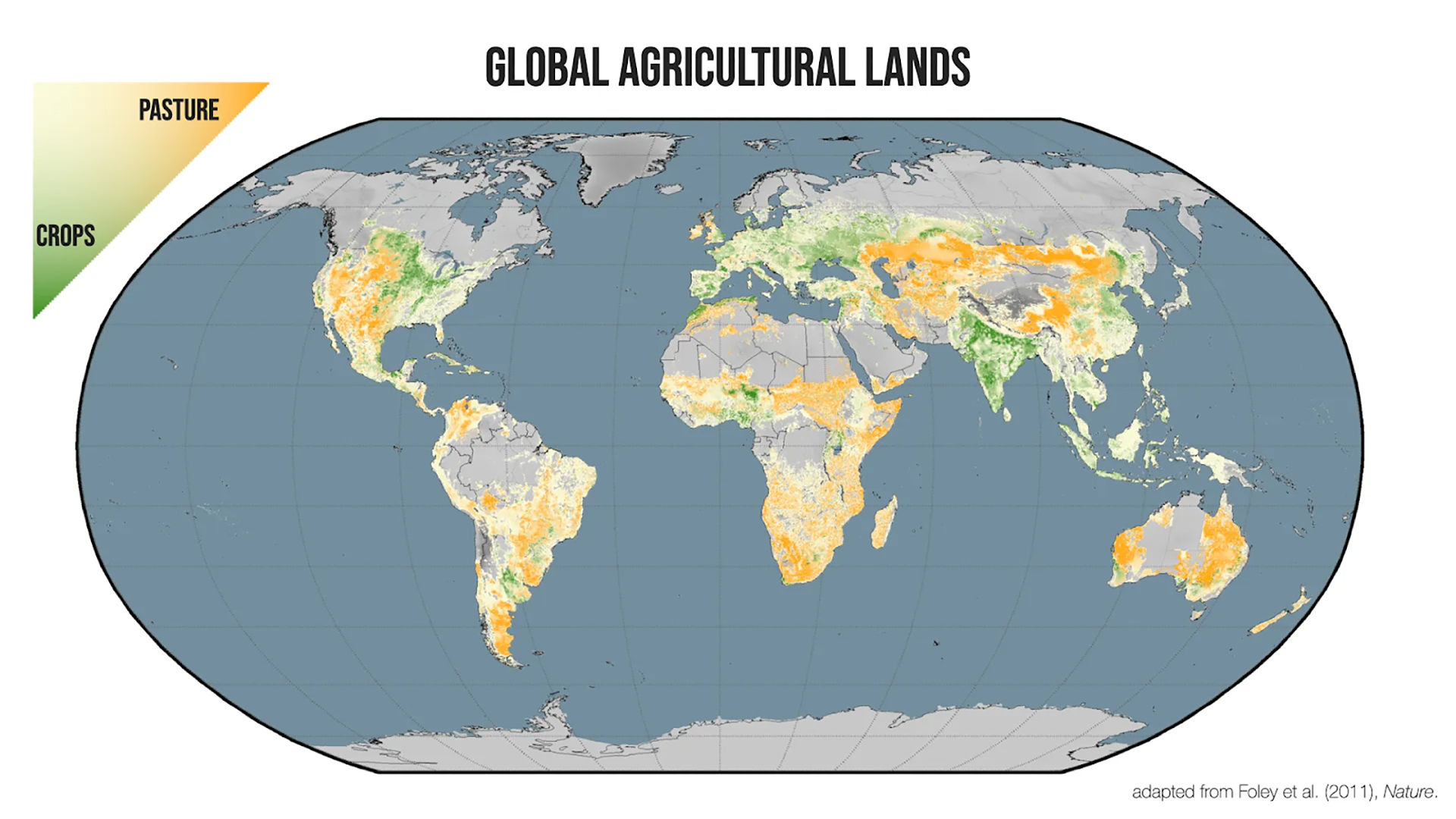
Map

Croplands and pastures cover ~37% of the world’s ice-free land area. Adapted from Foley et al. (2011)

Cattle continue emitting methane (the superpollutant ruminants belch that’s 80x more potent than carbon dioxide in the near term) as long as they remain on the landscape, regardless of what alternative grazing practices can or can’t do for soil’s capacity to store carbon in the form of soil organic carbon (SOC).

Some SOC may rise for a period, then slow toward equilibrium. Meanwhile, methane emissions continue year after year. Offsetting current global ruminant emissions through SOC would require storing 135 Gt of carbon, or roughly 495 Gt CO₂ , over 100 years – nearly twice the carbon stock in all managed grasslands. In regions where sequestration would be required, SOC would need to rise by 25% to 2,000%, depending on the region.

Image
A graph showing that more carbon sequestration is necessary to offset the emissions of ruminant animals than is possible to store in all of the world's grazing lands

This all matters because the appetite for beef is growing. Farmed ruminants now exceed 4 billion animals globally (including ~1.5 billion cattle) and are projected to grow, further increasing emissions from livestock, already the world’s largest source of human-caused methane.

Image
A chart showing the rise in meat consumption and number of ruminant animals globally

Amid rampant environmental degradation, today’s high level of beef production should not be accepted as a baseline, nor should the marketing and promotion that sustain high consumption.  To improve diets and align with the EAT-Lancet planetary boundaries guidelines, high-income countries like the United States need an 84% reduction in red meat consumption (limiting intake to 14 grams per day) to meet climate targets.

2. Shifting to plant-rich diets results in more food and higher carbon sequestration 

Despite being the single largest human use of land, beef production only provides about 2% of the global calorie supply and 5% of the global protein supply. This is a staggering mismatch between size and sustenance, with implications for national food security.

While not all land used for grazing cattle can support crops, beef uses nearly 40% of global cropland, enough to feed ~7 billion people if that land were used for food crops instead. Globally, only 16% of farmland is used for crops that feed people directly, yet those farms supply 83% of our global calories and 62% of global protein. Producing more food directly from legumes, grains, pulses, nuts, seeds, and other lower-impact foods can reduce food insecurity and methane, while freeing land for restoration.

Farmed ruminant land also carries enormous carbon sequestration opportunity costs. Around 42% of global pastureland is on land that could support forests. Restoring these areas could sequester about 445 Gt CO₂ – around seven years’ worth of total global emissions – by 2100. Other grazing lands could support native grasslands, savannas, wetlands, riparian recovery, and biodiversity corridors that benefit large herbivores.

3. Wild ecosystems have higher and more stable soil organic carbon than pastureland

Healthy soils are living systems that contain bacteria, fungi, earthworms, and other organisms that support nutrient cycling, water retention, plant growth, and ecosystem resilience. When soils lose organic matter, structure, and biological activity, they become less able to support vegetation, water, and climate resilience.

Agriculture as a whole has contributed substantially to the soil problem. Deforestation, largely driven by cattle ranching, removes vegetation that stabilizes and replenishes soils. Grazing often further compacts land, strips plant cover, erodes streambanks, and accelerates topsoil loss.

When people suggest that alternative grazing can replenish soil, we need to ask: compared to what? A pasture can sequester more carbon than degraded cropland or overgrazed land. But if the comparison is to nearby native ecosystems, or to fully restored forests or grasslands, the conclusion is vastly different, for both carbon storage and for providing space for wild plants and animals. Natural ecosystems tend to have higher SOC saturation than agricultural systems as a whole, meaning they store more carbon and are often closer to their maximum ecological carbon-holding potential.

The future of climate-smart land use is not about finding ever more elaborate ways to justify grazing...

Even if a particular grazing practice does less harm, that does not make grazing the best land use – especially when alternative grazing practices often encourage higher stocking rates and therefore more methane. Comparisons should be against the best plausible alternative: native ecosystem recovery, restored grasslands, forest regeneration where ecologically appropriate, or efficient crop production that feeds more people on less land.

4. Rain, temperature, geology, and previous land use determine soil organic carbon more than grazing techniques do

The question is not whether grazing can be improved. It can.

The biological mechanism underpinning such improvements is straightforward. Plants absorb carbon dioxide through photosynthesis and transfer some carbon belowground through roots, residues, and organic matter. Under some conditions, soils can accumulate carbon over time.

The direct physical engine of carbon transfer is the change in total plant biomass, both above- and belowground. While reducing herd size to lower grazing intensity can trigger a localized increase in plant growth, whether that shift is even possible to any significant extent is mostly regulated by precipitation, soil physics, and previous land use.

Across grazing systems, SOC outcomes depend heavily on rainfall, temperature, soil properties, plant communities, and previous land use. Predictors like baseline soil carbon stocks, soil texture (clay and sand content), mean annual precipitation, and temperature dominate the top of the ranking, all of which are independent of grazing practices.

5. Most grazing land is too arid to store meaningful amounts of soil organic carbon

In arid and semi-arid regions, which make up nearly 80% of global grazing land, reducing grazing intensity or altering practices often has, at best, neutral and frequently negative effects on SOC. Even where SOC gains occur in grazing lands, it is slow, finite, and easily reversible. Soils approach saturation, and stored carbon can later be lost through drought, warming, erosion, fire, or management changes.

At best, improving soil conditions through reducing grazing intensity could potentially mitigate 1–2 Gt CO₂‑eq per year in the near term, before SOC gains eventually saturate, with most of the benefit coming from climate and geology rather than grazing management. By comparison, restoring pasture in areas that could naturally support forests could initially remove 8.8 Gt CO₂ per year, several times greater than the potential from just reducing grazing intensity. Over time, as ecosystems approach their carbon storage potential, that rate declines, but cumulative drawdown could still reach 445 Gt CO₂ by 2100 (including 281 Gt in vegetation and 164 Gt in soils).

6. The regenerative case for beef relies on flawed studies without baselines or proper geographic controls

Perhaps you’ve seen a study claiming beef can be carbon-neutral. However, a new study shows low-quality evidence dominates much of the discussion around carbon drawdown benefits from grazing. Worse, those low-quality studies are cited three times as often as more credible research.

3X

How much more often low-quality studies on regenerative grazing are cited than more credible research

Common weaknesses include missing baseline SOC measurements, inadequate controls, short study duration, shallow soil sampling, and failure to measure change over time at the same site. Look for these flaws, and you will find few rigorous studies on the topic. Moreover, those you do find show neutral or negative SOC from grazing. Positive findings also often come from wetter, climate-favorable areas converted from cropland, where gains may occur because perennial vegetation is recovering rather than because cattle are present.

7. Grass-finished cattle are still not wild ruminants

The myth that modern cattle simply replaced the methane produced by historical populations of wild ruminants, such as bison, is intuitive but misguided. Domesticated cattle possess fundamentally different behaviors, migration patterns, microbiomes, and grazing impacts than the native, wild large herbivores they displaced.

At the peak of the last Ice Age, global emissions of methane from wild ruminants were only ~15 teragrams (Tg) per year. Today, four billion farmed ruminants emit 100 to 120 Tg of methane annually, surpassing historical estimates of wild ruminant emissions by seven to eight times. In the United States alone, modern beef generates ~250 million metric tons of CO₂‑eq annually, a footprint 150% larger than emissions from the peak historical population of 60 million American bison.

Ecologically, domestic cattle are a poor substitute for native wildlife. Wild bison, for instance, roam widely and quickly across landscapes, giving native plants years to recover. Cattle tend to concentrate around fragile riparian zones, causing erosion and degradation. Grass-finishing does not fix this, and compared with conventional beef, it can require 2–3 times more land and about one-third longer for cattle to reach slaughter weight, meaning more cattle are needed to maintain the same annual production. The result is more land pressure, more methane, and higher overall emissions per kilogram of beef.

While restoring large herbivores is not a clear climate solution, returning wild bison to their native ranges can still provide important biodiversity benefits. Wild bison ultimately return nutrients to the ecosystem and participate in natural predator-prey relationships, while commercial cattle are densely stocked, slaughtered at about 5% of their natural lifespan, and largely function as extractive commodities rather than participants in a self-sustaining wild ecosystem.

8. Beef drives biodiversity loss, and even reducing grazing intensity doesn’t mean ecosystems recover

Earth’s monitored wildlife populations have fallen 73% in the past half-century. Animal-sourced foods are the leading driver of biodiversity and habitat loss globally, with grazing cattle bearing disproportionate responsibility. Beef is the largest contributor to biodiversity loss in Key Biodiversity Areas (KBAs), accounting for around 31% of total losses. Expanding grazing therefore reinforces the leading driver of biodiversity loss. Ruminant meat increases extinction risk ~340 times more than grains and ~100 times more than legumes. As a result, 94% of non-human mammal biomass on land is now livestock, outweighing wild mammals 15 to 1.

The myth that grazing is the best use of land that cannot support crops ignores that it often still displaces native plants and wildlife. A meta-analysis of 109 studies found that livestock exclusion increased animal abundance and diversity, while grazing reduced native species richness. Other meta-analyses on grazing exclusion have found improvements in plant growth, vegetation biomass, soil organic carbon sequestration, and biodiversity in degraded grasslands.

Reducing grazing intensity is often the most defensible grazing intervention, because it starts from a clear ecological premise: heavy grazing damages land. This is true. Lower stocking rates can reduce erosion, vegetation loss, compaction, and local degradation. It may also reduce methane emissions on a given farm if herd sizes decline.

However, reduced grazing intensity does not guarantee ecosystem recovery. Some pastures may remain locked in degraded states when introduced or invasive forage grass monocultures suppress native plants, slow tree regrowth, and alter fire cycles.

The Bottom Line

Science supports the notion that better grazing can reduce some local environmental harms. Lower stocking rates can improve damaged landscapes. Alternative grazing may help in particular contexts. And grass-finished beef may reduce some feedlot-related issues.

But none of these changes address the core problems with beef: cattle are a leading methane emitter and land user, soil organic carbon benefits through grazing are limited and easily reversible, and grazing competes with more effective pathways for food production, carbon reduction, and biodiversity recovery.

Grazing can be improved. But maintaining large cattle populations is among the worst options for climate, biodiversity, and food production.

The future of climate-smart land use is not about finding ever more elaborate ways to justify grazing. It is about carefully reducing the need for grazing land, producing more food with lower-impact crops, restoring native ecosystems, and giving land back to carbon-rich, biodiverse life.

Soil health matters. If weak studies continue to prop up better grazing practices as the savior of soil, we’ll miss the forest for the trees. Failing to see the bigger picture – that the healthiest soil is found in protected, wild ecosystems that plant-rich diets free up – can steer us astray. It perpetuates the myth that beef, the most land- and emission-intensive food, is somehow not the problem.


About the Author

Nick Carter is a research fellow focused on solutions in Food, Agriculture, Land, Ocean, and Nature-Based Carbon Removal sectors at Project Drawdown. He has a decade of experience working with environmental organizations in research and communications and is currently director of environmental science at the Game Changers Institute, leading research for the sequel documentary. 

About Project Drawdown 

Project Drawdown is the world’s leading guide to science-based climate solutions. Our mission is to drive meaningful climate action around the world. A 501(c)(3) nonprofit organization, Project Drawdown is funded by individual and institutional donations. 

This work is published under a Creative Commons CC BY-NC-ND 4.0 license. You are welcome to republish it following the license terms.