These distinctions matter. A climate solution is rarely equally effective everywhere, and the same funding strategy won't work in every location.
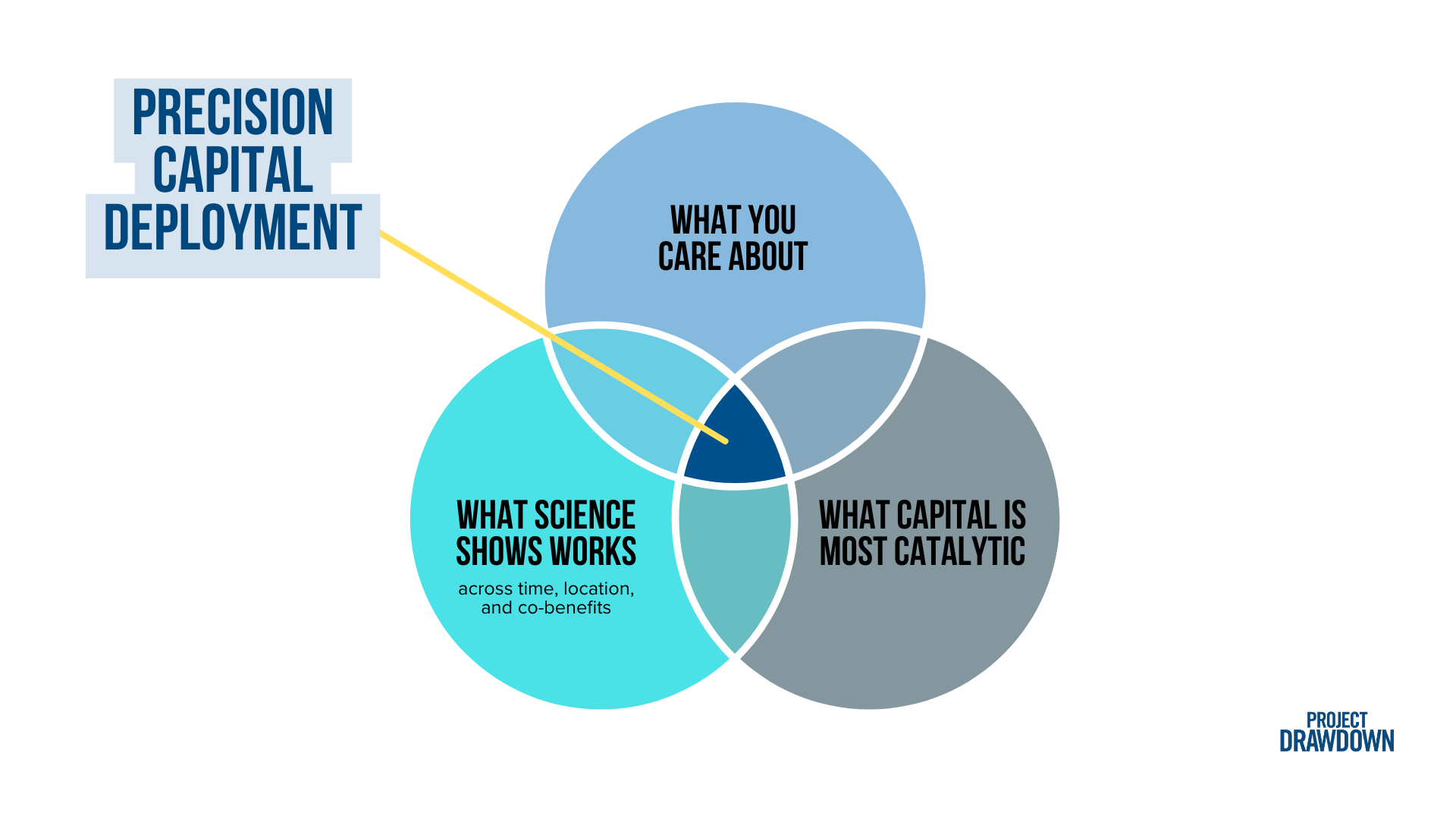
At Project Drawdown, we enable precision capital deployment through three lenses: time, location, and co-benefits. How quickly can a solution reduce warming? Where will it have the greatest impact? And how might it improve health, livelihoods, biodiversity, or other priorities alongside climate outcomes?
These are technical scientific questions. But their answers can provide practical guidance for capital managers deciding where to direct resources.
Our goal isn't to turn investors and philanthropists into climate scientists; it's to translate rigorous science into accessible, decision-ready insights to help people act with greater confidence and impact.
Capitalizing on the right kind of capital
Knowing which climate solutions work across time, location, and co-benefits, however, is only part of the equation. Equally important is understanding what prevents them from scaling to their full potential.
Some solutions need additional research or demonstration. Others are technologically mature but face policy barriers, insufficient infrastructure, limited access to financing, or a shortage of trained workers.
Philanthropy, in particular, can play an important role across this spectrum.
A grant supporting scientific research may help bring an emerging solution closer to viability. Funding for community organizations could build the trust and local capacity needed for successful implementation.
Support for policy development may remove barriers that prevent proven technologies from reaching millions of people.
In other cases, relatively modest philanthropic investments can help unlock much larger flows of public or private capital.
Precision capital deployment, therefore, isn't just about identifying climate solutions with the greatest emissions-reduction potential. It's about matching the right kind of capital to the right opportunity, at the right moment.
Science as a foundation for supercharging action
Of course, science alone cannot – and should not – determine where climate capital flows. Questions of equity, justice, community leadership, and acceptable risk require values-based judgments and meaningful engagement with the people most impacted by climate change and funding decisions.
Nor does scientific evidence eliminate uncertainty. Climate solutions operate within complex social, political, and economic systems. New information and unintended consequences will continue to emerge, and strategies must evolve accordingly.
But a strong scientific foundation can help funders distinguish between promising ideas and proven interventions, understand the risks of different approaches, and recognize when conditions are right for action. It can also help climate finance move beyond reacting to headlines toward anticipating opportunities.
This is especially important as the climate funding landscape changes. Areas that were once neglected may now attract substantial investment, while other high-impact opportunities remain overlooked. Yesterday's funding priorities aren't necessarily tomorrow's greatest opportunities. The ability to revisit assumptions, incorporate new evidence, and adjust strategies is a strength.
Ultimately, the purpose of translating climate science isn't simply to produce better reports or more sophisticated analyses. It's to advance solutions that will solve the climate crisis.
Climate capital managers don’t need to choose between ambition and rigor, or between evidence and values. They can feel empowered to boldly enter this new era of climate funding and seize the opportunity to use science to supercharge the impact of every dollar they spend.
About the Author
Lauren Gifford, Ph.D., is a climate strategy leader and carbon governance expert working at the intersection of climate science, finance, governance, and justice. As Senior Advisor for Climate Philanthropy and Investing at Project Drawdown, she guides philanthropies, investors, and institutions in aligning capital with science-based, high-integrity, and equitable climate strategies.
About Project Drawdown
Project Drawdown is the world’s leading guide to science-based climate solutions. Our mission is to drive meaningful climate action around the world. A 501(c)(3) nonprofit organization, Project Drawdown is funded by individual and institutional donations.
This work is published under a Creative Commons CC BY-NC-ND 4.0 license. You are welcome to republish it following the license terms.