As electricity demand grows and access expands, existing infrastructure shapes where adding renewable energy has the greatest climate impact. Just like in real estate, what matters most when siting renewables turns out to be location, location, location.
Why getting the most out of renewable energy is all about location, location, location

Image
Key Takeaways
- To quickly address climate change, where renewable energy is deployed can matter as much as how much is built. The greatest global emissions reductions can come from targeting the largest electricity grids and those most heavily dependent on fossil fuels.
- Smaller, fossil-fuel-dependent grids can offer greater emissions reductions per unit of renewable energy than larger, cleaner grids. For example, targeted investments in sub-Saharan Africa could deliver up to nine times the emissions reductions of equivalent investments in many mature markets.
- Strategic deployment requires infrastructure beyond renewable generation capacity. Maximizing climate benefits will require investments in grid interconnections, energy storage, and reliable, dispatchable sources such as hydropower and geothermal.
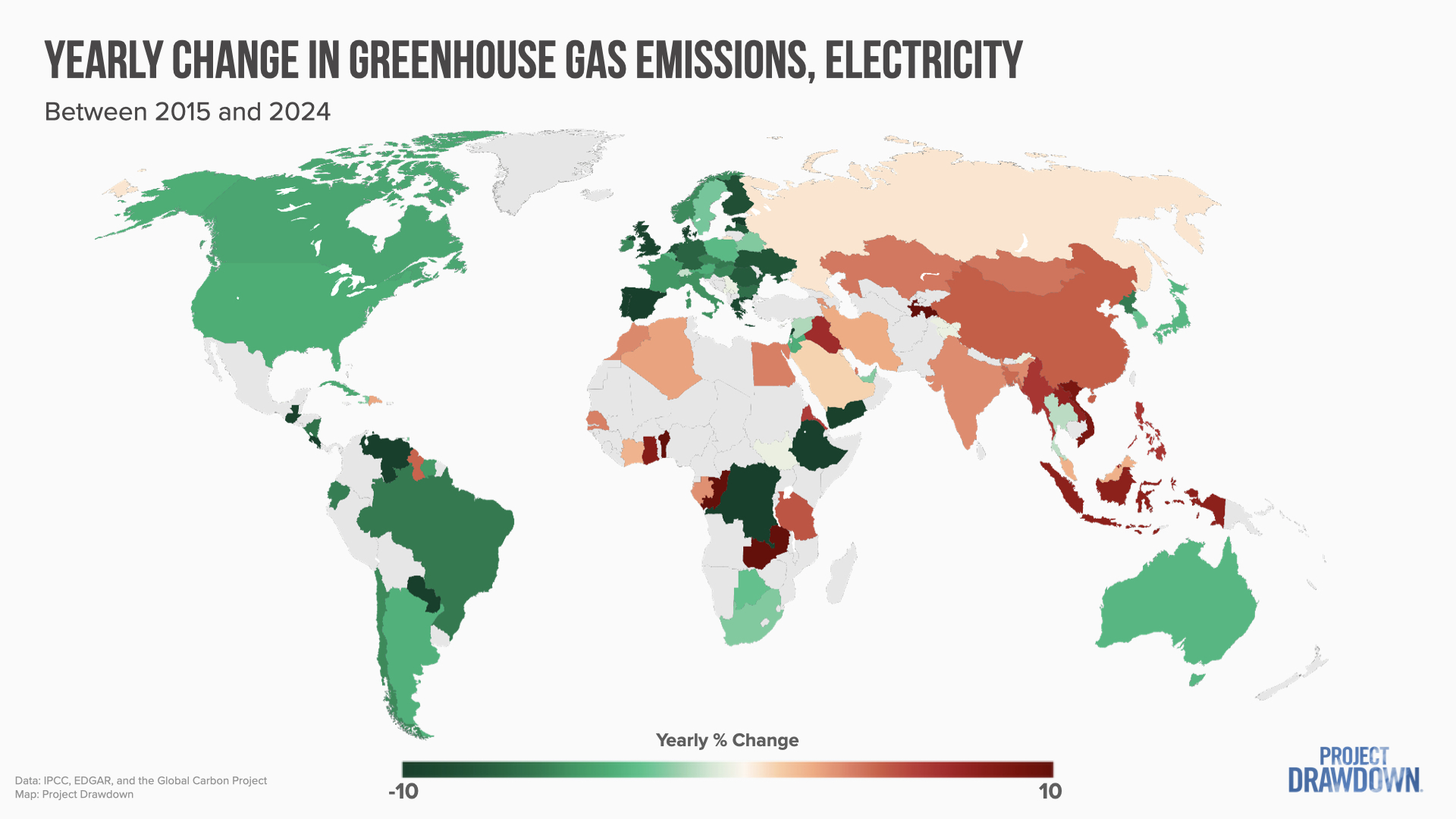
Despite a global upward trend, many countries have reduced their greenhouse gas emissions over the last decade. In those countries, progress has largely come from cleaner electricity generation from renewable energy sources like wind and solar.
Two years ago, wind and solar generation surpassed hydropower generation for the first time, and fossil fuel generation reached its lowest levels since the 1940s. According to estimates from energy think tank Ember, global solar generation in 2024 avoided emissions equivalent to the entire U.S. power sector.
Image
Bigger grid, bigger impact
Globally, the greatest potential for reducing emissions from electricity generation is concentrated in the countries with the largest electricity grids. Last year, the U.S. and China contributed 33% and 14% to global electricity generation and accounted for 38% and 12% of total power sector emissions, respectively. Because those two countries alone account for roughly half of electricity emissions, even relatively small increases in renewables across their biggest grids can have a considerable impact on global power sector emissions.
Image
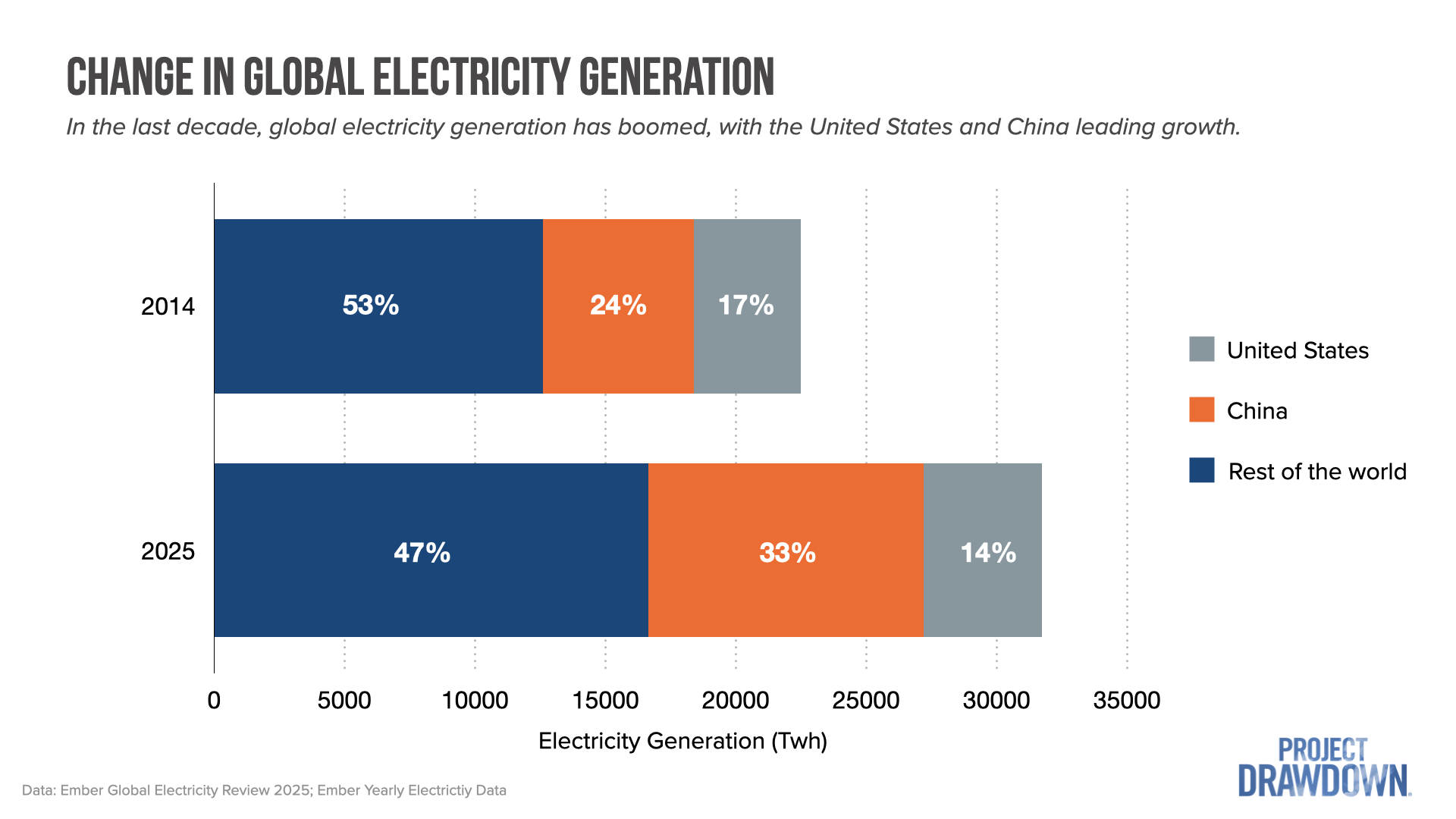
Over the past decade, the U.S. reduced emissions from electricity production by nearly half a gigaton of carbon dioxide each year, as much as 150 million gas-powered cars. And generation from wind and solar has now surpassed that from coal for the first time. This has resulted in a 27% decrease in the emissions intensity of the U.S. power grid since 2014. In other words, total electricity generation has grown even while emissions were reduced. The cumulative reduction in U.S. power sector emissions during that period was greater than the reduction across the entire EU power sector over the same period.
Image
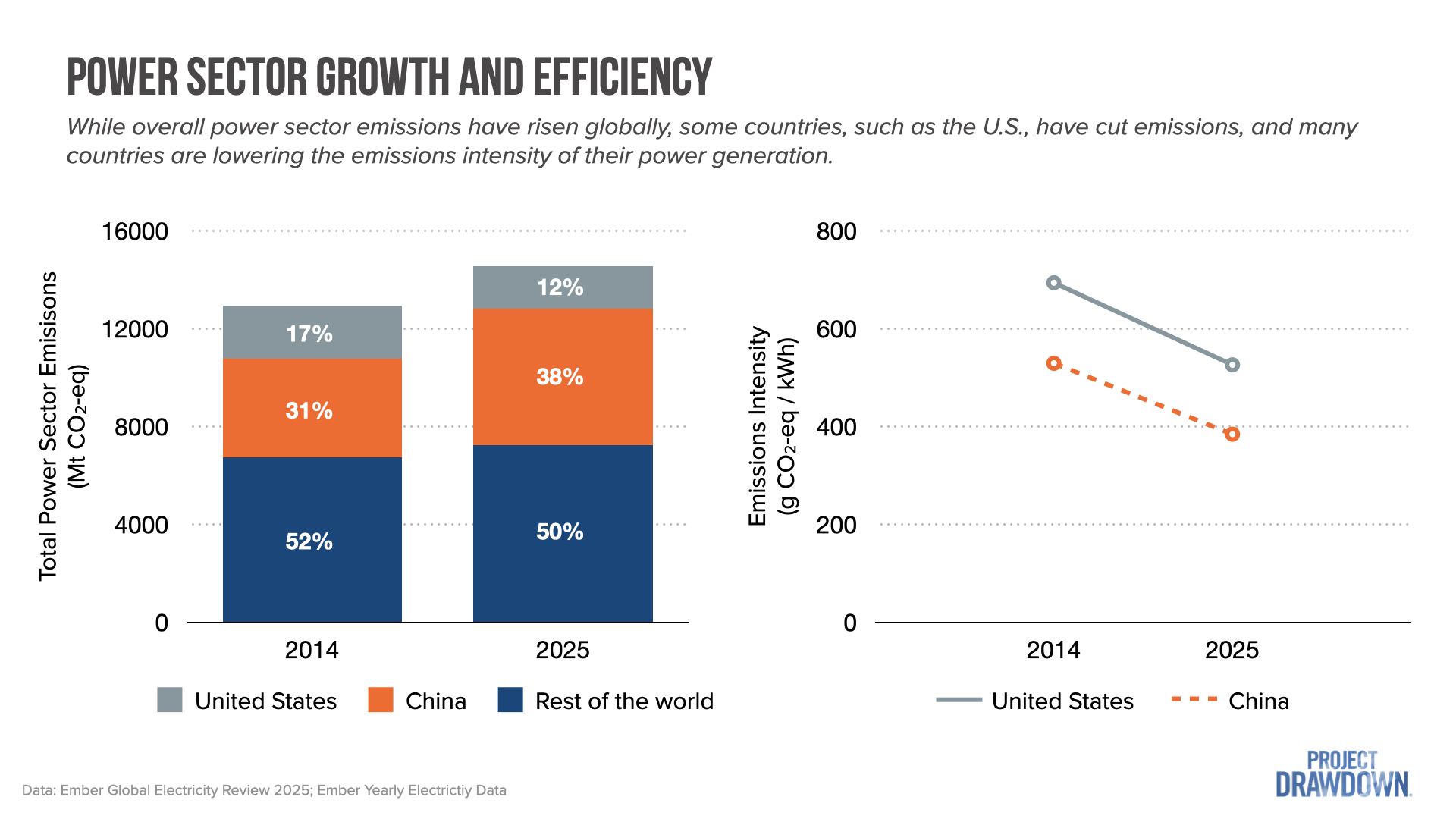
Unlike the U.S., emissions from electricity production in China increased between 2014 and 2025 by roughly 1.5 gigatons of carbon dioxide equivalents (Gt CO₂‑eq ), largely due to more coal generation. While emissions in China remain high for now, there is considerable potential for emissions reductions, especially through accelerated renewable energy deployment. In 2024, China led global growth in wind and solar generation, but also in coal generation. But even though coal generation increased, aggressive solar deployment avoided an additional 0.7 Gt CO₂‑eq.
If China follows a similar trend to the U.S. and reduces coal generation by 40% over the next decade, it could avoid as much as 3 Gt CO₂‑eq. That massive potential underscores the outsized role China’s energy systems play in global power sector emissions.
Cleaning up the dirtiest grids
To maximize the impact of renewables, grid size isn’t the only thing that matters. While the overall climate benefits of deploying large-scale renewables in big grids are undeniable, for smaller grids, climate impact is more closely tied to emissions benefits per megawatt-hour generated. In other words, for all but the biggest grids, what matters most is how dirty it is.
In an ideal world, each additional megawatt-hour of electricity provided by renewable energy would replace one from fossil fuels. But the actual displacement and emissions benefit of a solar panel or wind turbine depends on the composition and dynamics of all energy sources in a regional grid. Because of this, renewable deployment yields greater benefits in grids that currently rely heavily on coal, oil, and natural gas.
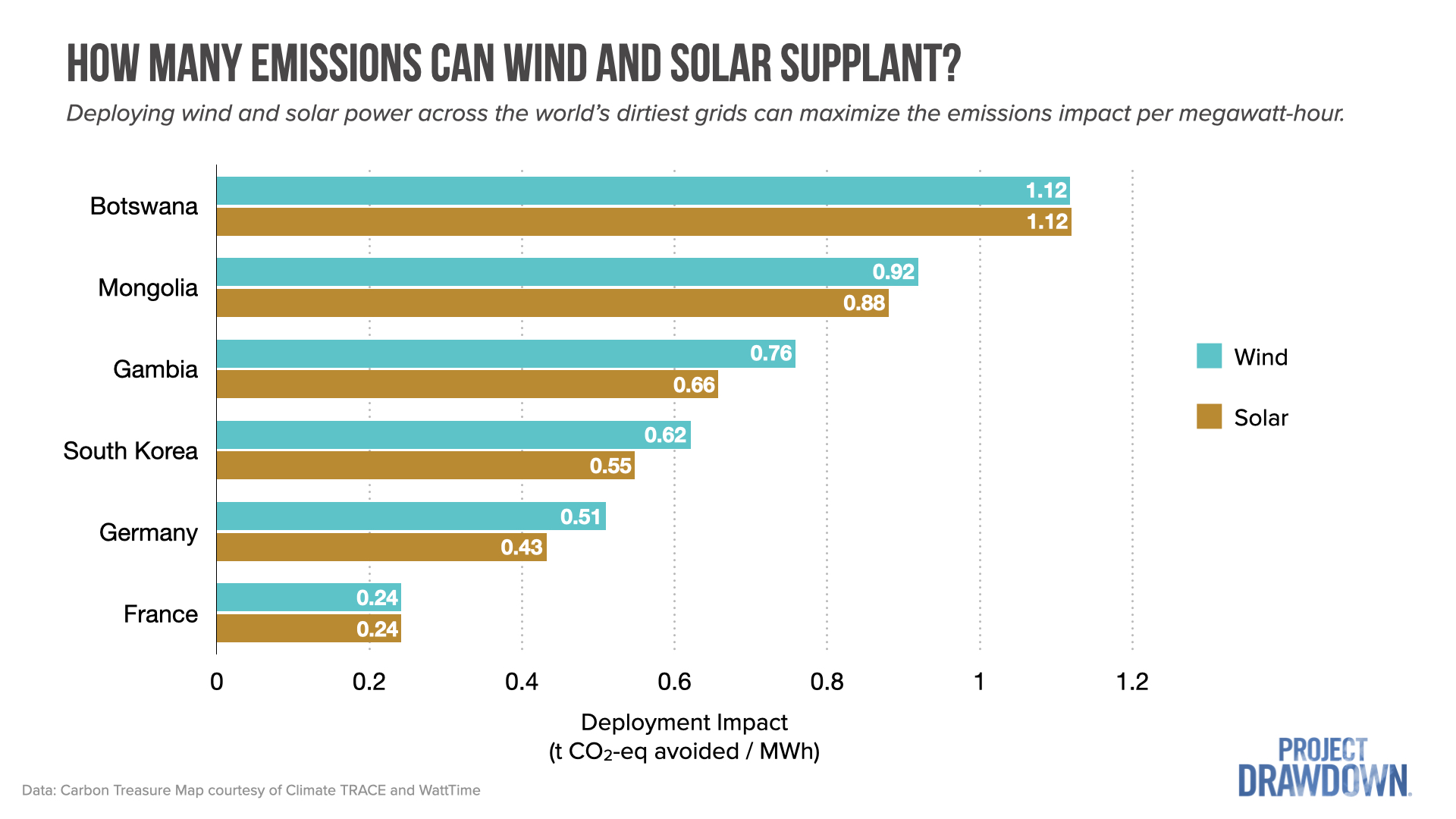
For instance, within the EU, where renewables contributed 48% of electricity generation in 2025, additional wind deployment in Germany could avoid twice as many emissions as in France. That’s because coal and natural gas account for 37% of electricity generation in Germany, while in France, where nuclear and hydropower account for more than 79% of generation, dirty fuels make up a much smaller share. Similarly, in South Korea, the majority of electricity comes from coal and gas, so deploying any renewable energy there has a greater climate impact than deployment in Germany or France.
In lower- and lower-middle-income countries with a heavy reliance on coal and oil generation, deploying renewable energy can have a much greater impact per megawatt-hour on local emissions and across other dimensions of human and environmental well-being. Targeted capital investments in sub-Saharan Africa can yield up to nine times the emissions reduction of equivalent investments in more mature markets, since a single dollar or single solar panel displaces more fossil fuels there than it could in the U.S. or Germany. Mongolia, Gambia, and Botswana have fossil-dominated electricity grids where adding solar or wind power could avoid as much as 1.12 tons of carbon dioxide equivalents per MWh, which far exceeds the estimated per megawatt-hour benefits for solar in Germany, France, and South Korea.
Image
Renewable energy expansion has significant potential to reduce emissions and improve livelihoods, but achieving these goals requires more than increased capacity. While wind and solar continue to see incredible capacity growth around the world, translating that capacity into generation will require infrastructure development, coordination for grid interconnection, and expanded storage capacity. Many countries will also need to expand capacity from sources such as hydropower or geothermal to maintain a reliable, dispatchable power supply as more variable renewables are integrated into regional grids.
Careful consideration of the best renewable energy resources for different regions not only reduces emissions from electricity generation globally, but also improves the effectiveness of electrification across sectors from transportation to buildings to industry. All renewable energy moves us toward a world that’s less reliant on polluting fossil fuels, but the clock is ticking. Strategically siting renewables in the biggest and dirtiest grids can bring us closer, quicker, to a world that runs sustainably on abundant clean electricity.
Analysis for this article used data from Ember's Global Electricity Review 2025 and Yearly Electricity Data, and the Carbon Treasure Map, courtesy of Climate TRACE and WattTime.
About the Author
Megan Matthews, Ph.D., is an interdisciplinary researcher interested in using data and outreach to promote sustainability, food equity, and environmental justice through the lens of agroecology. At Project Drawdown, her work focuses on climate solutions in the electricity and food & agriculture sectors.
Matthews would like to acknowledge Amanda Smith, Ph.D., James Gerber, Ph.D., and Al-Amin Bugaje, Ph.D. for their contributions to this article.
About Project Drawdown
Project Drawdown is the world’s leading guide to science-based climate solutions. Our mission is to drive meaningful climate action around the world. A 501(c)(3) nonprofit organization, Project Drawdown is funded by individual and institutional donations.
This work is published under a Creative Commons CC BY-NC-ND 4.0 license. You are welcome to republish it following the license terms.