Physical and mental wellness, including prevention of illness, injury, and premature mortality.

Icon

Deploy Building Automation Systems

Image
Image
Automate Building Systems
Coming Soon
On
Summary

We define Deploy Building Automation Systems (BASs) as reducing commercial (i.e., nonresidential or industrial) building energy use and associated GHG emissions by using sensors to monitor a building in operation and control systems such as heating, cooling, ventilation, plug loads, and lighting for the purpose of saving energy. This solution does not include automated building systems that control security, safety, and other functions, and applies to existing buildings only. 

Description for Social and Search
Automating building systems for heating, cooling and lighting is an efficiency measure that reduces the energy-related emissions from commercial buildings.
Overview

BASs (also referred to as building energy management systems, building management systems, or building automation control systems) use automation to optimize system performance and reduce the energy needed to operate commercial buildings. This cuts emissions generated by the energy sources, including emissions from fuels burned to provide heating as well as emissions from generating the electricity used to power air conditioners, plug loads, and lighting. Together, these contribute to an estimated 3.7Gt of energy-related emissions associated with operating nonresidential buildings per year (International Energy Agency [IEA], 2023b). This solution reduces critical climate pollutants, primarily CO₂, but also methane and nitrous oxides. 

The energy savings from BASs are the outcome of processes such as scheduled and occupancy-based control of heating, cooling, ventilation and lighting; optimization of set-point temperatures; predictive maintenance; and fault detection and diagnostics (Akbulut et al., 2025). Some BAS include smart controls that learn from occupant behaviors to optimize performance and energy savings (O’Grady et al., 2021). 

BASs can reduce commercial energy use by an estimated 5–40% (IEA, 2025). Local climate conditions, the type of BAS and how it is operated, building type and condition, and user behaviors can affect this outcome (Fernandez et al., 2017; Morkunaite et al., 2022). For example, modeling of U.S. buildings showed an average potential 23.3% energy savings with a BAS in supermarkets but a 48.8% energy savings for secondary schools and 29% savings for commercial buildings overall (Fernandez et al., 2017). These outcomes also included measures to correct for operational faults such as miscalibrated sensors and problems with seals. 

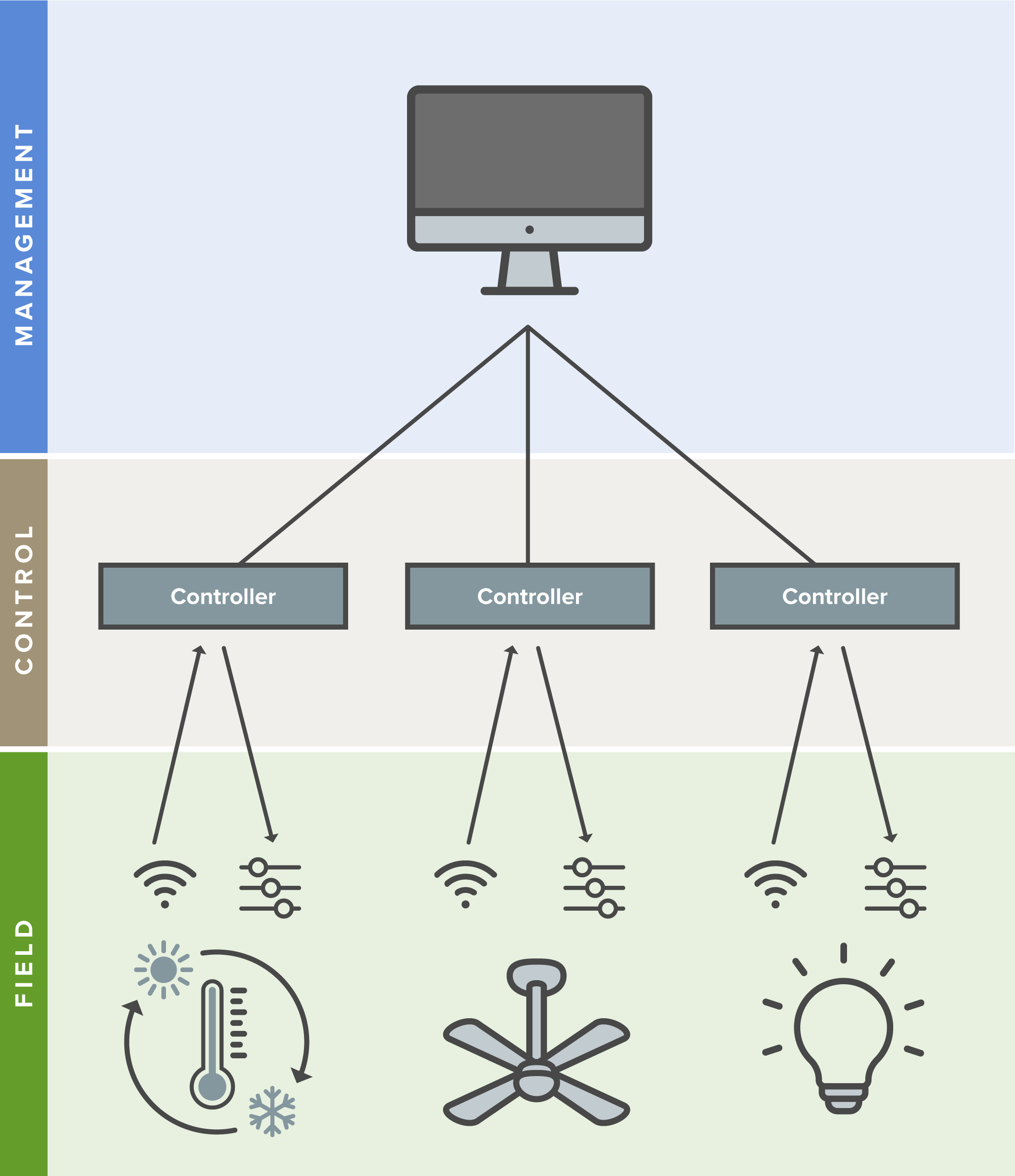
BASs typically consist of three architectural layers (Domingues et al., 2016) (Figure 1). At the field layer, sensors monitor conditions such as temperature, air flow, humidity, and lighting levels within a space and actuators adjust equipment in response to control signals. The control layer receives and processes incoming sensor data and sends control signals to the actuators according to programmed control logic and set parameters. The management layer is where data are logged, monitored, and analyzed to track and optimize performance, identify trends, and adjust automation settings. 

Figure 1. A typical BAS has three layers: a field layer, which senses the environment and adjusts equimpment as needed; a control layer, which handles communication between the sensors and actuators; and a management layer, which logs and analyzes data to optimize performance. Modified from dos Santos et al. (2021) and Fluke (n.d.).

Image
Diagram demonstrating Automated Building Systems functions of management, controllers, and devices in the field.

Sources: dos Santos, D. R., Dagrada, M., & Costante, E. (2021). Leveraging operational technology and the Internet of things to attack smart buildings. Journal of Computer Virology and Hacking Techniques17(1), 1–20; Fluke. (n.d.). Troubleshooting communications problems in building control systems. Fluke Corporation. 

References

ABI Research. (2025). Number of commercial buildings with automation systems by region [Report]. Link to source: https://www.abiresearch.com/news-resources/chart-data/forecast-number-of-automated-commercial-buildings-by-region 

Abuimara, T., Hobson, B. W., Gunay, B., O’Brien, W., & Kane, M. (2021). Current state and future challenges in building management: Practitioner interviews and a literature review. Journal of Building Engineering41, Article 102803. Link to source: https://doi.org/10.1016/j.jobe.2021.102803 

Akbulut, L., Taşdelen, K., Atılgan, A., Malinowski, M., Coşgun, A., Şenol, R., Akbulut, A., & Petryk, A. (2025). A systematic review of building energy management systems (BEMSs): Sensors, IoT, and AI integration. Energies18(24), Article 6522. Link to source: https://doi.org/10.3390/en18246522 

Ayorinde, E., & Kekana, L. I. (2025). Exploring the barriers facing the adoption of building automation systems for energy efficiency in a developing economy. Journal of Construction Project Management and Innovation15(2), 40–47. Link to source: https://doi.org/10.36615/jcpmi.v15i2.4371 

Backman, M. (2021). The commercial building automation market [Report]. Berg Insight. Link to source: https://media.berginsight.com/2021/02/07173719/bi-buildingautomation2-ps.pdf 

Domingues, P., Carreira, P., Vieira, R., & Kastner, W. (2016). Building automation systems: Concepts and technology review. Computer Standards & Interfaces45, 1–12. Link to source: https://doi.org/10.1016/j.csi.2015.11.005 

dos Santos, D. R., Dagrada, M., & Costante, E. (2021). Leveraging operational technology and the Internet of things to attack smart buildings. Journal of Computer Virology and Hacking Techniques17(1), 1–20. Link to source: https://doi.org/10.1007/s11416-020-00358-8 

Ebuy, H. T., Bril El Haouzi, H., Benelmir, R., & Pannequin, R. (2023). Occupant behavior impact on building sustainability performance: A literature review. Sustainability15(3), Article 2440. Link to source: https://doi.org/10.3390/su15032440 

European Parliament, & Council of the European Union. (2024). Directive (EU) 2024/1275 of the European parliament and of the council of 24 April 2024 on the energy performance of buildings (Document No. 32024L1275). Official Journal of the European Union. Link to source: https://eur-lex.europa.eu/legal-content/EN/TXT/?uri=OJ:L_202401275 

Fernandez, N., Xie, Y., Katipamula, S., Zhao, M., Wang, W., & Corbin, C. (2017). Impacts of commercial building controls on energy savings and peak load reduction (Report No. PNNL-25985). Pacific Northwest National Laboratory. Link to source: https://www.pnnl.gov/main/publications/external/technical_reports/PNNL-25985.pdf 

Fluke. (n.d.). Troubleshooting communications problems in building control systems. Fluke Corporation. Retrieved April 7, 2026, from Link to source: http://www.wecl.com.hk/Fluke/solutions/building-control-systems.pdf 

Garzia, F., Verbeke, S., Pozza, C., & Audenaert, A. (2023). Meeting user needs through building automation and control systems: A review of impacts and benefits in office environments. Buildings13(10), Article 2530. Link to source: https://doi.org/10.3390/buildings13102530 

Global Growth Insights. (2026). Building automation and control system market size, share, growth and industry analysis, by types (access control, electronic security and safety, energy management systems, fire and life safety, heating ventilation & air conditioning, other products), by applications (commercial, government, hospitality, industrial, institutional, IT/ITEs, residential, retail), regional insights and forecast to 2035 [Report GGI109442]. Retrieved February 12, 2026, from Link to source: https://www.globalgrowthinsights.com/market-reports/building-automation-and-control-system-market-109442 

Henneman, L., Choirat, C., Dedoussi, I., Dominici, F., Roberts, J., & Zigler, C. (2023). Mortality risk from United States coal electricity generation. Science382(6673), 941–946. Link to source: https://doi.org/10.1126/science.adf4915 

International Energy Agency. (2023a). Energy consumption in buildings by fuel in the net zero scenario, 2010-2030. Link to source: https://www.iea.org/data-and-statistics/charts/energy-consumption-in-buildings-by-fuel-in-the-net-zero-scenario-2010-2030-2 

International Energy Agency. (2023b). Global CO2 emissions from the operation of buildings in the net zero scenario, 2010-2030. Link to source: https://www.iea.org/data-and-statistics/charts/global-co2-emissions-from-the-operation-of-buildings-in-the-net-zero-scenario-2010-2030 

International Energy Agency. (2023c). Global floor area and buildings energy intensity in the net zero scenario, 2010-2030. Link to source: https://www.iea.org/data-and-statistics/charts/global-floor-area-and-buildings-energy-intensity-in-the-net-zero-scenario-2010-2030 

International Energy Agency. (2023d). Total floor area by use in the net zero scenario, 2010-2030. Link to source: https://www.iea.org/data-and-statistics/charts/total-floor-area-by-use-in-the-net-zero-scenario-2010-2030-2 

International Energy Agency. (2025). Energy efficiency 2025. Link to source: https://iea.blob.core.windows.net/assets/23a80bb2-6985-4507-ab99-c1d700f6548b/EnergyEfficiency2025.pdf 

Li, G., Ren, L., Fu, Y., Yang, Z., Adetola, V., Wen, J., Zhu, Q., Wu, T., Candan, K. S., & O’Neill, Z. (2023). A critical review of cyber-physical security for building automation systems. Annual Reviews in Control55, 237–254. Link to source: https://doi.org/10.1016/j.arcontrol.2023.02.004 

Morkunaite, L., Pupeikis, D., Jurelionis, A., Fokaides, P. A., & Papadopoulos, A. (2022). An analytical model for the impact of building control and automation upgrade on space heating energy efficiency. Buildings12(8), Article 1074. Link to source: https://doi.org/10.3390/buildings12081074 

Mulayim, O. B., Prakash, A. K., Paul, L., & Pritoni, M. (2025). Extraction and analysis of time series data from building automation systems using large language models. Lawrence Berkeley National Laboratory. Link to source: https://doi.org/10.20357/B73W4C 

O’Grady, T., Chong, H.-Y., & Morrison, G. M. (2021). A systematic review and meta-analysis of building automation systems. Building and Environment195, Article 107770. Link to source: https://doi.org/10.1016/j.buildenv.2021.107770 

Oliveira, A. P., Carraquico, T., & Martinez-Perez, C. (2026). Beyond efficiency: A systematic review of energy consumption and carbon footprint across the AI lifecycle. Sustainability18(3), Article 1359. Link to source: https://doi.org/10.3390/su18031359 

Poyyamozhi, M., Murugesan, B., Rajamanickam, N., Shorfuzzaman, M., & Aboelmagd, Y. (2024). IoT—A promising solution to energy management in smart buildings: A systematic review, applications, barriers, and future scope. Buildings14(11), Article 3446. Link to source: https://doi.org/10.3390/buildings14113446 

Rai, A. (2026). Building automation systems market analysis & forecast: 2026-2033. Coherent Market Insights. Retrieved February 12, 2026, from Link to source: https://www.coherentmarketinsights.com/market-insight/building-automation-systems-market-1350 

Taboada-Orozco, A., Yetongnon, K., & Nicolle, C. (2024). Smart buildings: A comprehensive systematic literature review on data-driven building management systems. Sensors24(13), Article 4405. Link to source: https://doi.org/10.3390/s24134405 

Trenbath, K., Meyer, R., Woldekidan, K., Maisha, K., & Harris, M. (2022). Commercial building sensors and control systems—Barriers, drivers, and costs [Technical report NREL/TP-6A50-82117]. National Renewable Energy Laboratory. Link to source: https://docs.nlr.gov/docs/fy22osti/82117.pdf 

U.S. Energy Information Administration. (2022a). Table B7. Building size, floorspace, 2018 [Data set]. Link to source: https://www.eia.gov/consumption/commercial/data/2018/bc/pdf/b7.pdf 

U.S. Energy Information Administration. (2022b). Table B12. Selected principal building activity: Part 1, floorspace, 2018 [Data set]. Link to source: https://www.eia.gov/consumption/commercial/data/2018/bc/pdf/b12.pdf 

U.S. Energy Information Administration. (2022c). Table B14. Selected principal building activity: Part 2, floorspace, 2018 [Data set]. Link to source: https://www.eia.gov/consumption/commercial/data/2018/bc/pdf/b14.pdf 

U.S. Environmental Protection Agency. (2026). Power sector programs—Progress report. Link to source: https://www.epa.gov/power-sector/progress-report 

van Roosmale, S., Audenaert, A., & Meysman, J. (2024). Understanding the opportunities and challenges of building automation and control systems to support facility management – An extensive literature review. Facilities42(7-8), 677–693. Link to source: https://doi.org/10.1108/F-05-2023-0042 

Van Thillo, L., Verbeke, S., & Audenaert, A. (2022). The potential of building automation and control systems to lower the energy demand in residential buildings: A review of their performance and influencing parameters. Renewable and Sustainable Energy Reviews158, Article 112099. Link to source: https://doi.org/10.1016/j.rser.2022.112099 

Vandenbogaerde, L., Verbeke, S., & Audenaert, A. (2023). Optimizing building energy consumption in office buildings: A review of building automation and control systems and factors influencing energy savings. Journal of Building Engineering76, Article 107233. Link to source: https://doi.org/10.1016/j.jobe.2023.107233 

Zarco-Soto, F. J., Zarco-Soto, I. M., Ali, S. S. S., & Zarco-Periñán, P. J. (2025). Energy consumption in buildings: A compilation of current studies. Energy Reports13, 1293–1307. Link to source: https://doi.org/10.1016/j.egyr.2024.12.069 

Credits

Lead Fellow

  • Heather McDiarmid Ph.D

Contributors

  • Ruthie Burrows, Ph.D.

  • James Gerber, Ph.D.

  • Daniel Jasper

  • Alex Sweeney

Internal Reviewers

  • Henry Igugu, Ph.D.

  • Amanda D. Smith, Ph.D.

  • Christina Swanson, Ph. D.

Effectiveness

We estimate that BASs reduce GHG emissions by 0.011 t CO₂‑eq/yr (20- and 100-yr basis) for every m2 of building space (Table 1) by reducing fuels and electricity used for heating, cooling and lighting. 

BASs reduce more emissions when installed in buildings that are energy intensive (e.g., hotels) or that use highly polluting fuels (e.g., heating oil) than in buildings that have low energy intensity (e.g., educational facilities) or that use renewable energy (Zarco-Soto et al., 2025).

We assumed 21% energy savings with BASs, which represents the median from 11 estimates, models, or measurements of whole-building energy savings from installed BASs. The effectiveness value is an average that was weighted for annual energy use per m2 by commercial building type and by the mix of fuels used for energy in buildings (IEA, 2023a). The analysis assumes that the relative proportion of commercial building space by type in the U.S. (U.S. Energy Information Administration [U.S. EIA], 2022b, 2022c) is representative of the proportions globally. 

Table 1. Effectiveness at reducing emissions.

Unit: t CO₂‑eq (100-year basis)/m2 using BAS/yr

Mean 0.011
Left Text Column Width
Cost

We determined that a BAS will cost US$0 per t CO₂‑eq reduced (Table 2) because the up-front cost is recovered through operational savings over the system’s lifetime. Buildings where energy savings are higher than average will show net savings because of higher operational savings, while more energy-efficient buildings may see a net cost.

The median up-front cost of the system is US$46/m2 building space but once installed, the system will save a building owner US$3.00/m2/yr in energy costs. Assuming a 15-year lifespan for the system, this results in a net cost of US$0/m2/yr. In other words, the system pays for itself in 15 years through operational savings.

The up-front cost includes the installed cost of the sensors, controllers, and networking infrastructure (Domingues et al., 2016). Operational costs consider only the cost savings from the 21% energy savings weighted by annual energy use per m2 by commercial building type, and relative building energy consumption by energy source (IEA, 2023a). The ongoing maintenance, software, and personnel costs are not included in this analysis. Additional savings may also be achieved through automated fault detection and diagnostics or other BAS features such as security. 

Table 2. Cost per unit climate impact.

Unit: US$ (2023) per t CO₂‑eq (100-year basis)

Median 0
Left Text Column Width

Methods and Supporting Data

Learning Curve

Insufficient data exists to assess the learning rate for BASs. However, market analyses suggest prices will decline due to competition and economies of scale, especially for midsize commercial buildings (Rai, 2026).

Speed of Action

Speed of action refers to how quickly a climate solution physically affects the atmosphere after it is deployed. This is different from speed of deployment, which is the pace at which solutions are adopted.

At Project Drawdown, we define the speed of action for each climate solution as emergency brake, gradual, or delayed.

Deploy Building Automation Systems is a GRADUAL climate solution. It has a steady, linear impact on the atmosphere. 

Caveats

Energy savings outcomes can differ based on whether they are derived from real world measurements or models, with modeled values often overestimating energy savings (Van Thillo et al., 2022; Vandenbogaerde et al., 2023). Model assumptions and simplifications, occupant behavior, real world conditions, and other factors contribute to the discrepancy (Van Thillo et al., 2022). Due to a lack of observed data, this analysis relies heavily on modeled energy savings. 

There can be very significant differences between building types in terms of total energy usage and energy savings potential. A U.S. study of BAS savings in commercial buildings modeled 4% energy savings in an efficient retail strip mall and 59% for an inefficient secondary school, with an aggregated average of 29% for all building types (Fernandez et al., 2017). Some building types, such as health-care facilities and technology centres, are underrepresented in studies of energy consumption in buildings (Zarco-Soto et al., 2025). 

Current Adoption

We estimated that 10 billion m2 of commercial building space use BASs (Table 3). We estimated this represents 18% of total commercial floor area based on collected data (ABI research, 2025; Global Growth Insights, 2026; IEA, 2023c; U.S. EIA, 2022a). This value is comparable to ABI research (2025) estimates that 15% of global commercial building stock use BASs, with highest adoption in North America and Western Europe.

These estimates are based on market reports from 2025 plus U.S. statistics from 2018 (ABI research, 2025; Global Growth Insights, 2026; U.S. EIA, 2022a). Market reports may overestimate BAS adoption as we defined it because they include BASs that focus on security and other applications. We expect most BASs to be ones that control the energy use of equipment. Adoption rates in the market reports are also expressed as a percentage of commercial buildings with BASs. We use this as a proxy for percentage of floor area, although this may be an underestimate because large buildings are more likely than small ones to use BASs (Trenbath et al., 2022).

Common barriers to BAS adoption are largely economic and technical ones such as high up-front costs, challenges with estimating savings, system complexity, and lack of interoperability (Trenbath et al., 2022). In low-income countries, there can be additional barriers such as power supply issues, limited access to technology, lack of awareness, and lack of trained workers (Ayorinde & Kekana, 2025). 

Table 3. Current adoption level (2025).

Unit: m2 using BASs

Mean 10,000,000,000
Left Text Column Width
Adoption Trend

We estimate that commercial building spaces add BASs at a rate of 730 million m2/yr (Table 4). This is based on a single market research report that estimated the percent of the global commercial buildings with BASs in 2024 and projected values for 2030 (ABI research, 2025). 

This value may not be an accurate indicator of the actual adoption trend for three reasons. First, it is based on a market report used to project future adoption. Second, we assume the percentage of the number of commercial buildings with BASs is a proxy for the percentage of building space with BASs, although larger commercial buildings may be more likely to adopt BASs. Finally, the market analysis did not differentiate between BASs that focus on energy savings and those that serve other purposes such as security. 

Market research groups are generally optimistic that BAS sales will see strong growth in the foreseeable future, especially in North America and Europe (Backman, 2021; Global Growth Insights, 2026).

Table 4. Adoption trend (2024–2030).

Unit: m2 BASs installed per year

Estimate 730,000,000
Left Text Column Width
Adoption Ceiling

If all existing commercial building space used BASs, they would serve 55 billion m2 of floor space globally (Table 5). This is based on the IEA’s estimate of total floor area for nonresidential buildings in 2022 (IEA, 2023d). 

Table 5. Adoption ceiling: upper limit for adoption level. 

Unit: m2 using BASs 

Estimate 55,000,000,000
Left Text Column Width
Achievable Adoption

We estimate that 17 to 34 billion m2 of existing commercial building space could be served by BASs (see Table 6). 

For the low achievable value, we applied Global Growth Insights’ (2026) estimate that 66% of U.S. commercial building stock use BASs to all high-income countries and applied ABI Research’s (2025) estimate that 12% of Asia Pacific buildings use BASs to all low- and middle-income countries. We used the percent of buildings with BASs as a proxy for the percent of commercial building area with BASs. The estimated low achievable adoption for BASs is consistent with our adoption trend applied over 10 years. 

For the high achievable value, we assumed all building space in high-income countries use BASs and applied the reported U.S. 2018 adoption rate of BASs for heating, cooling and ventilation to low- and middle-income countries (U.S. EIA, 2022a). The European Union’s Energy Performance of Buildings Directive requires all commercial buildings above a threshold output for heating and cooling to install BASs by the end of 2029 (European Parliament & Council of the European Union, 2024).

The high achievable adoption for BASs is consistent with an accelerated adoption trend, similar to that projected by market research (Backman, 2021; Global Growth Insights, 2026).

Table 6. Range of achievable adoption levels.

Unit: m2 using BASs

Current adoption 10,000,000,000
Achievable – low 17,000,000,000
Achievable – high 34,000,000,000
Adoption ceiling 55,000,000,000
Left Text Column Width

Current use of BASs reduces emissions by an estimated 0.11 Gt CO₂‑eq/yr (100- and 20-year basis, Table 7). If all existing commercial building space were served by BASs, it would reduce emissions by 0.58 Gt CO₂‑eq/yr (100- and 20-year basis). The estimated achievable range for existing buildings is 0.18–0.36 Gt CO₂‑eq/yr (100- and 20-year basis).

Table 7. Climate impact at different levels of adoption. 

Unit: Gt CO₂‑eq (100-year basis)/yr

Current adoption 0.11
Achievable – low 0.18
Achievable – high 0.36
Adoption ceiling 0.58
Left Text Column Width
Additional Benefits

Health

Reducing energy use may lower air pollution and limit exposure to pollutants such as lead and fine particulate matter generated by fossil fuels, thereby improving the health of nearby communities (Henneman et al., 2023; U.S. Environmental Protection Agency [U.S. EPA], 2026). There is limited evidence that building automation systems can improve visual and thermal comfort, leading to a better employee experience and increased productivity (Garzia et al., 2023; Trenbath et al., 2022). 

Air Quality

Reducing energy use can reduce climate and air pollutants associated with burning fossil fuels, such as CO₂, nitrogen oxides, methane, lead, and fine particulate matter (U.S. EPA, 2026).

Risks

Installing a BAS is no guarantee that the system will be used optimally. The complexity of BASs means that facility managers may not have the skills to realize the potential of the system (Mulayim et al., 2025). Occupant behavior is also a well-documented reason for why BASs fail to achieve energy savings. Occupant overrides of thermostats, opening of windows and blinds, etc., can significantly increase energy use (Ebuy et al., 2023)

Interoperability is a major challenge for BASs. New subsystems and controls are not always able to interact with existing BASs due to lack of universal standards. This can leave building owners locked into a single vendor for projects and services and can increase system complexity (Taboada-Orozco et al., 2024; Van Roosmale et al., 2024). 

Existing buildings risk seeing their BASs becoming obsolete as the technology advances and technical support for legacy equipment disappears (Van Roosmale et al., 2024). In addition, the reliance of BASs on data collection and communication leaves systems vulnerable to reliability and security issues (Van Roosmale et al., 2024).

Artificial Intelligence (AI) and big data analytic tools are increasingly being combined with BAS to improve performance. However, AI and associated data centers are energy intensive and, because emissions associated with AI computing are higher than emissions associated with rule-based automation tools, emissions savings at the building may not overcome the significant emissions from AI data centers (Oliveira et al., 2026). 

Interactions with Other Solutions

Reinforcing

BASs can be used to increase or decrease electricity demand during critical times to facilitate integration of renewable energy and minimize grid peak events (Fernandez et al., 2017).

Competing

There are diminishing returns when solutions that reduce building heating and cooling energy use are combined. Thus the climate impact of these solutions will be reduced when combined with BASs. 

Dashboard

Solution Basics

square meter (m2) of commercial building space in which operational systems are controlled by a building automation system for the purpose of saving energy

t CO₂-eq (100-yr)/unit/yr
0.011
units
Current 1.0×10¹⁰ 01.7×10¹⁰3.4×10¹⁰
Achievable (Low to High)

Climate Impact

Gt CO₂-eq (100-yr)/yr
Current 0.11 0.180.36
US$ per t CO₂-eq
0
Gradual

CO₂ , CH₄, N₂O

Trade-offs

BASs add complexity and new costs to building management even while overall saving operational costs and emissions. Operating BASs effectively to maximize savings requires competencies in both the technical aspects of building operation and also data management and even programming, skill sets that often require ongoing training (Abuimara et al., 2021). Many BASs are internet connected which increases vulnerability to cyberattacks (Li et al., 2023). Depending on the priorities of the owners and operators and the characteristics of the building, investments in alternative energy efficiency measures such as building envelope upgrades and improved windows could provide a better return on investment.

Action Word
Deploy
Solution Title
Building Automation Systems
Classification
Highly Recommended

Lawmakers and Policymakers

  • Set clear and measurable targets for building efficiency, emissions reduction, and the deployment of BASs.
  • Ensure public procurement standards require BASs for new commercial construction; require retrofits for existing public buildings.
  • Focus broader policies on energy efficiency through the use of intelligent control.
  • Create building codes that incentivize, facilitate, and/or phase in requirements for installing BASs in commercial buildings, in consultation with stakeholders and key actors; ensure building codes are consistent, offer clear guidelines, and are enforced; offer additional incentives for buildings that exceed requirements.
  • Create data security and privacy protection regulations for software and hardware; legally require periodic review to keep pace with technological advances and update policies as necessary; ensure legal liabilities are placed on equipment manufacturers and data managers, not building managers.
  • Work with international scientific bodies to establish standards for protocols, universal compatibility, data security, and privacy protection; align domestic with international standards.
  • Create regulations to discourage planned obsolescence and lock-in contracts for BAS maintenance, incentivize increased longevity for BAS hardware, and ensure data sharing between BAS operators and building owners.
  • Consider offering subsidies, tax breaks, or other financial incentives for the deployment of BASs; ensure financial incentives cover both new installations and retrofits.
  • Create regulatory frameworks that encourage the use of recycled materials for necessary hardware; require or encourage future models to be recyclable and/or modular to facilitate upgrades and reduce e-waste.
  • Simultaneously invest in energy and telecommunication infrastructure to facilitate connectivity; create backup power supplies and surge protection measures for electricity networks.
  • Create workforce training programs; create certification programs for retailers and installers; require periodic retraining to keep pace with technological developments.
  • Offer one-stop educational resources for BASs; offer demonstrations for installation and programming, and clear instructions on how to integrate the necessary components through online videos and in-person demos; offer building managers simplified recommendations for BAS hardware and software with comparisons to alternatives; clearly state benefits of BASs, highlighting the cost savings, social benefits, and environmental impacts.
  • Create or join green building certification schemes, green building councils, and/or public-private partnerships that offer information, training, and general support for BASs.

Practitioners

  • Adhere to – and endeavor to exceed – minimum building code requirements for integrating BASs into commercial building design, where available.
  • Properly train facility managers and offer free, easy-to-read instructional material; provide ongoing support, maintenance, and retraining when necessary; ensure training offers ample instruction on maintaining security and data privacy.
  • Help make systems interoperable and, when possible, universally compatible with other BASs.
  • Offer pay-as-you-go (PAYG) services to reduce initial financial burdens of BASs.
  • Offer recommendations or bundled services to increase capacity of a building's network infrastructure, ensuring it can accommodate a large number of devices.
  • Ensure data management protocols offer top-of-the-line security measures; identify appropriate data storage solutions, allowing for considerable data expansion; share building data with building owners and operators. 
  • Ensure technicians and employees are well versed in the complexity of integrating the different components of BASs and can offer accurate quotes for services.
  • Create workforce training programs; create certification programs for retailers and installers; require periodic retraining to keep pace with technological developments.
  • Work with other vendors and industry leaders to standardize terminology to improve customer service and increase adoption. Use open data formats and open data protocols to control costs and avoid vendor lock-in.
  • Offer digital displays that provide real-time feedback for automated operations and take into account manual overrides, showing managers the impacts of overrides such as adjusting thermostats.
  • Offer trade-in programs for old equipment and work with recycling facilities to recover as much material as possible; work with manufacturers to incorporate as much recycled material as possible into new products.
  • Offer one-stop educational resources for BASs; offer demonstrations for installation and programming, and clear instructions on how to integrate the necessary components through online videos and in-person demos; offer building managers simplified recommendations for BAS hardware and software with comparisons to alternatives; clearly state benefits of BASs highlighting the cost savings, social benefits, and environmental impacts.
  • Create or join green building certification schemes, green building councils, and/or public-private partnerships that offer information, training, and general support for BASs.

Business Leaders

  • Ensure corporate building and indoor spaces use BASs; take advantage of public incentives such as subsidies or tax credits for installation.
  • Refrain from overriding the system by addressing the needs of the building’s occupants and ensure facility managers are well trained to optimize energy and cost savings while maintaining comfort.
  • Help socialize the importance of BASs by incorporating these systems and related green building practices into corporate net zero strategies; highlight the use of BASs in public communications.
  • Invest in research and development to determine optimal user interfaces, protocols, compatibility, and/or algorithms for BASs.
  • Offer employees information on BASs and how to work with them to optimize cost and energy savings while preserving comfort.
  • Offer company grants to suppliers to improve energy use in their operations with BASs and related equipment.
  • Provide professional development opportunities to building management employees for training in BASs and other related fields.
  • Create or join green building certification schemes, green building councils, and/or public-private partnerships that offer information, training, and general support for BASs.

Further information:

Nonprofit Leaders

  • Ensure operations use BASs; take advantage of public incentives such as subsidies or tax credits for installation.
  • Refrain from overriding the system by addressing the needs of the building’s occupants and ensure facility managers are well trained to optimize energy and cost savings while maintaining comfort.
  • Help policymakers set clear and measurable targets for building efficiency, emissions reduction, and the deployment of BASs.
  • Help shift the focus of policymakers to broader policies on energy efficiency through the use of intelligent control.
  • Help create building codes that incentivize, facilitate, and/or phase in requirements for installing BASs in commercial buildings; help ensure building codes are enforced, are consistent, and offer clear guidelines; recommend additional incentives for buildings that exceed requirements.
  • Help design data security and privacy protection regulations for software and hardware; advocate for legal requirements for periodic reviews to keep pace with technological advances and require updates to policies as necessary; help ensure legal liabilities are placed on equipment manufacturers and data managers, not building managers.
  • Work with international scientific bodies to establish standards for protocols, universal compatibility, data security, and privacy protection; help align domestic with international standards.
  • Advocate for regulatory frameworks that discourage business practices that reduce adoption such as planned obsolescence; help create regulatory standards that incentivize increasing the longevity of the hardware required for BASs.
  • Advocate for subsidies, tax breaks, or other financial incentives for the deployment of BASs; help target subsidies to low- and middle-income communities and recommend policymakers simultaneously offer incentives for broadband and digital connectivity; help ensure financial incentives cover both new installations and retrofits.
  • Help create regulatory frameworks that encourage the use of recycled materials for necessary hardware; advocate for requirements or incentives for future models to be recyclable and/or modular to facilitate upgrades and reduce e-waste.
  • Simultaneously advocate for investments in energy and telecommunication infrastructure to facilitate connectivity; help policymakers plan and create backup power supplies and surge protection measures for electricity networks.
  • Create workforce training programs; create certification programs for retailers and installers; offer periodic retraining to keep pace with technological developments.
  • Offer one-stop educational resources for BASs; offer demonstrations for installation and programming, and clear instructions on how to integrate the necessary components through online videos and in-person demos; offer building managers simplified recommendations for BAS hardware and software with comparisons to alternatives; clearly state benefits of BASs highlighting the cost savings, social benefits, and environmental impacts.
  • Create or join green building certification schemes, green building councils, and/or public-private partnerships that offer information, training, and general support for BASs.

Further information:

Investors

  • Finance only new commercial construction and retrofits that use BASs as well as other green building practices.
  • Invest in research and development to improve BAS hardware and software compatibility and user experience for building managers.
  • Invest in start-ups seeking to deploy BASs; offer preferential loan agreements for developers using BASs, energy efficient building practices, and other related climate solutions.
  • Invest in businesses seeking to improve the longevity of BAS hardware and equipment; invest in companies improving the recyclability of hardware and/or incorporating recycled materials into new products; invest in projects seeking to make BAS hardware more resilient to climatic conditions such as high heat and humidity.
  • Invest in companies seeking to improve data security and privacy protection measures for BAS hardware and/or software; invest in companies seeking to simplify software to create a better user experience for building managers.
  • Issue or buy green bonds to deploy capital to projects that use BASs and integrate other green building practices.
  • Create or join green building certification schemes, green building councils, and/or public-private partnerships that offer information, training, and general support for programmable thermostats.

Further information:

Philanthropists and International Aid Agencies

  • Ensure operations use BASs; take advantage of public incentives such as subsidies or tax credits for installation.
  • Refrain from overriding the system by addressing the needs of the building’s occupants and ensure facility managers are well trained to optimize energy and cost savings while maintaining comfort.
  • Finance only new commercial construction and retrofits that use BASs as well as other green building practices.
  • Offer grants or preferential loan agreements for commercial developers using BASs, energy efficient building practices, and other related climate solutions.
  • Offer grants or invest in businesses seeking to improve the longevity of BAS hardware and equipment; offer financing for companies improving the recyclability of hardware and/or incorporating recycled materials into new products; invest in projects seeking to make BAS hardware more resilient to climatic conditions such as high heat and humidity.
  • Offer financing to companies seeking to improve data security and privacy protection measures for BAS hardware and/or software; provide grants or invest in companies seeking to simplify software to create a better user experience for building managers. Support the development of open data standards and control protocols.
  • Issue or buy green bonds to deploy capital to projects that use BASs and integrate other green building practices.
  • Help policymakers set clear and measurable targets for building efficiency, emissions reduction, and the deployment of BASs in commercial buildings.
  • Help shift the focus of policymakers to broader policies on energy efficiency through the use of intelligent control.
  • Help create building codes that incentivize, facilitate, and/or phase in requirements for installing BASs in commercial buildings; help ensure building codes are enforced, are consistent, and offer clear guidelines; recommend additional incentives for buildings that exceed requirements.
  • Help design data security and privacy protection regulations for software and hardware; advocate for legal requirements for periodic reviews to keep pace with technological advances and require updates to policies as necessary; help ensure legal liabilities are placed on equipment manufacturers and data managers, not building managers.
  • Work with international scientific bodies to establish standards for protocols, universal compatibility, data security, and privacy protection; help align domestic with international standards.
  • Advocate for regulatory frameworks that discourage business practices that reduce adoption, such as planned obsolescence; help create regulatory standards that incentivize increasing the longevity of the hardware required for BASs.
  • Advocate for subsidies, tax breaks or other financial incentives for the deployment of BASs in commercial buildings; help target subsidies to low- and middle-income communities and recommend policymakers simultaneously offer incentives for broadband and digital connectivity; help ensure financial incentives cover both new installations and retrofits.
  • Help create regulatory frameworks that encourage the use of recycled materials for necessary hardware; advocate for requirements or incentives for future models to be recyclable and/or modular to facilitate upgrades and reduce e-waste.
  • Simultaneously advocate for investments in energy and telecommunication infrastructure to facilitate connectivity; help policymakers plan and create backup power supplies and surge protection measures for electricity networks.
  • Create workforce training programs; create certification programs for retailers and installers; offer periodic retraining to keep pace with technological developments.
  • Offer one-stop educational resources for BASs; offer demonstrations for installation and programming, and clear instructions on how to integrate the necessary components through online videos and in-person demos; offer building managers simplified recommendations for BAS hardware and software with comparisons to alternatives; clearly state benefits of BASs highlighting the cost savings, social benefits, and environmental impacts.
  • Create or join green building certification schemes, green building councils, and/or public-private partnerships that offer information, training, and general support for BASs.

Further information:

Thought Leaders

  • Help policymakers set clear and measurable targets for building efficiency, emissions reduction, and BAS deployment in commercial buildings.
  • Help shift the focus of policymakers to broader energy efficiency policies through the use of intelligent control.
  • Help create building codes that incentivize, facilitate, and/or phase in requirements for installing BASs in commercial buildings; help ensure building codes are enforced, are consistent, and offer clear guidelines; recommend additional incentives for buildings that exceed requirements.
  • Help design data security and privacy protection regulations for software and hardware; advocate for legal requirements for periodic reviews to keep pace with technological advances and require updates to policies as necessary; help ensure legal liabilities are placed on equipment manufacturers and data managers, not building managers.
  • Work with international scientific bodies to establish standards for protocols, universal compatibility, data security, and privacy protection; help align domestic and international standards.
  • Advocate for regulatory frameworks that discourage business practices that reduce adoption such as planned obsolescence; help create regulatory standards that incentivize increasing the longevity of the hardware required for BASs.
  • Advocate for subsidies, tax breaks or other financial incentives for the deployment of BASs in commercial buildings; help target subsidies to low- and middle-income communities and recommend policymakers simultaneously offer incentives for broadband and digital connectivity; help ensure financial incentives cover both new installations and retrofits.
  • Help create regulatory frameworks that encourage the use of recycled materials for necessary hardware; advocate for requirements or incentives for future models to be recyclable and/or modular to facilitate upgrades and reduce e-waste.
  • Simultaneously advocate for investments in energy and telecommunication infrastructure to facilitate connectivity; help policymakers plan and create backup power supplies and surge protection measures for electricity networks.
  • Create workforce training programs; create certification programs for retailers and installers; offer periodic retraining to keep pace with technological developments.
  • Offer one-stop educational resources for BASs; offer demonstrations for installation and programming, and clear instructions on how to integrate the necessary components through online videos and in-person demos; offer building managers simplified recommendations for BAS hardware and software with comparisons to alternatives; clearly state benefits of BASs highlighting the cost savings, social benefits, and environmental impacts.
  • Create or join green building certification schemes, green building councils, and/or public-private partnerships that offer information, training, and general support for BASs.

Further information:

Technologists and Researchers

  • Help create building automation protocols; make systems interoperable and, when possible, universally compatible with other BASs; help ensure product lines don’t lock facility managers into single vendor products and services; help resolve discrepancies in data formats and architectures to facilitate data exchange, integration, and efficiency.
  • Design BASs to facilitate upgrades in both software and hardware; create long-lasting products that are widely compatible with other necessary technology to decrease e-waste.
  • Help design BASs to be recyclable, use recycled materials, and require low amounts of raw materials.
  • Help create security measures for necessary software and hardware to protect privacy and data.
  • Create open-source platforms to allow for development and improve integration of BAS software.
  • Help design environmentally resilient hardware that can operate effectively in high temperatures and humidity. 
  • Help create more accurate models for building managers to determine energy and cost savings compared to initial costs for transitioning to BASs.
  • Help create simplified processes for software updates to allow building managers to carry out updates without needing a professional technician to assist.
  • Incorporate charging for electric vehicles into BASs to optimize energy and cost savings.

Further information:

Communities, Households, and Individuals

  • Inquire about the use of BASs in local public buildings and facilities and at your place of employment; encourage building owners and managers to adopt them.
  • Advocate for regulatory frameworks that discourage business practices that reduce adoption such as planned obsolescence; help create regulatory standards that incentivize increasing the longevity of the hardware required for BASs.
  • Advocate for subsidies, tax breaks, or other financial incentives to deploy BASs in commercial buildings; help ensure financial incentives cover both new installations and retrofits.
  • Simultaneously advocate for investments in energy and telecommunication infrastructure to facilitate connectivity; help policymakers plan and create backup power supplies and surge protection measures for electricity networks.

Further information:

Evidence Base

Consensus of effectiveness in reducing GHG emissions: High. 

The IEA (2025)’s report on energy efficiency highlighted the importance of digital optimization using automation to boost efficiency gains in commercial buildings worldwide. 

O’Grady et al. (2021)’s review showed consistent energy and peak power savings plus improved human comfort with BASs. Most studies relied on models and there was a noted lack of field case studies to understand discrepancies between measured and modeled values. 

Fernandez et al. (2017) modeled the energy savings potential with advanced building control systems focussing on heating, cooling, and ventilation across 14 commercial building types and 16 U.S. climate regions. They reported an aggregated average of 29% annual energy savings with building control systems. 

Taboada-Orozco et al. (2024)’s comprehensive review of BAS studies noted discrepancies between model predictions and real world measures due to occupant behaviors. They highlighted emerging applications of BASs such as health-care assistance, indoor navigation, and improving indoor air quality. 

Poyyamozhi et al. (2024) profiled how the use of Internet of Things (IoT) technology in BASs has the potential to enhance its energy savings through machine learning and adjustments based on real-time data.

The results presented in this document summarize findings from two reviews and meta-analyses, five original studies, six technical reports, four market reports, eight product information webpages, and four databases reflecting current evidence from the U.S. and for the world as a whole. We recognize this limited geographic scope creates bias, and hope this work inspires research and data sharing on this topic in underrepresented regions.

Updated Date
Coming Soon Label
Coming Soon

Improve Windows & Glass

Image
Image
Building with many windows
Coming Soon
Off
Summary

We define Improve Windows & Glass as reducing the heat transferred through typical windows used in residential and nonresidential buildings by improving the thermal insulation capacity of the glass. Windows typically constitute a small portion of a building envelope but account for a substantial portion of the heat transferred (gained or lost) between the indoor space and the external environment. Using double-glazed rather than single-glazed windows cuts GHG emissions by reducing the energy required to heat or cool a building’s interior and improves the thermal comfort of its occupants.

Description for Social and Search
Improve Windows & Glass is a Highly Recommended climate solution. Upgrading single-glazed windows to double-glazing saves money, improves comfort, and cuts GHG emissions.
Overview

Windows represent 15–40% of a building's total envelope surface area (Shah et al., 2024). A significant amount of the heat transmitted through the building envelope occurs via windows (Basok et al., 2022; Cuce & Riffat, 2015), and the uncontrolled flow of heat due to poor thermal insulation capabilities of windows and glass can generally increase the energy required for heating or cooling indoor spaces by 30–50% (Arasteh et al., 2006; Balali et al., 2023; Gustavsen et al., 2011). Improving windows and glass helps reduce heat gain in warm climates and heat loss in cold climates, thereby reducing the energy required to thermally condition indoor spaces and cutting energy-related emissions while improving occupant comfort.

Operating buildings accounts for approximately 30% of global energy consumption (Delmastro & Chen, 2023). The International Energy Agency (IEA, 2023e) stated that heating indoor spaces accounted for more than 41 EJ of energy in 2022 (an equivalent of about 11,400 TWh). This energy is mainly fossil fuel–based (oil, natural gas, and coal), but also includes electricity, modern bioenergy, and solar thermal (IEA, 2023b; 2023e) (Figure 1). Space cooling is largely achieved through air conditioners. In 2022, cooling buildings used approximately 2,111 TWh (an equivalent of about 8 EJ) (IEA, 2023d; Ritchie, 2024). According to the IEA (2018), annual space-cooling energy consumption in 2016 (2,020 TWh) was more than three times its levels in 1990. Considering the mix of energy sources (IEA, 2023b), this solution potentially cuts CO₂, methane, and nitrous oxide emissions and reduces black carbon and F-gas refrigerant emissions from operating heating and cooling systems (Richardson, 2024; Pistochini et al., 2022).

Figure 1. Energy used in buildings globally largely originates from fossil fuel–based sources.

Source: International Energy Agency. (2023b, June 15). Energy consumption in buildings by fuel in the net zero scenario, 2010-2030. 

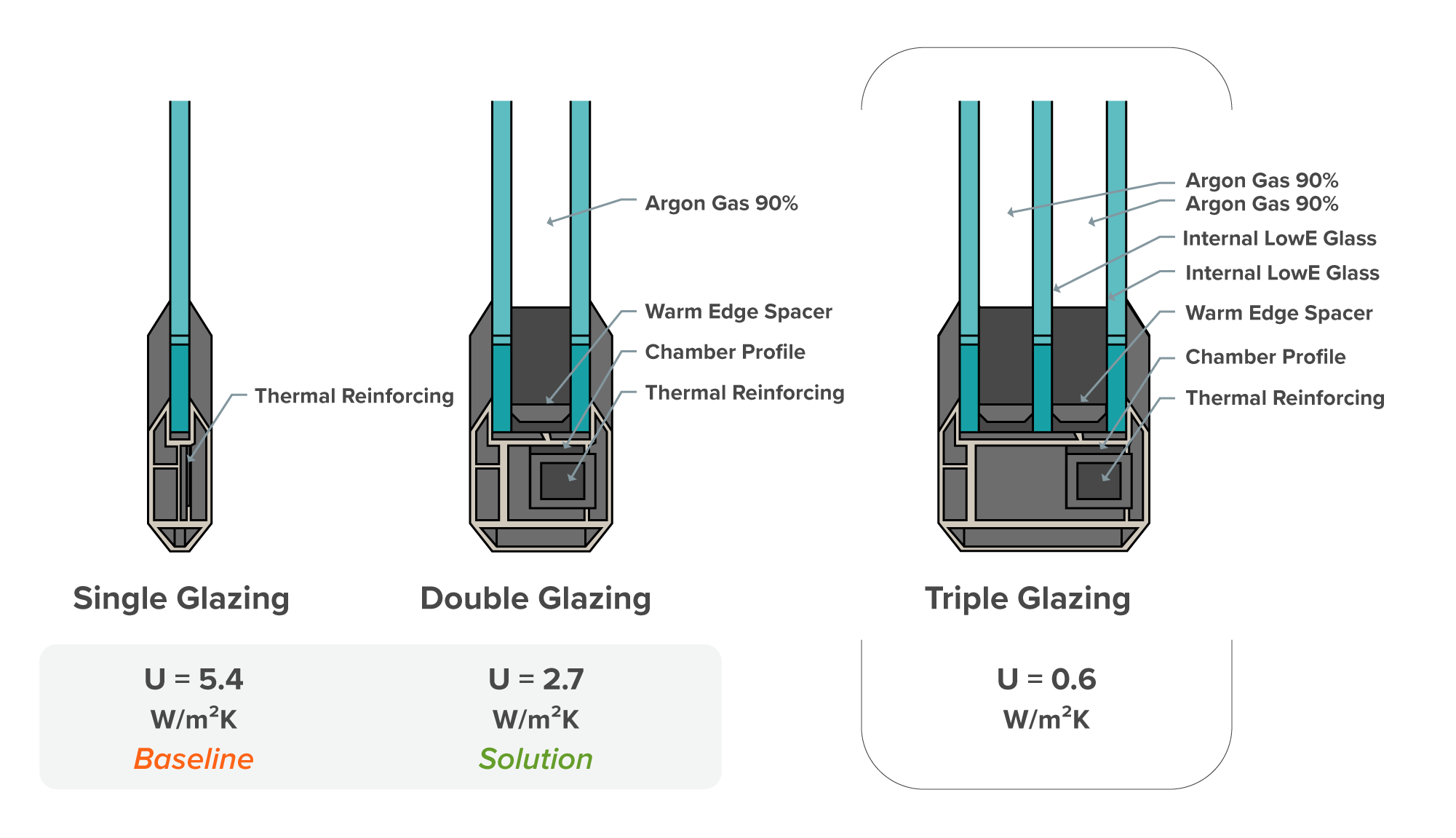
The properties of a window determine the rate of heat transfer (i.e., its thermal transmittance or U-value) and thus its efficacy at decreasing the flow of heat between the indoors and outdoors (Aguilar-Santana, 2020; Saint-Gobain, 2018). Window types such as double-glazed, double-glazed with low emissivity (low-e) coating, or triple-glazed (Figure 2) perform better than single-glazed windows due to their lower U-values (Aguilar-Santana et al., 2020; Li et al., 2023; Salazar et al., 2024). In more resourced countries or regions such as the United States, Canada, and the European Union, a minimum of double glazing is considered standard practice, accounting for a growing share of the number of windows installed or sold annually (Hermelink et al., 2017; Janssens, 2021). However, the minimum glazing U-value standards set by building energy regulations in most low- and middle-income countries, where the bulk of new construction occurs (IEA, 2023c), often do not mandate the use of better performing windows in buildings (Gaum, 2023). 

Improve Windows and Glass assesses the impact of retrofitting single-glazed windows in the current (2022) global building stock, focusing on scaling up the use of double glazing as the minimum. Retrofitting extends the lifespan of building components and helps these buildings remain in use. The U-value of 2.7 W/m2K we used for double glazing during our analysis also includes other double pane window types with similar U-values such as secondary glazing where a second window is added to the outside of the existing one.

Figure 2. Multiple-glazed windows reduce heat transmission better than single glazed windows and so create less demand for GHG-producing fuels. Modified from Aguilar-Santana et al. (2020) and Moghaddam et al. (2023).

Image
A description of different glazing types.

Sources: Aguilar-Santana, J. L., Jarimi, H., Velasco-Carrasco, M., & Riffat, S. (2020). Review on window-glazing technologies and future prospects. International Journal of Low-Carbon Technologies, 15(1), 112–120; Moghaddam, S. A., Serra, C., Gameiro da Silva, M., & Simões, N. (2023). Comprehensive review and analysis of glazing systems towards nearly zero-energy buildings: Energy performance, thermal comfort, cost-effectiveness, and environmental impact perspectives. Energies, 16(17), Article 6283.

References

Aguilar-Santana, J. L., Jarimi, H., Velasco-Carrasco, M., & Riffat, S. (2020). Review on window-glazing technologies and future prospects. International Journal of Low-Carbon Technologies, 15(1), 112–120. Link to source: https://doi.org/10.1093/ijlct/ctz032

Ahmed, A. E., Suwaed, M. S., Shakir, A. M., & Ghareeb, A. (2025). The impact of window orientation, glazing, and window-to-wall ratio on the heating and cooling energy of an office building: The case of hot and semi-arid climate. Journal of Engineering Research, 13(1), 409–422. Link to source: https://doi.org/10.1016/j.jer.2023.10.034

Arasteh, D., Selkowitz, S., Apte, J., & LaFrance, M. (2006). Zero energy windows. Lawrence Berkeley National Laboratory. Link to source: https://escholarship.org/uc/item/2zp5m6x8

Aroul, R., & Hansz, J. A. (2011). The role of dual-pane windows and improvement age in explaining residential property values. Journal of Sustainable Real Estate, 3(1), 142–161. Link to source: https://doi.org/10.1080/10835547.2011.12091822

Aruta, G., Ascione, F., Iovane, T., & Mastellone, M. (2025). Double-skin façades for the refurbishment of historic buildings: Energy-economic feasibility for different types of glazing and ventilation rates. Journal of Building Engineering, 103, Article 112125. Link to source: https://doi.org/10.1016/j.jobe.2025.112125

Asahi India Glass Ltd. (2025, April 25). Top benefits of float glass in modern homesLink to source: https://www.aisglass.com/blog/top-benefits-of-float-glass-in-modern-homes/

Balali, A., Yunusa-Kaltungo, A., & Edwards, R. (2023). A systematic review of passive energy consumption optimisation strategy selection for buildings through multiple criteria decision-making techniques. Renewable and Sustainable Energy Reviews, 171, Article 113013. Link to source: https://doi.org/10.1016/j.rser.2022.113013

Balasbaneh, A. T., Yeoh, D., Ramli, M. Z., & Valdi, M. H. T. (2022). Different alternative retrofit to improving the sustainability of building in tropical climate: Multi-criteria decision-making. Environmental Science and Pollution Research, 29(27), 41669–41683. Link to source: https://doi.org/10.1007/s11356-022-18647-8

Basok, B., Davydenko, B., Novikov, V., Pavlenko, A. M., Novitska, M., Sadko, K., & Goncharuk, S. (2022). Evaluation of heat transfer rates through transparent dividing structures. Energies, 15(13), Article 4910. Link to source: https://doi.org/10.3390/en15134910

Bulut, M., Wilkinson, S., Khan, A., Jin, X.-H., & Lee, C. L. (2021). Perceived benefits of retrofitted residential secondary glazing: An exploratory Australian study. International Journal of Building Pathology and Adaptation, 39(5), 720–733. Link to source: https://doi.org/10.1108/IJBPA-09-2020-0083

Calautit, J. K., Sun, H., Li, J., Dik, A., & Mohammadi, M. (2025). Keeping it simple: Field testing and techno-economic assessment of a low-cost secondary quad glazing for enhanced energy efficiency in buildings [Corrected proof]. Energy and Built Environment. Link to source: https://doi.org/10.1016/j.enbenv.2025.03.004

Cuce, E., & Riffat, S. B. (2015). Aerogel-assisted support pillars for thermal performance enhancement of vacuum glazing: A CFD research for a commercial product. Arabian Journal for Science and Engineering, 40(8), 2233–2238. Link to source: https://doi.org/10.1007/s13369-015-1727-5

Delmastro, C., & Chen, O. (2023, July 11). Energy system: Buildings. International Energy Agency. Link to source: https://www.iea.org/energy-system/buildings

Department for Levelling Up, Housing and Communities. (2023, December 14). Accredited official statistics chapter 5: Energy efficiency. GOV.UK. Link to source: https://www.gov.uk/government/statistics/chapters-for-english-housing-survey-2022-to-2023-headline-report/chapter-5-energy-efficiency#contents

DIY Double Glaze. (n.d.). 6 problems with double glazed windows and how you can resolve them. Retrieved September 13, 2025, from Link to source: https://www.diydoubleglaze.com.au/6-problems-with-double-glazed-windows-and-how-you-can-resolve-them/

Duan, Q., Hinkle, L., Wang, J., Zhang, E., & Memari, A. (2021). Condensation effects on energy performance of building window systems. Energy Reports, 7, 7345–7357. Link to source: https://doi.org/10.1016/j.egyr.2021.10.096

Es-sakali, N., Kaitouni, S. I., Laasri, I. A., Mghazli, M. O., Cherkaoui, M., & Pfafferott, J. (2022). Assessment of the energy efficiency for a building energy model using different glazing windows in a semi-arid climate. Proceedings of the 13th International Renewable Energy Congress (IREC), 1–5. Link to source: https://doi.org/10.1109/IREC56325.2022.10001934

Gasparotto, J., & Da Boit Martinello, K. (2021). Coal as an energy source and its impacts on human health. Energy Geoscience, 2(2), 113–120. Link to source: https://doi.org/10.1016/j.engeos.2020.07.003

Gaum, T. (2023). Building energy codes in the Global South: Comparing selected variables to develop a decision-making model to address climate-change guidelines [Spreadsheet]. SLIM3. Link to source: https://docs.google.com/spreadsheets/d/1aP4zaeDvfwSI-3Abuj8Z_VUUEHJzjMZS/edit?gid=988383392#gid=988383392

Gaum, T., & Laubscher, J. (2022). Building energy codes: Reviewing the status of implementation strategies in the Global South. International Journal of Built Environment and Sustainability, 9(1), 39–53. Link to source: https://doi.org/10.11113/ijbes.v9.n1.871

Global Alliance for Buildings and Construction, International Energy Agency, & the United Nations Environment Programme. (2020). GlobalABC regional roadmap for buildings and construction in Africa 2020-2050: Towards a zero-emission, efficient and resilient buildings and construction sector [Report]. International Energy Agency. Link to source: https://globalabc.org/sites/default/files/inline-files/Africa_Buildings%20Roadmap_FINAL_1.pdf

Gomaa, M. M., Abdallah, A. S. H., Aloshan, M. A., & Ragab, A. (2025). A comparative analysis of advanced glazing technologies for energy-efficient buildings in Jeddah city, Saudi Arabia. Buildings, 15(9), Article 1477. Link to source: https://doi.org/10.3390/buildings15091477

Gustavsen, A., Grynning, S., Arasteh, D., Jelle, B. P., & Goudey, H. (2011). Key elements of and material performance targets for highly insulating window frames. Energy and Buildings, 43(10), 2583–2594. Link to source: https://doi.org/10.1016/j.enbuild.2011.05.010

Harkouss, F., Fardoun, F., & Biwole, P. H. (2018). Multi-objective optimization methodology for net zero energy buildings. Journal of Building Engineering, 16, 57–71. Link to source: https://doi.org/10.1016/j.jobe.2017.12.003

Henneman, L., Choirat, C., Dedoussi, I., Dominici, F., Roberts, J., & Zigler, C. (2023). Mortality risk from United States coal electricity generation. Science382(6673), 941–946. Link to source: https://doi.org/10.1126/science.adf4915

Hermelink, A., von Manteuffel, B., & Grözinger, J. (2017). Minimum performance requirements for window replacement in the residential sector [Report]. ECOFYS. Link to source: https://glassforeurope.com/wp-content/uploads/2018/04/Minimum-performance-requirements-for-window-replacement-in-the-residential-sector.pdf

International Energy Agency. (2018). The future of cooling: Opportunities for energy-efficient air conditioningLink to source: https://www.iea.org/reports/the-future-of-cooling

International Energy Agency. (2022a, September 1). Global buildings sector CO2 emissions and floor area in the net zero scenario, 2020-2050Link to source: https://www.iea.org/data-and-statistics/charts/global-buildings-sector-co2-emissions-and-floor-area-in-the-net-zero-scenario-2020-2050

International Energy Agency. (2022b). Renovation of near 20% of existing building stock to zero-carbon-ready by 2030 is ambitious but necessaryLink to source: https://www.iea.org/reports/renovation-of-near-20-of-existing-building-stock-to-zero-carbon-ready-by-2030-is-ambitious-but-necessary

International Energy Agency. (2023b, June 15). Energy consumption in buildings by fuel in the net zero scenario, 2010-2030. Link to source: https://www.iea.org/data-and-statistics/charts/energy-consumption-in-buildings-by-fuel-in-the-net-zero-scenario-2010-2030-2

International Energy Agency. (2023c, June 15). Global floor area and buildings energy intensity in the net zero scenario, 2010-2030. Link to source: https://www.iea.org/data-and-statistics/charts/global-floor-area-and-buildings-energy-intensity-in-the-net-zero-scenario-2010-2030

International Energy Agency. (2023d). Space cooling: Net zero emissions guideLink to source: https://www.iea.org/reports/space-cooling-2

International Energy Agency. (2023e). Space heating: Net zero emissions guideLink to source: https://www.iea.org/reports/space-heating

International Energy Agency. (2023f, July 11). Total floor area by use in the net zero scenario, 2010-2030. Link to source: https://www.iea.org/data-and-statistics/charts/total-floor-area-by-use-in-the-net-zero-scenario-2010-2030-2

International Energy Agency. (2024). World energy balancesLink to source: https://www.iea.org/data-and-statistics/data-product/world-energy-balances

Janssens, C. (2021, September 27). Minimum energy performance requirements for window replacement in the 28 EU member states. Glassonweb. Link to source: https://www.glassonweb.com/article/minimum-energy-performance-requirements-window-replacement-28-eu-member-states 

Karabay, H., & Arici, M. (2012). Multiple pane window applications in various climatic regions of Turkey. Energy and Buildings, 45, 67–71. Link to source: https://doi.org/10.1016/j.enbuild.2011.10.020

Krarti, M., & Ihm, P. (2016). Evaluation of net-zero energy residential buildings in the MENA region. Sustainable Cities and Society, 22, 116–125. Link to source: https://doi.org/10.1016/j.scs.2016.02.007

Li, N., Meng, Q., Zhao, L., Li, H., Wang, J., Zhang, N., Wang, P., & Lu, S. (2023). Thermal performance study of multiple thermal insulating glazings with polycarbonate films as interval layers. Journal of Building Engineering, 76, Article 107159. Link to source: https://doi.org/10.1016/j.jobe.2023.107159

Likins-White, M., Tenent, R. C., & Zhai, Z. (2023). Degradation of insulating glass units: Thermal performance, measurements and energy impacts. Buildings, 13(2), Article 551. Link to source: https://doi.org/10.3390/buildings13020551

Lozinsky, C. H., Casquero-Modrego, N., & Walker, I. S. (2025). The health and indoor environmental quality impacts of residential building envelope retrofits: A literature review. Building and Environment, 270, Article 112568. Link to source: https://doi.org/10.1016/j.buildenv.2025.112568

Magraoui, C., Derradji, L., Hamid, A., Oukaci, S., Limam, A., & Merabtine, A. (2025). A smart roller shutters control for enhancing thermal comfort and sustainable energy efficiency in office buildings. Sustainability, 17(5), Article 2116. Link to source: https://doi.org/10.3390/su17052116

Menzies, G. F., & Wherrett, J. R. (2005). Multiglazed windows: Potential for savings in energy, emissions and cost. Building Services Engineering Research & Technology26(3), 249–258. Link to source: https://doi.org/10.1191/0143624405bt132tn

MLI Building Products. (2023, February 27). Are glass prices set to rise in 2023? Link to source: https://www.mlibuildingproducts.co.uk/glass-prices-rise-2023/

Moghaddam, S. A., Serra, C., Gameiro da Silva, M., & Simões, N. (2023). Comprehensive review and analysis of glazing systems towards nearly zero-energy buildings: Energy performance, thermal comfort, cost-effectiveness, and environmental impact perspectives. Energies, 16(17), Article 6283. Link to source: https://doi.org/10.3390/en16176283

Natural Resources Canada. (n.d.). Table 4.5a – Windows by region. Government of Canada. Retrieved July 23, 2025, from Link to source: https://oee.nrcan.gc.ca/corporate/statistics/neud/dpa/showTable.cfm?type=SH&sector=aaa&juris=ca&year=2019&rn=35&page=1

Owolabi, A. B., Suh, D., & Pignatta, G. (2023). Investigating the energy use in an Australian building: A case study of a west-facing apartment in Sydney. Ain Shams Engineering Journal, 14(8), Article 102040. Link to source: https://doi.org/10.1016/j.asej.2022.102040

Paarhammer. (n.d.). New building regulations coming soon. Paarhammer windows and doors. Retrieved August 15, 2025, from Link to source: https://www.paarhammer.com.au/blog/new-building-regulations-coming-soon

Pistochini, T., Dichter, M., Chakraborty, S., Dichter, N., & Aboud, A. (2022). Greenhouse gas emission forecasts for electrification of space heating in residential homes in the US. Energy Policy, 163, Article 112813. Link to source: https://doi.org/10.1016/j.enpol.2022.112813

Procurement Resource. (n.d.). Float glass price trend and forecast. Retrieved September 19, 2025, from Link to source: https://www.procurementresource.com/resource-center/glass-price-trends

Ren, Z., Wang, X., & Chen, D. (2014). Heat stress within energy efficient dwellings in Australia. Architectural Science Review, 57(3), 227–236. Link to source: https://doi.org/10.1080/00038628.2014.903568

Richardson, J. (2024, December 31). CO2 carbon savings of a heat pump and their environmental cost. The Renewable Energy Hub UK. Link to source: https://www.renewableenergyhub.co.uk/main/heat-pumps-information/co2-carbon-savings-of-a-heat-pump-and-their-environmental-cost#:~:text=Fluorinated%20hydrocarbons%20such%20as%20HFCs,warming%20potential

Ritchie, H. (2024). Air conditioning causes around 3% of greenhouse gas emissions. How will this change in the future? Our World in Data. Link to source: https://archive.ourworldindata.org/20251125-173858/air-conditioning-causes-around-greenhouse-gas-emissions-will-change-future.html 

Saadatian, S., Freire, F., & Simões, N. (2021). Embodied impacts of window systems: A comparative assessment of framing and glazing alternatives. Journal of Building Engineering, 35, Article 102042. Link to source: https://doi.org/10.1016/j.jobe.2020.102042

Saint-Gobain. (2018). Solar & thermal 1e thermal insulation. Link to source: https://www.saint-gobain-glass.co.uk/wp-content/uploads/2022/05/Solar-Thermal-1E-Thermal-Insulation-19-09-2018.pdf

Salazar, S. L., Simá, E., Vargas-López, R., Yang, R., Li, D., & Hernández-López, I. (2024). Assessing different glazing types for energy savings and CO2 reduction in a tropical climate: A comparative study. Journal of Building Engineering, 82, Article 108188. Link to source: https://doi.org/10.1016/j.jobe.2023.108188

Shah, B., Bhandari, M., & Tang, M. (2024). Importance of window installation in residential building envelopes having continuous external insulation in order to realize energy efficiency. Energies, 17(17), Article 4273. Link to source: https://doi.org/10.3390/en17174273

U.S. Energy Information Administration. (2018, May). 2015 Residential Energy Consumption Survey (RECS) survey data: Housing characteristics tables - structural and geographic characteristics - by housing unit type (HC2.1). Retrieved August 15, 2025, from Link to source: https://www.eia.gov/consumption/residential/data/2015/hc/php/hc2.1.php

U.S. Energy Information Administration. (2023). Table HC2.1 Structural and geographic characteristics of U.S. homes by housing unit type, 2020Link to source: https://www.eia.gov/consumption/residential/data/2020/hc/pdf/HC%202.1.pdf

U.S. Environmental Protection Agency. (2024). Climate change indicators in the United StatesLink to source: https://www.epa.gov/system/files/documents/2024-07/climate_indicators_2024.pdf 

U.S. Environmental Protection Agency. (2025). Power sector programs – Progress report. Link to source: https://www.epa.gov/power-sector/progress-report

Yuk, H., Choi, J. Y., Yang, S., & Kim, S. (2024). Balancing preservation and utilization: Window retrofit strategy for energy efficiency in historic modern building. Building and Environment, 259, Article 111648. Link to source: https://doi.org/10.1016/j.buildenv.2024.111648

Credits

Lead Fellow

  • Henry Igugu, Ph.D.

Contributors

  • Ruthie Burrows, Ph.D.

  • James Gerber, Ph.D.

  • Daniel Jasper

  • Alex Sweeney

Internal Reviewers

  • Sarah Gleeson, Ph.D.

  • Heather McDiarmid, Ph.D.

  • Amanda D. Smith, Ph.D.

Effectiveness

Each 1 m2 of single-glazed window glass in buildings that is upgraded to double glazing has the potential to cut GHG emissions by approximately 0.07 t CO₂‑eq/yr (20-yr and 100-yr basis).

To determine the solution’s effectiveness (Table 1), we evaluated the emissions cut from reducing space heating and space cooling. Since studies often capture different U-value ratings for similar window glass, we weighted the energy saved (kWh/yr) from improving the glass using consistent U-values for the baseline and solution (see Figure 2). Thereafter, we weighted the energy impact by the total area of glass substituted (m2) to determine the savings intensity (kWh/m2/yr) and multiplied the estimate by emission intensities of heating and cooling fuels based on the IEA’s world energy balances data (IEA, 2024).

This solution cuts CO₂, methane, and nitrous oxide emissions by reducing the amount of fossil fuels used for heating and for producing electricity used for cooling. The analysis includes studies from countries representative of heating-dominated and cooling-dominated climates such as the United States (Calautit et al., 2025) and Malaysia (Balasbaneh et al., 2022), respectively. Notably, the solution is also effective in other climates (Magraoui et al., 2025).

Table 1. Effectiveness at reducing emissions.

Unit: t CO₂‑eq /m2/yr, 100-yr basis

25th percentile 0.043
Mean 0.095
Median (50th percentile) 0.065
75th percentile 0.13
Left Text Column Width
Cost

Our estimate of the cost per unit climate impact (Table 2) indicates that replacing single-glazed windows with double-glazed windows in buildings globally results in considerable savings of approximately US$123/t CO₂‑eq.

We found that the solution’s initial cost varies considerably, from about US$31/m2 in Malaysia (Balasbaneh et al., 2022) to US$257–684/m2 in France (Harkouss et al., 2018), highlighting regional price differences that could affect adoption. Ultimately, we chose an initial cost of approximately US$144/m2 for double glazing. Using the cost of single glazing we found in studies from different regions (Aruta et al., 2025; Krarti & Ihm, 2016), our analysis determined a baseline initial cost of approximately US$35/m2. While the solution cost is more than four times the baseline, less energy is used for space heating or cooling, reducing the annual operating cost from US$23/m2 to approximately US$12/m2. After amortizing the initial cost over 30 years, the solution resulted in a net savings of US$8/m2/yr, compared with the baseline.

During our analysis, we normalized the initial cost by the baseline and solution U-value (see Figure 2) to ensure consistency. We assumed the initial cost includes the glass component alone, but some of our sources were ambiguous about the scope of the investment and may have also included frames and installation costs. To determine the cost per adoption unit, we weighted the amount of energy consumed for heating and cooling in each data source using the total area of windows upgraded in the respective case study buildings. The analysis does not include revenues because building owners typically do not generate any revenue from window glass installed. 

Table 2. Cost per unit of climate impact.

Unit: 2023 US$/t CO₂‑eq , 100-yr basis

Median -123
Left Text Column Width

Methods and Supporting Data

Learning Curve

We found no definitive data on the solution’s learning rate. While the adoption of double glazing grows, some studies have reported rising cost of glass in recent periods (MLI Building Products, 2023). In an assessment of regional float glass price trends, Procurement Resource (n.d.) argued that rising material, energy, and labor costs amid other economic pressures are driving up the cost of glass. Since modern windows are often made using float glass (Asahi India Glass Ltd., 2025), the initial cost could become more expensive.

Speed of Action

Speed of action refers to how quickly a climate solution physically affects the atmosphere after it is deployed. This is different from speed of deployment, which is the pace at which solutions are adopted.

At Project Drawdown, we define the speed of action for each climate solution as emergency brake, gradual, or delayed.

Improve Windows and Glass is a GRADUAL climate solution. It has a steady, linear impact on the atmosphere.

Caveats

Our analysis for this solution focused on the U-value of the glass component alone. It did not include other parameters such as the material type of the window frames or coatings on windows, though these also impact space heating and cooling energy use (Owolabi et al., 2023). We ensured that the data used in our analysis aligned with our approach (i.e., indicated the impact of solely substituting double-glazed or better glass for single-glazed). Due to limited data, we assumed that current adoption in LMICs is 5%. The adoption scenarios and climate impact may be influenced if the actual percentage is higher or lower.

A window’s orientation impacts the solar heat gain. Thus, the influence of upgrading to double-glazing on heating or cooling loads is affected by window placement. We found limited data that incorporates orientation and did not account for this difference.

Recently, some studies have indicated concerns about the payback period of upgrading to double glazing for building owners (Calautit et al., 2025), especially in LMICs, where higher initial costs could be a barrier. Creative initiatives such as incentive schemes can improve the payback period (Aruta et al., 2025). 

Current Adoption

To determine the current adoption of double-glazed windows, we first estimated the total amount of window glass installed in buildings by applying window-to-floor area ratios from studies to the currently existing 198.1 billion m2 residential and 54.6 billion m2 nonresidential building floor space (IEA, 2023f). This yielded approximately 23.3 billion mand 42.2 billion m2 of window glass installed in high-income countries (HICs) and low- and middle-income countries (LMICs), respectively (IEA, 2023c). 

We found limited data for the proportion of minimum double-glazed windows in HICs. The U.S. Energy Information Administration (U.S. EIA, 2023) reported that 80 million housing units (65%) in the U.S. have double-glazed windows installed. Percentages reported for other countries include 88% of housing units in the United Kingdom (Department for Levelling Up, Housing and Communities, 2023), 90% in Canada (Natural Resources Canada, n.d.), and 15% in Australia (Paarhammer, n.d.). Using these percentages, we estimated a 76% (median) solution adoption rate in HICs.

Since we found no definitive data for the solution’s adoption in LMICs, and considering a few LMICs have building energy codes that either mandate or encourage the use of higher performing windows (Gaum, 2023; Gaum & Laubscher, 2022), we assumed that double-glazed windows represent a conservative underestimate of 5%. 

All told, we estimate that as of 2022, installed double-glazed windows in buildings cover roughly 19.9 billion m2 globally (Table 3).

Table 3. Current (2022) adoption level.

Unit: m2 windows minimum double-glazed

25th percentile 14,300,000,000
Mean 17,100,000,000
Median (50th percentile) 19,900,000,000
75th percentile 22,700,000,000
Left Text Column Width
Adoption Trend

According to the Department for Levelling Up, Housing and Communities (2023), the percentage of UK homes that have double-glazed windows increased by 9% between 2012 and 2022. Similarly, adoption grew by about 6% in five years (2015–2020) in the United States (U.S. EIA, 2018). Using these countries as representatives, this growth translates to approximately 438–448 million m2 of double-glazed or better windows being added every year in HICs.

We found limited data for adoption trends in LMICs. Based on our assumption for the current adoption in LMICs, we assumed that the percentage adoption of double-glazed windows grew by 4% over 10 years (2012–2022). This assumption, which is likely a conservative underestimate, translates to an annual addition of about 178 million m2/yr of double glazing.

Based on these findings, we estimate that the adoption of double glazing or better windows has grown globally by nearly 622 million m2 annually (Table 4).

Historically, the bulk of the solution’s adoption has occurred in HICs. However, the Global Alliance for Buildings and Construction, IEA, and the United Nations Environment Programme (UNEP) emphasize that adopting double-glazed windows is a necessary sustainability strategy for the building sector, especially in Africa and LMICs (GlobalABC/IEA/UNEP, 2020). This indicates considerable potential for scaling the solution, with 76% of the global building sector’s growth in the past 12 years occurring in LMICs (IEA, 2023f), where there has been less adoption of double glazing or better windows.

Table 4. 2010–2022 adoption trend.

Unit: m2/yr

25th percentile 620,000,000
Mean 622,000,000
Median (50th percentile) 622,000,000
75th percentile 624,000,000
Left Text Column Width
Adoption Ceiling

We estimated an adoption ceiling (Table 5) of approximately 46.7 billion m2 of double-glazed windows globally. For this adoption scenario, 90% and 61% of window glass that existed in 2022 will be retrofitted to double-glazed or better by 2050 in buildings in HICs and buildings in LMICs, respectively.

In our analysis, we used the current double-glazed windows ratio of 90% in Canada (Natural Resources Canada, n.d) as a benchmark for the building sector’s adoption ceiling in HICs. For buildings in LMICs, we used the IEA’s recommended 2%/yr retrofit rate (IEA, 2022b) over 28 years (2022–2050). This estimated 56% growth was added to the current adoption of 5% to determine the region’s adoption ceiling. The analysis results in about 21 billion m2 and 26 billion m2 of double-glazed windows installed in buildings in HICs and LMICs, respectively.

Table 5. Adoption ceiling.

Unit: m2 windows minimum double-glazed

Estimate 46,700,000,000
Left Text Column Width
Achievable Adoption

Our analysis estimated a low achievable adoption of approximately 32.9 billion m2 of double-glazed or better windows installed in buildings globally (Table 6). For this scenario, we estimate that the percentage of windows that were at minimum double-glazed as of 2022 in buildings in HICs (76%) and buildings in LMICs (5%) grows to 81% and 33%, respectively.

Under the high achievable scenario, 86% of window glass in buildings in HICs and 47% of window glass in buildings in LMICs is at minimum double-glazed. This translates to a total of nearly 40.0 billion m2 of double glazing or better installed by 2050.

The achievable adoption scenarios are largely driven by the growth that is possible in LMICs. We assumed a retrofit rate of 1%/yr for the Achievable – Low scenario, which is the current global retrofit rate in the building industry (IEA, 2022b); for Achievable – High, we used 1.5%/yr. We also assumed that the current (2022) building stock will still be in use by 2050.

Table 6. Range of achievable adoption levels.

Unit: m2 windows minimum double-glazed

Current adoption 19,900,000,000
Achievable – low 32,900,000,000
Achievable – high 40,000,000,000
Adoption ceiling 46,700,000,000
Left Text Column Width

The current adoption of double-glazed windows in buildings reduces global GHG emissions by approximately 1.3 Gt CO₂‑eq/yr on a 100-yr and 20-yr basis (Table 7). If the low achievable adoption scenario is reached, this solution could potentially cut about 2.1 Gt CO₂‑eq/yr (100-yr and 20-yr basis). The high achievable scenario would decrease global emissions 2.6 Gt CO₂‑eq/yr year (100-yr and 20-yr basis). We estimated that the adoption ceiling could avoid up to 3.0 Gt CO₂‑eq/yr of emissions on a 100-yr basis (3.1 Gt CO₂‑eq/yr, 20-yr basis).

This solution only accounts for the impact of retrofitting the building stock that exists as of 2022. However, the current global built floor area (252.7 billion m2) is projected to grow by an additional 183 billion m2, by 2050 (IEA, 2022a; 2023b). This means a possible addition of 1.6 billion m2 of new window glass every year, indicating that the potential for scaling the climate impact exists.

Table 7. Climate impact at different levels of adoption.

Unit: Gt CO₂‑eq/yr, 100-yr basis

Current adoption 1.3
Achievable – low 2.1
Achievable – high 2.6
Adoption ceiling 3.0
Left Text Column Width
Additional Benefits

Income and Work

While multi-glazed windows are often more of an initial investment than single-pane windows, improved performance of these windows is associated with more energy and cost savings (Menzies & Wherrett, 2005). Regional climates often affect the most appropriate window type and the amount of savings (Karabay & Arici, 2012). In residential buildings, double-glazed windows can add value to homes and increase property values (Aroul & Hansz, 2011). 

Health

Reductions in air pollution due to lower heating and cooling demand decrease exposures to pollutants such as mercury and fine particulate matter generated from fossil fuel–based power plants, improving the health of nearby communities (U.S. Environmental Protection Agency [EPA], 2025). These pollutants have been linked to increased morbidity from cardiovascular and respiratory disease, asthma, infections, and cancer (Gasparotto & Martinello, 2021) and to increased risk of mortality (Henneman et al., 2023). 

Better-performing windows can benefit health through improved thermal comfort (Bulut et al., 2021). When combined with other measures to reduce cooling loads, double-glazed windows can help with the risk of indoor heat stress (Ren et al., 2014). Improved windows may also reduce condensation and mold growth in buildings (Lozinsky et al., 2025). Residents of households with double-glazed windows have reported improvements in noise insulation after retrofitting single-pane windows (Bulut et al., 2021). 

Air Quality

Higher-performing glass can reduce air pollution by lowering gas and electricity demand for heating and cooling, which can decrease pollutants such as CO₂, nitrogen oxides, methane, mercury, and fine particulate matter generated from fossil fuel–based power plants (U.S. EPA, 2025).

Risks

Faulty installation could compromise the expected benefits of double glazing. It could also lead to condensation on the inner pane if the sealant deteriorates, affecting visibility, aesthetics, and performance and resulting in a potential shorter lifespan than single glazing (Duan et al., 2021; Likins-White, 2023). Additional costs may be incurred when attempting to secure adequate expertise and equipment to ensure proper handling and installation (DIY Double Glaze, n.d.). Depending on the extent of the retrofits, this may drive up construction costs, which is a concern for building developers. However, it also represents opportunities to improve available technical expertise in regions where these services are unavailable or underdeveloped.

Interactions with Other Solutions

Reinforcing

Improve Windows and Glass reduces the amount of space heating and cooling required. This may reduce the required size and complexity of heating and cooling systems, making them more economically accessible.

Upgrading window glass can motivate building owners to improve other elements of the building envelope. This could improve the cost efficiency of the upgrades when approached holistically. 

Competing

The potential climate impact of deploying these solutions could be lower due to the reduced amount of space heating and cooling required in buildings from improving window glass.

Dashboard

Solution Basics

m2 windows minimum double-glazed

t CO₂-eq (100-yr)/unit/yr
00.040.065median
units
Current 1.99×10¹⁰ 03.29×10¹⁰4.0×10¹⁰
Achievable (Low to High)

Climate Impact

Gt CO₂-eq (100-yr)/yr
Current 1.3 2.12.6
US$ per t CO₂-eq
-123
Gradual

CO₂ , CH₄, N₂O

Trade-offs

Manufacturing double-glazed or better windows generates more industrial sector emissions than does manufacturing single-glazed windows due to the additional materials used. However, life-cycle analysis studies such as Balasbaneh et al. (2022) compared different glazing options ranging from single to triple glazing and determined that the emissions reduced by using better windows outweighs the embodied emissions. Although it is outside the scope of this solution, window frames account for as much as 46–80% of a window's embodied emissions, especially when using conventional window frame materials such as polyvinyl chloride and aluminum (Saadatian et al., 2021). Despite the higher embodied emissions, the emissions reductions from implementing the solution are substantial.

°C days
015,000

Space heating demand (18 °C basis)

Heating degree days are a measure of total space-heating demand to maintain an indoor temperature above 18 °C. Here we show annual average heating degree days for the decade ending in 2025.

Copernicus Climate Change Service. (2023). ERA5 hourly data on single levels from 1940 to present [Data set]. Copernicus Climate Change Service (C3S) Climate Data Store (CDS). Retrieved January 13, 2026 from Link to source: https://doi.org/10.24381/cds.adbb2d47 

Hersbach, H., Bell, B., Berrisford, P., Hirahara, S., Horányi, A., Muñoz‐Sabater, J., Nicolas, J., Peubey, C., Radu, R., Schepers, D., Simmins, A., Soci, C., Abdalla, S., Abellan, X., Balsamo, G., Bechtold, P., Biavati, G., Bidlot, J., Bonavita, M., … Thépaut, J. N. (2020). The ERA5 global reanalysis. Quarterly Journal of the Royal Meteorological Society, 146(730), 1999–2049. Link to source: https://doi.org/10.1002/qj.3803

°C days
015,000

Space heating demand (18 °C basis)

Heating degree days are a measure of total space-heating demand to maintain an indoor temperature above 18 °C. Here we show annual average heating degree days for the decade ending in 2025.

Copernicus Climate Change Service. (2023). ERA5 hourly data on single levels from 1940 to present [Data set]. Copernicus Climate Change Service (C3S) Climate Data Store (CDS). Retrieved January 13, 2026 from Link to source: https://doi.org/10.24381/cds.adbb2d47 

Hersbach, H., Bell, B., Berrisford, P., Hirahara, S., Horányi, A., Muñoz‐Sabater, J., Nicolas, J., Peubey, C., Radu, R., Schepers, D., Simmins, A., Soci, C., Abdalla, S., Abellan, X., Balsamo, G., Bechtold, P., Biavati, G., Bidlot, J., Bonavita, M., … Thépaut, J. N. (2020). The ERA5 global reanalysis. Quarterly Journal of the Royal Meteorological Society, 146(730), 1999–2049. Link to source: https://doi.org/10.1002/qj.3803

Maps Introduction

The effectiveness of replacing single-glazed windows in buildings to mitigate climate change varies depending on how buildings are heated and the emissions intensity of electricity used for cooling in each region. We used regional data for the share of heating fuel in buildings (IEA, 2023a). For the electricity used to provide cooling in buildings, we used a global estimate for emission intensity. While the need for heating has historically outweighed the need for cooling, global trends show a steady increase in cooling degree days and a decline in heating degree days, even in colder climates (Eurostat, 2024; U.S. Environmental Protection Agency (U.S. EPA), 2024). Nonetheless, studies such as Kennard et al. (2022) claim that population growth, especially in cooling-dominated climates, will drive rising cooling demand. This growth could potentially drive up the amount of electricity needed to air condition buildings (Waite et al. 2017).

Building energy efficiency codes, especially mandatory regulations, could help drive the adoption of the solution via higher U-value requirements for windows and glass, particularly in low- and middle-income countries (Gaum, 2023). Our analysis also shows that the cost of double-glazed windows varies by country and region.

Action Word
Improve
Solution Title
Windows & Glass
Classification
Highly Recommended

Lawmakers and Policymakers

  • Set clear and measurable targets for building efficiency, emissions reduction, and the deployment of improved windows.
  • Enact holistic policy plans and building codes to reduce GHG emissions from buildings through improved windows and framing systems.
  • Set public procurement standards for windows and glass, using double-glazed windows, at minimum, for public buildings.
  • Amend building codes to include minimum requirements based on window performance; gradually increase the standards over time if necessary.
  • Periodically update codes, policies, and public guidance to keep pace with research and development.
  • Make double-glazed windows the minimum standard option through a range of policy interventions, including regulations, subsidies, and educational programs where relevant; extend incentives to high performing secondary-, double- or triple-glazed windows, if relevant.
  • Offer financial incentives such as subsidies, tax credits, and grants for consumers, manufacturers, start-ups, and improved window installers.
  • Ensure financial incentives reach, and offer additional incentives for, low- and middle-income communities.
  • Ensure financial incentives cover both new installations and retrofits.
  • Create financial disincentives such as higher taxes and fines for lower performing windows.
  • Subsidize workforce or skills development and/or work with businesses to identify gaps and needs such as technical knowledge or the advantages of new technology.
  • Invest in research and development to improve window design, manufacturing, adoption, supply chain access, and circularity.
  • Create green building certification schemes and/or public-private partnerships that offer information, training, and general support for improved windows.
  • Offer educational resources, one-stop shops for windows, and demonstrations for installation and retrofits; offer tours of model builds that feature improved windows for commercial and private developers, highlighting the cost savings, and environmental benefits.

Further information:

Practitioners

  • Finance or develop only new construction and retrofits that use improved windows and other low-carbon practices.
  • Take advantage of financial incentives such as subsidies, tax credits, and grants for installing improved windows.
  • Seek or negotiate preferential loan agreements for developers using improved windows and other climate-friendly practices.
  • Use double-glazed windows as the most basic standard and offer a variety of better-performing options such as triple-glazed.
  • Work with designers and architects who integrate efficient windows and other efficient materials into their designs.
  • Integrate improved window designs into construction databases, including listing prices, thermal insulation properties, and environmental benefits.
  • Advocate for financial incentives, improved building codes, and educational programs advancing the use of improved windows.
  • Use educational resources, one-stop shops for retrofitting and weatherization, installation demonstrations, and tours of model builds.
  • Conduct research to improve the manufacturing, adoption, supply chain access, and circularity of windows.
  • Create or join green building certification schemes, green building councils, and/or public-private partnerships that offer information, training, and general support for improving windows.

Further information:

Business Leaders

  • Finance only new construction and retrofits that use improved windows and other low-carbon practices.
  • Expand product lines to include improved window designs.
  • Integrate improved window designs into construction databases, listing prices, thermal insulation properties, and environmental benefits.
  • Invest in research and development to improve window design, manufacturing, adoption, supply chain access, and circularity.
  • Advocate for financial incentives, improved building codes, and educational programs advancing the use of improved windows.
  • Join green building certification schemes and/or public-private partnerships that offer information, training, and general support for improved windows.
  • Create long-term purchasing agreements with improved window manufacturers to support stable demand and improve economies of scale.
  • Create or join green building certification schemes, green building councils, and/or public-private partnerships that offer information, training, and general support for improved windows.

Further information:

Nonprofit Leaders

  • Finance or develop only new construction and retrofits that use improved windows and other low-carbon practices.
  • Advocate for clear and measurable public targets for building efficiency, emissions reduction, and deployment of improved windows.
  • Advocate for holistic policy plans and building codes to reduce GHG emissions from buildings that include improved windows and framing systems.
  • Advocate for financial incentives, improved building codes, and educational programs advancing the use of improved windows.
  • Conduct research to improve window design, manufacturing, adoption, supply chain access, and circularity.
  • Work with businesses for workforce or skills development.
  • Offer educational resources, one-stop shops for windows, and demonstrations for installation and retrofits; offer tours of model builds that feature improved windows for commercial and private developers, highlighting the cost savings and environmental benefits.
  • Create, join, or administer green building certification schemes and/or public-private partnerships that offer information, training, and general support for improved windows.

Further information:

Investors

  • Finance only new construction and retrofits that use improved windows and other low-carbon practices.
  • Invest in research and development and start-ups to improve window design, manufacturing, adoption, supply chain access, and circularity.
  • Issue green bonds to invest in projects that use improved windows and integrate other climate-friendly construction practices.
  • Offer preferential loan agreements for developers using improved windows and other climate-friendly practices.
  • Join green building certification schemes and/or public-private partnerships that offer information, training, and general support for improved windows.

Further information:

Philanthropists and International Aid Agencies

  • Finance only new construction and retrofits that use improved windows and other low-carbon practices.
  • Offer grants for developers using improved windows and other climate-friendly practices.
  • Create financing programs for private construction in low-income or under-resourced communities requiring the use of improved windows.
  • Advocate for clear and measurable public targets for building efficiency, emissions reduction, and the deployment of improved windows.
  • Advocate for holistic policy plans and building codes to reduce GHG emissions from buildings that include improved windows and framing systems.
  • Advocate for financial incentives, improved building codes, and educational programs for improved windows.
  • Fund research to improve window design, manufacturing, adoption, supply chain access, and circularity.
  • Offer educational resources, one-stop shops for retrofitting and weatherization, installation demonstrations, and tours of model builds for commercial and private developers, highlighting the cost savings and environmental benefits.
  • Create, join, or administer green building certification schemes and/or public-private partnerships that offer information, training, and general support for improved windows.

Further information:

Thought Leaders

  • Advocate for clear and measurable public targets for building efficiency, emissions reduction, and the deployment of improved windows.
  • Advocate for holistic policy plans and building codes to reduce GHG emissions from buildings that include improved windows and framing systems.
  • Advocate for financial incentives, improved building codes, and educational programs for improved windows.
  • Conduct research to improve window design, manufacturing, adoption, supply chain access, and circularity.
  • Contract with businesses for workforce or skills development.
  • Offer or support educational resources, one-stop shops for retrofitting and weatherization, installation demonstrations, and tours of model builds for commercial and private developers, highlighting the cost savings and environmental benefits of improved windows.
  • Create, join, or administer green building certification schemes and/or public-private partnerships that offer information, training, and general support for improved windows.

Further information:

Technologists and Researchers

  • Research and develop high-performance window technologies such as vacuum glazing, aerogel applications, potential integration of solar photovoltaic glass, and the use of unconventional gases to fill multi-pane windows and improve performance.
  • Create improved alternatives to common practices for air and vapor sealing.
  • Find alternative materials for spacers with reduced thermal conductivity in double- and triple-glazed windows.
  • Research and develop alternative window frame designs to improve thermal performance, structural insulating materials, and improve ease of installation (e.g., out-of-the-box window installation kits).
  • Improve efficiency of the window manufacturing process, supply chain access, and the circular economy of glass.

Communities, Households, and Individuals

  • Finance or develop only new construction and retrofits that use improved windows and other low-carbon practices.
  • Take advantage of financial incentives such as subsidies, tax credits, and grants for installing improved windows.
  • Advocate for clear and measurable public targets for building efficiency, emissions reduction, and the deployment of improved windows.
  • Advocate for holistic policy plans and building codes to reduce GHG emissions from buildings that include improved windows and framing systems.
  • Advocate for financial incentives, improved building codes, and educational programs for improved windows.
  • Organize local “green home tours” and open houses to showcase climate-friendly builds, fostering demand by highlighting cost savings and environmental benefits of improved windows.
  • Capture community feedback and share it with local policymakers to address barriers such as permitting logistics or up-front costs, helping to shape policies that drive adoption.
  • Create, join, or administer green building certification schemes and/or public-private partnerships that offer information, training, and general support for improved windows.

Further information:

Evidence Base

Consensus of effectiveness in reducing GHG emissions: High

Improving windows and glass helps optimize the amount of heating required in buildings by reducing heat loss. Calautit et al. (2025) reported that energy used for heating in a United Kingdom residence dropped nearly 23% after reducing the glass U-value from 5.6 W/m2K to 2.8 W/m2K. Using the same building parameters, the study tested the impact of reducing the U-value by 1.35 W/m2K in the climatic conditions of Netherlands, Japan, United States, Sweden and Australia. The outcomes were similar, with about a 10–12% reduction in heating loads (Calautit et al., 2025). The results from Yuk et al. (2024), Magraoui et al. (2025), and Ahmed et al. (2025) further support these findings. 

Similarly, the solution reduces heat gained from the outdoors into buildings, thereby cutting cooling loads. Gomaa et al. (2025) reported that energy use in a Saudi Arabian residence was reduced by 1,265 kWh/yr (49%) after improving the glass U-value from 5.6 to 0.9 W/m2K (84%). Es-sakali et al. (2022) recorded 36% less electricity consumed after reducing the U-value by 1.44 W/m2K in Morocco’s climate.

The results presented in this document summarize findings from 10 original studies reflecting current evidence from 13 countries. We recognize this limited geographic scope creates bias, and hope this work inspires research and data sharing on this topic in underrepresented regions. The studies we found used simulations to assess the impact of retrofitting windows due to the inherent difficulty of real-world experiments. However, we used studies that include field measurements and calibration of the building simulations to validate their models.

Updated Date
Coming Soon Label
Coming Soon
Subscribe to Health