Climate solutions aren’t created equal. Here’s how we evaluate what works and what doesn’t.

Image
A graphic with a blue background and three thought bubbles that read "Could it work?", "What are the risks?", and "Is it ready?"

Every potential climate solution for the Drawdown Explorer begins as a hypothesis. 

This sounds geeky, but we’re scientists – we can’t help it. It’s the way we think. Our hypothesis looks something like this: “If we do [name of climate solution], it will [reduce emissions or remove carbon dioxide] by [how it works]”.

To test our hypothesis, we comb the scientific literature, international and government reports, industry data, NGO analyses, and even social media and news articles. We study the underlying physics, chemistry, biology, and engineering of how the potential solution works, gather data on its current adoption and effectiveness, and make calculations to assess its likely climate impact if it were scaled up. We estimate costs and consider how implementing the solution could affect natural systems, human well-being, and even other climate solutions. 

And then we decide: Is this potential solution one that we can recommend? Simple, right? 

It turns out that this isn’t as easy as it sounds. When we started work on the Explorer, we already understood that all climate solutions are not created equal. But by the time we had analyzed the first dozen or so solutions on our list, it was clear that we needed to be more specific. And we knew that our decisions had to be transparent and consistent.  

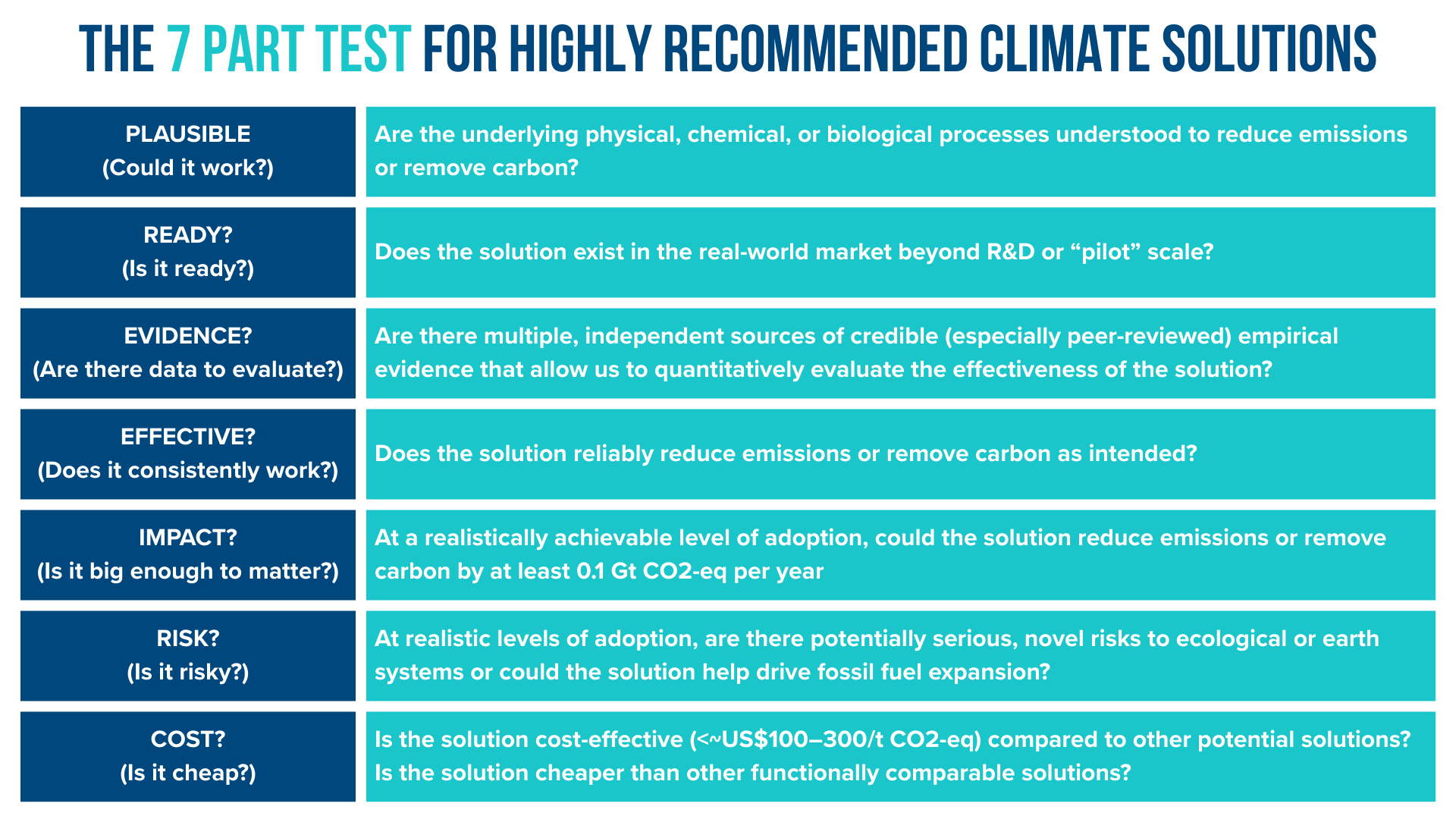
So, nerds that we are, we expanded our simple hypothesis to a seven-part test, asking if a particular practice or technology is plausible, ready, evidenced, effective, impactful, risky, and affordable.

Image
A graphic table with the seven questions Project Drawdown uses to evaluate climate solutions

For every potential climate solution, we answered each of these questions as either “Yes” or “No,” with an occasional “Limited” or “Uncertain/Unknown” substituted when the answer was less clear. Then we developed rules to assign each solution into one of four categories – Highly Recommended, Worthwhile, Keep Watching, and Not Recommended – based on how it met each element of this test. Let’s look at each of these categories more closely.

The Most Effective, Promising, and Needed Climate Solutions

“Highly Recommended” climate solutions are the high-achievers that pass all seven parts of the test. These solutions are well-supported by the evidence, have a globally meaningful climate impact when scaled up, and are cost-effective methods for reducing emissions or removing carbon. While implementing the solution could have some adverse impacts or risks, it does not pose a serious threat to people, the planet, or the environment, nor will it drive the expansion of production and use of fossil fuels. Scaling up these effective, high-impact climate solutions, like using heat pumps or protecting forests, should be the highest priority in our efforts to rein in climate change.

Less Impactful Climate Solutions Still Worth Doing

“Worthwhile” solutions must pass all parts of the test except the Impact criterion. They are effective and ready to go, but even at a generous and achievable level of adoption, their likely global climate impact is below our threshold of 0.1 Gt CO₂‑eq per year (~0.16% of current global emissions). These solutions are definitely worth doing, but given the urgency of the climate crisis and our need to drastically cut emissions now, they should not take precedence over more impactful “Highly Recommended” climate solutions. For example, improving the fuel efficiency of fishing vessels will reduce emissions, but since there are many more cars than fishing boats, prioritizing fuel efficiency for the former will deliver a greater climate impact. 

Promising Climate Solutions Not Ready For Primetime

The next category, “Keep Watching,” is for potential solutions that, although they show promise on paper or even in pilot studies, are not quite ready for large-scale deployment. For this category, we look at readiness, evidence, effectiveness, and cost. If the solution is already in use, are there credible, quantitative data available to evaluate it? If there are data, does the solution consistently work as intended to reduce emissions or remove carbon? 

For some solutions, such as protecting the seafloor, there are not enough data to evaluate the climate effects of disturbance or the effectiveness of protection. For others, such as enhanced rock weathering, results from multiple early deployments, while promising, have been inconsistent regarding the technology's reliability in durably removing carbon dioxide from the air. Cost can also be a decisional issue. For example, small modular nuclear reactors can produce large amounts of zero-carbon electricity, but they are much more expensive than other technologies such as wind, solar, batteries, and enhanced geothermal that can do the same. 

We labeled these types of solutions as “Keep Watching” because, as they are further developed, tested, and deployed, there will be more evidence and data to evaluate them, and their costs may come down. In the next few years, some of these solutions will likely be promoted to either “Worthwhile” or “Highly Recommended.”  

Climate “Solutions” Not Worth Pursuing

This brings us to the “Not Recommended” category. Among the more than 150 potential climate solutions on our list, there are several that concern us based on our research. After several intense discussions, we concluded there are two possible reasons to label a potential climate solution as “Not Recommended.” 

We built the Drawdown Explorer to provide everything one could need to take smarter climate action today.

The first is that the potential solution cannot plausibly work to produce net reductions in emissions or net removal of carbon dioxide (or other greenhouse gases) from the air. For example, vertical farms, which grow crops stacked indoors, are so energy- and material-intensive that their emissions actually outweigh the potential emissions savings from reducing food miles or land use. 

The second reason to reject a potential climate solution is risk. Many climate solution technologies or practices have potential trade-offs, downsides, or risks, ranging from the need for new mining for critical minerals to reducing local incomes by protecting forests from commercial exploitation. But when is a potentially effective climate solution too risky? This was one of the thorniest questions we tackled.

We ultimately decided that two types of risks should preclude the deployment of a potential climate solution. One is the risk that the solution could fundamentally harm or disrupt ecosystems or Earth systems. For example, ocean fertilization aims to remove atmospheric carbon dioxide by using nutrients to enhance photosynthesis by marine phytoplankton. But large-scale deployment of this solution could disrupt existing nutrient cycles and food webs in the ocean, with unpredictable and uncontrollable environmental and social consequences. The other unacceptable risk is that the climate solution itself could imperil climate progress by driving the expansion of production and use of fossil fuels. This is our rationale for labeling the use of carbon capture and storage with fossil fuel power plants and production of blue hydrogen as “Not Recommended.” 

Actionable Intelligence For Climate Solutions 

Today, as we confront the increasingly urgent climate crisis, we are fortunate to have a large and diverse portfolio of solutions that, based on science and practice, we know will reduce emissions or remove carbon. Just as science has led the way in describing the problem of climate change, we at Project Drawdown are using science to guide resources toward the most effective solutions to the crisis.

To quickly make up ground after decades of largely inefficient climate action, we need to be smarter and more strategic, prioritizing proven, high-impact, and cost-effective solutions. To stop polluting entirely and actually reduce greenhouse gas levels in the atmosphere, we are going to need to deploy all or most of them. 

We built the Drawdown Explorer to provide everything one could need to take smarter climate action today. So let’s get to work and create a healthier, better tomorrow.


Christina (Tina) Swanson, Ph.D., is an environmental scientist with a background in cross-disciplinary research, multi-faceted engagement at the interface of science and policy, and an enduring passion to turn science into action to solve environmental problems and benefit society.

This work was published under a Creative Commons CC BY-NC-ND 4.0 license. You are welcome to republish it following the license terms.

Support Climate Action

Drawdown Delivered

Join the 85,000+ subscribers discovering how to drive meaningful climate action around the world! Every other week, you'll get expert insights, cutting-edge research, and inspiring stories.

Receive biweekly email newsletter updates from Project Drawdown. Unsubscribe at any time.