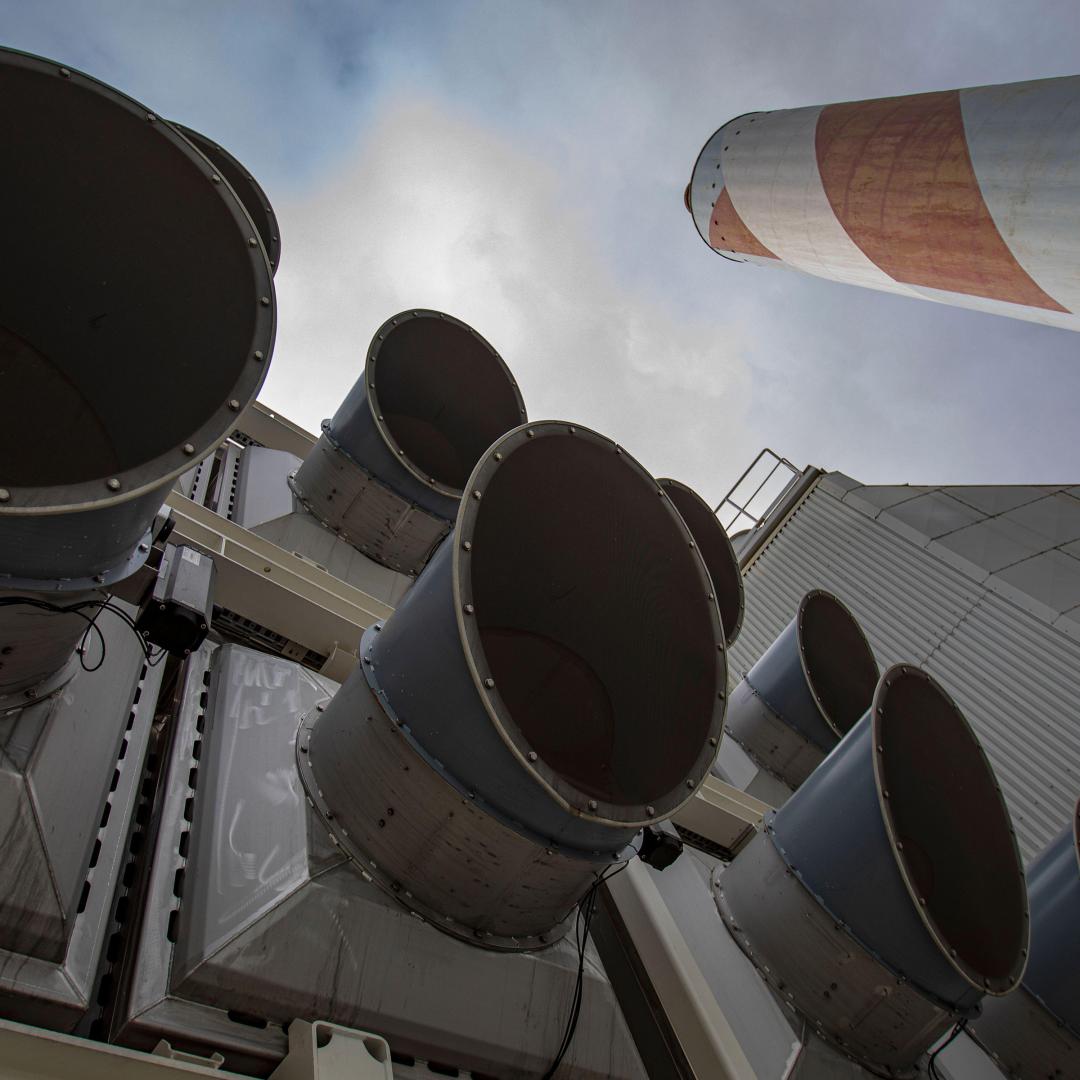
Use Atmospheric Oxidation Enhancement

Image
Image
Sky with clouds and sun
Coming Soon
Off
Summary

Atmospheric oxidation enhancement (AOE) of methane is a technology that injects highly reactive hydroxyl and chlorine radical aerosols into the air to accelerate the natural conversion of methane into CO₂. Methane is a greenhouse gas found naturally in the atmosphere, but human activities such as production and use of fossil fuels, landfilling waste, and increasing populations of ruminant animals have dramatically increased concentrations. Methane decays in the atmosphere in ~10 years but, because it is ~80 times stronger at trapping heat than CO₂ on a 20-year basis, actions to reduce its concentration more quickly have climate benefits. 

AOE for methane removal is still in the early phases of research, and its ability to meaningfully and cost-effectively remove methane is questionable. In addition, there are other more practical, cost-effective, and proven technologies that can prevent methane emissions from entering the atmosphere (e.g., Improve Landfill ManagementManage Oil & Gas Methane and Manage Coal Mine Methane). And, this solution, which is designed to alter atmospheric chemistry, could have unintended consequences, present novel risks to Earth systems, and pose geopolitical, legal, and ethical challenges. Therefore, even though this solution addresses a potent GHG, it is “Not Recommended.” 

Description for Social and Search
Atmosphieric oxidation enhancement is not recommended as a a climate solution.
Overview

What is our assessment?

Based on the potential for harmful impacts, the risks of using AOE to destroy atmospheric methane outweigh its uncertain benefits. Because of this, as well as the fact that there are other effective solutions to reduce methane emissions already available, this climate solution is “Not Recommended.”

Plausible Could it work? Yes
Ready Is it ready? No
Evidence Are there data to evaluate it? No
Effective Does it consistently work? ?
Impact Is it big enough to matter? ?
Risk Is it risky or harmful? Yes
Cost Is it cheap? No

What is it?

AOE of methane is a technology designed to accelerate the natural decay of methane to CO₂  by increasing the concentration of hydroxyl and chlorine radicals in the air. In the presence of sunlight and oxygen, these molecules convert methane to CO₂. This solution aims to increase the atmospheric concentration of these molecules by injecting precursors, such as iron salts and hydrogen peroxide, into the air.

Does it work?

Methane is a potent greenhouse gas, more than 80 times stronger than CO₂ at trapping heat on a 20-year basis. Under natural conditions, it persists in the atmosphere for about 10 years before it converts into CO₂. Therefore, artificially accelerating methane conversion reduces its disproportionate warming impact. 

There is evidence that the concentration of hydroxyl radicals affects the rate at which methane is converted into CO₂ in the atmosphere. However, research into AOE for methane removal is still in its early stages and limited to a few modeling and laboratory studies. There are currently no real-world examples of atmospheric methane removal. The effectiveness of the solution is unknown and uncertain. Based on current research, no one knows if it is possible to remove atmospheric methane at a meaningful scale in a safe and cost-effective manner. 

Why are we excited?

Because methane is such a potent greenhouse gas, any actions to reduce its concentration in the atmosphere would be emergency brake solutions with immediate and disproportionate climate benefits. In addition, unlike direct air capture or carbon capture and storage, there is no need to capture or store the gas that the process produces. 

Why are we concerned?

AOE for methane removal is an untested technology designed to alter atmospheric chemistry that presents novel and potentially uncontrollable risks to Earth systems and ecosystem processes. Hydroxyl and chlorine radicals are highly reactive molecules, and they do not react solely with methane. When they react with other atmospheric constituents they can generate other, even stronger, climate pollutants such as nitrous oxide as well as other air pollutants such as PM2.5, carbon monoxide, nitrogen dioxide, and ground-level ozone, and they could deplete stratospheric ozone. Some proposed AOE methods, such as atmospheric injection of iron salt aerosols, create chlorine radicals. The chlorine- and iron-containing byproducts of these aerosols could adversely affect ocean chemistry and food webs when they are deposited on the ocean surface (see Deploy Ocean Fertilization). 

Other serious concerns include technical feasibility, scalability, cost, monitoring, reporting and verification, and governance. For example, in order for methane in the atmosphere to be reduced at climate-relevant scales, the production of chlorine or hydroxyl radicals would need to be magnitudes greater than the current global production. Costs have not been estimated, but they would likely be high. New tools for monitoring atmospheric methane would need to be developed to quantify the amounts of methane removed for accurate accounting and verification. Similar to stratospheric aerosol injection, deployment of atmospheric methane removal could pose geopolitical, legal, and ethical challenges. In addition, it could distract from or delay action on other methane reduction approaches, such as managing oil and gas methanemanaging coal mine methaneimproving landfill management, and increasing centralized composting.

Solution in Action

References

He, M., Jacob, D. J., Estrada, L. A., Varon, D. J., Sulprizio, M., Balasus, N., East, J. D., Penn, E., Pendergrass, D. C., Chen, Z., Mooring, T. A., Maasakkers, J. D., Brodrick, P. G., Frankenberg, C., Bowman, K. W., & Bruhwiler, L. (2026). Attributing 2019–2024 methane growth using TROPOMI satellite observations. Science Advances12(15), Article eadz9007. Link to source: https://doi.org/10.1126/sciadv.adz9007

Jackson, R. B., Abernethy, S., Canadell, J. G., Cargnello, M., Davis, S. J., Féron, S., Fuss, S., Heyer, A. J., Hong, C., Jones, C. D., Damon Matthews, H., O’Connor, F. M., Pisciotta, M., Rhoda, H. M., de Richter, R., Solomon, E. I., Wilcox, J. L., & Zickfeld, K. (2021). Atmospheric methane removal: A research agenda. Philosophical Transactions of the Royal Society A: Mathematical, Physical and Engineering Sciences379(2210), Article 20200454. Link to source: https://doi.org/10.1098/rsta.2020.0454

Lackner, K. S. (2020). Practical constraints on atmospheric methane removal. Nature Sustainability3(5), Article 357. Link to source: https://doi.org/10.1038/s41893-020-0496-7

Lebling, K., & Harasaki, H. (2025). 5 things to know about atmospheric methane removal [Insights]. World Resources Institute. Link to source: https://www.wri.org/insights/atmospheric-methane-removal

Li, Q., Meidan, D., Hess, P., Añel, J. A., Cuevas, C. A., Doney, S., Fernandez, R. P., van Herpen, M., Höglund-Isaksson, L., Johnson, M. S., Kinnison, D. E., Lamarque, J-F.,  Röckmann, T., Mahowald, N. M., & Saiz-Lopez, A. (2023). Global environmental implications of atmospheric methane removal through chlorine-mediated chemistry-climate interactions. Nature Communications14(1), Article 4045. Link to source: https://www.nature.com/articles/s41467-023-39794-7

Lindsey, R. (2025, May 21). Climate change: Atmospheric carbon dioxide. National Oceanic and Atmospheric Administration. Link to source: https://www.climate.gov/news-features/understanding-climate/climate-change-atmospheric-carbon-dioxide

Liu, Y., Yao, X., Zhou, L., Ming, T., Li, W., & de Richter, R. (2024). Removal of atmospheric methane by increasing hydroxyl radicals via a water vapor enhancement strategy. Atmosphere15(9), Article 1046. Link to source: https://www.mdpi.com/2073-4433/15/9/1046

Ming, T., Li, W., Yuan, Q., Davies, P., de Richter, R., Peng, C., Deng, Q., Yuan, Y., Caillol, S., & Zhou, N. (2022). Perspectives on removal of atmospheric methane. Advances in Applied Energy5, Article 100085. Link to source: https://doi.org/10.1016/j.adapen.2022.100085

Nisbet-Jones, P. B. R., Fernandez, J. M., Fisher, R. E., France, J. L., Lowry, D., Waltham, D. A., Woolley Maisch, C. A., & Nisbet, E. G. (2022). Is the destruction or removal of atmospheric methane a worthwhile option? Philosophical Transactions of the Royal Society A: Mathematical, Physical and Engineering Sciences380(2215), Article 20210108. Link to source: https://doi.org/10.1098/rsta.2021.0108

Pennacchio, L., Mikkelsen, M. K., Krogsbøll, M., van Herpen, M., & Johnson, M. S. (2024). Physical and practical constraints on atmospheric methane removal technologies. Environmental Research Letters19(10), Article 104058. Link to source: https://doi.org/10.1088/1748-9326/ad7041

Spark Climate Solutions. (n.d.-a). Atmospheric methane removal. Retrieved March 3, 2026, from Link to source: https://www.sparkclimate.org/methane-removal/home

Spark Climate Solutions. (n.d.-b). Approaches to atmospheric methane removal. Retrieved March 3, 2026, from Link to source: https://www.sparkclimate.org/methane-removal/primer/approaches

van Herpen, M. M. J. W., Li, Q., Saiz-Lopez, A., Liisberg, J. B., Röckmann, T., Cuevas, C. A., Fernandez, R. P., Mak, J. E., Mahowald, N. M., Hess, P., Meidan, D., Stuut, J.-B. W., & Johnson, M. S. (2023). Photocatalytic chlorine atom production on mineral dust–sea spray aerosols over the North Atlantic. Proceedings of the National Academy of Sciences120(31), Article e2303974120, Link to source: https://doi.org/10.1073/pnas.2303974120

Wang, J., & He, Q. P. (2023). Methane removal from air: Challenges and opportunities. Methane2(4), 404–414. Link to source: https://doi.org/10.3390/methane2040027

Credits

Lead Fellow:

  • Jason Lam

Internal Reviewers:

  • Christina Swanson, Ph.D.
  • Paul C. West, Ph.D.
Speed of Action
Caveats
Risks
Consensus
Trade-offs
Action Word
Use
Solution Title
Atmospheric Oxidation Enhancement
Classification
Not Recommended

Lawmakers and Policymakers

Practitioners

Business Leaders

Nonprofit Leaders

Investors

Philanthropists and International Aid Agencies

Thought Leaders

Technologists and Researchers

Communities, Households, and Individuals

Updated Date
Coming Soon Label
Coming Soon

Use Methane-Oxidizing Coatings

Image
Image
Worker spraying a coating on a surface
Coming Soon
Off

Key Takeaways

  • Photocatalytic methane-oxidizing coatings on roofs and other surfaces can convert methane to CO₂.  
  • This solution has low energy and operational costs because it relies on natural air movement and could be deployed on existing structures.
  • Effectiveness of these coatings is uncertain, and their resistance to weathering under real-world environmental conditions is unknown.
  • The total area of coated surfaces would need to be huge for this solution to have a globally meaningful climate impact.
Summary

Photocatalytic methane-oxidizing coatings applied to roofs and other surfaces exposed to air can convert methane molecules that contact the surface into CO₂. The concentration of methane in the air is low, less than 2 ppm but, because methane is ~80 times better at trapping heat than CO₂ on a 20-year basis, actions to quickly reduce its concentration have outsized climate benefits. Several photocatalytic compounds can be incorporated into thin coatings such as paint and applied to a variety of surfaces. However, significant advances are needed in photocatalytic surface coatings’ chemical conversion efficiency and resistance to weathering. Methane removal using this method is also limited by the area of the coated surface and the rate at which methane molecules contact it; models suggest that the area of coated surfaces needed to achieve a meaningful climate impact would be infeasibly large. More practical, cost-effective, and proven technologies are available to prevent methane emissions from entering the atmosphere from high-emitting industries. However, methane is a potent GHG and deployment of methane-oxidizing coatings on existing structures could be minimally disruptive and targeted at areas with elevated methane concentrations. Given these caveats, we will “Keep Watching” this solution. 

Description for Social and Search
The use of methane-oxidizing surface coatings is a plausible climate solution, but its potential impact is currently limited by technological and practical considerations.
Overview

What is our assessment?

Based on our assessment, removing methane from the air using photocatalytic methane-oxidizing surface coatings is plausible, but its effectiveness and potential climate impact are currently limited by technological and practical uncertainties. However, because methane is such potent GHG, we will “Keep Watching” this solution. 

Plausible Could it work? Yes
Ready Is it ready? No
Evidence Are there data to evaluate it? Limited
Effective Does it consistently work? ?
Impact Is it big enough to matter? ?
Risk Is it risky or harmful? No
Cost Is it cheap? ?

What is it?

This solution aims to remove methane from the air by coating large surfaces that contact air, such as buildings and wind turbine blades, with photocatalytic chemicals that convert methane to CO₂ on contact (Jackson et al., 2021; Lebling & Harasaki, 2025). Methane-oxidizing coatings use sunlight to drive the chemical reaction and rely on natural air movement to bring methane in the air into contact with the coated surface (Abernethy & Jackson, 2024). 

Does it work?

Methane is a potent but short-lived greenhouse gas, more than 80 times stronger than CO₂ at trapping heat on a 20-year basis (IPCC, 2023). Actions that accelerate methane conversion to CO₂ would reduce its disproportionate warming impact (Jackson et al., 2019). Several photocatalytic compounds, such as titanium dioxide, can convert methane into CO₂ and can be incorporated into thin coatings such as paint and applied to a variety of surfaces. However, the chemical reaction to convert methane to CO₂ is not 100% efficient and, because the atmospheric concentration of methane is so low (~2 ppm compared to 430 ppm for CO₂ ), the amount of methane removed is limited by the area of the coated surface and the rate at which methane molecules contact it (Abernethy & Jackson, 2024; Pennacchio et al., 2024). Research into using methane-oxidizing coatings is still in its early stages and limited to a few modeling and laboratory studies. Modeling estimates suggest that the area of coated surfaces needed to achieve a meaningful climate impact would be impractically large (Pennacchio et al., 2024). 

Why are we excited?

Because methane is such a potent GHG, actions that reduce its concentration in the atmosphere have immediate climate benefits. Unlike direct air capture or carbon capture and storage, there is no need to capture or store any gases because the goal is to oxidize methane to CO₂ (Ming et al., 2022). Using a chemical treatment that can be incorporated into coating materials such as paint is minimally invasive or disruptive. In addition, because the solution relies on natural air movement rather than fans, its energy demands and operating costs are low. The effectiveness of this solution could be enhanced if it were deployed in areas with habitually elevated methane concentrations, such as cattle, waste management, oil and gas facilities, and rice paddies (Nisbet-Jones et al., 2021). 

Why are we concerned?

Significant advances in the methane removal efficiency of photocatalytic surface coatings are needed for this solution to be effective, scalable, and practical (Lebling & Harasaki, 2025). Other unknowns include the lifespan of the photocatalytic coatings on different types of surfaces and under different environmental and weather conditions (Lei et al., 2025; Liu et al., 2023). Costs are unknown due to these limitations, and could be high relative to other more targeted methane reduction solutions such as managing oil and gas methanemanaging coal mine methaneimproving landfill management, and increasing centralized composting. New tools for monitoring and measuring changes in the low concentrations of atmospheric methane will need to be developed to quantify the amounts of methane removed for accurate accounting and verification. Finally, some researchers argue that use of photocatalytic coatings to neutralize potent GHGs would be more effectively and impactfully directed at longer-lived climate pollutants such as nitrous oxide (Lackner, 2020). 

Solution in Action

References

Abernethy, S., & Jackson, R. B. (2024). Atmospheric methane removal may reduce climate risks. Environmental Research Letters19(5), Article 051001. Link to source: https://iopscience.iop.org/article/10.1088/1748-9326/ad3b22/pdf

Intergovernmental Panel On Climate Change. (2023). Climate change 2022 – Impacts, adaptation and vulnerability: Working Group II contribution to the sixth assessment report of the Intergovernmental Panel on Climate Change (1st ed.). Cambridge University Press. Link to source: https://doi.org/10.1017/9781009325844

Jackson, R. B., Solomon, E. I., Canadell, J. G., Cargnello, M., & Field, C. B. (2019). Methane removal and atmospheric restoration. Nature Sustainability2(6), 436–438. Link to source: https://par.nsf.gov/servlets/purl/10142837

Jackson, R. B., Abernethy, S., Canadell, J. G., Cargnello, M., Davis, S. J., Féron, S., Fuss, S., Heyer, A. J., Hong, C., Jones, C. D., Damon Matthews, H., O’Connor, F. M., Pisciotta, M., Rhoda, H. M., de Richter, R., Solomon, E. I., Wilcox, J. L., & Zickfeld, K. (2021). Atmospheric methane removal: A research agenda. Philosophical Transactions of the Royal Society A: Mathematical, Physical and Engineering Sciences379(2210), Article 20200454. Link to source: https://doi.org/10.1098/rsta.2020.0454

Lackner, K. S. (2020). Practical constraints on atmospheric methane removal. Nature Sustainability3(5), 357–357. Link to source: https://doi.org/10.1038/s41893-020-0496-7

Lebling, K., & Harasaki, H. (2025). 5 things to know about atmospheric methane removal. World Resources Institute. Link to source: https://www.wri.org/insights/atmospheric-methane-removal

Lei, Y., Sala, X., García-Antón, J., & Muñoz, J. (2025). A review on photocatalytic methane conversion systems: from fundamental mechanisms to the emerging role of ferroelectric materials. Journal of Materials Chemistry A13(18), 12712–12745. Link to source: https://pubs.rsc.org/ta/article/13/18/12712/875561/A-review-on-photocatalytic-methane-conversion

Liu, Z., Xu, B., Jiang, Y. J., Zhou, Y., Sun, X., Wang, Y., & Zhu, W. (2023). Photocatalytic conversion of methane: current state of the art, challenges, and future perspectives. ACS Environmental Au3(5), 252–276. Link to source: https://pmc.ncbi.nlm.nih.gov/articles/PMC10515711/#sec1

Ming, T., Li, W., Yuan, Q., Davies, P., de Richter, R., Peng, C., Deng, Q., Yuan, Y., Caillol, S., & Zhou, N. (2022). Perspectives on removal of atmospheric methane. Advances in Applied Energy5, Article 100085. Link to source: https://doi.org/10.1016/j.adapen.2022.100085

Nisbet-Jones, P. B. R., Fernandez, J. M., Fisher, R. E., France, J. L., Lowry, D., Waltham, D. A., Woolley Maisch, C. A., & Nisbet, E. G. (2021). Is the destruction or removal of atmospheric methane a worthwhile option? Philosophical Transactions of the Royal Society A: Mathematical, Physical and Engineering Sciences380(2215), Article 20210108. Link to source: https://doi.org/10.1098/rsta.2021.0108

Pennacchio, L., Mikkelsen, M. K., Krogsbøll, M., van Herpen, M., & Johnson, M. S. (2024). Physical and practical constraints on atmospheric methane removal technologies. Environmental Research Letters19(10), Article 104058. Link to source: https://doi.org/10.1088/1748-9326/ad7041

Wang, J., & He, Q. P. (2023). Methane removal from air: Challenges and opportunities. Methane2(4), 404–414. Link to source: https://doi.org/10.3390/methane2040027

Credits

Lead Fellows

  • Christina Swanson, Ph.D.
  • Jason Lam

Internal Reviewers

  • Megan Matthews, Ph.D.
  • Paul C. West, Ph.D.
Speed of Action
Caveats
Risks
Consensus
Trade-offs
Action Word
Use
Solution Title
Methane-Oxidizing Coatings
Classification
Keep Watching

Lawmakers and Policymakers

Practitioners

Business Leaders

Nonprofit Leaders

Investors

Philanthropists and International Aid Agencies

Thought Leaders

Technologists and Researchers

Communities, Households, and Individuals

Updated Date
Coming Soon Label
Coming Soon

Deploy Direct Air Capture

Image
Image
An image of large fans used for direct air capture of carbon dioxide
Coming Soon
Off
Summary

Direct air capture (DAC) is an industrial process that captures CO₂ from the air and then injects it deep underground for permanent, geologic storage. This process is energy-intensive. Therefore, DAC can only be effective for net carbon removal if it does not generate high levels of emissions during the process. This requires that DAC be powered by zero- or low-carbon energy sources and that the captured carbon is permanently stored rather than used for emission-generating applications. Unlike the situation for many other carbon removal methods, the amounts of CO₂ captured and stored using DAC can be reliably measured, which is an advantage in the carbon marketplace. However, the effectiveness of DAC has been extremely low so far. DAC is also expensive, up to US$1,000/t CO₂ removed and stored. Substantial funding to support DAC development has come from fossil-fuel interests or their government proxies, which view carbon capture as a strategy to extend society’s use of fossil fuels. Therefore, there is a risk that DAC could be used to delay or avoid emissions reductions and perpetuate or even expand fossil-fuel production and use. Based on this risk, as well as the functional and financial challenges for scaling this technology to remove globally meaningful amounts of CO₂, we conclude that DAC is “Not Recommended” as a climate solution.

Description for Social and Search
Direct air capture (DAC) is an industrial process that captures CO2 from the air and then injects it deep underground for permanent, geologic storage.
Overview

What is our assessment?

Based on the difficulty of capturing low concentrations of CO₂ from the air and the associated technological, energy consumption, and financial challenges facing DAC, it is unlikely that this climate technology can be scaled up to remove globally meaningful amounts of CO₂. Furthermore, based on the current financial and policy support for DAC from fossil-fuel interests, there is a clear risk that the technology will be used to enable and perpetuate the production and use of fossil fuels, which is antithetical to solving the climate crisis. Therefore, we conclude that deployment of DAC is “Not Recommended” as a climate solution.

Plausible Could it work? Yes
Ready Is it ready? No
Evidence Are there data to evaluate it? Yes
Effective Does it consistently work? No
Impact Is it big enough to matter? No
Risk Is it risky or harmful? Yes
Cost Is it cheap? No

What is it? 

DAC is a suite of engineered technologies that remove CO₂ directly from the atmosphere, concentrate it, and then inject it underground for permanent storage. CO₂ is captured from the atmosphere by moving large volumes of air, usually with large fans, past a reactive material that selectively binds CO₂, either a solid sorbent (referred to as solid-DAC or S-DAC) or a liquid solvent (referred to as liquid-DAC or L-DAC). The captured CO₂ is recovered from the reactive material by applying heat, pressure, or chemical reactions, and collected and compressed for transportation and storage. The concentrated CO₂ is then injected deep underground into geological formations, such as saline aquifers or basalt formations, where it can be permanently stored. 

Does it work?

The technology and chemistry for the selective capture of CO₂ from air are effective, although the CO₂ capture efficiency varies with the reactive material and other factors. A variety of solid and liquid reactive materials have been developed, along with material-specific processes for recovering captured CO₂ and regenerating the sorbents. This process is very energy-intensive and, for liquid-DAC, water-intensive. To capture and recover 1 t CO₂, solid-DAC uses about 1,100 kWh, while liquid-DAC uses about 2,500 kWh and consumes as much as 7 t of water. Most of the energy for DAC (70–90%) is used to generate heat for recovery of the captured CO₂ and regeneration of the sorbent material. Liquid-DAC requires temperatures up to about 900 °C (1,652 °F), while solid-DAC requires temperatures of only about 100 °C (212 °F). Because the process is so energy intensive, DAC achieves net carbon removal – capturing and sequestering more CO₂ than it emits – only if it is powered by zero or low-carbon energy sources and/or uses waste heat. For example, recent reporting showed that the amount of CO₂ captured and stored by Climeworks, the largest commercial DAC company currently in operation, was insufficient to offset the facility’s operational GHG emissions. CO₂ captured by a DAC facility can also be used for other purposes, such as enhanced oil recovery or production of algae biofuels. However, life cycle analyses conducted by the National Energy Technology Laboratory show that these pathways do not result in net carbon removal due to the emissions from production and/or use of these other products. Therefore, in addition to its requirements for zero or low-carbon energy, DAC can only be an effective method for net carbon removal if the CO₂ it captures is permanently stored deep underground. With appropriate pre-injection site selection, geologic testing, and post-injection monitoring, underground storage of CO₂ is safe and effectively permanent.

Why are we excited about it?

Unlike some other carbon removal technologies and practices, a DAC facility has a relatively small footprint and can be located anywhere there is sufficient low-carbon energy and infrastructure and capacity to transport or store captured CO₂. In addition, the amount of CO₂ removed from the atmosphere can be directly measured by monitoring the flow and concentration of captured CO₂ at the point of storage. Compared to many other carbon removal approaches, this method provides a higher level of confidence in the amount of CO₂ being removed for investors and carbon credit purchasers. The geological sequestration of captured CO₂ has high permanence, effectively removing CO₂ from the atmosphere for thousands of years with a low risk of reversal. There are numerous research and pilot projects underway to improve CO₂ capture efficiency, reduce energy use, and reduce costs, which may improve the effectiveness and cost of this technology. 

Why are we concerned?

The concentration of CO₂ in the atmosphere is small, currently about 420 parts per million, or about 0.04%. This means that a DAC facility must process huge amounts of air – more than 1,600 t by one estimate – and consume more energy than a typical U.S. household uses in a month to capture 1 t CO₂. Scaled up to remove a globally meaningful amount of CO₂ (>0.1 Gt CO₂ /yr), DAC would consume more energy than the annual energy consumption of 10 million U.S. households. In addition, removing and storing CO₂ using DAC is very expensive, costing up to US$1,000/t CO₂ stored. This is more than twice the cost per t for all other commercially available carbon removal technologies and practices. 

For these reasons, the technical and financial feasibility of scaling DAC to remove globally meaningful amounts of CO₂ from the atmosphere is low. Despite these challenges, as of September 2025, more than 30 companies have sold more than 2.4 million t of future carbon removal credits. However, less than 1,300 t CO₂ has actually been removed so far – or only 0.05% of these promised credits. To put this in perspective, despite spending billions of dollars, DAC has removed about as much CO₂ as would be saved by keeping 250-300 cars off the road for a single year.

There is also an opportunity cost for DAC. Even if a DAC facility is powered by solar, wind, geothermal, or nuclear energy, that carbon-free energy could have been used to displace coal- and gas-powered electricity instead, reducing emissions by far more than a DAC facility can capture and store. Similarly, the large amounts of public and private sector funding going to DAC could be more cost-effective and carbon-effective if used for other, more effective actions to cut emissions or remove CO₂. There is also the risk that DAC will be used to delay or avoid emissions reduction actions or for greenwashing by fossil fuel companies and other emitters. Substantial amounts of the funding supporting the development of DAC are coming from fossil fuel companies, which have publicly stated that they view carbon capture as a strategy to extend society’s use of fossil fuels. Finally, unlike most other emissions reduction or carbon removal actions, DAC provides no obvious other benefits to nature or human well-being.

Solution in Action

References

Alexandersson, B. O. P and Grettisson, V. (2025) Climeworks’ capture fails to cover its own emissions. Heimildin. Link to source: https://heimildin.is/grein/24581/

Bashir, A., Ali, M., Patil, S., Aljawad, M. S., Mahmoud, M., Al-Shehri, D., Hoteit, H., & Kamal, M. S. (2024). Comprehensive review of CO2 geological storage: Exploring principles, mechanisms, and prospects. Earth-Science Reviews249, 104672. Link to source: https://www.sciencedirect.com/science/article/pii/S0012825223003616

Bindl, M., Edwards, M. R., & Cui, R. Y. (2025). Risks of relying on uncertain carbon dioxide removal in climate policy. Nature Communications16(1), 5958. Link to source: https://www.nature.com/articles/s41467-025-61106-4

Bisotti, F., Hoff, K. A., Mathisen, A., & Hovland, J. (2023). Direct air capture (DAC) deployment: National context cannot be neglected. A case study applied to Norway. Chemical Engineering Science282, 119313. Link to source: https://www.sciencedirect.com/science/article/pii/S0009250923008692

Calma, J. (2023) To capture CO2 in the US, climate tech startups partner with oil and gas. The Verge. Link to source: https://www.theverge.com/2023/4/21/23690040/climeworks-direct-air-carbon-capture-oil-gas

CDR.fyi. (2025) Keep Calm and Remove On - CDR.fyi 2024 Year in Review. Link to source: https://www.cdr.fyi/blog/2024-year-in-review

Chatterjee, S., & Huang, K. W. (2019). Unrealistic energy and materials requirement for direct air capture in deep mitigation pathways. Nat. Commun. 11, 3287. Link to source: https://www.nature.com/articles/s41467-020-17203-7

Chen, S. (2025) Energy and water use for DAC. Carbon180. Link to source: https://carbon180.org/blog/energy-and-water-use-for-dac/#:~:text=To%20estimate%20the%20amount%20of%20energy%20consumed%20by,%3D%20%28Energy%20per%20tCO2%29%20%2A%20%28Total%20DAC%20capacity%29

Eke, V., Sahu, T., Ghuman, K. K., Freire-Gormaly, M., & O'Brien, P. G. (2025). A comprehensive review of life cycle assessments of direct air capture and carbon dioxide storage. Sustainable Production and Consumption. Link to source: https://www.sciencedirect.com/science/article/pii/S2352550925000399

Gulden, L. E., & Harvey, C. (2025). Tracing sources of funds used to lobby the US government about carbon capture, use, and storage. Environmental Science & Policy, 171, 104171. Link to source: https://www.sciencedirect.com/science/article/pii/S146290112500187X

Hager, B. & MIT Climate Portal Writing Team (2024) What is the risk that CO2 stored underground after carbon capture will escape again? MIT Climate Portal. Link to source: https://climate.mit.edu/ask-mit/what-risk-co2-stored-underground-after-carbon-capture-will-escape-again

Hiar, C. (2023) Oil companies want to remove carbon from the air — using taxpayer dollars. Climatewire, E&E News. Link to source: https://www.eenews.net/articles/oil-companies-want-to-remove-carbon-from-the-air-using-taxpayer-dollars/

International Energy Agency (no date) Direct Air Capture. Website. Link to source: https://www.iea.org/energy-system/carbon-capture-utilisation-and-storage/direct-air-capture

Isometric (2025) Direct Air Capture explained: Understanding the process, benefits and cost of DAC. Link to source: https://isometric.com/writing-articles/direct-air-capture-explained

Jacobson, M. Z. (2019). The health and climate impacts of carbon capture and direct air capture. Energy & Environmental Science12(12), 3567-3574. Link to source: https://web.stanford.edu/group/efmh/jacobson/Articles/Others/19-CCS-DAC.pdf

Jacobson, M. Z., Fu, D., Sambor, D. J., & Muhlbauer, A. (2025). Energy, health, and climate costs of carbon-capture and direct-air-capture versus 100%-wind-water-solar climate policies in 149 countries. Environmental Science & Technology59(6), 3034-3045. Link to source: https://pubs.acs.org/doi/10.1021/acs.est.4c10686?ref=pdf

Lebling, K., Leslie-Bole, H., Byrum, Z., Wilcox, J. & Riedl, D. (2025) 6 Things to Know About Direct Air Capture. World Resources Institute. Link to source: https://www.wri.org/insights/direct-air-capture-resource-considerations-and-costs-carbon-removal

Mackler, S., Fishman, X., & Broberg, D. (2021). A policy agenda for gigaton-scale carbon management. The Electricity Journal34(7), 106999. Link to source: https://www.sciencedirect.com/science/article/pii/S1040619021000907

Maloney, C. B. and Khanna, R. (2022). Memorandum: Investigation of Fossil Fuel Industry Disinformation. U.S. House of Representatives, Committee on Oversight and Reform. Link to source: https://oversightdemocrats.house.gov/sites/evo-subsites/democrats-oversight.house.gov/files/2022.09.14%20FINAL%20COR%20Supplemental%20Memo.pdf

Martin, P. (2023) Why Direct Air Capture Sucks (and not in a good way!). LinkedIn. Link to source: https://www.linkedin.com/pulse/why-direct-air-capture-sucks-good-way-paul-martin/

Milman, O. (2023) The world’s biggest carbon capture facility is being built in Texas. Will it work? The Guardian. Link to source: https://www.theguardian.com/environment/2023/sep/12/carbon-capture-texas-worlds-biggest-will-it-work

National Academies of Sciences, Medicine, Division on Earth, Life Studies, Ocean Studies Board, Board on Chemical Sciences, ... & Reliable Sequestration. (2019). Negative emissions technologies and reliable sequestration: A research agenda. Link to source: https://nap.nationalacademies.org/read/25259/chapter/7#203

OPIS and CDR.fyi. (2025) Bridging the Gap: Durable CDR Market Pricing Survey: Purchaser and Supplier Expectations in 2025 and 2030. Link to source: https://www.cdr.fyi/reports/pricing-survey-jan-2025.pdf

Ozkan, M. (2025). Atmospheric alchemy: The energy and cost dynamics of direct air carbon capture. MRS Energy & Sustainability, 12(1), 46-61. Link to source: https://link.springer.com/content/pdf/10.1557/s43581-024-00091-5.pdf

Pett-Ridge, J., Ammar, H., & Aui, A. (2023). Roads to Removal. Options for Carbon Dioxide Removal in the United States. Chapter 7. Direct Air Capture with Storage (DACS) and Renewable Energy. Link to source: https://roads2removal.org/wp-content/uploads/07_RtR_Direct-Air-Capture.pdf

Scott, M. and T. Slavin (2023) Fossil-fuel industry embrace raises alarm bells over direct air capture. Reuters. Link to source: https://www.reuters.com/sustainability/climate-energy/fossil-fuel-industry-embrace-raises-alarm-bells-over-direct-air-capture-2023-10-10/

Skone, T. J. (2021) Life Cycle Greenhouse Gas Analysis of Direct Air Capture Systems. National Energy Technology Laboratory. Link to source: https://netl.doe.gov/sites/default/files/netl-file/21DAC_Skone.pdf  

Terlouw, T., Treyer, K., Bauer, C., & Mazzotti, M. (2021). Life cycle assessment of direct air carbon capture and storage with low-carbon energy sources. Environmental science & technology55(16), 11397-11411. Link to source: https://pubs.acs.org/doi/10.1021/acs.est.1c03263

U. S. Department of Energy, Fossil Energy and Carbon Management (2024) Direct Air Capture Explained. Link to source: https://www.energy.gov/sites/default/files/2024-08/Direct%20Air%20Capture%20Factsheet_August%202024.pdf 

Wang, J., Li, S., Deng, S., Zeng, X., Li, K., Liu, J., ... & Lei, L. (2023). Energetic and life cycle assessment of direct air capture: a review. Sustainable Production and Consumption36, 1-16. Link to source: https://www.sciencedirect.com/science/article/abs/pii/S2352550922003384

World Resources Institute. (no date) U.S. Climate Policy Resource Center, Direct Air Capture. Link to source: https://www.wri.org/us-climate-policy-implementation/sectors/direct-air-capture

Young, J., McQueen, N., Charalambous, C., Foteinis, S., Hawrot, O., Ojeda, M., ... & Van Der Spek, M. (2023). The cost of direct air capture and storage can be reduced via strategic deployment but is unlikely to fall below stated cost targets. One Earth 6, 899–917. Link to source: https://www.sciencedirect.com/science/article/pii/S2590332223003007?ref=pdf_download&fr=RR-2&rr=96c1a3aebb261758

Credits

Lead Fellows

  • Jonathan Foley, Ph.D.
  • Christina Swanson, Ph.D.

Internal Reviewer

  • Sarah Gleeson, Ph.D.
Speed of Action
Caveats
Additional Benefits
Risks
Consensus
Trade-offs
Action Word
Deploy
Solution Title
Direct Air Capture
Classification
Not Recommended
Updated Date
Coming Soon Label
Coming Soon
Subscribe to Atmospheric Removal & Storage