
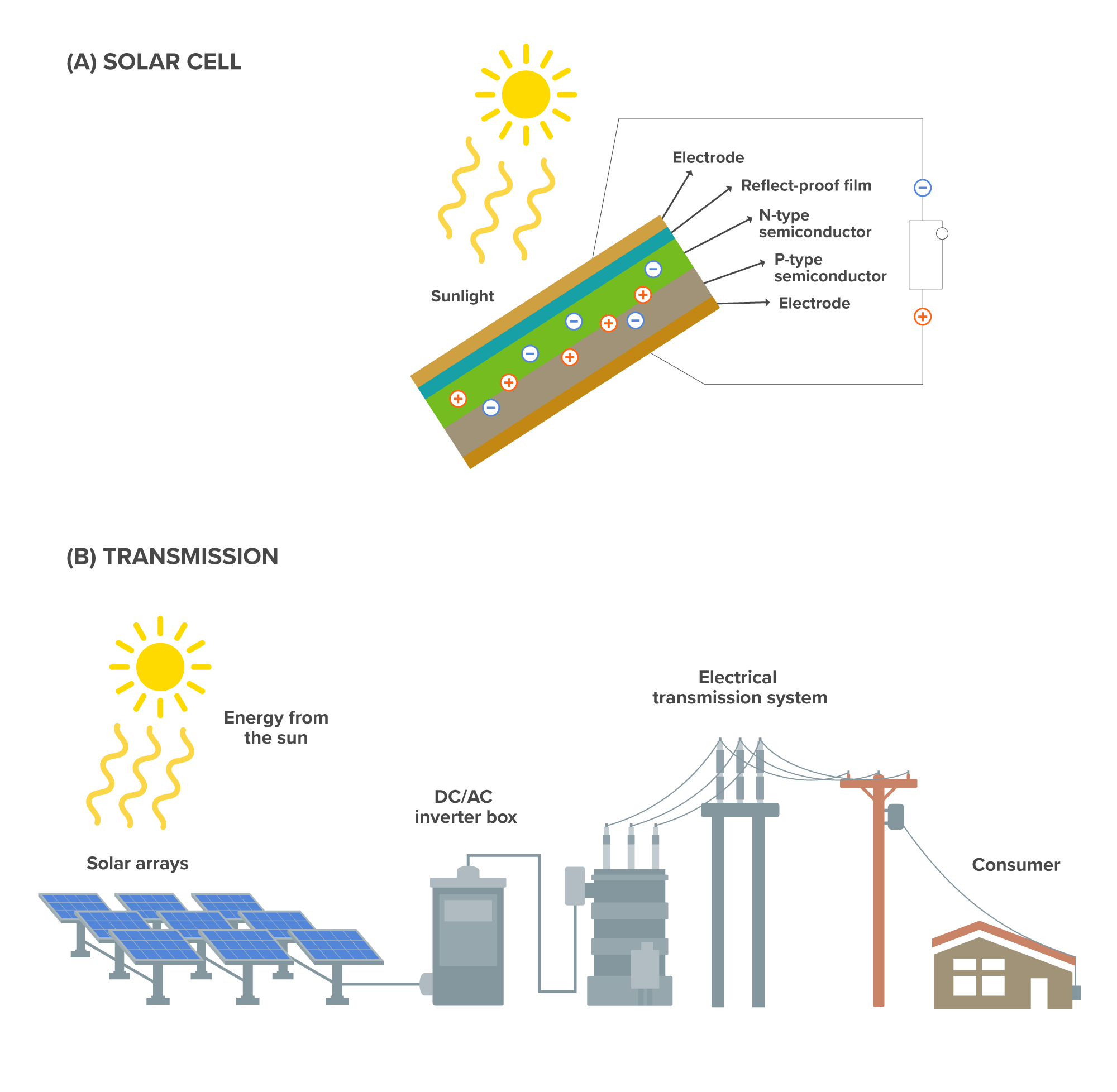
Figure 1. (a) Anatomy of a solar cell. Two layers of semiconductor material – most commonly crystalline silicone – are sandwiched between electrodes. Both layers together create a silicon wafer. The layers of this silicon wafer are oppositely charged, which creates an electric field at the material interface. When energy from the sun is absorbed, electrons with sufficient energy cross the electric field and flow towards the electrodes, creating an electric current. (b) Solar panels are built by combining multiple solar cells into modules; multiple panels are used in a solar array. After electricity generation, inverters and transmission systems deliver power to consumers. Modified from (a) Husain et al. and (b) Renew Wisconsin.
Sources: Husain, A.A., Hasan, W.Z.W., Shafie, S., Hamidon, M.N., & Pandey, S.S. (2018). Renewable and Sustainable Energy Reviews, 94, 779–791; (b) Renew Wisconsin. (2018). Utility-scale solar in Wisconsin.